



Two weeks ago, at the dawn of the Iran war, we profiled LUCAS. It was the most read post in Defense Tech and Acquisition history. Last week we wrote about Stop Funding Duct Tape, calling to retire low performing legacy systems. Then as Operation Epic Fury progressed, CENTCOM kept the highlight reel rolling with air defenses in rubble, command nodes shattered, and thousands of targets neutralized. CENTCOM also profiled the primary U.S weapon systems employed to achieve these effects.
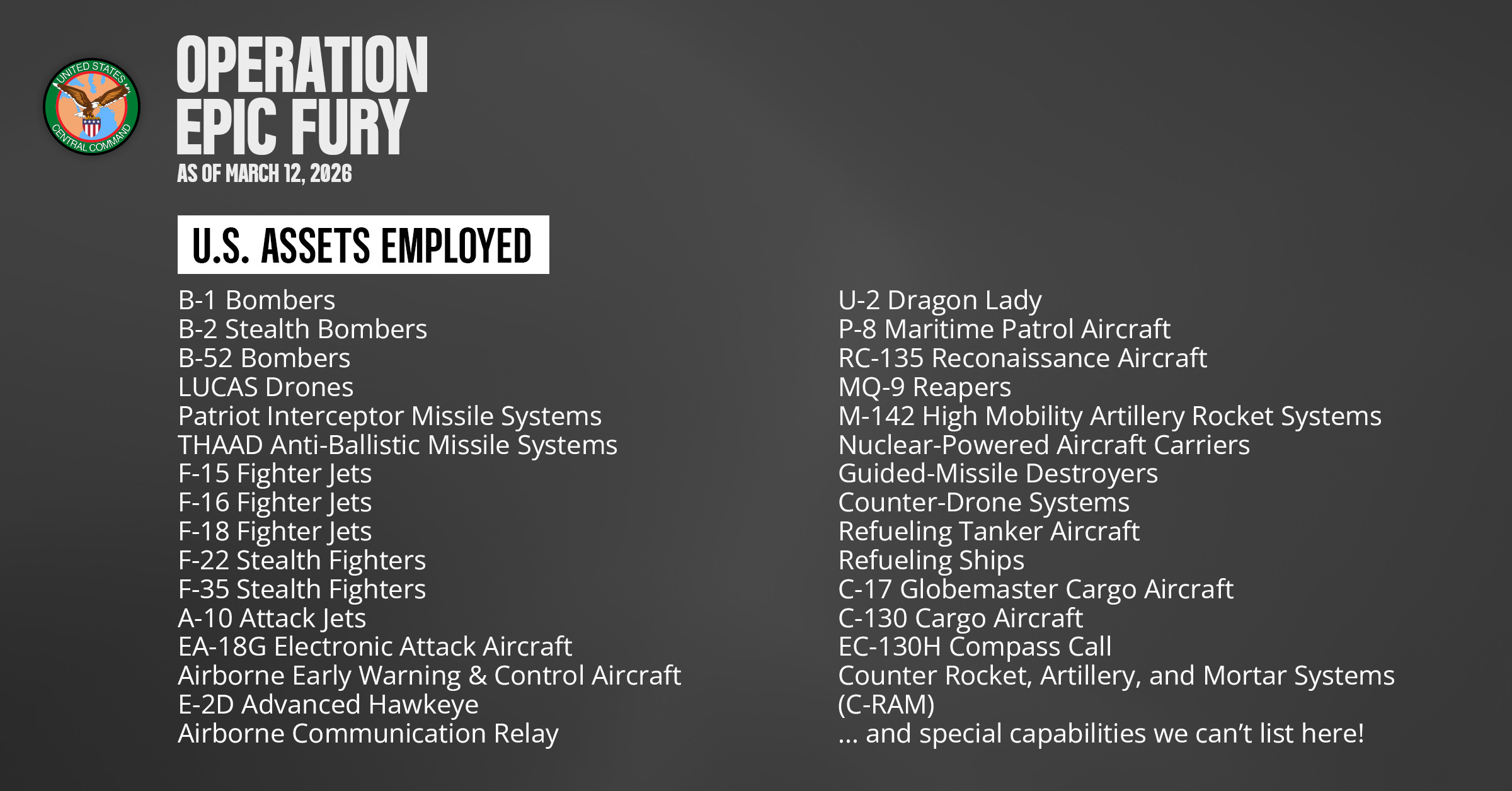
One key fact stood out when looking at that list: These systems are ancient.
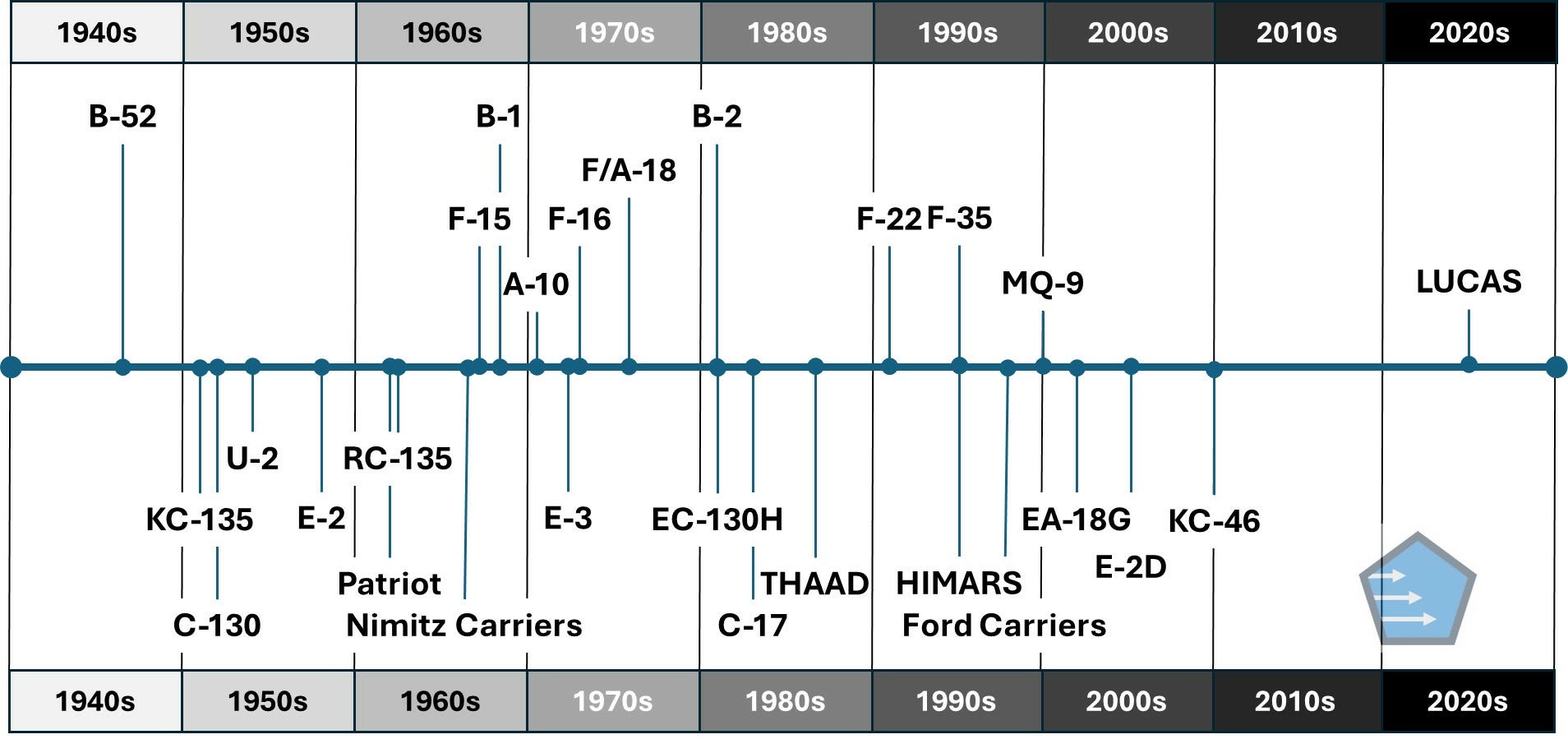
The only major system designed in the last 15 years that has been used in combat is LUCAS — which we had to reverse engineer!
The KC-46 was designed 15 years ago, based on Boeing’s 1970s-era commercial 767s. The next two most recently designed systems are the early/mid 2000s E-2D and EA-18G. They are based on the 1950s E-2 and 1970s F/A-18.
The 80-year old B-52 Stratofortress is leading this phase of the bombing campaign still dropping payloads at scale. The Air Force is pouring billions into new engines and radars them to keep them flying for decades more. The U-2, instrumental during the Cuban Missile Crisis, has been trying and failing to retire for the last 20 years.
An Optimist Perspective
America’s engineering ingenuity turned Cold War relics into enduring powerhouses through relentless modernization. Many of these weapon systems have received major upgrades over the decades. The F-15 for example had/has an A, B, C, D, E, and EX model, along with multiple FMS variants. The F-22 has had major improvements to its stealth characteristics, radar capabilities, electronic warfare suite, defensive systems and infrared targeting. Aegis has gone through multiple advanced capability blocks to keep maritime forces relevant. Modern avionics, sensors, and weapons keep the legacy fleets lethal. The list above doesn’t include key software, space systems and classified assets, some of which are more modern.

A Realist Perspective
Relying on platforms designed 40 to 80 years ago, that can only survive in relatively permissive environments against second-tier adversaries, is not a long-term strategy. It is a massive bet that peer competitors will grant us the same conditions.
Every dollar re-engining an elderly B-52 or patching an older F-15 C/D is a dollar not supporting fielding systems with more modern, modular and survivable designs. The department cannot keep tolerating three-to-five-decade gaps between new weapon concepts and keep pretending the math works against China.
The B-21 Raider will be extraordinary and will earn its keep in contested environments until a new technology or better integration of existing tech allows them to be more easily detected and targeted. However, even with production acceleration, we can only expect to see a full fleet that can replace the B-2s and B-1s in the late 2030s.
The LUCAS story shows the potential for building a better high-medium-low mix today. Using a rapid design to production timeline along with the ability to be mass produced across multiple vendors from day one. This is the new acquisition model. A focus on speed plus constrained requirements can help drive a pipeline of innovation that provides optionality to acquirers and operators alike to field new and constantly iterating capabilities to stay ahead of the threats…and provide desperately needed capacity for a highly distributed fight..
Scaling the Pipeline
There is no shortage of innovative ideas or funded prototypes. Across the military program offices and labs, DIU, SCO, DARPA and privately-funded projects, there is a tremendous backlog of potential solutions that could be matured and scaled to serve as a balance to the exquisite and (mostly) aging force.
After two decades of Middle East operations, we had every opportunity to build out one-way attack capability across air, sea, and ground domains. We mostly didn’t. It has been a great disappointment to those of us who saw this problem but watched as excuses were made for why the technology wasn’t ready and why it wouldn’t work for whatever reason. It was almost as if we saw ourselves as being passengers in the tech evolution and adoption process, and not part of the solution.
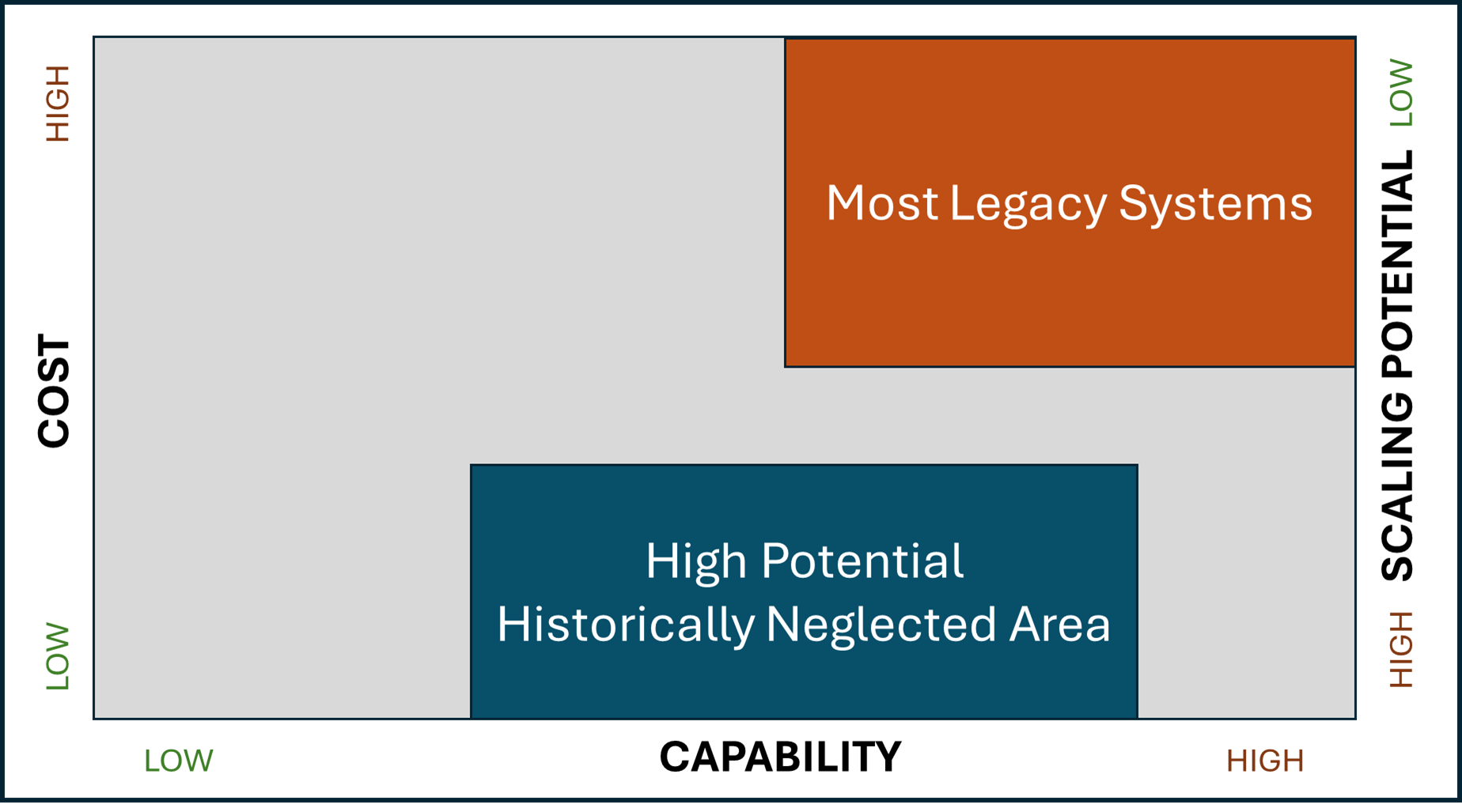
There has however been some progress in recent years. The NOMARS program proved that it was possible to deploy autonomous ships. The GVAP program showed that there is significant technological advancement to support autonomous ground vehicle operations. Companies like Merlin have shown that it is possible to deploy fully autonomous aircraft as it moves to install self-flying functions on C-130 aircraft.
The technology is here. The private capital is here. The mission demands are here. The programs are even in-place. What’s missing is the willpower to scale.
As we wrote in Stop Funding Duct Tape, we don’t have a funding problem, we have a prioritization problem. LUCAS shows how fast we can move when all the pieces align. Now is the time to solve the high-low mix problem so the joint force has maximum flexibility and capacity. We need it solved across every domain — at scale!
Maritime Underwater: It’s time to scale the CAMP program if the demonstrations prove successful. Allow the XL-UUV program to continue delivering Boeing Orca’s at the rate of 3-4 a year while Anduril delivers 20 lower-cost vessels a year. There is a good funding start in reconciliation. Build on that in the FY27 budget.
Maritime Surface: It’s time to scale the MASC program across all vessel sizes. There is a good funding start in reconciliation. Build on that in the FY27 budget. The Navy has three Unmanned Surface Vessel Squadrons. Let’s keep pushing them to advance the CONOPS for how USVs can be deployed and managed across the fleet while continuing deep experimentation with operational commanders as part of exercises and long-duration deployments.
Air Front: It’s time to scale the CCA program. Award production contracts for Increment 1 to both General Atomics and Anduril and plan to purchase 500 of each to get a real fleet fielded ASAP. Continue work on Increment 2 to populate that pipeline with additional vendors with different capabilities.
One-Way Attack: It’s time to scale the Drone Dominance program. $1.1B is a great start but this should be 10X heading into FY27. This would provide the capital needed to scale across multiple drone classes and really boost the supply chains that are needed to compete with our adversaries.
Ground Combat Vehicle: It’s time to scale the Unmanned Ground Commercial Robotic Vehicles program. The price point is on target. Let industry go to work while the Army works on the CONOPs and architectures for deploying and controlling mass robotic systems across the Army echelons.
Missiles: It’s time to scale lower cost interceptor programs, low-cost cruise and air to air missiles and hypersonics. There are all active programs for these efforts (FAMM, ERAM, MDA LCI, MACE). There are enough industry players and expanding supply chains to support acceleration to significant procurement levels. There is a good funding start in reconciliation. Build on that in the FY27 budget.
As Arthur Herman and Shyam Sankar have written, our generation needs its own Kelly Johnsons, Hyman Rickovers, and John Boyds. People who design new things, not better versions of old things. The good news is that these people exist today (just attend any conference to see the level of innovation), now they need to be celebrated and rewarded with well-funded programs and contracts.
As we pivot toward portfolio approaches, commercial integration, and rebuilding the industrial base, the goal has to be rapid iteration and production of new systems, not endlessly modernizing the ones we already have. Legacy modernization buys time. New designs win the future. Operation Epic Fury is proving both in real time.
It’s time to Mobilize!
Join over 14,000 defense and industry subscribers to get our weekly recaps and thought pieces. Paid subscribers also get budget and legislative analysis and are valued supporters of our work.
For the Army at least, there seems to be a dearth of service-level ConOps to support the UGCRV effort. Even if there were ConOps, the technical description seems to be for a "tactical truck" type vehicle to move with or follow an ABCT combat formation. There does not seem to be any holistic ConOp to describe who the service sees autonomy across a theater from port/marshaling area to point of penetration.
The continued fascination with specific tactical-level activities (breach, carrying 1 ton within a combat formation [but without specifics], long-haul cargo) without an overarching operational ConOp that cascades down seems a weakness. There are myriad tasks and missions autonomous systems could perform as an integrated formation member, but that integrated approach does not seem to have serious attention from senior leaders leading to a rather haphazard approach in material solutions.
Where is an Army Operating Concept that describes, at echelon, the employment of crewed and unscrewed systems in heterogeneous formations with distributed capabilities that avoid burdening crewed assets with the full protection or network requirements? Where's the discussion of how to focus crewed systems on core functions that require human action while off-loading enabling functions that can better be performed by autonomous systems?
Unlike other services, the Army is formation-based and not system-based and simply having high functioning autonomous systems to perform discrete functions may not be enough to support closing with and destroying adversary formations on the ground.
This is fire. I remember reading about the concerns around incrementally adding onto old tech in 2018 not long after the then-latest NSS came out. We obviously seemed to think it was fine and let the roof continue leaking. I think this piece gets right to the heart of the fact that we need to make a lot of ctrl+alt+delete style moves if we're really taking LSCO seriously. I'd also like to add that self-respecting line companies in the regular Army are still using PVS 14s... and what iteration of the Abrams are we even on at this point?