



Welcome to the latest edition of Defense Tech and Acquisition. This week was AUSA, the Army’s premier conference, so most of the news this week is dominated by our Army friends.
The Army is leaning forward on flexible spending plans, harnessing commercial acquisition, and taking steps to remove requirements to effectively prioritize and execute their constrained budgets.
The Army’s moving out on new initiatives from C-UAS to rebuilding the DIB.
We cover venture in defense, state defense spending, and how audits help ops.
Air Force and Navy explore new fighters and Space continues to go commercial.
Enjoy!
Top Stories
Army Working with Appropriators to Iron Out Flexible Spending
The Army plans to use the upcoming FY26 budget request to test the waters on a proposal to bundle dollars in three distinct categories — UAS, Counter UAS, and EW — instead of requesting funds for specific systems.
By doing this, leaders say that they will be better able to keep up with the pace of changing technology and quickly pivot to what works.
Army Secretary Christine Wormuth said a key part of those active conversations includes House and Senate appropriators to determine just what route they are most receptive towards.
Part of the challenge there centers on lawmakers’ reluctance to provide slush funds they can’t control.
While there is no guarantee that Army leaders and appropriators strike a deal, Wormuth is cautiously optimistic, which wasn’t the case nine months ago.
Related Articles: Army Transforming Through Fiscal Limbo and Army seeks more flexible funding on EW capabilities, programs
Our Take: If this is able to be implemented, it would have huge implications. As we advocated as part of the Atlantic Council Commission, the PPBE Reform Commission, and our various PPBE Reform reports, DoD and Congress need to consolidate budget accounts to enable greater management of capability portfolios. UAS, C-UAS, and EW are the perfect capability areas to roll this out, given their dynamic operational and technology environments. They cannot afford to spend 2-3 years planning and programming budgets as that drives outdated tech solutions.
Why Venture Capital Is Indispensable for U.S. Industrial Strategy: Activating Investors to Realize Disruptive National Capabilities
Michael Brown and Pavneet Singh
Over the past few decades, the U.S. innovation ecosystem has shifted; instead of aligning with the strategic priorities of the U.S. government, companies are now more responsive to the demands of global consumers and businesses, often backed by venture capital.
Consequently, the private sector has become less inclined to invest in hardware-based or capital-intensive projects, as these investments typically offer lower potential returns compared to the more lucrative software-focused ventures.
90% of VC investment today is in software, meaning that industries like AI and cybersecurity will be well funded.
However, to ensure adequate funding for the hardware-based, capital-intensive technologies such as advanced manufacturing and materials, semiconductors, energy technologies, quantum computing and space technologies, the USG must be more proactive in attracting the required capital for commercialization.
To effectively use the unique strengths of the venture capital ecosystem, the paper concludes by making five recommendations for aligning U.S. national technology priorities with venture capital incentives:
Prioritize Promising Federal Research for Commercial Development
Cultivate Entrepreneurial Founding Teams
Create Transparency for the Federal Total Addressable Market (TAM)
Demonstrate Technology Maturity, and
Develop a Public Capital Framework.
With the right incentives to attract venture capital, the U.S. can ignite investor interest, mobilize hundreds of billions in private capital, and build the critical technologies essential for national security, economic prosperity, and global leadership.
DOD Releases Report on Defense Spending by State in FY23
DoD contract obligations, payroll spending, and grant awards in the 50 states and DC totaled $609.2B, which is 2.2% of the country's GDP.
DOD spending amounts to $1,819 per U.S. citizen.
$431.4B (71%) were obligated through contracts for products and services.
$167.4B (27%) paid the salaries of DoD personnel.
$10.4B (2%) were awarded as grants.
Texas, Virginia, and California remain top recipients for overall defense spending
Texas moved to the #1 spot, seeing an $8.9B increase over FY22.
Virginia, Hawaii, and Connecticut ranked highest when considering defense spending impacts on their respective state GDPs.
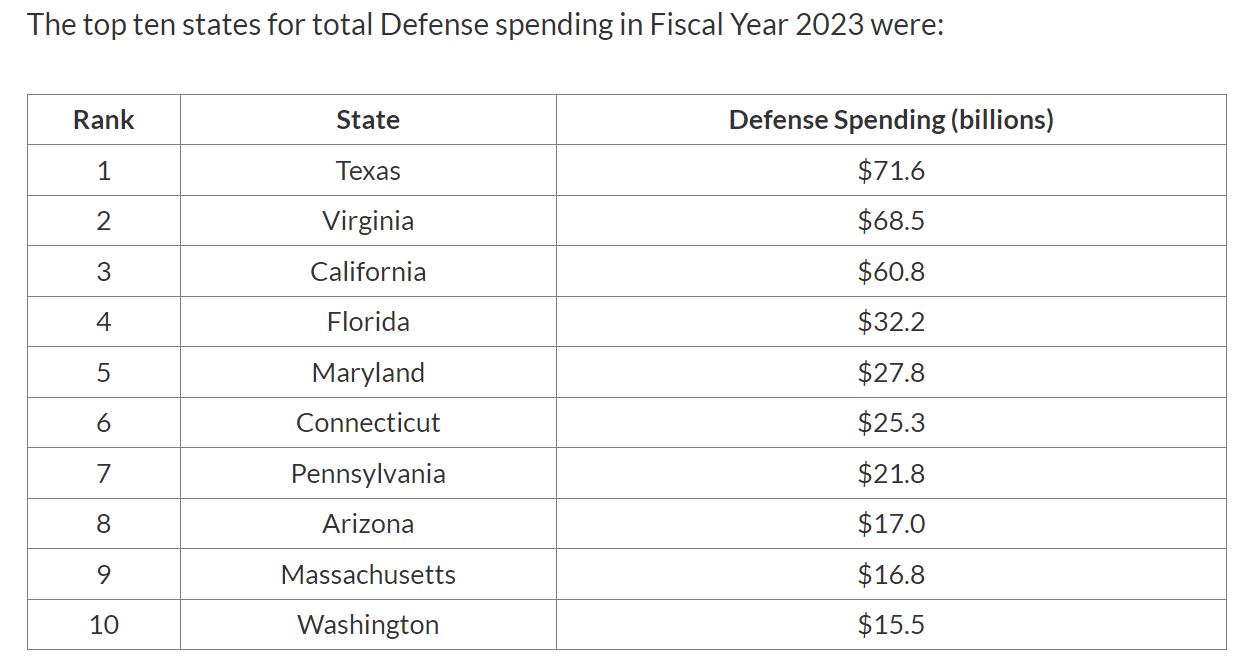
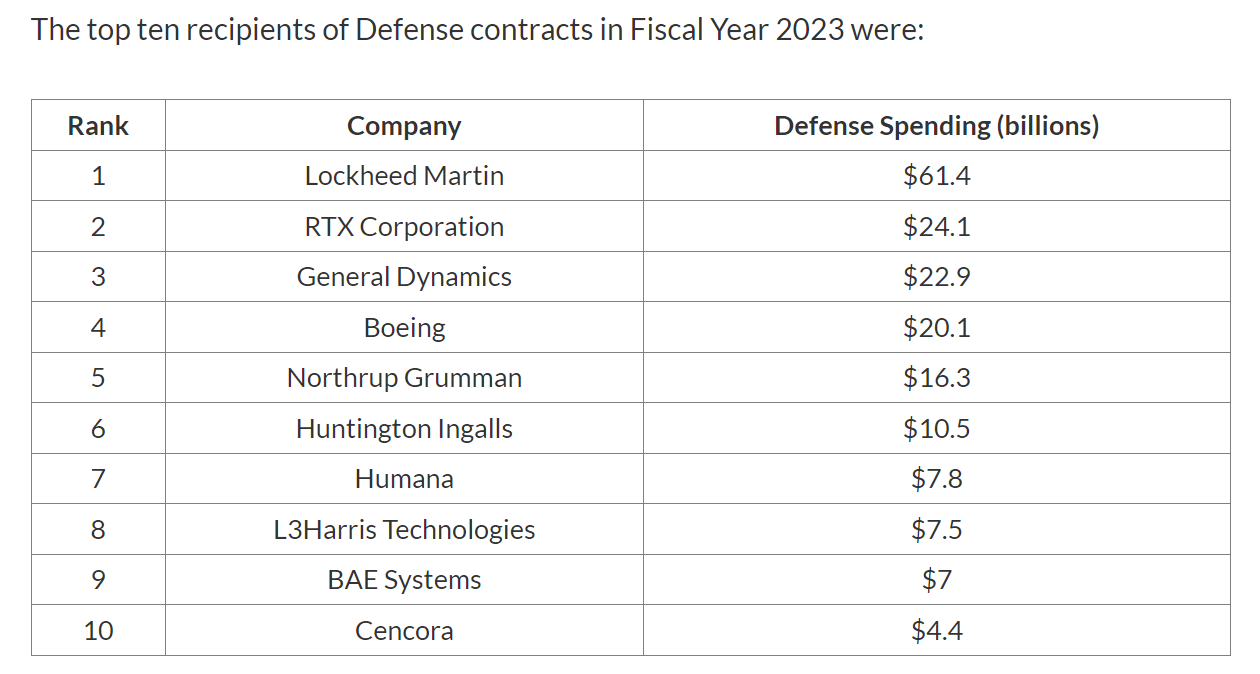
The FY23 report and previous years' reports, can be found on the OLDCC website.
How the Pentagon’s Financial Audit Will Help Win Wars
The cultural and technological drive toward transparency will ultimately make U.S. forces more effective.
Elaine McCusker, Mark Easton, and Greg Little
In about four weeks, despite all the progress being made, we will likely hear that the Pentagon has again failed its annual financial audit.
The warfighting benefits that are accumulating now as a result of the audit.
Far from a mere compliance exercise, the cultural and technological changes required to pass an audit are the same ones necessary to keep U.S. forces dominant.
For the DoD to pass its audit, it must account for more than dollars. It must track the vast array of things the military uses.
Over the past 5 years, DoD has spent >$4B to improve visibility and transparency.
By improving visibility into resources, the DoD has made strides in ensuring that the right resources are available at the right time and that limited dollars are not put toward duplicative capabilities.
Tomorrow’s victories will increasingly depend on decision advantage: the ability to make faster and better decisions than adversaries by harnessing accurate, reliable, and timely data.
The data integration promoted by the audit promises to enable commanders to access information about the availability and the condition of munitions, vehicles, equipment, parts, and supplies.
The entire defense enterprise must shift from a compliance-driven, labor-intensive audit remediation mindset to one focused on mission outcomes.
Our Take: The importance of this capability was not as apparent to us initially as it should have been - it often seemed like another exercise in compliance with rules that didn’t add a lot of value. This definitely shifted when a service comptroller noted to us that the inability to pass an audit was evidence of a broader problem: that they were often unable to even track major assets. If we are to expect DoD to allocate funds more precisely against the tech and programs needed to meet defense goals, then they need/deserve to have the same level of precision on the items they have in their current inventory.
The U.S. Needs World War II Production Strategy For Drones
Ukrainian forces in their fight against Russia burned through 10,000 drones per month in 2023. Most of those UAVs and their components came from China.
The U.S. military-industrial complex, which every year produces only a fraction of what Ukraine uses up on the battlefield every 30 days.
The DoD needs to rethink the way it buys small reconnaissance UAVs and loitering munitions.
In WWII, the U.S. had long anticipated war and did not convert commercial automakers into mass aircraft manufacturers overnight. Washington had seen the gathering of storm clouds over Europe and Asia and had started planning for a production ramp-up in the late 1930s and early 1940s.
The DoD should look for commercial electronics manufacturers that can make cameras, electric motors and battery components for drones and loitering munitions that defense prime manufacturers could assemble.
Such partnerships would boost production capacity and bring down costs.
Competing against the scale of China’s electronics manufacturing is daunting, but one place Washington might look for advice is SpaceX.
The Pentagon has done surprisingly little to leverage electronics manufacturing capacity within allied and partner countries, such as Japan, South Korea and Taiwan.
It should work quickly to lower national security controls blocking international cooperation and establish joint drone development programs.
Our Take: This is excellent advice. Its time to start acting as if a conflict has already broken out and we need to mobilize. We will need the weight of the full American enterprise to be engaged and ready to support. Its time to start exercising this capability so that we can be ready.
Defense Tech
Lockheed Launches Virtual Parts Catalog ModSTAR for AI-Wielding Digital Engineers

Lockheed Martin, is pulling from its vast archives of digital engineering data to build a comprehensive “hardware catalog” of proven, tested components that its designers can draw on.
The newly announced initiative, ModSTAR, will feed into the company’s ARISE simulation toolkit announced last year.
The combination is meant to let Lockheed engineers run detailed tests of their designs before they even start building a prototype — potentially cutting months and years off development timelines.
Earlier versions of the digital design and virtual testing approach were used for parts of high-profile hypersonic programs like the PrSM and the ARRW.
Today “build to print” manufacturing practices have become the norm at both at Lockheed Martin’s in-house factories and its legion of subcontractors.
This approach requires digital models of everything, to mm levels of precision and quality control teams to scan the actual products to check they match.
The ability of ARISE to apply artificial intelligence to analyze the data generated by these simulations has significant potential.
Our Take: It’s always encouraging to see long-time primes adopt modern engineering practices and push the state of the art in cases. The key will be to use this modeling to conduct cost trades and identify-mitigate areas that drive increases.
PrimerAI Introduces Near-Zero Hallucination Update to AI Platform
An AI company that contracts with the U.S. government says its AI system’s analysis of large data sets can produce nearly flawless results.
PrimerAI announced on Oct. 14 that an update to its AI platform can achieve a near-zero hallucination rate, a result that the company believes has broader implications for the DoD and defense industry as a whole.
The term hallucinations in AI parlance refers to models spitting out incorrect results. In high-stakes environments where precision and time lines are crucial, Primer’s enhanced platform emerges as a game changing solution
“While many AI platforms experience a hallucination rate of 10%, PrimerAI had whittled it down to .3%. The biggest boon of the update was the ability to fact-check its own results.” Sean Moriarty, PrimerAI CEO
Army
Hard Choices Afoot if Army Unable to Grow its Annual Budget
Over the past several years, the Army’s annual budget has remained relatively flat. If that trend continues, Army Secretary Christine Wormuth warned that the Army will need to take a hard look at what weapons program to cut.
FY25 request: $185.9B including $14.1B RDT&E and $24.4B for Procurement.
Earlier the Army stopped FARA and phased out Shadow and Raven UAS.
GEN George latest push is sending developmental high-energy lasers to the Middle East to test against drones and selecting units to test out new tech.
Our Take: The Army comprised 22% of the FY25 budget request, compared to the Air Force’s 31% and Navy’s 30%. While the RDT&E and Procurement account for $38.5B, the Army spends $72B on O&M and $71B for MILPERS. It is unlikely we’ll see a significant topline increase from this Congress, not a significant shift in the Army’s favor once Congress actually passes a budget.
Officials Move to Purge Stale Weapon Requirements From Army Books
The Army has begun weeding through its mountain of formal requirements for any equipment or resources — from networks to weapons — it may look to discard due to their stale or outdated nature. The Army is also beginning to asses what potential modifications may make other resources worth pursuing.
To streamline the strenuous task of combing through its books, the service is employing automation tools.
Requirements describe desired capabilities that the military wants to have.
There’s a sizable bureaucracy in the armed forces devoted to creating and refining requirements, passing them to acquisition specialists as the basis for programs.
Lousy requirements have led to billions of dollars wasted in the Army and DoD.
The service’s new process is essentially an Army Requirements Oversight Council event, but in reverse. Instead of approving new requirements, as the panel usually does, it approves their removal.
The Army is calling it CORA, which is coincidentally a backwards “AROC,” but it stands for Continuous Objectives Requirements Analysis.
Is it additive capability or is it war-winning capability? We need to focus as much as we can on war-winning capability and that obviously requires tough choices.
CORA analysis for these topics includes a review of requirement documents within the topic ‘Battlespace’, a validation of associated resourcing, and identification of associated and related documents and resourcing.
While the automation software is used to determine CORA candidates, the capability is also helping the Army’s Strategic Portfolio Analysis Review process and designing five-year funding plans.
Our Take: Wow, way to go Army!! Leveraging automation! Removing requirements! It will be interesting to observe how this changes the Army’s requirement generation process moving forward. Hopefully it conveys that the ability to predict everything you need way in advance is a flawed concept and that what you really need is the ability to pivot as situations change.
Army Stepping On the Gas to Field Counter-Drone Tech, George Says
As conflicts in Ukraine and Israel continue, the Army is focusing on counter-UAS capabilities and its “Transformation in Contact” initiative.
GEN George announced four major areas the Army will step on the gas in 2025:
Counter uncrewed aerial systems
Transformation in Contact 2.0
Operational transformation
Strengthening the defense industrial base.
The Army is investing in drastically improving its ability to counter enemy drones. We have to give every formation the right systems to sense, seek and defeat enemy UAS to enhance their protection and security.
Transformation in Contact 2.0 will expand to include “two divisions, two armor brigade combat teams, two striker brigade combat teams and additional formations in the guard and the reserves.
In 2025, the Army will also double down on operational transformation, which consists of expanding the range and improving the accuracy of long-range precision fires.
The Army will also continue to prioritize modernization and strengthening of the defense industrial base, specifically with enhancing production capacity and investing in critical munitions inventories.
Not long ago, we were producing 14,000 155mm rounds a month. Today, we are producing close to 50,000 rounds a month, and we're on track to expand that capacity to 100,000 in about a year.
“We're the most innovative country in the world. We have to transform our systems and work with American industry to transform with us, because if we don't change, we undermine deterrence.” GEN Randy George
Related Story: Army expanding ‘transforming-in-contact’ concept to divisions, armored and Stryker brigades
Army Speeds Up Development of Multipurpose Launched Effects
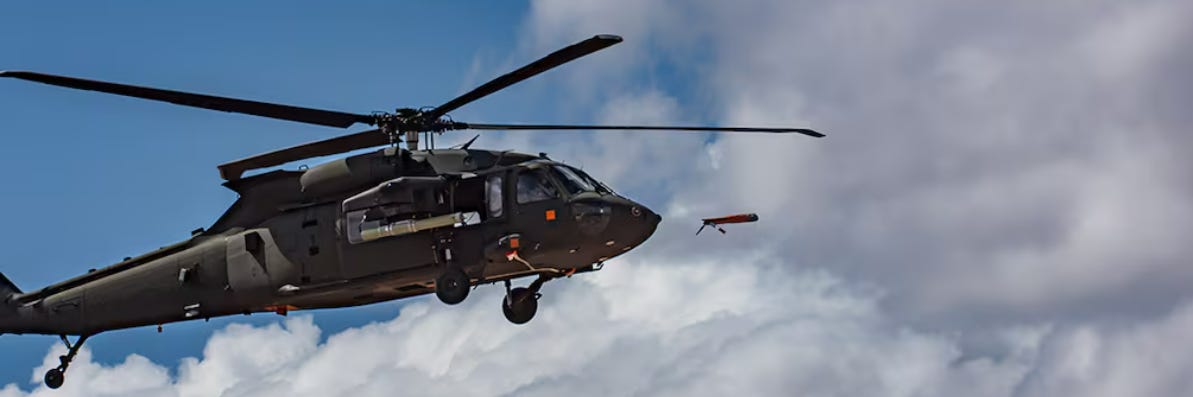
With funds freed up from the Army’s aviation rebalance earlier this year, they will move more quickly on Long-Range Launched Effects development and procurement.
Launched Effects (LE) is the Army’s term of art for an envisioned unmanned segment among its aerial platforms, capable of delivering a wide range of capabilities such as targeting, reconnaissance, surveillance, network extension or kinetic strike.
Launched Effects can be deployed from both air and ground vehicles.
The effort represents a new direction in the Army’s aviation portfolio, which prioritizes drones and the more loosely defined category of LE platforms as the tip of the spear in enemy contact.
The Army also continues to mature its medium-range capability which is in a prototyping effort well underway using Anduril Industries’ Altius 700 aircraft.
Collins Aerospace is the mission system provider
Aurora Flight Sciences is the system integrator.
Technology Service Corp., Northrop Grumman provide modular payloads.
Army Selects Five Companies for Self-Propelled Howitzer Roadshow
As the Army moves out on its quest to revamp its self-propelled howitzer plans, it announced the five companies picked to demo their existing platforms.
Rheinmetall, BAE Systems, Hanwha, General Dynamics, and Elbit Systems.
The Army divvying up $4M among the bunch to cover OTAs.
The plan now is to visit those companies to see what platform capabilities they have today that can potentially fill the gap created when the Army halted Extended Range Cannon Artillery (ERCA) platform work.
Following that market research phase, the service will decide if there are viable options on the market today or if it will need to embark on a new development effort.
The Army accounted for options in FY26 and info would feed POM 27 budgets.
“Hopefully some time next year [the Army will know] whether we can go straight to procuring those things, or if we need to do development.” Doug Bush
Our Take: YES!!! Buy Before Build. It’s the LAW!! It’s sad that in late 2024, if the Army identifies one or more of these are viable commercial solutions, they’ll work it into the FY27 budget and hope it makes the cut.
Army Preparing For V-280 Valor To Dramatically Transform Air Assaults
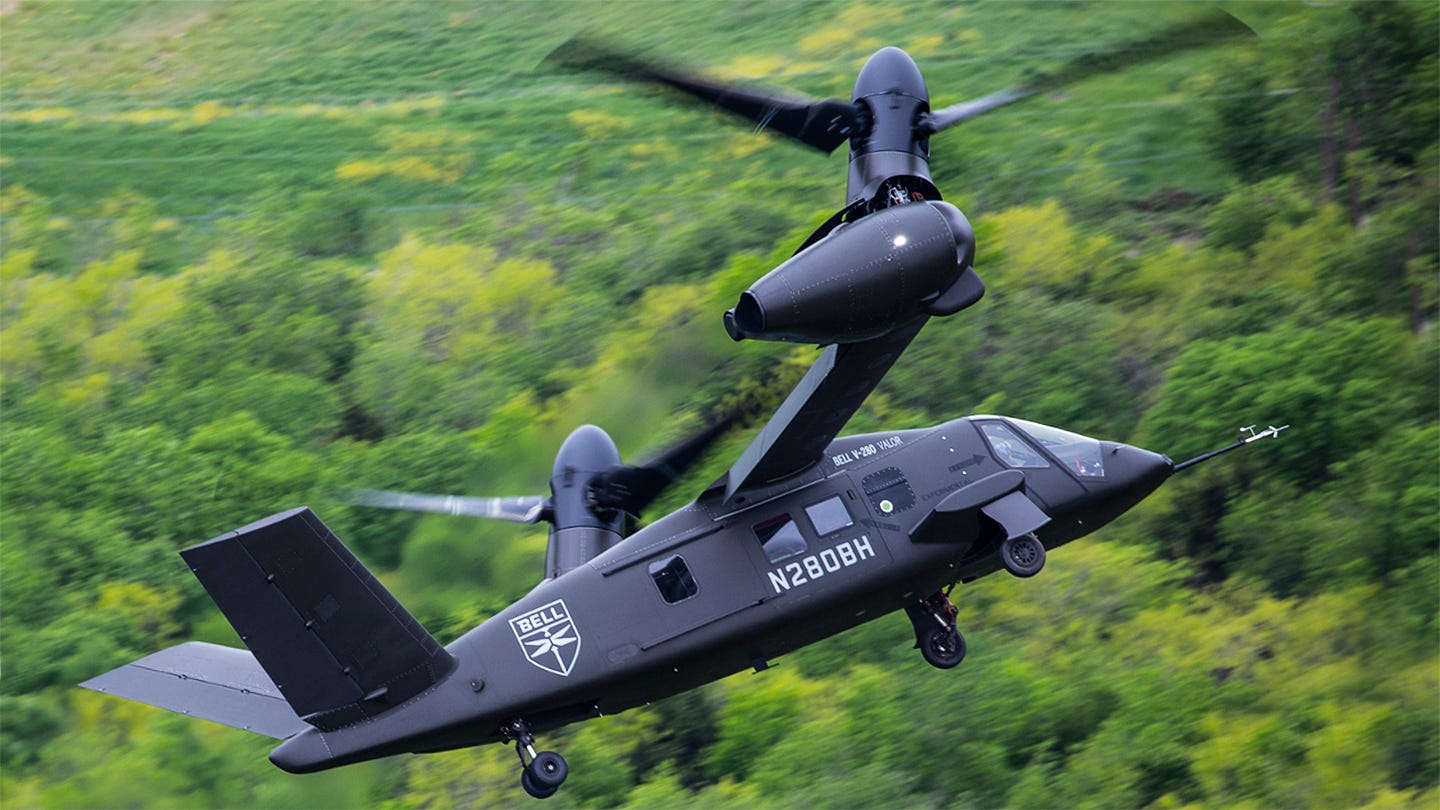
The Army doesn’t expect to get its hands on the new V-280 Valor Future Long-Range Assault Aircraft (FLRAA) until 2030 at the earliest, but it’s already developing tactics for when the advanced tiltrotor arrives.
The Bell Textron-built aircraft, known as FLRAA, received Milestone B approval in August to begin its EMD phase. The Army is planning for the aircraft’s first flight to occur in 2026, with LRIP in 2028 and initial fielding in 2030.
FLRAA is anticipated to bring a revolution, including entirely overhauling the speed, range, and survivability of air assault operations.
FLRAA is also leading to a new concept of operations for the Army, called Large-Scale, Long-Range Air Assault (L2A2).
L2A2 is defined by its ability to deliver one Brigade Combat Team in one period of darkness, over 500 miles, arriving behind enemy lines, and be able to conduct sustained combat operations.
While the EMD phase for FLRAA continues, the Army is practicing the L2A2 concept using the aircraft it has on hand.
Over the last 12 months, the “The Screaming Eagles” or 101st have undertaken four exercises to explore what it takes to move a Brigade Combat Team over that distance, all the while moving exclusively at night.
“Would I love to put a FLRAA everywhere that there’s a Black Hawk? Sure. Do I think it’s affordable? Probably not”. MG Clair Gill
Related Article: Army Practices New Air Assault Concept Without New Helicopter
Our Take: We would like to see the Services stop buying platforms that they know are unaffordable from the start and that will be challenged to compete in future budgets in a way that supports scaling. If the V-280 is being developed to support operations against peer competitors (especially in the Indo-Pacific), then thousands of them are going to be needed. For context, 12,000 helicopters were used in the Vietnam conflict in what has to be considered a rather focused operation. The V-280 is expected to cost over $40M per unit, when the Blackhawk is in the $7M range. This is not the way of the future (affordable mass).
For Replicator 2, Army Wants AI-Enabled Counter-Drone Tech
The Army is eyeing a mix of existing and new technology to potentially scale through the second iteration of the Replicator initiative, including systems that use artificial intelligence and machine learning to target and intercept small-drone threats.
The Army could start to ramp up production of these existing lines right away, Bush told reporters at the Association of the Army’s annual conference, and may seek to reprogram funding in FY25.
The service is especially interested in systems that can not only detect objects but also use AI and machine learning to help decide how to engage them.
The Replicator team takes advantage of planned demonstrations to validate systems, and Stewart highlighted NORAD and NORTHCOM’s upcoming C-sUAS event, Falcon Peak, as one near-term opportunity.
Drone Swarms to Exoskeletons, Army Charts Path for Robotic Future
As the Army updates how it uses robots and autonomous systems in the next FY drone swarms, automated convoy operations and an exoskeleton to lighten the load are on the horizon.
The Army released its Robotics and Autonomous Systems, or RAS, strategy in 2017 with a series of near-, mid- and long-term priorities.
Since the release, the service has met its early goals, which included lightening the load for dismounted soldiers, automating some parts of ground resupply and adding more robots in dangerous jobs such as explosive ordnance disposal.
The Army got its first $7M from Congress for robot strategy work in FY15; that grew to $335M in the FY21 budget. For FY25, the current request is for $480M
New projects, include:
Tethered-Unmanned Aircraft Systems
Medium-sized Joint Tactical Autonomous Aerial Resupply System
Common Robotic System Medium
Dismounted Unit Soldier Transport (DUST)
First-person-view drone
Exoskeleton for dismounted soldiers.
No Pilots, All Cargo: Airbus Tests Loading of Autonomous Helicopter

Airbus U.S. Space and Defense has conducted its first demonstration as part of a program to build an autonomous, uncrewed version of the UH-72 Lakota transportation helicopter for the Marine Corps.
The Lakota variant, which Airbus calls the UH-72 Logistics Connector, is the company’s bid for the Marines’ Aerial Logistics Connector program.
Aerial Logistics Connector is one of several DoD programs aimed at improving how the military delivers logistical support to troops in distributed environments during a high-intensity conflict.
Airbus aims to have the UH-72 helicopter fly autonomously.
Without the need for a cockpit, the UH-72 can use the space behind its nose for more cargo storage.
The nose may open up like a clamshell or swing open to one side on a hinge; Airbus has not yet decided on the exact configuration.
The ability to front-load cargo into the UH-72 will make it possible to carry larger containers or equipment that would not fit in a normal Lakota’s side.
It will also allow users to load cargo into the helicopter with a forklift and load missiles for transport.
Demonstrations will continue through the first phase of the MTA program, which ends in late 2025 - then the Marine Corps will decide whether to move forward with the program and with who.
The service aims to have a flying prototype for the Aerial Logistics Connector program in 2028 or 2029 and make a production decision by the end of 2029.
Related Article: The Army’s latest response to contested logistics is an uncrewed one-ton VTOL lifter
Army Seeks New Space Capabilities for the ‘Tactical Edge’
The Army is doubling down on giving Soldiers better access to space capabilities—and insisting none of their efforts to advantage their troops will duplicate work by the Space Force.
Primarily, the Army is investing in new space-based gear for communications, intelligence, and position, navigation, and timing.
The Army’s major program is the Tactical Intelligence Targeting Access Nodes (TITAN) ground stations designed to enhance situational awareness and give Soldiers targeting data from satellites and high-altitude assets.
The Army is also experimenting with new satellite communications terminals that will be able to connect to multiple satellite constellations, giving troops more options and increased reliability called Next Generation Tactical Terminal.
This mirrors similar programs elsewhere:
The Space Force is seeking $228M to fund research and development of its own hybrid SATCOM terminal in 2025
The Navy has a program called Satellite Terminal (transportable) Non-Geostationary (STtNG).
The Air Force Research Laboratory is pursuing Global Lightning.
Lawmakers complained earlier this year that the military services need to better coordinate these efforts.
The Army released its Army Space Vision for multi-domain operations earlier this year, including plans to increase its space specialists and to establish a new enlisted career field.
That prompted a spirited debate with experts from the Mitchell Institute for Aerospace Studies, who argued in multiple op-eds that the Army is duplicating the Space Force’s effort, wasting resources, undermining cooperation, and favoring its own forces over joint capabilities
Our Take: Buying SATCOM terminals in different form factors is reasonable but starting multiple development efforts for very similar requirements does appear wasteful. Any contract (however this shakes out) should have more than one vendor that can offer the product since having a single provider would be an unacceptable risk. There may yet be virtue to each of the services pursuing some level of customization for their unique requirements (what goes on a ship has different needs than what goes on a JLTV) - this does deserve more analysis. As the Mitchell Institute argued, these actions should not be taken merely because you can only “trust what you control.”
Project Convergence to Plant a Flag in the Pacific
The military’s massive experimentation event, Project Convergence, will plant a flag in the strategically vital Pacific region next year.
The vast majority of experimentation at Project Convergence is slated to take place in Hawaii and Guam, then all the way out along the first island chain from Japan to the Philippines, and down under in Australia over the month of April.
Japan’s Ground Self Defense Force will be a full participant as well as Australia and the rest of the Five Eyes partners — Canada, New Zealand and the United Kingdom. The Philippines will be considered an observer for this round.
The campaign is expected to more closely align the Army and the other services with the Air Force’s Agile Combat Employment concept and to work closely with the air service’s Battle Network.
“Our large experiments need to be concept-informed, and the concepts we’re talking about are the sets of capabilities and relationships that we think we’re going to need to win in the operating environments we are going to face in the future and the priority theater for the Department of Defense is the Pacific.” Brig. Gen. Zachary Miller, head of the Joint Modernization Command
New Patriot Missile Interceptor Axed By Army
The Army is no longer pursuing a new interceptor for its Patriot surface-to-air missile systems as it wants to reduce reliance on the highly in demand and heavily strained Patriot force and look more at tailored air defense force packages leveraging its Integrated Battle Command System (IBCS) network.
This had been known as the Lower-Tier Future Interceptor (LTFI).
The Army is also looking more at how the Terminal High Altitude Area Defense (THAAD) ballistic missile defense system can directly complement Patriot.
The decision to axe the LFTI effort highlights broader discussions the Army is having about the future of its Patriot force, which has been and continues to be in extremely high demand, but also too small to adequately meet those needs.
The total number of THAAD batteries is even smaller and that system is also managed outside of the Army by the MDA.
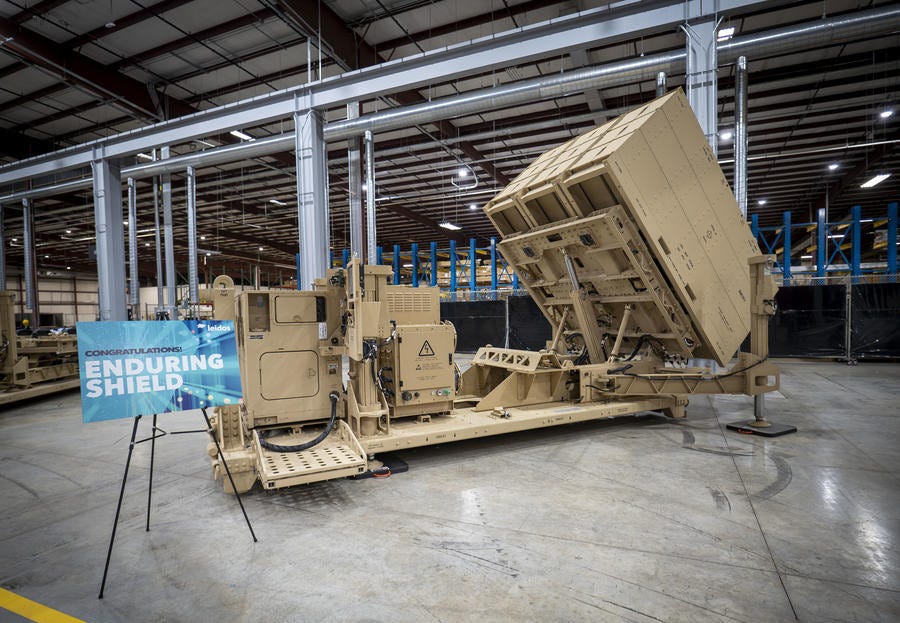
The IFPC program, and the Enduring Shield system at the center of it, is a particularly significant part of the Army’s broader air and missile defense modernization plans.
The primary interceptor for Enduring Shield, which the service is working toward fielding operationally now, is the AIM-9X Sidewinder.
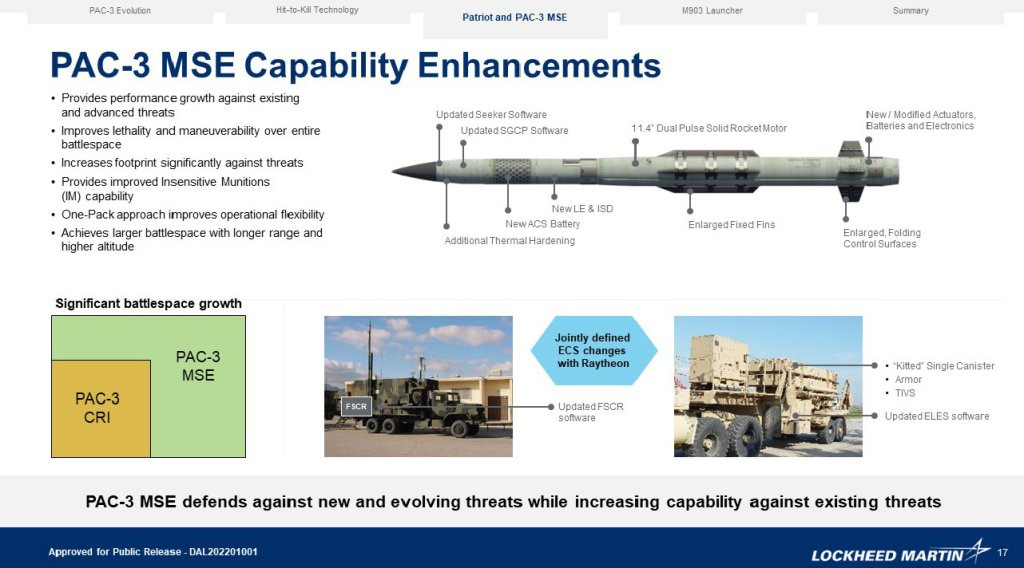
“That was going to be a very expensive endeavor. … Interceptors in that family or class of interceptors are very capable, but also very expensive. After going through a business case analysis within the PEO and with the Army senior leaders, what we’ve decided to do is, one, look at continuing to upgrade the PAC-3 MSE missile, which I believe is probably the best air defense missile in the world, [and] continue to advance that capability so that it can remain relevance against the evolving threats.” BG Frank Lozano
Our Take: The simple numbers of a PAC-S MSE missile costing over $4M each while the AIM-9X is under $500K we think gives you the answer on where the investment should be going if it can address the majority of threats that are typically encountered (and not the hyper-extreme edge cases). This seems like a very wise decision however given that the LMTI would have likely been even more costly than the PAC-3 MSE.
Army Wants Faster Fielding of Air and Missile Defense
With the skies in Ukraine and the Middle East increasingly unfriendly, and China threatening to retake Taiwan this decade, the Army is trying to accelerate the development and deployment of integrated air and missile defense systems.
The Army is working to increase the capacity of air and missile defense systems and components like PAC-3 and Coyote missiles and boost the capability of existing systems while developing new technologies like:
The Lower Tier Air and Missile Defense System (LTAMDS) radar
The Indirect Fire Protection Capability Increment 2 (IFPC Inc 2)
The Integrated Battle Command System (IBCS)
The Army’s FY25 budget request included $5.6B - a 77% increase in integrated air and missile defense capabilities compared to the year prior.
Unfortunately, LTAMDS is expected to deliver at least a year later than the original Nov 2028 date.
If IFPC Inc 2 pursues a second interceptor, some estimates expect development to continue into 2030 before LRIP could be approved.
The good news is that the Army has fielded four battalions of the Maneuver Short-Range Air Defense and looking at fielding an additional four.
The Army also had a successful IBCS full-rate production decision (a core component of its integrated fires architecture) and fielding two battalions a year is planned to kick-off next year.
Related Article: Army Weighing Sending Missile Defense Prototypes Forward Into Theater
Army Gaining Ground on Human-Machine Integrated Formations
The Army wants to integrate robots into its fighting formations, and the service will soon be hosting an industry day to provide companies a chance to offer solutions to this problem.
Initiated in 2023, the Army’s human-machine integrated formations initiative is the service’s effort to fight with a mix of human soldiers and unmanned systems on the battlefield, with the goal of having the robots make first contact with an adversary.
How the Army is Helping Ukraine With Front Line Repairs
It starts with a message on the secure messaging app Signal.
Front line units in Ukraine see an issue with their equipment and send notes to translators, who soon share those with the U.S. military.
Then, operating from one of seven stations in Poland, American forces schedule video calls with the Ukrainians to help them repair the weapons.
This is the process for the Army’s virtual repair mission to help keep equipment working as long and as close to the front line as possible in Ukraine.
The equipment in the shop ranges from howitzers to tanks, and repairs can take anywhere from hours to weeks. Altogether, soldiers assisting with it said, the work is helping Ukraine keep its weapons in working order, and teaching the U.S. how to repair on the fly.
When the Ukrainians have an issue and share it with the translators, the team in Poland consults with their technical manuals.
They then tinker with their own equipment, trying to recreate the same issue the soldiers are having on the front lines. From there they can discern the root issue.
Army Formalizing Micro-high Altitude Balloons for Surveillance Ops
The new effort for microHABs is being led by the Army's PEO for Aviation, which for the moment is the primary acquisition shop overseeing the service's pursuit of systems that can operate at the upper edges of the stratosphere — roughly between 60,000 and 100,000 feet, and just below orbital space.
The Army is about to approve a new requirement for small high-altitude balloons for sensing deep inside enemy territory.
Micro-high altitude balloons (mHABs) are smaller and they carry less payload, but they’re more transportable, so they’re a little bit more tactical in nature.
The Army is exploring many High Altitude platforms.
Other Army Stories:
Army picking 2 cargo drones to pair with autonomous boats for Project Convergence 2025
Army aims for final draft of software mega-contract by Nov. 7
Army moves to rapidly field Anduril’s Ghost-X drones via Replicator
Army’s IVAS Goggles to Undergo Upgrades, Battalion Assessment
SMDC Reviewing Classification in Push for Improved Integration with Allies
In War of Industrial Capacity, West Shouldn’t Go 1-to-1 on Ammo with Russia
Army planning 2025 prototyping activity for next-gen C2 effort
Navy
Navy’s 381-Ship Goal Tough to Reach Under Current Budget Outlook
The Navy’s plan to reach its desired fleet goal is impossible under the current levels of funding, the service’s warfighting, requirements and capabilities officer said this week.
Last year, the Navy informed Congress that a future battle force objective of 381 ships is required to meet future campaigning and warfighting demands.
The Navy’s budget would have to grow 3 to 5% above inflation to meet that goal.
At the roughly 2% of GDP rate allocation to defense, the 381-ship fleet would be unobtainable. There are 297 ships in today’s battle force.
The Navy plans to work towards its goals in the CNO’s Navigation Plan through two mutually reinforcing ways:
Implementing Project 33
Expanding the Navy’s contribution to the Joint warfighting ecosystem.
Project 33 objectives include fielding robotic and autonomous systems in all domains using non-traditional sea denial and disruptive capabilities to fill those readiness gaps.
The idea is to “rapidly swarm a problem and get a solution to the fleet in two years” or less. Disruptive capabilities help “turn data faster” and “[make] sure you’re prepared” for whatever might come next.
Our Take: We certainly don’t disagree that the budget is inadequate for the demands however the Navy has also have driven this situation by placing all their bets on the most exquisite systems and acting in similar ways as the Battleship Age where naval commanders assumed operations would continue in roughly the same way despite the introduction of the aircraft carrier. Russia’s Black Sea fleet probably assumed a similar position and they are paying the price. The Navy has a chance to use the budget shortfall as an opportunity to pivot and place a much weightier hedge in unmanned assets both undersea and surface.
The Navy, Not The Air Force, Will Soon Have the World’s Greatest Fighter Jet (And Biggest Bills to Pay)
The Air Force has paused its effort to develop a new manned stealth fighter while the Navy, by contrast, is going full steam ahead with its own new manned stealth fighter.
The result will be a split in American air power as the Air Force and Navy – which currently use versions of the F-35 – pursue different air-power objectives.
The Air Force has suspended its next-gen manned fighter program while it considers a bigger investment in armed fighter drones. The Navy for its part has decided drones aren’t ready to do what its next fighter needs to do.
The Navy expects to pick one of three contractors soon – either Boeing, Lockheed Martin or Northrop Grumman – to develop and build the new F/A-XX fighter.
The fighter would replace today’s F/A-18E/F Super Hornet on aircraft carrier decks starting in the 2030s.
The F/A-XX is likely to be big and fast, with a large weapons payload and enough internal fuel to range 500+ miles across the vast expanse of the Pacific Ocean.
It should be stealthy, with a small radar and infrared signature, and would be equipped to operate as a team with nearby drones.
The Air Force seems comfortable suspending NGAD because it’s increasingly confident that its new family of “collaborative combat aircraft,” that will be capable of taking over many of the missions the Air Force presently assigns to manned jets such as the F-35 and the bigger, older F-22 Raptor.
The Navy isn’t nearly as confident in drones – especially when it comes to unmanned aircraft operating from the crowded decks of its 11 carriers.
If the MQ-25 is successful in the coming decade, the Navy may yet move forward with armed drones for carrier air wings.
The Navy and Marines are buying F-35C carrier jets, but these lack the payload and flexibility of the F/A-18s. Among other things the Hornet is the only Navy jet that can carry the fleet’s new, huge AIM-174B long-range air-to-air missile.
While this split might seem to reflect poor planning, the opposite is actually true.
If the Air Force’s new fighter drones don’t work out, the flying branch could begrudgingly borrow the Navy’s F/A-XX design.
If the Navy’s F/A-XX program falters, the sailing branch in theory could join whatever new manned fighter program the Air Force eventually launches to replace the paused NGAD.
This has happened before with the F-4 (a Navy push) and F-35 (an Air Force push)
Our Take: At this point (given the massive investments already made), it probably makes sense to proceed on this path but the Navy also shouldn’t focus its efforts entirely on the MQ-25. They should allow experimentation (even ground based) on some other form factors with other vendors to support their longer-range unmanned efforts. Working closely with the Air Force on MUMT is smart as a lot of energy and funding is being put behind that in that can support the Navy’s goals.
Air Force
How the Air Force Can Reclaim the Skies
The U.S. military is in a dogfight to control the skies. For decades after WWII, America took its air superiority for granted. We no longer can. Our primary adversaries have massively invested in modern fighters, advanced surface-to-air missiles and other new countermeasure technologies. Each new system blunts our competitive edge.
China is on the cusp of world-changing air capabilities.
If conflict erupts, China may be able to bracket off the Western Pacific, striking our bases with salvos of missiles and using state-of-the-art air-defense batteries to keep our aircraft at bay.
Beijing could also launch swarms of sophisticated fighter jets that would far outnumber what the U.S. could muster on short notice.
America’s top military brass suspect that Mr. Xi has directed the Chinese military to be ready to seize the island by 2027, and he has spent royally to give them the tools to do the job.
This year Mr. Xi announced a 7.2% increase in defense spending. He has likely doubled production rates for several tactical fighter programs, such as fourth- and fifth-generation J-16 and J-20 warplanes and has built one of the most sophisticated and continually improving air-defense systems.
For the future to echo our past air superiority, we should execute a full-scale rebuilding of the shrinking Air Force. That should begin with NGAD, the manned replacement for the 180 best fighter aircraft, the F-22 Raptor.
NGAD would be the most capable fighter aircraft ever produced, but it can’t accomplish its mission on its own. The Air Force combat fleet that would accompany it—in particular, the fighter fleet—is in a death spiral.
The Air Force intends to retire almost 1,000 aircraft in the next five years, including about 400 fighters. This year, we fought for legislation in the Senate that would prevent the retirement of 26 F-15E and 32 F-22A fighters.
The Air Force hasn’t committed to producing more than 100 B-21s thus far, but Congress should supercharge production of this plane by increasing the planned fleet size closer to 200.
Our adversaries have new air-denial capabilities, and the Pentagon has consistently underinvested in logistics networks, putting these lifelines at extreme risk.
Economic development and national security have always gone hand in hand. We have committed to restoring American air superiority by making the most of the nation’s innovative defense manufacturers. We invite U.S. national security officials to join us.
Path to Air Force's CJADC2 Contribution Revealed Thru Integrating PEO
After years of changing strategies, the Air Force may have finally landed on a pathway to build and field its contribution to the CJADC2 effort.
The newest strategy -- creating a Department of the Air Force Battle Network laser-focused on C2 capabilities and only C2 capabilities -- stems from the C3BM integrating program executive office created about two years ago.
Maj. Gen. Luke Cropsey, the first leader of the C3BM office, sees his task as revolutionary for the Air Force.
The C3BM office works with and across different program offices to build cross-compatible capabilities that can plug into overarching networks.
Integration has been a key factor in the office’s decision making every step of the way, as programs of record had historically been in stovepipes and produced platforms that couldn’t connect to others.
Col. Jonathan Zall has been a member of the ABMS Cross Functional Team for about three years, working with the group to determine operator requirements that will get pulled into the DAF Battle Network.
He’s now seeing an actual plan to get after service-wide integration and capabilities that would deliver on the promise of ABMS.
Under Cropsey and the C3BM office, Zall told Inside Defense, the Air Force has focused the effort in a way it hadn’t been before and has prioritized the service’s resources more effectively.
The C3BM office doesn’t own every program working on communications capabilities, but Cropsey said it works as a connector between the PEOs and helps guide development and integration.
The office tries not to be overbearing, Cropsey said, letting other programs choose to work collaboratively with the office rather than ordering programs to implement his strategies.
Cropsey told reporters in September that CBC2 had been delivered to each air defense sector in NORAD and that the next step is expanding it beyond that command.
The C3BM office’s approach is incremental and methodical looking at how to create smaller networks to meet immediate communications needs with plans to then connect those networks together.
Under Roper, the goal seemed to be creating “one network to rule them all,” by running experiments and demos on connecting various platforms in various ways.
“I think it’s, in some ways, come full circle and more back towards some of the things that Roper was trying to do, but in a more systematic and clearly articulated fashion and from a bottom-up approach versus top-down.” Stacy Pettyjohn, CNAS
“We have an opportunity that is pretty much once-in-generation to really change how the DAF is glued together. How do we consolidate those gains so that, as we’re deploying DAF Battle Network capabilities out the door, that those are sustainable, scalable things that are going into the force structure that we have and the broader warfighting apparatus?” Maj Gen Luke Cropsey
Other Air Force News:
Space Force
New DoD Space Policy Directive Clarifies Space Force, SPACECOM Roles
The language in the new version of DoDD 3100.10 is notable for the specific reference to SPACECOM's responsibility for "offensive" as well as "defensive" operations worldwide — the word offensive is not included in the 2022 version.
Three primary missions for which Space Force Guardians must be organized, trained and equipped to fulfill:
Provide freedom of operation for the United States in, from, and to space.
Conduct space operations.
Protect U.S. interests in space.
Establishes the ASD for space policy as the chair of the Space Warfighting Activities group.
The first time includes a separate section on responsibilities of the CSO.
Adds four new taskings to SPACECOM Commander’s responsibilities;
Serves as the joint lead CCMD [combatant command] for integrating and synchronizing joint space training and education.
Synchronizes and deconflicts global offensive and defensive space operations in coordination with other CCMDs; the Services; USG departments and
agencies, allies, and partners; and others IAW joint campaign objectives.Serves as a member of the Space Acquisition Council.
Serves as the DoD manager for NASA human spaceflight support operations.
NASA’s $100B Moon Mission Is Going Nowhere
Michael Bloomberg
The Artemis program — years behind schedule and billions over budget — should have taxpayers and presidents demanding answers.
There are government boondoggles, and then there’s NASA’s Artemis program.
More than a half century after Neil Armstrong’s giant leap for mankind, Artemis was intended to land astronauts back on the moon.
It has so far spent nearly $100B without anyone getting off the ground, yet its complexity and outrageous waste are still spiraling upward.
The next US president should rethink the program in its entirety.
The more I have learned about Artemis, the more it has become apparent that it is a colossal waste of taxpayer money.
There is little humans can do on the moon that robots cannot. We do not need another person on the moon to collect rocks or take scientific measurements.
NASA’s IG estimates the program has so far burned through $23.8B.
Each launch will likely cost at least $4B, quadruple initial estimates.
Even if the SLS is completed, it isn’t powerful enough to get anyone to the moon.
Meanwhile, NASA is canceling or postponing the Veritas mission to Venus; the Viper lunar rover; and the NEO Surveyor telescope, intended to scan the solar system for hazardous asteroids — as Artemis consumes ever more of its budget.
What on Earth are we doing?
SpaceX’s Starship launch and Mechazilla landing was one for the ages!
Kudos to the entire SpaceX team for the historic launch and capture of the world’s largest, most powerful rocket on the tower. LFG to Mars!

SpaceX Secures $734M in New Contracts for National Security Space
The company won the first task orders issued under the National Security Space Launch (NSSL) Phase 3 Lane 1 program
The contracts worth $733.5M span seven missions for the SDA and one for the NRO projected to launch in 2026. These are part of the NSSL Phase 3 procurement of launch services for U.S. defense and intelligence agencies.
The NSSL Phase 3 Lane 1 program is structured as an Indefinite Delivery, Indefinite Quantity (IDIQ) contract, a flexible procurement method often used in government contracting.
The total value of the Lane 1 contract is estimated at $5.6B over five years, with Blue Origin, SpaceX, and United Launch Alliance selected as the primary vendors to compete for individual task orders.
SDA is utilizing SpaceX’s Falcon 9 rocket to launch small satellites into a LEO constellation, a network of satellites designed to enhance military communications and intelligence capabilities.
SpaceX already completed two successful launches for the Tranche 0.
“The Phase 3 Lane 1 construct allows us to execute launch services more quickly for risk-tolerant payloads, putting more capabilities in orbit faster to support national security.” Brig. Gen. Kristin Panzenhagen, PEO for Assured Access to Space
NRO Speeding Contracting to Support Commercial Partners
NRO is sticking to what it sees as its primary lane in the interagency division of labor for commercial acquisition: procuring pixels.
NRO has been moving to speed its processes for acquiring commercial imagery in order to help support a robust US industrial base.
Tapping commercial innovation — in remote sensing, in launch, in data processing and in artificial intelligence/machine learning — is critical to helping the NRO meet one of its key challenges: keeping up with the pace of technological change.
Keeping ahead of the tech curve, and being able to rapidly deliver new capability to users, is a “whole of government” effort, involving Congress and the DoD — especially with regard to speeding acquisition processes.
US Space Command’s Joint Commercial Operations (JCO) cell on Oct. 1 began expanding its remit from buying commercial space domain awareness data to include purchasing TacSRT data. The JCO director, Barbara Golf, has stressed that the cell is working closely with NGA to avoid duplicative data buys.
“We continue to enhance our internal processes to award contracts faster, which industry likes, and to create more opportunity and great engage with new industrial partners. We are willing to go big on investments where it makes sense for success. The electro-optical contract we ordered a couple years ago, which is about $4B over 10 years, is an example.” Troy Meink, NRO’s principal deputy director
International
Chinese Scientists Report Using Quantum Computer to Hack Military-grade
Chinese researchers, using a D-Wave quantum computer, claim to have executed what they are calling the first successful quantum attack on widely used encryption algorithms, posing a “real and substantial threat” to sectors like banking and the military, as reported by SCMP.
The D-Wave Advantage, initially designed for non-cryptographic applications, was used to breach SPN-structured algorithms but has not yet cracked specific passcodes, highlighting the early-stage nature of this threat.
Despite the advance, the researchers acknowledge limitations such as environmental interference, underdeveloped hardware and the inability to develop a single attack method for multiple encryption systems still hinder quantum computing’s full cryptographic potential.
Related Story: China hacks military-grade encryption using quantum computer, poses threat to West
Congress
We’re 19 days into FY25 with no defense budget approved and once again operating under a costly CR. Assuming Congress passes a budget in mid-Dec, that will cost the DoD and Industry roughly $20B in lost buying power, increased costs, and risks. Imagine what DoD could have spent $20B on to deter or defeat adversaries in war.
Podcasts, Books, and Videos
General Catalyst Layers in Financing to Boost Its Fortunes w/Hemant Taneja and Pranav Singhvi, Strictly VC Download
Code to Combat: Transforming DoD Tech w/Collen Roller, Defense Unicorns
Office of Strategic Capital w/Jason Rathje, Building the Base
Forming Non-Traditional Partnerships w/Mamie Cruse, Second Front
NRO and Space Force w/Dr. Troy Meink, Aerospace Nation
Building Cybersecurity Ecosystems in DoD w/Chris Hughes, Defense Mavericks
Upcoming Events and Webinars
Integrating cATO With Agile, DevSecOps Practices, Aquia, Oct 22, Webinar
TechNet Indo Pacific, AFCEA, Oct 22-24, Honolulu, HI
Expeditionary Warfare Conference, NDIA, Oct 22-24, Laurel, MD
AI+Robotics Summit, SCSP, Oct 23, Washington DC
AUVSI Defense, Oct 23-24, McLean, VA
Use code DEFENSE15 for 15% off registration
Microelectronics Commons and NSTC Symposium, Oct 28-30, Washington, DC
Systems and Mission Engineering Conference, NDIA, Oct 28-31, Norfolk, VA
AI Summit, GovCIO, Nov 7, Reston, VA
RCV Software Pathway Industry Day, Nov 20, Sterling Height, MI
Reagan National Defense Forum, Dec 6-7, Sumi Valley, CA
Defense Manufacturing Conference, JDMTP, Dec 2-5, Austin, TX
I/ITSEC Training/Simulation Conf, NTSA, Dec 2-6, Orlando, FL
See our Events Page for all the other events over the next year.
Join the thousands of subscribers to get our weekly recaps and thought pieces. Paid subscribers also get budget and legislative analysis and are valued supporters of our work.