




The Acquisition Transformation Strategy (ATS) does not merely rename PEOs. It flips acquisition from a locked Acquisition Program Baseline to schedule-driven capability increments and makes “the Portfolio Acquisition Executives the single accountable official for portfolio outcomes with authority to restructure programs.”
The shift is that the focus is no longer just on delivering the first block of capability against an APB baseline, then handing the platform off for post-IOC modification packages. PAEs are now expected to continuously search for acceleration opportunities, make deliberate tradeoffs, and deliver useful capability quickly while sustaining a pipeline for the next two or three increments.
This is how acceptance of more acquisition risk translates to lower operational risk and makes the broader acquisition system an asset to the operational community, rather than something to try to find a way to work around.
First Focus on Speed, Then Focus on Scale, Then Improve
Under the traditional program model, detailed performance requirements are established first, followed by cost and schedule estimates and an Acquisition Program Baseline. Those estimates then become the primary measures of program health, even as the operational need and technology environment continue to change.
The new paradigm starts with an accelerated delivery date as the dominant planning constraint, with cost as a ceiling and mission effectiveness defined broadly enough to permit meaningful trades. That gives the PAE room to field useful capability sooner, scale it to the fleet or force, and then improve performance through subsequent increments.
Scale must be treated as a capability in its own right. A solution that works but cannot be produced in meaningful quantities does not fully solve the operational problem.
For PAEs and program teams, that shift can be reduced to a simple question:
What capability increment can be fielded fast enough to matter, and what’s the smallest requirements set that gets you there?
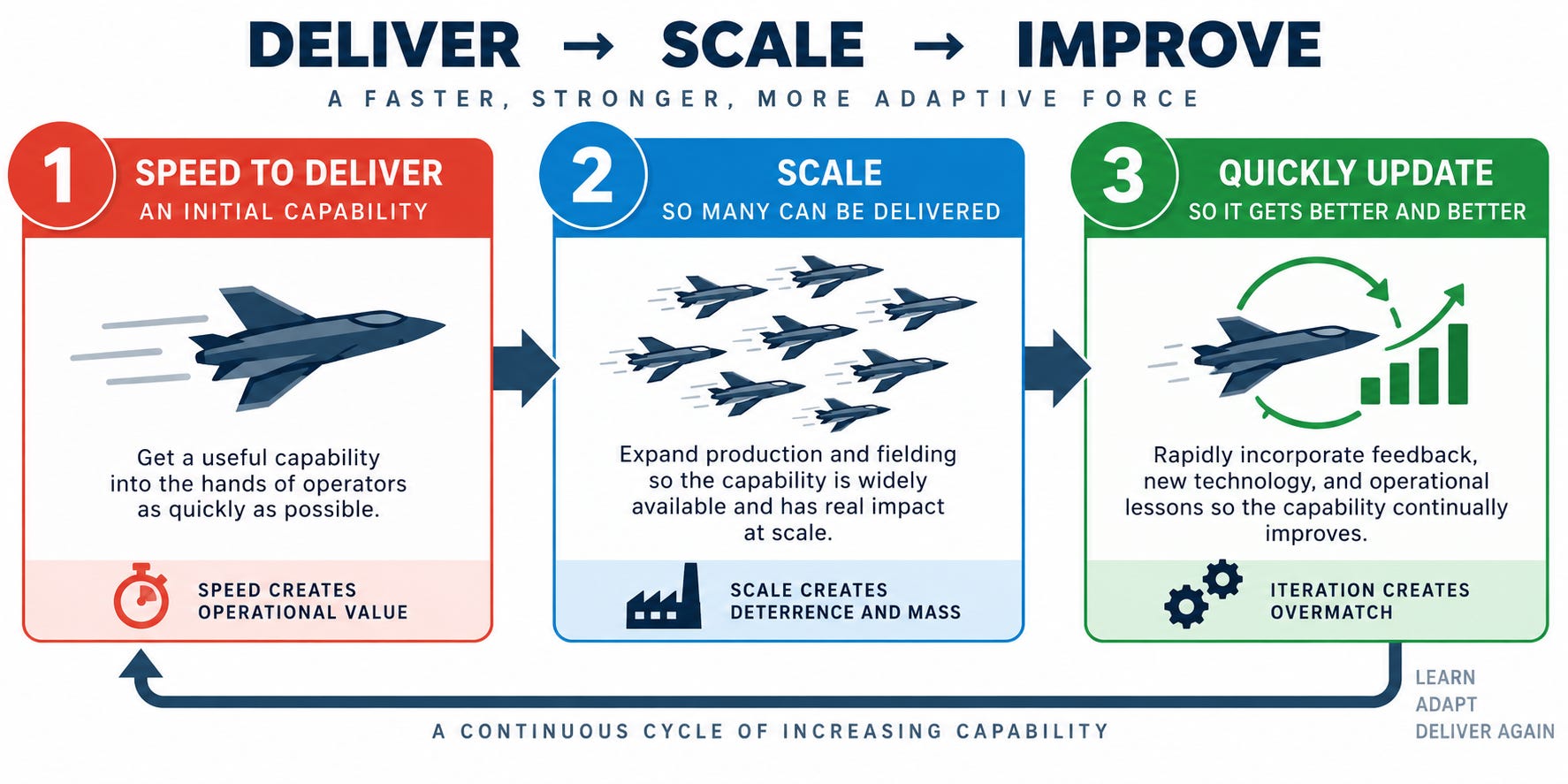
Structure programs as schedule-driven capability increments with aggressive production delivery schedules, unit-cost ceiling goals, and broad mission effectiveness goals.
Start New Acquisitions for Iterative Delivery
New acquisitions should not simply reuse the structure and artifacts of the programs they replace. Start with the operational need, an aggressive delivery date, and a unit-cost ceiling, then scope the first increment around what can realistically be fielded within that envelope.
For program offices, “ready for a new start” should mean more than having a validated requirements document. It should mean knowing the smallest useful capability worth fielding, what is deliberately deferred to later increments, and how the effort fits into the broader portfolio roadmap.
Transition from Programs to a Portfolio
The approach described above is achievable within current program constraints even though it may require an adjustment of the acquisition strategy and some flexibility added to the current APB. PAEs/CPEs should move away from portfolios dominated by large, fixed programs and toward acquisition strategies that deliver suites of capabilities through a mix of S&T prototypes, rapid operational prototypes, software/AI efforts, and traditional hardware development. PAEs can use rapid, software, or traditional pathways as appropriate, but the key is defining clear operational outcomes through mission threads or a requirements backlog where progress can be measured iteratively.
This creates an innovation pipeline of efforts at different maturity levels across multiple capability areas and a diverse mix of traditional primes, nontraditional contractors, SBIR companies, and commercial vendors. With capability trade councils and the user community, PAEs can decide what is good enough to field now, what should shift to the next increment, and what should end because it no longer provides differentiated value. This can be captured as a dynamic capability roadmap that is reviewed and updated regularly.
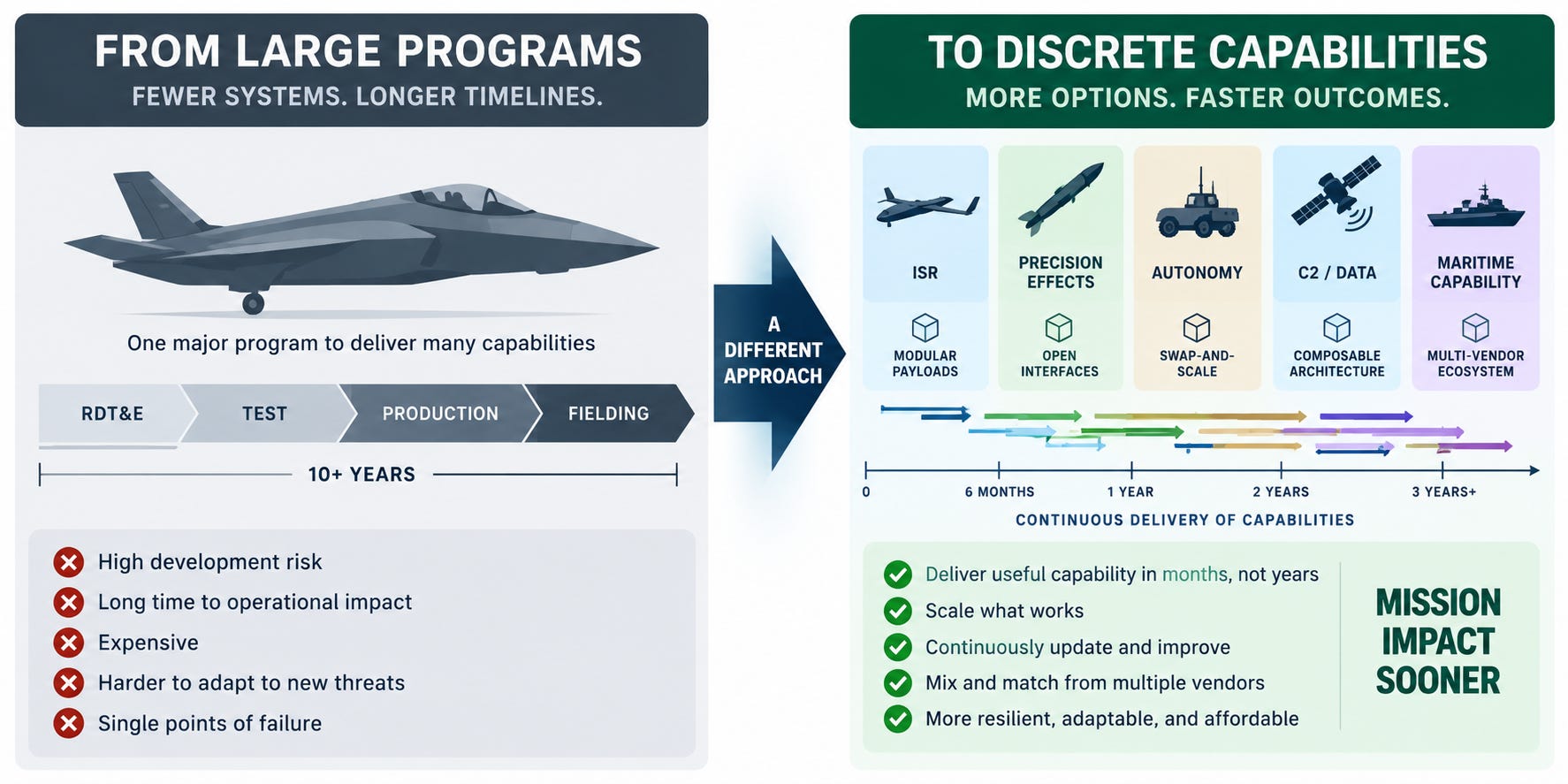
Key questions that PAEs should ask to help restructure legacy programs into a viable portfolio include determining and continually assessing:
Are programs getting too big and cumbersome? Should they be decomposed so different vendors can compete for components or mission elements where they have differentiated expertise?
Where are current programs in the acquisition lifecycle? Early-stage efforts may be easier to restructure, while programs nearing delivery may be better left largely intact.
Which capability gaps matter most over the next 12, 24, and 36 months? Does the portfolio roadmap reflect the highest-priority operational needs and user pain points?
Which programs are consuming disproportionate money or schedule? Are there alternative investments that could deliver more value sooner?
Where can performance be phased to support earlier fielding? What can be delivered now, what belongs in the next increment, and what should be deferred or dropped?
How do you maintain competition and resiliency? Identify monopoly vendors, critical single-source dependencies, and opportunities to introduce new suppliers, prototypes, or commercial solutions. Continually assess which emerging capabilities can augment or replace primary efforts that are stalling, underperforming, or delivering less value.
Make prudent cost, schedule, and performance trades that prioritize time-to-field, including execution of portfolio-level programming within defined and authorized boundaries.
Move Resources Toward What Is Working
A PAE can identify a better capability trade or a faster path to fielding, but those decisions have limited value if resources remain trapped inside individual program structures.
The intent appears to be greater portfolio-level flexibility to move resources toward higher-value efforts within defined and authorized boundaries. The exact limits will depend on Service implementing guidance, fiscal law, and Congressional controls, but the principle is important: portfolio accountability has to be matched with enough resource flexibility to act on portfolio priorities. Otherwise, the PAE remains accountable for portfolio outcomes while still largely making recommendations about where resources should move.
What It Takes to Make the Portfolio Model Work
Through our work with PAEs and portfolio teams, CDN sees a consistent set of actions that can help translate the portfolio construct from policy into execution across the Department, industry, and Congress.
PAEs Build a Portfolio Acquisition Strategy
A Portfolio Acquisition Strategy (PAS) can serve as the capstone document for how the PAE acquires capabilities across the full breadth of its portfolio. It can address the common elements that apply across programs so that individual programs can either adopt these elements wholesale or develop a focused annex addressing only what is unique to their situation. It also minimizes the overhead of independently generating, coordinating, and approving duplicative documents.
Congress in the FY26 NDAA Section 1805 requires portfolio acquisition strategies to include:
Incremental capability delivery and integrated roadmaps,
Enterprise architectures, standards, and data rights,
Continuous market research, experimentation, and user feedback,
Contracting and workforce strategies that support multiple vendors across development, production, and sustainment.
PAEs Execute a Portfolio Map
This is key to move away from the legacy paradigm and adopt the portfolio vision.
Publish the portfolio mission and 12/24/36-month delivery priorities. Define the operational outcomes the portfolio exists to produce.
Inventory every program, prototype, commercial effort, and major dependency. Don’t limit the map to programs of record.
Identify the next deliverable increment for every major capability. Assign each a delivery date, unit-cost ceiling, mission-effectiveness goal, and production quantity.
Stand up the capability trade council. Predefine who can trade which requirements and what remains constrained by statute, safety, or operational necessity.
Map critical interfaces and data rights. Determine where incumbent control prevents competition or rapid integration.
Identify the bottom 10–20% of activities by mission impact. Consider descoping, delaying, terminating, or redirecting their resources.
Map the industrial base. Identify vendor lock, sole sources, production bottlenecks, second-source opportunities, and realistic surge rates.
Establish a portfolio scorecard. Track time-to-field, production quantities, unit cost, mission effect, supplier diversity, integration cycle time, and transition rates.
PAEs Rapidly Prototype, Experiment, and Use Commercial First
Work with DIU, an OT consortium, or another industry outreach mechanism to map what already exists against priority portfolio needs. Use a streamlined CSO-type process (a short white paper or solutions briefing) so industry does not waste resources with a feckless RFI or a full proposal. Then talk to whoever gave you the most promising responses.
From there, craft a contracting path depending on technology maturity, the state of competition, and the prioritization of the operational need:
Procurement for Experimentation. Acquire a few mature or near-mature solutions and put them in front of the operational and test communities to understand viability. This is the cheapest way to kill a bad assumption before it becomes a program of record.
CRADA/No-Cost Contract. Best fit when the government and a vendor both bring something to co-develop and neither side wants to commit to a full acquisition relationship yet.
Prototype OTs with a deliberate path to follow-on production. Use when a solution needs maturation, integration, or operational demonstration before production. Define successful completion and the transition strategy up front so a successfully completed prototype can move to follow-on production, when conditions are met, without restarting the acquisition competition from scratch.
Industry Adapt Business Development to Portfolio Construct
The shift to portfolio acquisition also changes how industry should engage with PAEs and program offices. Companies need to do more than demonstrate that a product meets a requirement. They should focus on how it fits into the broader portfolio and how quickly it can deliver mission value.
Frame the value at the portfolio level. Instead of arguing that a product should become a new program, identify what existing capability, component, mission thread, or requirement it improves, replaces, or makes unnecessary. The strongest offering may be a subsystem, software module, sensor, effector, or production capability that strengthens several programs across the portfolio.
Offer trade space. Show the PAE what can be delivered in 12 months at one price point, what additional time and funding would buy, and which performance attributes can be traded without undermining mission effectiveness. That gives the government something it can actually use in a schedule-driven acquisition model.
Tell the integration story. Show how the solution connects to existing platforms, networks, data standards, and mission systems to deliver new mission effects across the broader kill chain. Address APIs, interfaces, data rights, sustainment, and what is required to integrate the capability without unnecessary friction.
Bring a production roadmap. A promising prototype is less compelling if there is no credible path from 10 units to 100 or 1,000. Show manufacturing capacity, critical suppliers, lead times, workforce and capital constraints along with how quickly production can scale.
Congress Develop a New Funding Approach
The shift to a portfolio approach does not just apply to the PAEs but has to translate into the authorization and appropriation processes on the Hill.
Consolidate Program Elements (budget accounts). The >1,500 PEs severely limit the PAE’s ability to move funds to the highest value activities.
Focus on Capabilities, Not Programs or Platforms. Congress has legitimate interests in programs with significant workforce and industrial-base footprints in members’ districts and states. But if preserving individual programs dominates the process, PAEs will struggle to shift resources toward higher-value capabilities.
Improve BTR Threshold. As PEs are consolidated, provide a greater level of BTR flexibility across funding lines so that ATRs are reserved to only the largest transfers. Require notification or veto ability (after 30 days) for BTRs above a certain level.
Deprioritize the FMR. The Secretary directed cutting regulations to include the 7,300-page Financial Management Regulation which has been a nightmare of complexity and interpretation. Work with DoW to replace it with common-sense financial rules that address the key equities such as time, purpose, amount; bonafide need and anti-deficiency.
Demand Dynamic Reporting. Connect PAE flexibility to the amount of relevant information that is received. Require PAEs to provide portfolio reviews to key PSMs and members that is focused on capability delivery. Provide capability roadmaps for easier understanding and demand PAEs keep them updated.
Track Measures of Success
Each stakeholder should have common measures of success that determine how much progress is actually being made in the portfolio transition.
For PAEs, success means using the authority: making real capability trades, restructuring programs around deliverable increments, moving resources toward higher-value efforts, and stopping or descoping work that no longer justifies its cost and time.
For program offices, success means helping PAEs manage the innovation pipeline through continuous market research, technical insight, and identification of opportunities that improve portfolio outcomes.
For industry, winning will require showing not only that a solution performs, but where it fits, how quickly it integrates, what it costs at scale, and what existing capability or requirement it can replace.
For Congress, the bargain should be greater flexibility in exchange for greater transparency: give accountable acquisition leaders enough room to make meaningful portfolio trades, then measure whether that flexibility produces faster fielding, greater production, stronger competition, and better warfighting outcomes.
Change Will Create Friction
No transformation of this scale will happen without disruption. PAEs will make trades that disappoint programs, terminate efforts that have constituencies, shift resources toward new opportunities, and ask industry to compete in different ways. Congress will have to balance greater flexibility with new forms of transparency and accountability.
The PAE transition will succeed only when portfolios become the unit of management, programs become vehicles for iterative capability delivery, and resources can move toward the opportunities that deliver the greatest mission value. Changing titles and reporting chains is easy. Changing how the Department makes decisions is the real transformation.

“focus on capabilities, not programs or platforms”
that’ll be the fight…
Show me a single PAE that is actually doing anything remotely like this. The creep back towards JCIDs is turning into a march for some.