

Welcome to the latest edition of Defense Tech and Acquisition.

The biggest stories across the Department and the defense industry this week:
Unmanned Systems Get a New Center to Codify Insights from Operations
The Department and Industry Focus on Scaling Production
The Army Improves How it Acquires Munitions and Ammo
The Navy advances many unmanned systems and Phase II of MUSVs
Air Force continues to make progress on integrating CCAs in operations
Space Force advances space logistics and selects 2 companies for GHOST-R
Golden Dome sets two-stage path to full deployment and capability
Foreign investments needs better governance and Saildrone goes International

CENTCOM Has Become a Battle Lab for Unmanned Systems

BLUF: A Task Force-59 Corsair recovered two U.S. personnel in June; a month later three Corsairs struck Bandar Abbas in the first U.S. combat use of sea drones. The fight is now teaching the Navy command, sustainment, and how much risk to accept on uncrewed platforms.
Real-world use of uncrewed systems gives the Navy an unrivaled opportunity to learn how to command and deploy robotic systems and refine their deployment, employment and sustainment.
The Navy’s February 2026 Fighting Instructions lay out specific roles for unmanned platforms.
Combat puts additional demands on unmanned systems, including maintaining communications, operating for extended periods, navigating contested waters and remaining useful when an adversary is actively trying to interfere with them.
there is an unanswered question of how much risk the military should accept when deploying uncrewed systems, including how to determine when a system has delivered enough value to justify its loss.
Many unmanned systems are cheaper than crewed platforms, but not cheap.
Our Take: Combat use is the easy part to celebrate and the hard part to institutionalize. The success stories do not prove the Department can command, sustain, and restock them as a portfolio. The Department must progress past demonstration and turn TF-59 and CENTCOM employment data into production quantities, open interfaces, spare pipelines, and trade space for DRPMs and PAEs to acquire capabilities.
DEPSECWAR Establishes Force Agility and Streamlining Team
BLUF: Deputy Feinberg establishes the Force Agility and Streamlining Team (FAST) within the DoD Comptroller office as a permanent cut-waste shop, with a director and a mandate to kill or realign programs that do not serve warfighting.
The FAST will serve as the foundation of an enduring institutional mechanism to advance this imperative across the Department.
The FAST shall be led by a Director who reports directly to the USW(C), who shall provide direction, oversight, and administrative support for the FAST.
The Director, FAST, in coordination with many Department leaders, shall promote a culture of cost awareness and fiscal responsibility; recommend elimination, realignment, or modification of wasteful, inefficient, and duplicative programs and processes; and ensure Department resources are aligned to warfighting priorities.
Our Take: This institutionalizes last year’s cost-savings push by parking a standing cut-waste team inside the office that already manages the books. DoD has no shortage of inefficient, duplicative, and non-warfighting spending; those dollars would be better used on combat power. If FAST applies commercial discipline and deal-making rigor instead of adding another process layer, it could improve how the Department allocates scarce resources.

More Than 100K Personnel Use Maven Smart System

BLUF: The DoW is growing the user base for Palantir’s Maven Smart System amid the Iran conflict and other demands for the AI-powered platform.
The MSS tool can fuse disparate systems, data streams and intelligence information for commanders and greatly speed up the U.S. military’s processes for targeting adversaries.
The Maven capability helped the U.S. military strike 13,000 targets in just 38 days during Epic Fury.
While the DoW is good at the tactical use cases, it is not good at understanding the entire data architecture, being able to actually integrate supply chain workflows, integrate logistics all the way back to procurement, all the way back to early supply chain to better understand what we should be doing today to prepare for the 90-day fight, the 120-day fight, the 180-day fight.
“In January of this year, we had about 50,000 people using Maven. Then Operation Epic Fury kicks off, and now we’re up to over 100,000. We’re proliferating it out to all the commands. Everybody wants this because once they see the power of it, they want to sign up as quickly as they can to get across classification models.” James Mazol, DUSD(R&E)
“That’s data-centric warfare. That’s using AI at scale. We’re developing those algorithms, we’re pushing them out, and we’re actually integrating those quite effectively into a technology-centric solution. Part of the deal, though, is that our operational community then takes the process and they reconstruct it to improve things. What this turns into is magic on the battlefield.” Cameron Stanley, CDAO
Drone Dominance Phase 2.5 Qualifier Invitees Announced
BLUF: The Drone Dominance Program has challenged 17 companies to prove their systems capabilities in the Phase 2.5 Bomber Qualifier at Camp Grayling, MI in October 2026.
This event will test 17 unique drones in three missions across two stages: a vendor-operated bomber qualifier and a military-operated bomber Gauntlet to identify the most capable systems.
Each industry contestant must have at least 6 complete systems for testing, as this Phase will be the most demanding and expedited testing of the DDP.
Congratulations to the following organizations who have been invited to compete
Achiever UA | Areya Corporation | Cyclops Defense | Grim Tech | Gurzuf Defence | Halo Aeronautics | KrateoSky | KRUSH Tech | Meta Bureau US | Obscurity Labs | Skycutter | Swarm Defense | The AIRO Group | UA Defense Tech | UDD Tech Corp. | UFORCE USA Services | W.S. Darley & Co.
What’s Unique About NORTHCOM’s Falcon Peak 26.2 Counter-Drone Exercise
BLUF: NORTHCOM’s fourth Falcon Peak exercise is designed to demonstrate, refine and connect capabilities that counter small, hostile drones in desert terrains, and for the first time, those threatening America along the southern border.
The organized trials cover three lanes: drone-on-drone interceptors, kinetic or ballistic mitigation using shotgun-based systems, and capabilities that sense and detect enemy UASs.
Pentagon counter-UAS exercises have been known to focus often on tactical, expeditionary warfare and impacts on forces abroad.
But this year, Falcon Peak 26.2 is directly targeting NORTHCOM’s mission to defend against drone threats that have been emerging across U.S. airspace, critical infrastructure, and incursions escalating around the southern border.
Beyond being the first Falcon Peak exercise to emulate border combat and unfold on the military’s sprawling Yuma Proving Ground, 26.2 also marks the first iteration that the command deployed Anduril’s autonomous C2 software platform Lattice as a digital backbone and baseline standard against which all commercial sensor-to-shooter counter-UAS assets are measured.
Commercial participants must feed their sensor data, radar tracks and targeting data directly into the Lattice system during this exercise. At least 20 vendors have been involved, with anywhere between 15 and 30 opportunities to do intercepts.
Related: NORTHCOM’s Next Counter-Drone Demo Will be its First in an Urban Area
Company 3D Prints Ship Parts, Drones at Sea

BLUF: Firestorm Labs 3D printed drones and new ship parts aboard a Navy vessel.
Firestorm Labs’ xCell manufacturing system is the size of a large motorcycle that is placed inside two 20-foot-long shipping containers that allow it to function efficiently in harsh environments.
In July, the company deployed the technology aboard the USS Essex amphibious assault ship on its way to the Navy’s RIMPAC exercise in Hawaii.
For 12 days, sailors and Marines learned to use the system and printed over 1,000 unique parts and 12 of the company’s Squall first-person view drones.
The manufacturing cell can print tens of thousands of unique parts, including items where the supply chain either is no longer there or is way too slow and would take the Navy months to obtain.
“The DoD is clamoring for the ability to modify stuff in the field and not have another human help support them. We wanted to rethink how you build drones from the ground up, using things like advanced manufacturing. We have this incredible tool that the end users have never had access to before, which is industrial 3D printing that a non-technical person could learn how to use in a couple hours. Say you wanted to invent a product, and you understood basic computer-aided design, you could do that.” Dan Magy, Firestorm Labs CEO
Pentagon Cyber Chief: The Demand Far Exceeds Supply

BLUF: The single priority of the top cyber policy official is expanding the cyber options available to the president and the defense secretary, describing a gap between what commanders are asking for and what the force can deliver.
One particular instance of that limelight are previous reports from an operation in Venezuela to apprehend the country’s former president Nicolás Maduro. Power outages during the operation were claimed to be the result of a cyberattack. Cyber ops may have been involved, but the visible physical attacks that were also part of the operation alone could plausibly explain the outages.
Cyber is used not just to counter other malicious cyber actors as a cyber-on-cyber tool, but actually as an integrated tool of cyber warfare.
Data is fundamental to every battle that we fight going forward. Being able to use our cyber tools to deny that to our adversaries as we go into a kinetic fight will ensure our mission success and provide greater safety for our troops.
“I’m focused on one single priority, and that is building a more robust set of capabilities for the secretary and the president. The demand far exceeds the supply we have.” Katie Sutton, ASW for Cyber Policy
Other Defense Tech News:
DARPA Pushes Industry to Build Lighter Drones to Carry Heavy Loads



The Pentagon Struggles with the Ghost of Rickover
BLUF: America’s greatest national security advantage is the breadth and vitality of its free-market economy. The Pentagon should be drawing on all of it: established manufacturers, commercial technology companies, a rebuilt middle tier, and disruptive entrepreneurs competing to deliver better weapons faster and more affordably.
I warned that the Pentagon’s supplier-transparency memo could become the most damaging defense acquisition policy in 50 years. I stand by that criticism.
A Fostering One Strong Industrial Base, memo signed by Deputy Secretary Steve Feinberg could be a significant step toward repairing the divide between defense and the vibrant commercial economy.
Admiral Hyman Rickover’s career captures how that chasm was created. He went from mythical innovator in submarines to a bean-counting apparatchik once it was decided the navy no longer needed to innovate or for industry to compete for new solutions.
Rickover’s transition to chief cost bureaucrat came about because he confronted a real problem when producing submarines at scale. His solution to keep prices low was to demand uniform cost-accounting data as a means to cap profits, measured as a percentage of government-approved costs.
His cure just didn’t fit the real American economy.
CAS helped split the industrial base in two by making the boundary between defense and commercial too expensive to cross.
The August 18 memo has not been rescinded and will continue to do harm and send mixed signals to industry until it is.
The Pentagon needs to choose. It should emulate the innovative 1950s Rickover and exorcise the ghost of the 1960s one.
Related: They Overreached: Amid Industry Worry, New Feinberg Memo Tweaks Accounting Regime
America’s Attrition Trap

BLUF: Attrition is the defining feature of today’s conflicts. The wars in Ukraine and the Middle East have become grinding contests over which side can exhaust the other’s military capacity, economic resources, and political will.
Gaps illustrate why states increasingly choose strategies of attrition or find themselves trapped in them.
Between military capacity and power to deploy and sustain.
Between traditional principles of warfare and a modern battlefield which technology makes decisive breakthroughs increasingly difficult.
Between military means and political ends.
As American leaders increasingly seek short, decisive military operations, the U.S. may increasingly confront adversaries that see advantages in prolonging conflicts.
The U.S. and NATO have far greater economic and military power than Russia does. Yet a war of attrition measures power differently. GDP cannot be fired from artillery tubes.
What is changing is the speed at which innovative tactics and operations can be rendered ineffective.
Technology is also changing how traditional principles of war are applied in the Middle East. Both sides can persistently generate concentrated effects without concentrating forces, destroying the enemy’s ability to keep fighting becomes harder.
The Pentagon has planned for short, decisive military operations, yet adversaries today have the means and incentives to prolong conflicts in the hope that they can regenerate capacity, impose costs, and outlast American political will.
The U.S. has built a military that relies heavily on relatively small numbers of sophisticated and expensive weapons systems, an industrial base that cannot rapidly replace many of these systems, and strategies that too often leave the political conditions required for victory unresolved.
U.S. military leaders must build forces and concepts around the assumption that future wars are unlikely to be resolved quickly, while political leaders must be more realistic about whether the objectives they set can be achieved by military force alone and in a short time frame
The Defense Readiness Gap
Doug Berenson, Kelleigh Bilms, and Tim Garnett
BLUF: The DoW readiness challenges is an enterprise that compensates through manual coordination, fragmented workflows, and individual heroics rather than integrated visibility, predictive planning, and dynamic execution.
The Enterprise Readiness Gap emerges across both industrial readiness to surge — the ability to translate validated demand into delivered capability at speed and scale — and readiness to project power — the ability to deliver and sustain mission-ready capability when and where it is needed.
It takes years longer to field capabilities, with many delays, lower production volumes, declining readiness rates, and increased maintenance delays.
The DoW manages an operational arsenal with an asset base >$1.4T.
DoW invests nearly $700M daily to maintain and recapitalize the arsenal.
Adding 30 days of ready forces in the arsenal is a $20M value annually.
Recommendations:
Redefine readiness and how current metrics are reported.
Develop a common operating picture that promotes accurate readiness planning, metrics tracking, and governance.
Build the cost of inaction into readiness modernization business cases.
Modernize the systems and workflows that create recurring readiness friction.
Officials Tell Industry to Take Risks to Solve Supply Chain Issues

BLUF: The DoW is looking to bolster domestic supply chains and ensure production at speed and scale in preparation for potential future conflicts, and industry needs to take more risks to expand and strengthen these processes.
The domestic supply chain is simply not where it needs to be to field new defense capabilities and sustain existing legacy platforms.
There is a lot of discourse about what the government and armed services can do to bolster domestic production, and a lot of it comes down to creating a healthier supply base that is willing to take on risk and co-invest in production capabilities.
The hard part is figuring out how to work collectively at the interagency level and then partnering with industry to make the necessary investments to move the supply chain and domestic production into a more stable position.
The department and armed services are investing a lot in bolstering domestic supply chains, but a lot of the program offices are still in the early days of shifting their attitude around risk taking, and while there’s some friction, changes are starting to happen.
“When you look at technology moving on, industry generally is chasing the next thing, but we really need to keep legacy production going to keep those systems fielded. On the other side of the equation, when we think about new systems, it's about how do we gain scale quickly? How do we address qualifications in order to do so?” Andy Magliochetti, DASN Defense Industrial Base
Our Take: As the Department shifts from individual programs to PAE portfolios, industry engagement has to move with it. Production and supply-chain decisions can no longer be made program by program. They need to be optimized across a full set of related capabilities to sustain legacy systems while scaling new ones quickly. That starts with shared data and visibility into capacity, bottlenecks, and risk, then converting those insights into portfolio-level investment strategies that industry is willing to co-fund.
The Pentagon Asked Industry How Fast it Could Make More Weapons. The Numbers Remain Private.
BLUF: Twenty-six days after the Pentagon’s deadline for defense companies to propose faster weapons production, the DoW has not publicly disclosed how many companies responded or what production timelines they offered.
Deputy Defense Secretary Steve Feinberg gave industry leaders until Aug. 26 to submit plans for “significantly faster, more aggressive delivery schedules and/or increased production for critical capabilities,” according to his Aug. 5 memo.
Feinberg directed companies to identify ways to accelerate production and delivery, propose capital investments and facility expansions and explain how the Pentagon could enable higher production.
The memo identified 16 critical programs under consideration for accelerated production or increased procurement. The responses were intended to inform the department’s FY28 budget request.
HII Boosts UUV Site by 25% Amid Rising Navy Tech Demand

BLUF: HII has expanded its uncrewed systems production facility in Pocasset, MA, by 25%, responding to heightened global requirements for autonomous maritime technology.
The additional 10,000ft2 increases the manufacturing campus to 50,000ft2.
The expanded Pocasset facility enhances HII’s ability to deliver advanced systems such as the REMUS family of UUVs, the ROMULUS USV, and the Lionfish SUUV for the Navy.
Derived from HII’s REMUS 300 commercial platform, Lionfish production is currently underway, supported by a recently awarded option-year contract from the Navy.
Production of the REMUS 620 UUV will also take place at the enhanced site.
New infrastructure at the campus supports greater integration of HII’s Odyssey Autonomous Control Solutions (ACS) software, which underpins maritime autonomy and simulation capabilities across multiple vehicles and mission types.

As the last few days of FY26 come to a close, please remember to thank the contracting officers and financial management professionals who are tirelessly working through a massive surge of year-end requests despite fewer people and major enterprise changes.

Army Lays Out Plan to Buy Munitions Differently

BLUF: Project Strike is the Army’s strategic plan to buy munitions differently. The Army’s initiative is aimed at expanding its missile industrial ecosystem by bringing in nontraditional vendors and providing industry a more consistent demand signal.
The plan addresses the Army’s authority to shift funding priorities, expand the market space with nontraditional partners and enable persistent competition through consistent demand signaling.
Industry repeatedly tells the government that predictability matters.
Manufacturing capacity requires investment in facilities, machines, workers, suppliers, training and capital, he said. Parts can have long lead times, and investments are easier to make when demand is credible and sustained.
Traditional primes are needed because they bring experience, capability and scale. However, nontraditional companies are also needed, along with commercial technologies and smaller firms.
Companies can bring fresh approaches to existing problems like expensive and complex propulsion, along with new manufacturing techniques, software and materials and business models.
Mikesh asked industry to embrace nontraditional teaming, rather than viewing smaller firms with transformative technology as competition.
Project Strike is therefore about more than just buying missiles. It’s about building an industrial ecosystem required to sustain U.S. and allied combat power.
“Project Strike is also about expanding the missile market, space and production capacity. It’s about giving the Army greater flexibility to move resources toward priorities. It’s about bringing nontraditional partners into the ecosystem. We want to create persistent competition through consistent demand signaling.” BG Robert Mikesh, PME for Offensive Fires
Our Take: Fully agree. A comprehensive strategy with clear and sustained demand signaling, active industry engagement, persistent competition, and partnerships between traditional primes and nontraditional firms is essential to strengthen and rebuild the munitions industrial base and accelerate deliveries.
BAE Systems Delivers AMPV-Based Prototypes to Army for Trials

BLUF: BAE Systems handed over two prototype Infantry Fighting Vehicles to the Army aiming to speed up delivery of advanced ground combat solutions as part of Transformation in Contact (TiC) 2.0.
Both AMPV 30s feature the Kongsberg Medium Caliber Turret and counter-drone technology for battlefield protection.
The new vehicles, developed at a cost of $17m from BAE Systems’ own research and development budget, use the chassis of the Armoured Multi-Purpose Vehicle (AMPV) as their foundation.
They were delivered in April this year, following a six-month development cycle.
Since then, the Army’s TiC unit has subjected the AMPV 30s, to comprehensive field trials, including live-fire exercises, to evaluate their potential on a modern battlefield.
The platform’s modular design is highlighted as enabling compatibility with more than 30 turret systems and facilitating the addition of new technologies.
Beyond enhanced firepower, the AMPV 30 prototypes also incorporate protection and situational awareness systems.
How the Army Can Build a Faster Learning Force
Howard Romans and Richard McConnell
BLUF: To maintain advantage, the Army must change how it fights, trains, organizes, and buys equipment.
Army Transformation and acquisition reform call for a faster learning organization.
If officers struggle to embrace mild discomfort in a classroom, what happens when the battlefield demands rapid, unconventional thinking?
Whether officers can tolerate ambiguity, experimentation, and temporary embarrassment are traits essential to warfighting. PME already recognizes the need for creative and critical thinking, but recognition is not the same as practice.
Proposed Army Learning Innovation Architecture
Capture. Make local innovation visible.
Screen. Sort ideas without killing them prematurely.
Test. Connect innovators with validators.
Share. Make useful adaptations searchable.
Institutionalize. Route successful ideas to the right owner.
A PME course on innovation should produce a usable artifact: a problem statement, prototype description, and recommendation for who should receive the idea next.
Ukraine’s Brave1 shows what becomes possible when a military stops fearing unorthodoxy and treats creativity as a core competency. The Army cannot afford to treat innovation as a side project. In a world where change accelerates, advantage belongs to the force that experiments boldly and adapts without hesitation.
Soldier Feedback Drives Transformation
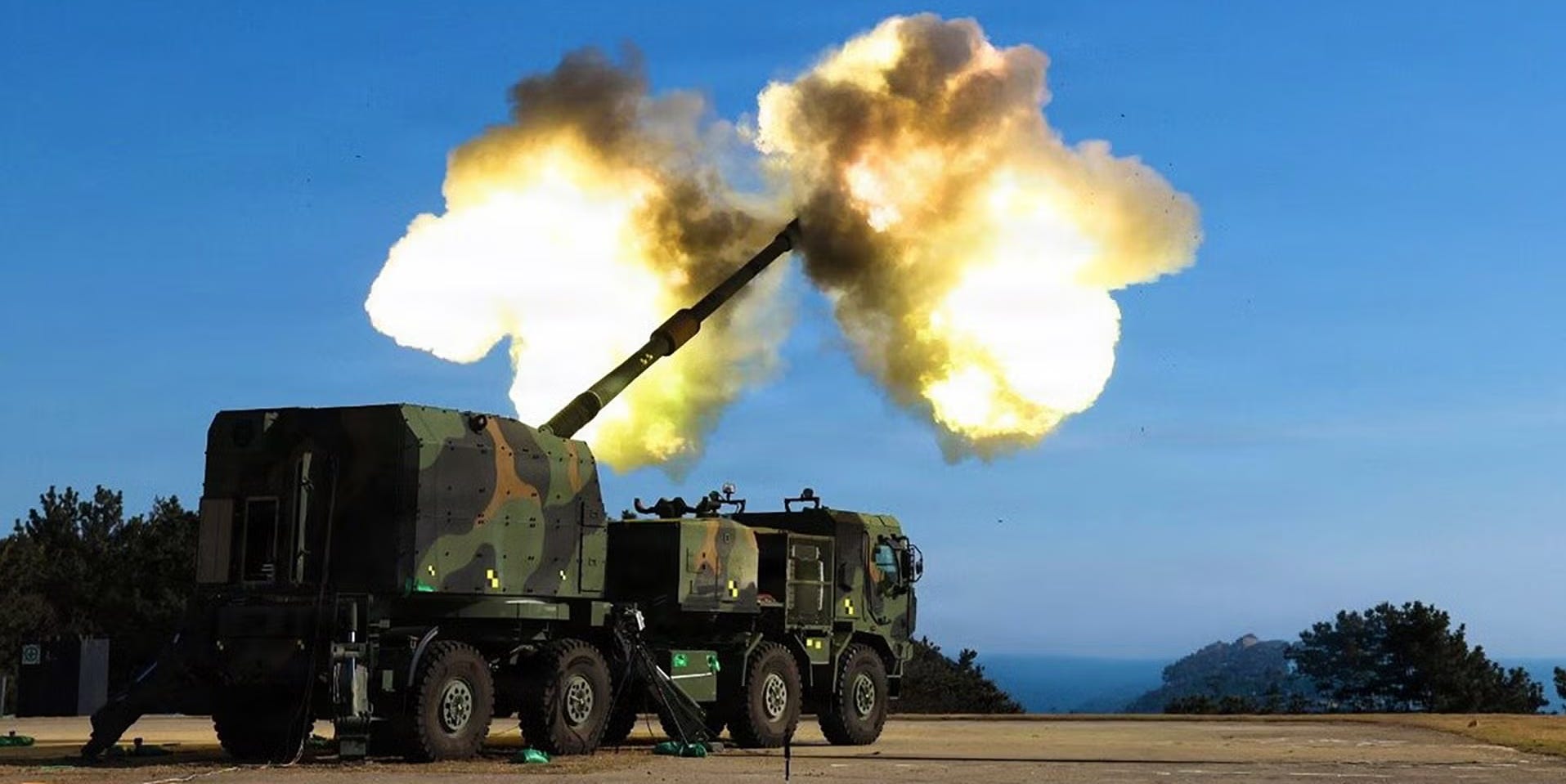
BLUF: Soldier feedback continues to be a central part of the Army’s ongoing effort to connect the battlefield to the acquisition process as the service works to get new capabilities into troops’ hands.
The Army looks at operational gaps and determines what capabilities need to be developed, and hearing what soldiers have to say after experimenting with new capabilities is an important part of the development process.
The process is part of the Pentagon’s acquisition transformation, which is moving the Army away from viewing acquisition as a collection of individual programs and more toward managing capabilities as part of an integrated portfolio.
Standing up the PAEs has resulted in faster solutions to challenging issues, and soldiers “are central to the capability integration process.
“We listen to soldiers, we experiment, test and observe what is happening in real-world operations while also paying attention to industry innovation,. We work hard to develop desired characteristics and requirements for materiel solutions, and then we work to integrate force structure and support for the weapons systems that ultimately provide our force with an integrated capability.”
“We want soldiers operating emerging technologies early so that their feedback can influence engineering and acquisition decisions, not after we've already locked in a design. The measure of success is whether we deliver meaningful combat capability to soldiers at the speed required by the operational environment. ” LTG Frank Lozano, PAE Fires
Army Awards Palantir $48M to Modernize Ammo Management
BLUF: Army awarded Palantir Technologies a $48.1M contract to develop software designed to improve how it tracks and manages ammunition.
The new software will streamline ammunition management by consolidating nine separate legacy platforms.
This system is one element to modernize overall ammunition systems, retire legacy systems and improve audit readiness.
The software will use commercial low-code, no-code technology and give soldiers the ability to track munitions throughout their lifecycle.
The legacy systems also operate independently, meaning changes to training schedules may not be reflected across the ammunition management process in real time.
Palantir will develop the new software over the next 12 months and provide support for an additional five years.
Continuous Transformation Needs a Clear End State
Matt Russell and Michael Carvelli
BLUF: The Army’s Transformation Initiative (ATI) applies an enduring approach through specific reorganizations, program cuts, equipment deliveries, and personnel moves. ATI assigns deadlines to several major capabilities, but many directed actions lack completion dates. The lack of a defined end state creates problems.
Without an end state, continuous transformation can blur the line between progress and activity. Leadership turnover compounds this problem.
Constant adaptation requires clear decisions. Each ATI phase needs defined criteria that allow leaders to close completed work, expand successful changes, revise weak approaches, or stop efforts that fail to deliver before committing resources to the next phase.
ATI requires leaders to manage three connected lines of effort: fielding battlefield capabilities, reorganizing the force, and ending outdated programs or spending. These lines of effort define the scope leaders must assess during each ATI phase.
ATI can measure organization, resources, readiness, and performance separately. Each phase would end after leaders review those measures and determine whether the Army achieved the intended result.
Each major ATI phase should define the capability being delivered, the units affected, the expected operational result, the planned cost, and the projected savings. Validation should occur before leaders close each phase.
Other Army News:
Leidos wins $127M contract extension for Army’s ARTEMIS ISR mission
Army awards $4.7M contract to integrate AI weapon sensors into live training

Navy Establishes Robotic and Autonomous Systems Warfighting Development Center

BLUF: SECNAV and CNO established the Robotic and Autonomous Systems Warfighting Development Center (RASWDC) under RADM Melvin Smith as the Fleet owner for unmanned tactics, training, and employment, paired with DRPM RAS on the buy side. The test is whether experiments become deployable combat power.
Headquartered at Joint Expeditionary Base Little Creek-Fort Story, RASWDC is a warfighting development center operating under U.S. Fleet Forces Command.
The command will serve as the Navy’s dedicated, Fleet-facing operational integration point for robotic and autonomous capabilities.
The establishment of RASWDC operates in tandem with the recently announced DRPM RAS. While DRPM RAS provides single accountable portfolio authority for RAS acquisition, requirements implementation, budgeting, technical standards, and fielding, RASWDC focuses entirely on operational employment.
Together, these organizations create a rapid, direct feedback loop between the acquisition enterprise and operational forces.
The CNO designated RADM Melvin Smith as the inaugural Commander of RASWDC and the supported commander for the establishment of the new organization.
"To maintain our decisive maritime advantage, we must rapidly integrate robotic and autonomous systems into how we operate, train, and deploy. The establishment of RASWDC ensures our Sailors are equipped with the tactical edge, advanced training, and specialized doctrine required to win the high-end fight. By forging a direct feedback loop, we are accelerating the delivery of unmanned capabilities from the foundry directly to the Fleet, ensuring our forces are postured to meet any challenge." ADM Daryl Caudle, CNO
Our Take: Navy leadership’s decision to stand up RASWDC is the right organizational move. Acquisition reform alone will not put RAS into the fight; the Fleet still needs a single operational owner for tactics, training, doctrine, and employment. Isolated UxS successes have shown what is possible, but they have not yet broken the pattern of slow adoption and uneven integration across communities. RASWDC’s value will be measured by whether it can convert those experiments into repeatable CONOPS, certified crews, and deployable combat power. The DRPM RAS feedback loop must shorten the path from prototype to Fleet use. If it does, RASWDC will not just accelerate unmanned systems. It will help define how the future Navy fights.
Related: Navy launches Robotics and Autonomous Systems Warfighting Development Center and Navy stands up hub to prepare unmanned systems for combat
Navy Prepares to Add New Sea Drones and Vendors to Online Marketplace
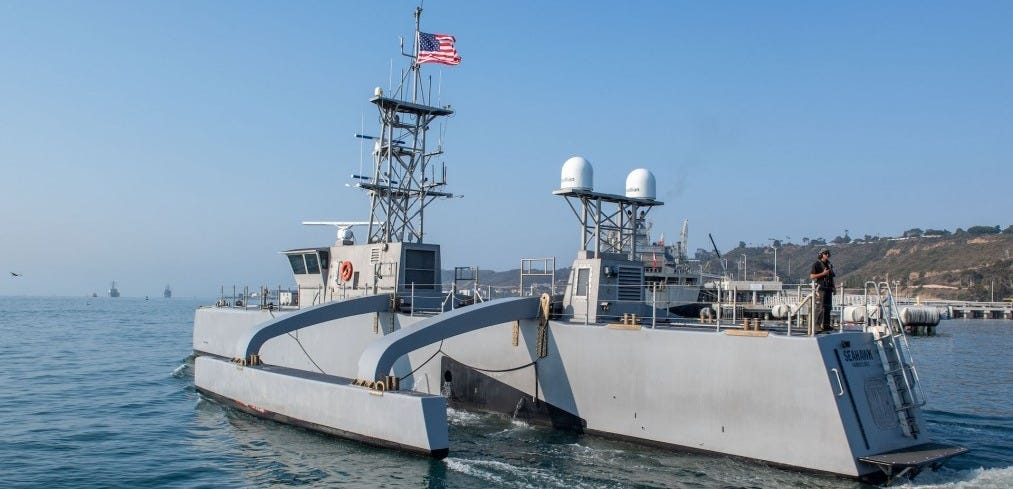
BLUF: The Navy’s DRPM / PAE RAS issued a solicitation via a CSO to onboard Phase II MUSVs. It steams ahead with plans to add new sea drone technologies to the military’s online marketplace and build up its uncrewed systems arsenal.
MUSV uses modular design principles to create adaptable and resilient solutions that can effectively counter evolving threats.
We invite interested parties with expertise in innovative solutions to complex problems, vessel construction, autonomy, perception systems, and general maritime experience to participate in this opportunity.
Vendors will be evaluated on platform maturity, open-architecture autonomy compatibility, endurance, payload integration capacity, and rapid-production scalability.
This open call will allow new entrants to compete and existing vendors to submit updated product blocks and modular payload configurations.
Approved platforms will be added to the maritime marketplace hosted on the drones.mil website, which was launched to streamline the acquisition process for unmanned systems.
The Navy unveiled its plans for an MUSV marketplace earlier this year as part of a broader shakeup of its approach for buying autonomous watercraft.
Uncrewed and autonomous systems enabled by AI are a key element of CNO ADM Daryl Caudle’s Hedge Strategy that he introduced earlier this year. He noted that medium USVs could be deployed for scouting, screening, and striking.
Related: Navy Launches Phase II for Medium Robo-Ship project, seeks ‘innovative solutions’
U.S. Destroyer Practices Underway Refueling with Seahawk USV

BLUF: U.S. destroyer USS Chafee refueled a Seahawk USV in the Pacific at RIMPAC as part of the Navy’s latest development effort to hone at-sea drone sustainment.
The astern refueling method was previously tested between Seahawk and oiler USNS Guadalupe (T-AO 200) in April.
Seahawk deployed alongside the Theodore Roosevelt Carrier Strike Group.
The 145-ton trimaran drone vessel is one of two built by Leidos for DARPA and ONR. The MDUSVs were transferred to the Navy in 2021.
Alongside its sistership Sea Hunter, the drone boats have since been used for testing across the Indo-Pacific.
Compared to the Navy’s traditional warships, the unmanned vessels cannot be refueled through traditional underway replenishment methods.
Navy Tests CCA Operations With MQ-20

BLUF: The Navy recently tested how it will operate CCA using a General Atomics ASI MQ-20 Avenger to evaluate mission planning and execution.
The Collaborative Autonomy Mission Planning (CAMP) test took place during the Gray Flag 2026 exercise at Point Mugu Sea Range, CA.
The Navy’s Strike Planning & Execution Systems (PMX-281) developed a mission plan and sent it to the Avenger for execution, though the announcement did not elaborate on the type of mission the aircraft conducted.
The Navy says the test will help it integrate autonomous aircraft into its future operations, regardless of the specific system being flown.
While this squadron learning and preparation is ongoing, the Navy will be contracting with industry to provide USN CCA Increment 1 prototype development and demonstration of an affordable, highly capable, risk tolerant, carrier-capable, weaponized, extended range, autonomous unmanned air vehicle that can be deployed from and recovered to aircraft carriers.
“CAMP is about making autonomy more usable by integrating into mission environments with both manned and unmanned platforms.” CAPT Todd Keith, PMX-281 Program Manager.
Blackbeard Hypersonic Missile Seen Flying On F/A-18 Super Hornet For The First Time
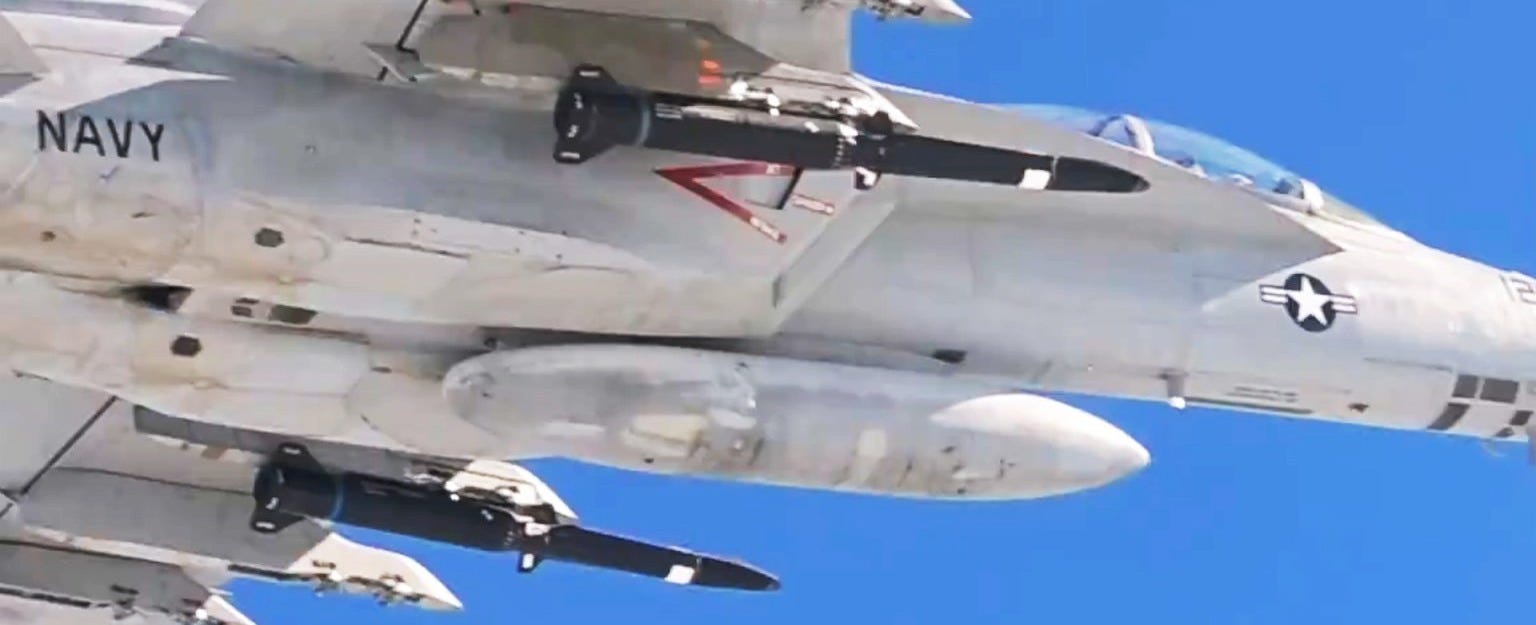
BLUF: The Navy is pushing to get Blackbeard, a lower-cost and fast-to-produce standoff weapon, into operational service by 2028 at the latest.
The first look at Blackbeard hypersonic strike missiles under the wings of F/A-18E/F Super Hornets during actual flight testing.
The Navy is hoping to have Blackbeard in at least limited service no later than 2028, giving its carrier air wings an all-new fast-flying standoff weapon, particularly for engaging enemy ships.
The missile is also being designed to be relatively cheap and quick to manufacture.
PAE Aviation released a video montage of Blackbeard undergoing flight testing.
Castelion has received several multi-million-dollar contracts from the Navy just this year explicitly to support integration of the weapon onto the Super Hornet, as well as otherwise accelerating its development.
The new flight testing footage also underscores the relatively small size of Blackbeard overall. While the Super Hornet is set to be the first operational launch platform, it is very likely to be integrated on other aircraft quickly thereafter.
A New Arms Race is Unfolding on the Ocean Floor

BLUF: Companies and governments are increasingly waking up to the fact that the future of warfare isn’t just in the skies, but also on the ocean floor.
Critical underwater infrastructure that underpins the global economy is becoming increasingly vulnerable, and governments are starting to assess how they can be protected.
Nations and corporations alike are devoting attention as well as piles of cash to new technologies designed for underwater use, as concerns grow about the vulnerability of critical infrastructure like connectivity cables and energy pipelines traversing the seabed.
Defense and tech companies are now seeking a role in the emerging market for operating beneath the ocean surface.
More than 1.5 million kilometers of submarine communications cables are in service globally as of early 2026.
Rather than guarding every mile of cable with warships, a future with fleets of autonomous vehicles could continuously patrol strategic areas of the seabed and converging when one detects something unusual.
Navies will increasingly combine crewed and autonomous systems, making interoperability between them increasingly important.
“It’s the changing threat environment that’s brought this to the fore.” Katja Bego, Senior Research Fellow at Chatham House
Navy’s Sub Tsar Unveils Four-Pillar Plan to Accelerate Submarine Deliveries
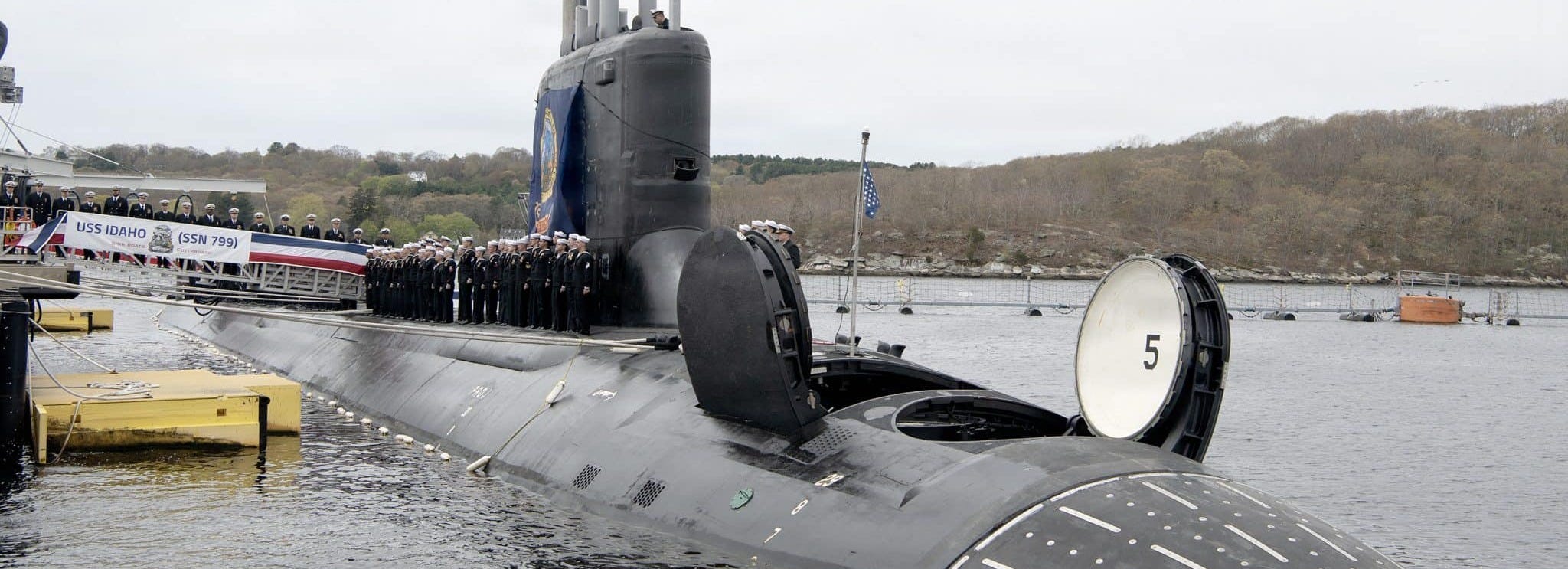
BLUF: VADM Rob Gaucher, Director Submarine Programs has set out a four-pillar strategy for accelerating the navy’s submarine-building output.
This process is designed to reflect and underpin the CNO’s testimony that a raised production rate will be in place by 2032.
The raised rate would deliver two Virginia-class nuclear-powered attack submarines (SSNs) and one Columbia-class nuclear-powered ballistic missile submarine (SSBN) off the production line each year.
The USN’s latest shipbuilding plan, released on 11 May, said “The navy’s requirement to increase the submarine production rate to at least one Columbia-class and two Virginia-class submarines per year remains the top industrial base priority.”
There are also some closer-in, more specific delivery targets that are part of meeting this requirement, including delivering the lead Columbia SSBN in 2028, and then establishing the rhythm of delivering one Columbia boat per year by 2030 and two Virginias per year by 2031.
12 Columbias are to be built, and 44 more Virginias are in build or planned within in total class of 70 boats. Thus, an integrated construction program is critical.
“You can’t look at Virginia and Columbia in a vacuum because you’re sharing workforce, it’s the same shipyard, you’re sharing footprint.” VADM Rob Gaucher, Director Submarine Programs
Navy W93 Mk7 Program Enters New Phase of Development

BLUF: Navy’s PAE Strategic Systems Programs’ (SSP) W93 Mk7 program has entered into the Engineering and Manufacturing Development (EMD) phase after achieving Milestone B.
The W93 warhead and the Mk7 reentry body assembly are the first U.S. nuclear warhead and reentry system program initiated in nearly four decades and will provide a modern warhead to the U.S. submarine launched ballistic missile fleet.
PAE SSP is actively modernizing the sea-based leg of the nuclear triad through the development of the D5LE2 strategic weapon system and pioneering regional strike capabilities of the future through development of SLCM-N and the non-nuclear hypersonic conventional prompt strike system.
“W93/Mk7 will provide flexibility and adaptability to meet future Warfighter needs and ensure an uninterrupted at sea deterrent for the sea-based leg of the nuclear triad. We were able to accelerate our entry into this next phase because of the dedicated partnership between PAE SSP, National Nuclear Security Administration, and our industry base. This is what working at hyper-speed looks like.” VADM Douglas Williams, PAE SSP
The Surface Navy in an AI World: Rethinking the FFX
BLUF: No one disagrees that the Navy has not had much luck constructing warships this century. Instead of hoping for different results from the same approach to force design by balancing competing requirements and ship construction, it is time to return to first principles to ask what unique qualities the Future Frigate (FFX) brings to the Navy in a future increasingly shaped by AI.
The Navy continues to face significant challenges when building the next small surface combatant, the FFX. It is becoming increasingly difficult to pack meaningful warfighting capability into a ship that is smaller and cheaper to build and operate than today’s Arleigh Burke-class destroyers.
What is needed is not a better ship based on traditional thinking, but new thinking about how a frigate can contribute to future combat effectiveness and national security.
It is time for the U.S. Navy to build its first ship designed intentionally to exploit the synthetic reality created by AI and operate with USVs and UUVs that can exceed frigates in terms of endurance and carrying capacities.
So, what would the FFX look like?
Remove piloted aircraft from the FFX and instead equip it with recoverable reconnaissance and one-way strike UAV capable to kill a similar platform.
Incorporate a spiral development philosophy; that is, it should be deliberately built to accommodate future technologies iteratively.
Build the ship to accommodate a separate battle staff and significant C3 capabilities not usually found on frigates.
Incorporate excess capacity, which means ample space, cooling, electricity, and whatever the best guess is about the additional resources that are likely to be required in the future.
Rethinking what a frigate contributes to the human-machine team allows us to see a small surface combatant in a new light.
We Absolutely Need to Change, Says New Navy Maintenance Head
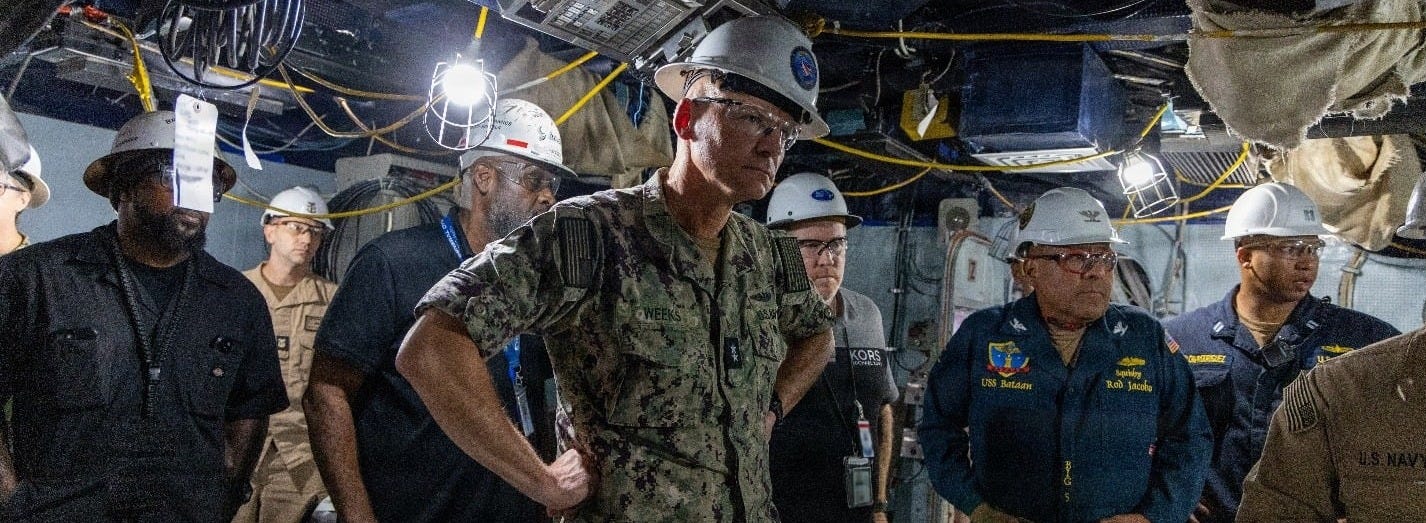
BLUF: A submariner turned head of the Navy’s vast maintenance operation promised his office would create a more nimble organization that would better balance risk to speed ships back to the fleet.
PAE IO is now in charge of the Navy’s major maintenance efforts including the 38,000 civilian maintainers across the four public shipyards and contracting with private repair yards for surface ship maintenance.
The Navy’s public yards are largely responsible for fixing nuclear submarines and carriers while the surface Navy’s amphibious warships, cruisers and destroyers are maintained and modernized in a network of private yards across the country.
Maintenance trends have not been positive. Over the last decade, the Navy has seen increasing delays in the maintenance of its destroyers and amphibious warships by 20-100% depending on the ship.
Private shipyards responsible for the Navy’s surface work have long complained the service is not delivering a steady supply of work, is slow to issue contracts and change orders and often fails to deliver government furnished equipment for availabilities on time.
NAVSEA historically oversaw the Navy’s maintenance effort, yet was reorganized as part of the PAE establishment. Part of the effort will be to be more comfortable with risk rather than the Navy’s traditional mindset of overanalysis.
The PAE IO trimmed four months off a public yard availability for a submarine through direct conversations over the risk of curtailing some of the repairs.
“We absolutely need to change, and we’re not getting it done. We just aren’t. We’ve got to be better than we are and we have got to focus on what is it going to take to deliver the ship, the submarine, the aircraft carrier out of maintenance.” RADM Todd Weeks, PAE Industrial Operations
Navy Wants More Offensive, Expeditionary Cyber Capabilities

BLUF: The Navy’s cyber advisor is looking for more tools from industry to conduct offensive cyber operations at the tactical edge, demonstrating a significant development and maturation of the application of cyber capabilities.
The Navy is focused on integrating multi-domain capabilities to support tactical and operational commanders in contested environments.
These efforts are designed to deliver timely, relevant effects in support of maritime operations, enhancing the agility and self-sufficiency of forward-deployed Sailors and Marines. They are are working in close coordination with CYBERCOM.
Some cyber capabilities are going to have to be employed at tactical edge by the different servicemembers in different combatant commands at different times.
Hacking on the tactical edge requires different equipment, as battlefield targets are less likely to be connected to the traditional internet.
Often that means hitting targets using the electromagnetic spectrum via radio waves, an authority battlefield commanders have much more leeway over than traditional cyber or hacking.
“What I would offer to industry, if you are interested in talking about expeditionary cyber, cyber at the tactical edge, particularly offensive or capabilities that support offense, please come talk to me. I would love to hear more from industry about expeditionary cyber capabilities.” Anne Marie Schumann, DoN Principal Cyber Advisor
Other Navy News:
Birdon starts construction of MUSVs
Navy’s massive shipyard overhaul lacks oversight
Navy appears to be sticking with electromagnetics on carriers
Investing in Connectivity Key to Continued Maritime Dominance
NIWC Atlantic Welcomes Greg Lancaster as the New Executive Director

Joint Navy-Marine Corps Osprey Test Advances Future Fleet Anti-Submarine Capability
BLUF: A joint test team successfully executed the first lot acceptance test of sonobuoys from an MV-22B Osprey tiltrotor aircraft off the coast of San Clemente Island, CA.
The Air Anti-Submarine Warfare Systems Program Office, the Osprey Joint Program Office and Marine Operational Test and Evaluation Squadron 1 conducted the milestone test.
The demonstration validated the Osprey as an alternative platform for the Navy's sonobuoy quality assurance program, boosting operational readiness and laying the groundwork for expanded tactical employment across the fleet.
By utilizing the Osprey for this type of mission, we are reinforcing our supply chain and ensuring front line aircrews have the mission-ready stores they need to detect and track undersea threats
Marines Rushing To Equip Amphibious Combat Vehicles With New Anti-Drone Jammers
BLUF: The Marine Corps is buying Anduril Pulsar-L electronic warfare jammers to meet an urgent operational need to better protect its 8×8 wheeled Amphibious Combat Vehicles (ACV) from drones.
This is part of broader efforts the Marines are pursuing to boost the ACV’s defenses against uncrewed aerial attackers, as well as incoming anti-tank guided missiles and other threats.
Drone threats are real now and have notably sidelined even the most advanced heavy armor in Ukraine.
MARCORSYSCOM announced it had awarded a sole-source deal to Anduril, valued at $15M, for an unspecified number of Pulsar-Ls.
Anduril first unveiled Pulsar-L, a lightweight addition to its larger Pulsar family of electronic warfare systems, in April 2025.

CCA Builders Start Revving Production Rates, as They Await 2027 Funding
BLUF: General Atomics Aeronautical Systems Inc. and Anduril Industries both say they’re ready to produce Collaborative Combat Aircraft in volume.
General Atomics announced it has the capacity to produce its FQ-42A Vengeance drones at a rate of six aircraft per month.
Anduril, which started production of its FQ-44A Fury at its new Arsenal-1 facility in Ohio in March, aims to build 150 aircraft annually.
The Air Force’s FY27 budget request includes $996.5M to acquire CCAs, plus another $150M in advance procurement funds for 2028.
General Atomics said in a statement that it is self-funding FQ-42 production today as it awaits Congressional fiscal 2027 appropriations.
Air Force Secretary Troy Meink said they aim to field at least 500 CCAs by 2032.
“The CCA program’s rate of progress has been incredible. Every week, the Air Force is pushing forward with new and more impressive accomplishments using Vengeance. It’s amazing to think of how far this program has come in such a short amount of time.” Mike Atwood, VP of advanced programs at GA-ASI
General Atomics FQ-42A Vengeance CCA Now Flying Together with USAF Fighters
BLUF: The Air Force is continuing to expand crewed-uncrewed teaming and other testing of GA’s FQ-42, as well as Anduril’s FQ-44 Fury with F-35s and F-15Es.
The Air Force’s F-22s also look set to be the first operational airborne controllers for USAF CCAs.
Both CCAs are set to make their first appearance at a large-force employment (LFE) exercise in December, offering a valuable new opportunity for deeper and more realistic integration with crewed fighters.
The service is also focused on figuring out how the drones will be deployed, launched, recovered, supported, and otherwise operated on a day-to-day basis.
GA-ASI announced a new demo of semi-autonomous air-to-air combat capability involving crewed F-5AT Advanced Tiger jets from a private contractor.
“The live exercise proved that a CCA and a manned fighter can collaborate to fuse sensor data from AMS-GRA-compliant sensors to track, engage, and eliminate an airborne target while using a Beyond Line of Sight (BLOS) data link to accomplish seamless coordination between the two aircraft.” GA-ASI statement.
Related Article: Collaborative Combat Aircraft arrive at Creech AFB, advancing operational integration
Our Take: This is a big deal that operational tactics are advancing apace with CCAs. While we remain skeptical of manned-unmanned teaming with this particular variant of CCA, having industry and dedicated operators thinking through this is
Anduril Wins Deal to Help Design Future Aircraft
BLUF: The Air Force has awarded Anduril Industries a contract worth up to $85M to develop computer-based design tools for future aircraft, part of a push to design and test new systems digitally before building physical hardware.
The Air Force has funded the first task order, worth $50K with additional funding expected to follow as later task orders are issued.
AFRL made the award under a program called VOLARE, short for Digital System-Level Mission-Driven Integrated Design Methods for Aerospace Systems.
The program covers two related goals:
building a software product that can model an aircraft’s overall vehicle systems
developing methods for designing thermal management systems (to keep an aircraft’s engines, electronics and sensors from overheating).
Air Force Certifies Anduril Barracuda Cruise Missile for Open System
BLUF: The Anduril-built Barracuda cruise missile received certification as the Air Force’s first large-scale production munition compliant with open systems architecture.
Anduril is slated to deliver its first Barracuda missiles in early 2027.
AFRL’s Munition Open Architecture Test and Evaluation Laboratory, or MOATEL, oversees the Weapon Open System Architecture certification process.
The lab’s engineers spent four days at Anduril’s California headquarters verifying compliance with open system architecture, known as WOSA.
The MOATEL verification tested 14 WOSA domains: Mission Autonomy, Seeker, Inertial Measurement Unit, GPS, Air-Data Sensor, Propulsion, Airframe Control, Target State Estimator, Altimeter Aiding Navigation, Clock, Autopilot, Guidance, Navigation, and Munitions Data Bus.
Anduril has integrated four different turbojet engines into the Barracuda 500, giving the company flexibility in providing engines as it seeks to churn out missiles in the coming years.
The MOATEL assessment’s certification also clears the way to use the Barracuda with current and future communication systems.
“Barracuda’s open software architecture means that it can be equipped with a variety of different datalinks and communications modalities, unlocking integrations with a vast spectrum of different aircraft and other communications nodes.” Anduril spokesperson
“This is showing that open architecture can scale beyond prototypes. Without that independent path from S&T to MOATEL, the industrial base cannot deliver new technology to the warfighter at the speed the fight requires.” Jonathan Shaver, PM and creator of WOSA at AFRL’s Air Warfare Directorate
Related Article: Anduril Industries says Barracuda is first mass-produced weapon to clear independent Air Force WOSA verification ahead of 2027 deliveries
Sentinel ICBM Achieves Vertical Stacking Ahead of 2027 Initial Flight Testing

BLUF: The Air Force Sentinel intercontinental ballistic missile program completed vertical stacking of the inert missile, confirming that all subsystems are on track for initial flight testing in 2027.
The campaign verified the viability of all missile stages, propulsion elements, shroud and subcomponents to be assembled into a single configuration test pad.
Sentinel is on track to field initial capability in the early 2030s as a ground-based deterrent for decades.
According to officials, the program is still on track for Milestone B, which allows the project to enter the engineering and manufacturing development phase.
The program office is parsing through a large amount of data, and have integrated AFCAA and CAPE but are still unsure of the cost.
“Sentinel is no longer conceptual or designs for what the nation’s next-generation ICBM looks like; it’s a physical, fully integrated system that is one major step closer to being ready for flight testing.” Gen. Dale White, DRPM Critical Major Weapon Systems
Air Force Injects $87M into IVEWS F-16 Electronic Warfare Upgrades
BLUF: The Air Force funds $87.4M for initial production of an F-16 EW capability, bolstering the fighter’s self-protection against increasingly advanced threats.
Bringing the total program value to $1.92B, this is expected to jump-start fielding and integration of the AN/ALQ-257 Integrated Viper Electronic Warfare Suite, or IVEWS into the fighter’s airframe.
The F-16 has seen a lot of action in Operation Epic Fury and has handled Iranian air defenses and electronic warfare capabilities.
However, peer adversaries such as the Chinese military have more sophisticated means to foil the jet fighter’s aims.
Full-rate production of the suites for the full 450-aircraft fleet is scheduled to follow this initial batch.
Air Force Bids Adieu to EC-130H Electronic Attack Plane
BLUF: The Air Force has formally retired the EC-130H Compass Call, capping over 40 years of operations for the electronic attack aircraft.
The EC-130H — a C-130 turboprop modified with electronic attack equipment — entered service in 1983 to disrupt enemy communications and jam radars.
The Air Force is replacing the EC-130H with the EA-37B, which will also be dubbed the Compass Call. The new electronic attack aircraft is based on a Gulfstream G550 business jet, and will similarly wield tech from BAE integrated by L3Harris.
The modern Compass Call will fly at twice the altitude and double the speed of its predecessor and operate more powerful systems against adversaries.
Our Take: This was a desperately needed upgrade and this aircraft has demonstrated its value many times over.
Newest AIM-9X Missiles Not Meeting Operational Availability Goal
BLUF: One of the Air Force and Navy’s most common air-to-air missiles is falling short of a key readiness metric, and the services are ramping up stocks of a vital air-to-ground missile.
The AIM-9X Sidewinder Block II is facing operational availability shortages.
Operational availability is defined as “the degree to which one can expect a piece of equipment or weapon system to work properly when it is required.”
The Air Force is at 58% operational availability for the latest version of the Sidewinder, and the Navy is at 78% —the requirement is 86%.
That shortage is forcing squadrons to face lower training asset availability, preventing fighter pilots from having the requisite number of training sorties.
Pilots use regular training sorties to practice locking onto targets, tracking high off-boresight angles, and simulating missile shots.
But reliability problems with integrating a new circuit processor into the latest configuration, the AIM-9X-4, have “impacted missile reliability and halted testing.”
The Air Force and Navy plan to buy more than 11,000 AIM-9X Block II missiles, which are infrared-guided, short-range, supersonic air-to-air weapons.
Air & Space Forces Association Videos

SPACECOM Boss Wants Better Domain Awareness to Target Threats on Orbit
BLUF: The head of U.S. Space Command said the U.S. still has “a long way to go” in improving its ability to detect and target threats in the domain.
Space domain awareness, which is the military’s term for being able to see and understand what’s happening in the environment, is foundational for military operations on orbit.
Whiting highlighted three examples of areas for improvement:
better integration of commercial and allied data
stronger linkages between sensors, command-and-and control systems, and effectors, including space weapons
expanded ground- and space-based surveillance capabilities
While data quality from both commercial industry and U.S. allies has improved significantly in recent years, integration issues and unstable funding have made it hard to take full advantage of those improvements.
“Do I have all the track quality that I need at all times? No. And that is why, in my current list of gaps that we every year go through a process to analyze, in my top five, we have a need for improved space domain awareness for space engagements.” SPACECOM Commander Gen. Stephen Whiting
Space Academy is Critical Step in the Future of Warfare
Matt Cookson
BLUF: If the U.S. is to win this next space race, it must create a service academy for the Space Force.
The U.S. needs to maintain its technological edge over people, but without quality leadership, these weapons will be of limited use.
A major factor behind the U.S. military’s dominance is the quality of its officers, as the other academies demonstrate.
To make this happen, it needs Congressional backing and funding.
If we don’t take the lead in space, it is only a matter of time before China and Russia will take the edge. That threatens U.S. security and empowers our enemies. We simply can’t afford to fall behind in space warfare.
Space Force to Put Commercial Satellite Servicing to the Test in 2027
BLUF: The Space Force is preparing two commercial satellite servicing missions for 2027 that will test ways of giving military spacecraft more freedom to maneuver after launch.
One mission, led by Astroscale U.S., will attempt to refuel a military satellite in GEO and then replenish the servicing spacecraft from an orbiting fuel depot.
The other, led by Starfish Space, will use a commercial space tug to dock with and move multiple national security satellites.
The missions will test more than whether spacecraft can rendezvous and dock. Space Systems Command wants to learn:
how the military can buy servicing from commercial operators
how much infrastructure would be needed to make those services routinely available
whether refueling or life extension could in some cases be more economical than replacing satellites.
After reaching orbit, Astroscale’s Provisioner spacecraft will rendezvous with a military satellite equipped to receive fuel and transfer hydrazine to the client spacecraft.
Starfish Space’s Otter will rendezvous and dock with another spacecraft, and use its own propulsion to move the combined vehicles.
It could take over station keeping for a satellite running short of fuel, reposition a spacecraft or move it into a disposal orbit.
The Space Systems Command is examining the potential use of refueling for RG-XX, a planned constellation of maneuverable satellites that will conduct surveillance and reconnaissance in geosynchronous orbit.
“If we have a refueling capability in space, if we have the ability to service those vehicles, it changes the dynamic, it allows us to operate in space like we never have before.” Col. Scott Carstetter, director of servicing, mobility and logistics at Space Systems Command
Space Force Challenge Seeks to Strengthen Orbital Resilience

BLUF: SpaceWERX, recently hosted a challenge workshop to bring in industry’s best and brightest to help extend the Defense Department’s Joint Logistics Enterprise into space.
The Joint Logistics Enterprise is a collaboration between the Joint Staff’s logistics directorate, the Defense Logistics Agency and U.S. Transportation Command formed in 2010 to create a globally integrated logistics network.
The end state is an integrated network of orbital warehousing, transport vehicles and refueling capabilities, connected by the mission planning, operational data and autonomy needed to manage a distributed enterprise in real time.
The challenge is led by SSC in partnership with SpaceWERX and focuses on six major areas necessary to building out a resilient in-space logistics network:
propellant management
orbital transfer vehicles
network mechanics
orbital warehousing
repair, reuse and refuel
logistics health monitoring
Together, these capabilities will enable the continuous operation of satellites and other space assets rather than being limited by finite onboard fuel or supplies.
Air, Space Forces Pick Up Research Pace for Orbital Cargo Delivery
BLUF: The Air and Space Forces over the past year have been picking up the pace of their multi-tiered research initiative aimed at rapidly delivering cargo into global hot zones by launching it through space.
The bi-service effort to leverage commercial capabilities for point-to-point delivery via space is somewhat confusing because it encompasses multiple funding sources — jointly and through service-specific spending.
It started with AFRL’s Vanguard program called Rocket Cargo, which began in June 2021 and focused on launching rockets filled with 30 tons of logistical supplies from the U.S. into space, and down on far-flung bases and battlefields.
The focus towards reentry capsules provides several promising advantages:
the logistics of rapidly unloading cargo at the delivery site,
the ability to deliver cargo to a more diverse range of austere sites and terrain,
the ability to deploy multiple reentry capsules in a single launch to deliver cargo to the point of need at several different locations, and
potential for broad vendor diversity, both in the reentry capsule systems and options to deliver reentry capsules from multiple launch providers.
There are three primary efforts focused on cargo delivery through orbit, each with its own technological focus and budgets.
The development of reentry capsules now is undertaken by AFRL called the Payload Delivery System (PDS) funded jointly by the Air and Space Forces.
Space Force’s Servicing, Mobility, and Logistics (SML) program managed by System Delta 80 is responsible for the Point-to-Point Delivery (P2D) program.
AFRL’s Rocket Experimentation for Global Agile Logistics (REGAL) focused on funding P2D-related tech and demonstrations.
AFRL awarded Blue Origin $1.3M and Anduril $1M under REGAL in September 2025.
In July, the lab added $11.7M to Blue Origin’s contract bringing the total up to $13M.
Related Article: Space Cargo Unlimited Locks Up a Third of SpaceX’s Starfall Return Capacity
Pentagon Taps Northrop Grumman, True Anomaly for Recon Satellites That Can Monitor Other Space Systems
BLUF: SSC and DIU awarded prototype contracts to Northrop Grumman and True Anomaly to build next-generation reconnaissance satellites that can keep an eye on other objects in orbit.
The awards will support the Geosynchronous High-Resolution Optical Space-Based Tactical Reconnaissance (GHOST-R) initiative, part of the Space Force’s RG-XX program.
Officials involved in the GHOST-R effort want to use commercially developed space vehicles, buses, and electro-optical payloads to deliver “high-resolution space-to-space imagery for characterizing resident space objects” in GEO.
Under the deal, True Anomaly will provide its Jackal platform, Mosaic command-and-control system, and “rendezvous and proximity operations” sensor suite.
Northrop Grumman plans to deliver the company’s ESPASat-L satellite — which the contractor says is the size of a “small suitcase” — and incorporate optical payloads provided by TRL11, a maker of video solutions for space.
“We are leveraging rapid prototyping to push the envelope of what commercial tech can deliver to the RG-XX program. This approach burns down technical risk, drives down lifecycle costs, and gets vital capability to the warfighter faster to ensure a more resilient architecture. Successful prototypes will have a direct path to transition into the program of record.” Col. Bryon McClain, acting PAE for Space Combat Power
Related Article: GHOST-R: The Pentagon Buys Satellites That Can Chase and DIU and SSC Announce Joint GHOST-R Mission
Katalyst Selected for Pentagon Program to Demonstrate Space-Based Power Beaming

BLUF: Katalyst was chosen by the Operational Energy Capability Improvement Fund (OECIF), which issues awards focused on maturing first-of-its-kind energy technologies for future warfighting platforms.
Quantum Space also recently received an OECIF award.
In the ASGARD mission, a Katalyst Nexus spacecraft will use robotic arms to assemble the tiles on orbit.
Once assembled, the tiles will harness solar energy, convert it to radio frequency microwave energy, and transmit that energy down to Earth.
The NRL is developing modular tiles that will form the large-format power beaming system.

Pentagon Sets Two-Stage Path for Golden Dome Missile Shield, Full Defense by 2035
BLUF: The first stage stitches together systems the military already operates to stand up an early shield. The second stage transitions to a more affordable architecture designed specifically for homeland defense.
Under the plan outlined by Guetlein, the initial capability arrives in 2028, drawing on existing systems rather than new development.
The subsequent architecture, intended to be more affordable and tailored to homeland defense, is targeted for 2035.
Guetlein framed the second phase as a deliberate move toward a system built for its specific mission rather than assembled from available components.
The Golden Dome Czar Must Get Control of All US Missile Defense Programs
BLUF: The U.S. is largely defenseless against Russian and Chinese aerial attacks. This is a major strategic problem in today’s era of massed drone and missile warfare—and no one is clearly in charge of solving it.
DoW took a first step toward assigning responsibility for a U.S. air and missile defense architecture by standing up the Golden Dome office.
But critical elements of a defensive shield remain outside its control: the air and missile defense systems that have proven in Ukraine and the Middle East.
The Aegis system, for example, is a U.S. Navy program—though its ballistic missile defense component is funded by the Missile Defense Agency (MDA). Patriot interceptors, in turn, belong to the Army.
Theater High Altitude Aerial Defense (THAAD) batteries and the Ground Based Midcourse Defense System (GMDS) are developed by the MDA but operated and maintained by the Army.
U.S. Northern Command is responsible for U.S. air surveillance but relies heavily on radars belonging to the Federal Aviation Administration (FAA).
Diffusion of responsibility is a recipe for failure.
Rickover in his efforts to build the nuclear Navy had control over all elements of the program including in civil authority organizations.
For Golden Dome, this will entail taking the requisite authorities from their normal stewards and re-delegating them to the Golden Dome director.

Washington’s Foreign Equity Bets Need Better Governance
BLUF: The Government has funded efforts overseas, but this was not subject to the corporate governance standards required of American companies: an independent board, an independent audit committee, and audited disclosure to shareholders.
The government currently invests in more than a dozen foreign projects, totaling billions in equity and debt investment.
There are strong national and economic security justifications for the recent push to use equity strategically to build secure American supply chains.
When public money flows to a foreign company not listed on a U.S. exchange, the American taxpayer receives fewer protections and fewer still when it flows to a privately held company, foreign or domestic.
Washington should compile a standard set of existing U.S. corporate governance terms and apply them as a baseline when negotiating equity investments in unlisted foreign companies.
It should condition its support on compliance with a short list of fundamental governance principles:
a majority independent board, meaning independent of management
an independent audit committee that selects and oversees the auditor
audited financial statements
a consent right if the company falls out of compliance.
This proposal provides a level playing field using existing authority to protect American taxpayer dollars and American companies without sacrificing national security objectives.
Our Take: This just makes sense especially with the potential for corruption in many oversea domiciles.
Saildrone Registers First USVs Under National Flag
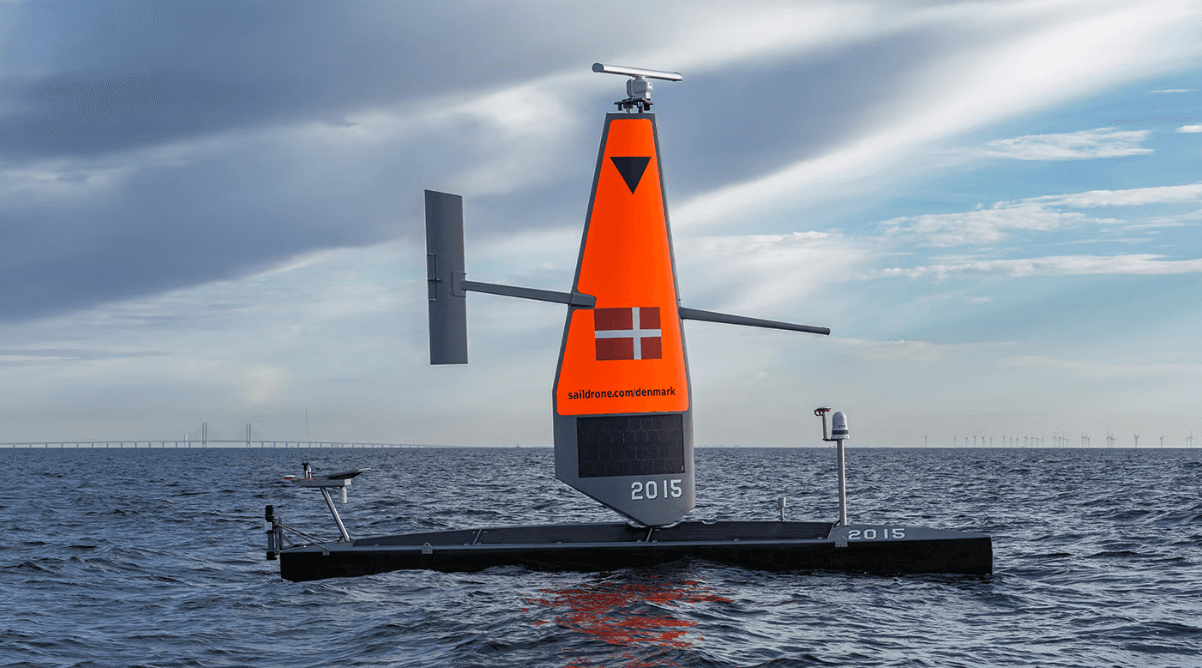
BLUF: Saildrone, a developer of autonomous unmanned surface vehicles (USVs) for maritime operations, has registered its first four Saildrone Voyager USVs in Denmark, allowing them to operate under the Danish flag.
Bayraktar Drone Launches Sonobuoys During Turkish Naval Exercise
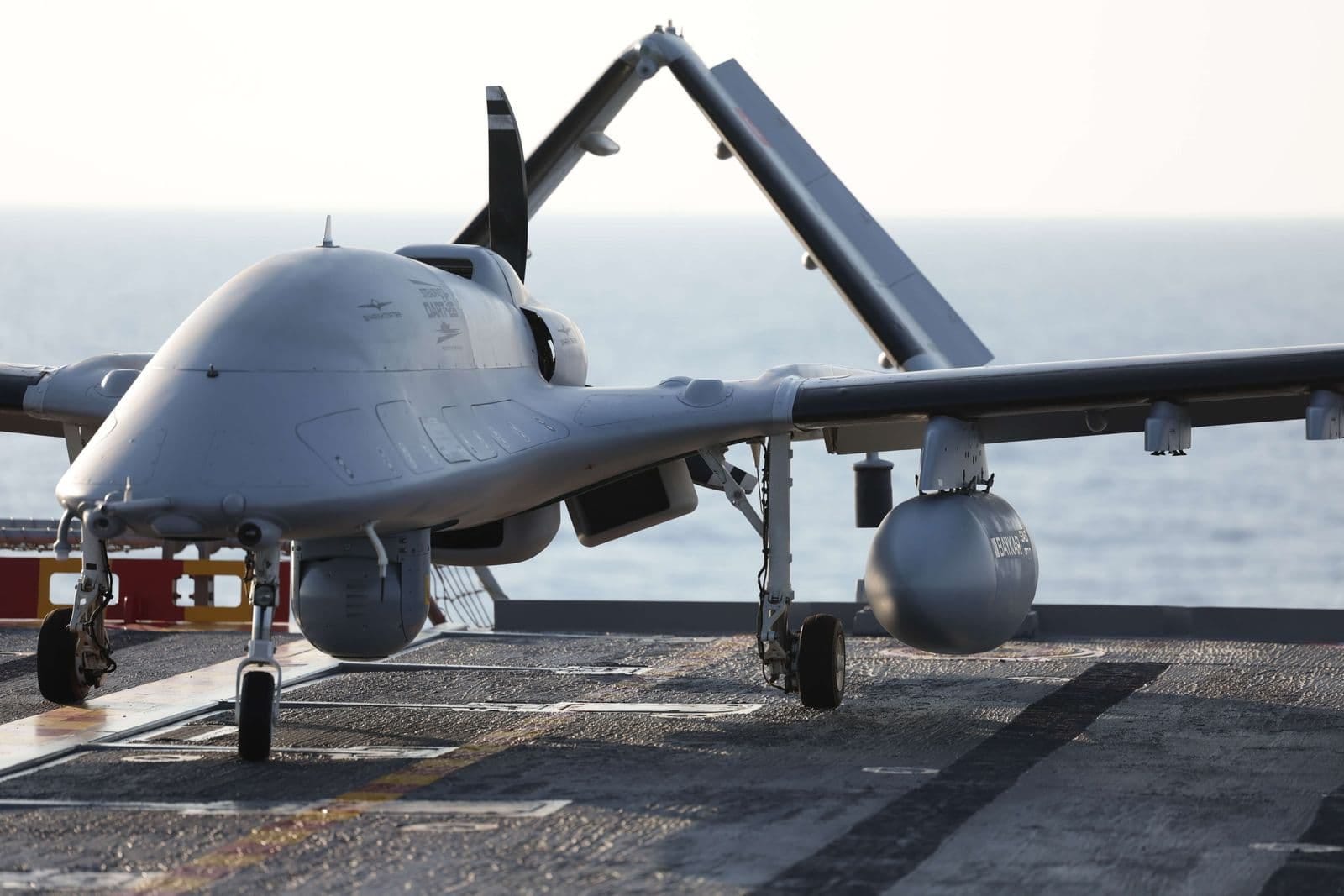
BLUF: Baykar Technologies’ Bayraktar TB3 unmanned combat aerial vehicle (UCAV) has demonstrated a new anti-submarine warfare capability by launching two sonobuoys during Turkey’s Seawolf-I/2026 exercise.
UK Launches First Space Squadron to ‘Degrade and Deny’ Enemies
BLUF: The UK Chief of the Air Staff announced that Britain will stand up a new space squadron focused on countering enemy threats and defending local “interests.”
For the UK, No. 3 SES is an addition to the:
No. 1 Space Ops Squadron that teams with the National Space Operations Centre to track hazardous objects
No. 2 Space Warning Squadron, established to provide missile warning and space tracking capabilities.
From 2030 to 2035, the UK plans on spending a minimum of £9 billion on “new capabilities” for the space domain.
Other International News:
Terma partners with Japanese firm to supply naval decoy systems
Embedded Across Europe: U.S. Exchange Officers Gather to Sharpen Allied Interoperability
Preparation Becomes Tomorrow’s Shield as Orient Shield 26 Closes

Golden Dome
SASC • Sep 29 • HON David Trachtenberg, Dr. Thomas Karako, David Mosher
See our NDAA and budget posts for the latest insights and analysis.

Why Acquisition Reform Needs More Than New Policy | Arnold Punaro
FedGovToday
Resilient Command and Control | Stephen Winchell, DARPA
Modular, Resilient Systems | M. Barry Tanner, Navy CIO
Biomanufacturing and National Security | Maille O’Donnell
NDIA ETI Horizons
GPS-Denied Autonomy, Synthetic GPS, VICTUS | Jessie Hamel
The Startup Defense
NDIA ETI Conference
GEN Christopher Mahoney, VCJCS
CDAO Summit | Cameron Stanley

Discussion with BGen Tim Helfrich, PAE F&AA
Aerospace Nation • Sep 28 • Webinar
Disruptor Day: Multi-Sensor Data Fusion for Maritime Domain Awareness Q&A
DoN Rapid Capability Office • Oct 1 • Webinar
Resilience Conference
Oct 5-6 • London
Land Forces
Oct 6-8 • Perth • Western Australia
DEFCON
Stanford • Oct 7 • Silicon Valley, CA
Apex Europe
Oct 7-8 • London
AUSA Army Annual Meeting and Expo
Oct 12-14 • Washington DC
Scaling Our Industrial Foundation
Wharton Aerospace Ventures • Oct 12-14 • Washington DC
Mission Engineering and Integration Activity TEM
USW(R&E) • Oct 15 • TBD
Counter UAS Indo-Pacific
SAE Media • Oct 19-20 • Honolulu, HI
Silicon Valley Space Week
Oct 27-29 • Mountain View, CA
TechNet Indo-pacific
AFCEA • Oct 27-29 • Honolulu, HI
Ironclad Maritime Summit
Oct 27 • Nortfolk, VA
Defense Conference
PSC • Oct 30 • Crystal City, VA or Virtual
See our Events Page for all the other events over the next year.