

Welcome to the latest edition of Defense Tech and Acquisition.
The biggest stories across the Department and the defense industry this week:
DRPM-UxS Delivers over 25,000 Systems to CENTCOM
Many new drones - Fast UAS, UUVs, UGVs, and underground
Army engages industry, merges orgs, and opens test ranges.
Hudson lays out future fleet design, MUSV update, and new talent program.
Air Force learns lessons from Epic Fury and advances AI integration into the force.
Space Force launching new classified capabilities and solving optical cross links.
Naval drone carriers becoming more real and Russia beefs up drones RF capes.

DRPM-UxS Deliver Over 25,000 Autonomous and Counter-Unmanned Systems to CENTCOM AOR

BLUF: Direct Reporting Portfolio Manager for Unmanned Systems (DPRM-UxS) delivered a massive surge of combat-ready, mass-producible unmanned systems and counter-drone capabilities to CENTCOM, providing operational commanders with immediate, cost-effective tactical lethality across the theater. Through an investment of approximately $782M this year, DRPM-UxS has fielded:
Over 1,300 One-Way Attack (OWA) UAVs, providing precision deep-strike mass.
Over 100 USVs and UUVs, expanding maritime reconnaissance and strike lethality
Over 24,000 Counter-UAS, establishing a dense, multi-layered defensive shield to protect forward-deployed forces against adversary drone attacks through its counter unit, Joint Interagency Task Force 401 (JIATF-401).
"We are moving at the speed of modern combat to equip our forces with decisive, affordable mass. DRPM-UxS was established to cut through red tape and put lethal technology directly into the hands of our frontline troops. The thousands of systems operating across CENTCOM this year are just the beginning. We will out-innovate, out-build, and out-adapt any adversary on the battlefield. The goal is to scale these capabilities across the Joint Force." Owen West, Project Agincourt CEO, DRPM-UxS
Our Take: Delivery of warfighting capabilities is the #1 objective for the defense acquisition enterprise. The DPRM UxS team delivering thousands to CENTCOM is a major win. Hopefully there are thousands (or hundreds of thousands) more in the pipeline to rapidly deliver to PACOM and other CCMDs. This requires rapid scaling of budgets (we’re looking at you Congress) and personnel (acquisition and operations).

Georgia Tech AE Has World Speed Record for Small Jet Powered Drones
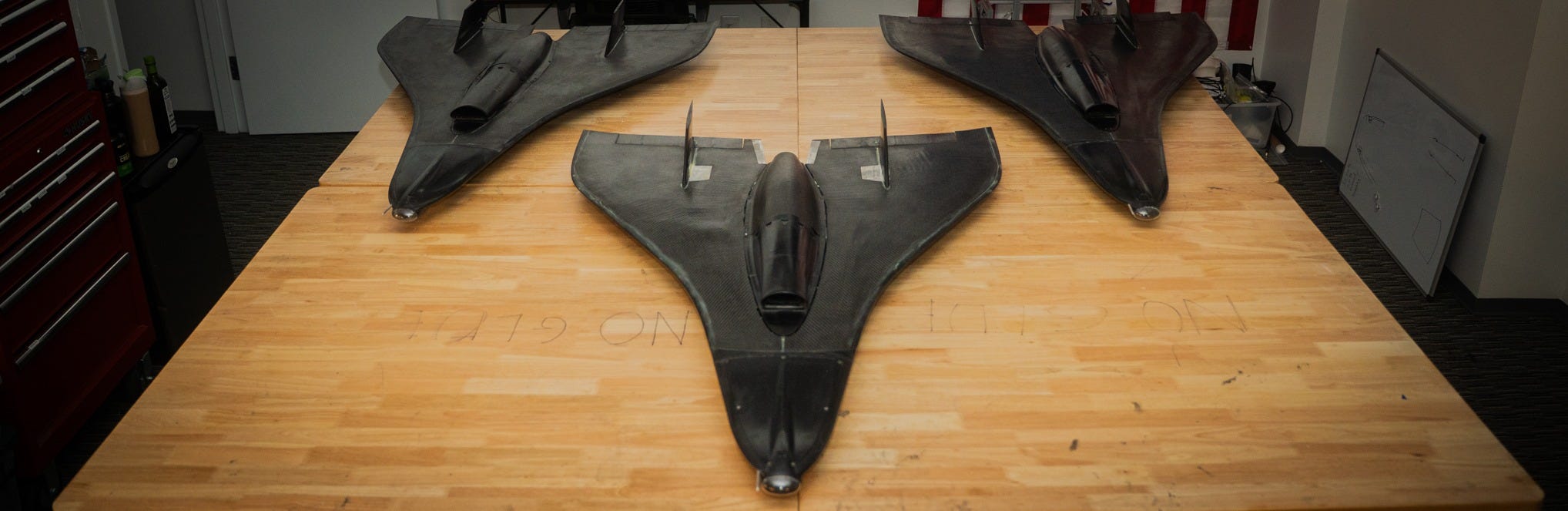
BLUF: Tomas Salvo, who previously was at Skydio, Mach Industries, and Relativity Space developed three Reapers in his dorm that hit 491 mph carrying a 2.6lb payload.
Each of them can hold that speed for 4 minutes on a full tank.
Reaper can be rail- or truck-launched, climb to 2,000 m (6,600 ft) in under 20 seconds, then fly for 50 km (31 mi) at full speed.
This is now a reliable and repeatable system. Future testing and small optimizations should push the top speed past 800 km/h (500 mph).
He shares his development progress on X and has a Go Fund Me.
Prototype X-BAT VTOL Fighter Drone Unveiled
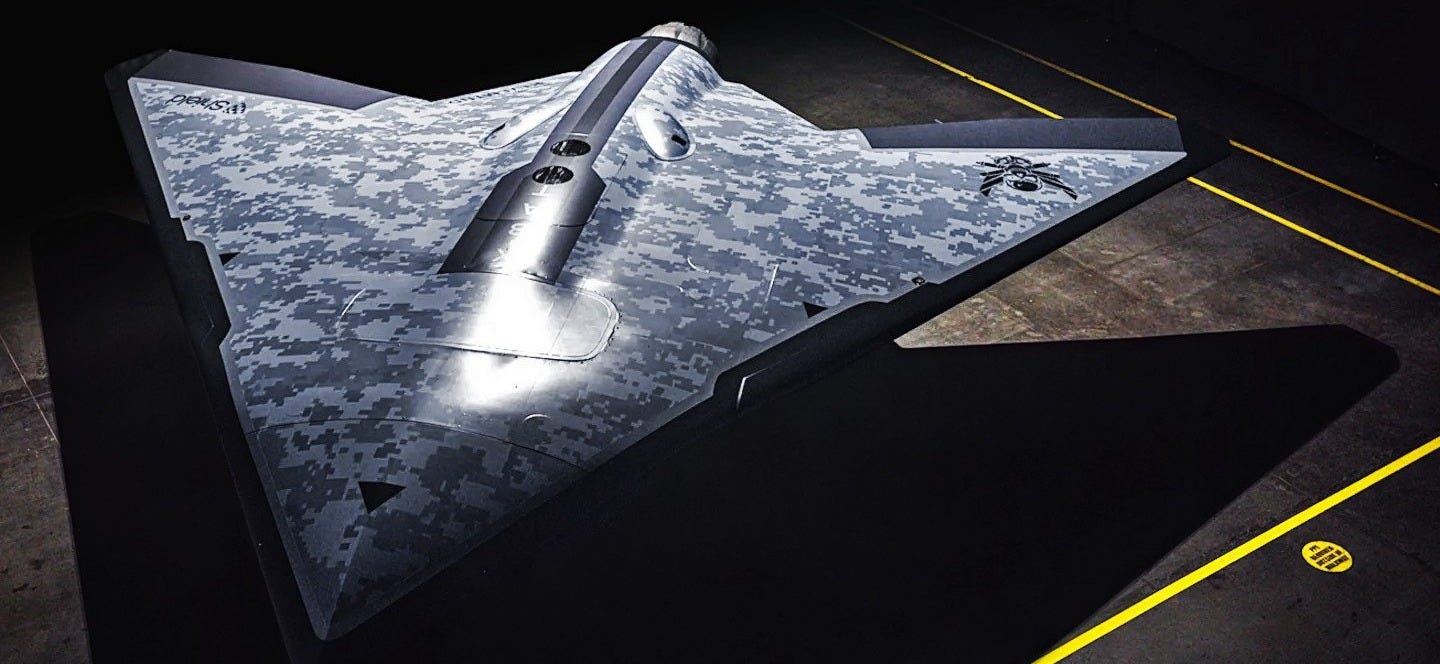
BLUF: Shield AI has shared the first look at a full-scale prototype of its X-BAT jet-powered stealth fighter drone, which is designed to both take off and land vertically from a tail-sitting position. This is the company’s latest step toward proving out what remains an extremely ambitious aircraft concept. The tailless X-BAT has already received a significant vote of confidence from the Navy, which is hoping to see the drone develop into a real operational capability on a very aggressive timeline.
The drone is in the process of being moved from the company’s main hub in Frisco, Texas, to its flight test facility in Newton, KS. These sites are also known as X-Forge 1 and X-Forge 2, respectively.
Design changes include the prototype’s thrust-vectoring exhaust nozzle extends significantly to the rear of the drone beyond the trailing edges of the wings. Previously shown models and renders had the nozzle in a position more inset in the rear fuselage.
Shield AI had previously said that the prototype nozzle arrangement would lack low-observable (LO) attributes, but also that this would change after initial testing.
It appears to be remarkably good LO optimization, especially true for a prototype.
X-BAT is designed to operate as a multi-mission tactical platform capable of carrying munitions internally and on hardpoints under the wings. The drones will also be able to carry various sensors, EW packages, and other mission systems.
Drone That Can Travel Faster Than Speed of Sound to Get Major Power Boost With Turbojet Engines

BLUF: Safran Power Units will supply its turbojet engines for the Falcon Supersonic UAV developed by UVAD Technologies.
As a multi-role platform, Falcon can serve as an introductory counter-hypersonic system and can be adapted for high-speed ISR, function as an interceptor, or operate alongside fighter jets as an attritable high-speed UAV.
Falcon will be powered by two turbojet engines provided by Safran Power Units, delivering robustness, reliability, and extended lifespan.
Safran Power Units’ engines will enable the Falcon to reach supersonic speeds at low and medium altitudes, while ensuring rapid deployment and recovery.
This level of performance allows for more frequent and cost-effective training sessions for air, naval, and missile defense operators.
Falcon’s supersonic speed, aerodynamic design, and high maneuverability enable it to execute complex flight patterns and evasive maneuvers, making it a powerful asset for both training scenarios and real-world operational deployments.
CDAO Tradewinds Announcement
BLUF: In FY27, the CDAO intends to collaborate with the OUSW(R&E) Office for Small Business Innovation and publish a Direct-to-Phase II Open Topic for SI.
CDAO expects to leverage awardable solutions on Tradewinds Solution Marketplace as the candidate pool for eligible SI-Solutions.
Small businesses (with solutions not already part of Tradewinds Marketplace) that may qualify under the SBIR program are welcome to submit video solution pitches to Tradewinds in anticipation for the potential future solicitation release.
SBIR eligibility will be determined as part of the standard DoW solicitation and evaluation process.
SOCOM Taps Aeon for Limited Run of Shoulder-Fired Zeus $13.8M Deal
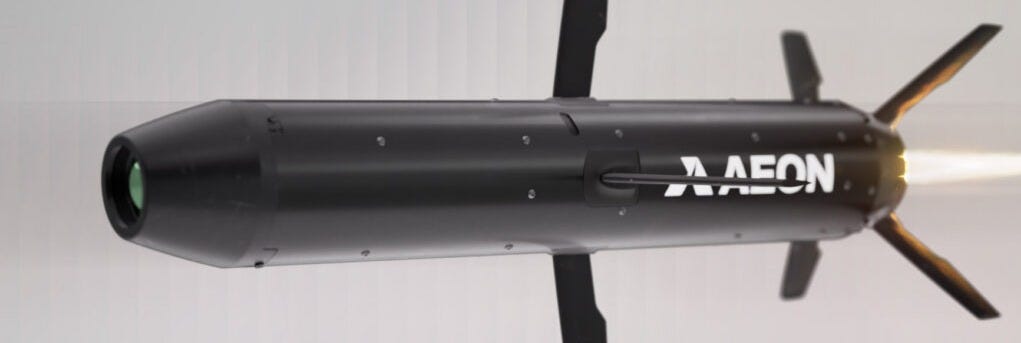
BLUF: SOCOM tapped Aeon Industrial to produce a limited run of a new, developmental shoulder-fired version of its Zeus missile and launcher.
Under a recent $13.8M low-rate initial production deal, the company will deliver <100 of the weapons to SOCOM over the next year.
The system, which is around 20 pounds with a 30-inch-long weapon, is designed to be fired primarily in confined and urban environments.
This is the first time that the US has purchased the shoulder-fired version Zeus that includes the missile and the tube it is launched out of.
The US military has been using unguided systems like the M72 LAW for decades, while also turning to more expensive, guided systems like the Javelin.
Aeon is now pushing Zeus as a possible lower-cost alternative to legacy guided systems.
Can Inertial Navigation Make Ground-Robot Swarms Real?

BLUF: Two startups, working together for just under a week, may have found a way around the biggest obstacle to deploying swarms of ground robots: the need for GPS-free navigation in a small package.
Swarmbotics AI, which makes 100-pound autonomous robots, is teaming up with TERN, whose navigation software doesn’t need GPS.
The Army has been seeking alternatives to the spoofable, jammable satellite-based system for years.
The Army is fielding jam-resistant GPS cards for munitions and is also working on ALTNAV, which uses a different satellite constellation.
But its plans for a robot-forward ground force require a PNT system that can get by without a satellite signal at all. The self-driving car industry, with its reliance on GPS and unstealthy LiDAR, hasn’t been much help.
TERN’s Independently Derived Positioning System (IDPS), combines input from the vehicle’s own sensors, including “wheel speed, steering angle, and 3D motion data,” with onboard map data.
Both companies have participated in the Army’s Operation Jailbreak tech demos.
Game of Drones Goes Underground

BLUF: The latest Game of Drones, held Sept. 14-18, autonomous platforms were tested in a new environment: underground.
The demonstration sent drones with fiberoptic wire through service tunnels at a site on Edwards AFB, CA. The service tunnels were dark, dusty and narrow with hard-right angles.
The tunnel tests were meant to showcase the capability of wired drones to navigate a dark underground tunnel in a radio frequency-denied environment.
Overcoming these operational challenges showcased the adaptability and functionality of these types of low-cost drones in a real-world scenario.
Innovative and adaptive warfare depends on reliable tests, and Game of Drones is used to determine how testing should work in the new paradigm of drone warfare.
“This novel environment offered significant challenges from an operational standpoint including limited visibility, tight corridors and signal loss. Attendees were interested in observing the live demonstration and successful tests showcasing the tools and systems utilized to adapt to these environmental challenges.” Lance Alix, DCMA’s Special Programs Unmanned Systems Engineer
Navy’s Underwater Drone Can Recharge its Batteries While Attached to Host Ships

BLUF: Lockheed Martin unveiled its Lamprey Multi-Mission Autonomous Undersea Vehicle (LampreyMMAUV), an advanced underwater platform developed to expand the Navy’s capabilities in increasingly contested maritime environments. The system combines autonomous underwater operations with a flexible payload design, allowing it to support a variety of missions alongside existing naval vessels.
Lamprey can contribute to covert intelligence gathering, underwater surveillance, electronic warfare and sea-denial operations.
Its distinctive design allows it to attach to a host surface ship or submarine and travel with the vessel to a designated operational area.
Once there, it can separate from its host and undertake assigned missions independently.
Another important feature is its onboard battery-charging capability. Built-in hydrogenators generate power to recharge the vehicle's batteries while it remains attached to a host platform.
This enables Lamprey to reach its destination with its batteries charged and ready for operational deployment.
Next US Stealth Drone Could Stay Airborne for Over Two Days Without Refueling

BLUF: General Atomics is in the process of designing a new flying-wing drone called NextGen. Intended for reconnaissance and strike missions, the new drone will also help inform the development of the company’s existing Gambit family of combat drones.
Rather than relying solely on a conventional jet engine or turboprop, General Atomics is pursuing hybrid-electric propulsion.
This could mean the drone will have a combustion engine generating electricity to power electric fans.
Alternatively, this could mean it will come with a combustion engine providing propulsion directly, with electrical assistance.
At the core of this decision will be efficiency. A hybrid setup could allow the combustion engine to operate closer to its optimum efficiency, potentially reducing fuel consumption significantly.
It could offer improved stealth and quieter operations.
Super Intelligence and the Distancing Effect

BLUF: As prediction shortens the path from sensing to action, it creates distance.
Modern military technology is designed to maximize standoff. Precision fires, remote sensors, autonomous systems, and one-way attack drones all increase the distance between the operator and the point of impact.
This separation is tactically useful and often necessary, but it changes the human relationship with violence.
The spread of low-cost autonomous drones, algorithmic targeting, and remote strike systems is shifting agency from humans to machine agents.
The operator still participates, but increasingly through processes that distance the soldier from the target environment. The result is not only physical standoff, but cognitive and emotional standoff as well.
As warfighters rely more heavily on automated tools, commanders and staffs may engage one another through machine-produced recommendations and counter-recommendations rather than through direct professional debate, creating a surreal, “My SI says your SI is wrong” exchange.
Engaged staffs help the commander explore options. Staffs argue and defend their positions and help commanders see risk.
As SI tools move from informing decisions to framing them, research warns that automation bias can lead operators and commanders to accept machine recommendations with insufficient critical review, especially under time pressure.
Modern machine-learning systems can predict outcomes and recommend actions at speeds no human staff can match. They produce outputs without showing the logic behind them. The user receives an answer, often with a confidence score, but without a transparent chain of reasoning.
Automation reduces cognitive overload, and machine-speed processing can help headquarters act inside an adversary’s timeline.
Commanders must learn to calibrate trust in automated systems, avoiding both automation bias and reflexive distrust.
Leaders must learn to direct the systems under their authority and not merely employ their outputs.
How to Unite Fragmented Science, Technology Enterprise
BLUF: DoW S&T is fragmented and not working as one team with unity of purpose.
The U.S. spends >$20B each year on DoW S&T research across government laboratories, private industry and academic institutions.
There are dozens of research labs, FFRDCs, CRADAs with colleges and universities, grants, SBIR investments, student scholarships and more.
Faced with the challenge to rapidly expand innovation, reduce costs and accelerate delivery to warfighters, the ability of this vast domain to respond is limited by and demands development of a strong cross-cutting sense of community and integration.
At a fundamental level, S&T lacks an overarching sense of identity. Are its personnel in the acquisition community or the research community?
The S&T community is broken into specialty areas and subcommunities, impacting cross-functional activities. What can be done to bring the fragmented community together?
Quarterly meetings of S&T leadership from the Services, Agencies, and OSW.
The focus should be on one challenge faced by each combatant command and/or Service.
Consider establishing assistant secretaries for research in the services to parallel OSW(R&E).
Increase DTIC’s funding to enable the technical innovation seen in industry.
Advanced Radar Contract Bolsters USCENTCOM Counter-UAS Defense
BLUF: JIATF-401 awards CHAOS Industries a $6.9M contract for Vanquish Prime advanced radar systems to strengthen CENTCOM C-UAS protection.
The acquisition supports JIATF-401’s efforts to rapidly deliver operationally relevant C-UAS capabilities to the warfighter, strengthening detection and tracking as part of a layered defense against evolving unmanned aircraft threats.
The radar systems will provide long-range detection and tracking capabilities to improve situational awareness and help U.S. forces respond more effectively to aerial threats.
By aligning targeted acquisitions with operational requirements, JIATF-401 is working to equip warfighters with integrated C-UAS capabilities that address threats across the detection and defeat process.
Advanced radar systems provide a critical layer within this approach, helping forces identify and track potential threats and supporting a coordinated defense alongside other C-UAS technologies.
The award also includes training and technology to support the integration and operational use of the systems, strengthening C-UAS capabilities in support of mission requirements.
“This acquisition is a testament to our commitment to providing the warfighter with the most advanced capabilities available. The threat from unmanned systems is real and constantly evolving. By equipping our forces in CENTCOM with state-of-the-art technology, we are ensuring they have the decisive edge needed to protect our personnel and secure our strategic interests. This is about delivering the right tools at the speed of relevance.” LTC Matthew Strohman, JIATF-401’s Capability Manager for Mobile C-UAS.
Caladh Emerges from Stealth

Kristen Railey Kita, Founder and CEO announced Caladh’s launch. Caladh systems detect, track, and defeat hostile drones above and below the waterline so they can’t get near critical infrastructure.
Caladh defends ports, ships and subsea infrastructure from drone attacks above and below the waterline by bringing the principles of EW underwater.
Transition to Post-Quantum Cryptography Standards
Dustin Moody, Ray Perlner, Andrew Regenscheid, Angela Robinson, and David Cooper
BLUF: Federal systems will move off quantum-vulnerable public-key algorithms: deprecation after 2030, disallowance after 2035, and earlier deadlines for high value assets.
NIST’s approach to transitioning from quantum-vulnerable digital signature and key-establishment algorithms to post-quantum ones, and supports Executive Order 14412 and OMB Memorandum M-26-15, which direct federal agencies to prioritize migrating their most sensitive systems.
Quantum-vulnerable digital signatures (ECDSA, EdDSA, RSA) and key establishment (FF/EC DH and MQV, RSA) are deprecated after 2030 and disallowed after 2035. High value assets and high impact systems must adopt PQC key establishment by December 31, 2030 and PQC digital signatures by December 31, 2031.
Recommendations:
Begin cryptographic inventories, migration planning, and early deployment of PQC-enabled products now.
Build long-term cryptographic agility.
Use ML-KEM-768 as the default key-encapsulation parameter set.
Hardware vendors should start PQC integration immediately because of long hardware lead times.
Identify systems that cannot support PQC and prioritize them for replacement or decommissioning.
NSC Announces >$50M in ISAC Awards Funded by FutureG Office
BLUF: The National Spectrum Consortium (NSC), in partnership with the FutureG Office in OUSW(R&E), announced eleven awards totaling >$50M under the Real-world Application Prototyping for ISAC Demonstrations (RAPID) program.
The investment underscores FutureG’s commitment to developing integrated sensing and communications (ISAC) technologies, which will play a critical role in the emerging 6G wireless standard and provide valuable new capabilities across the military and commercial network landscape.
Beyond funding these projects as individual efforts, FutureG and the NSC seek to integrate ISAC development work across the RAPID portfolio, while also boosting an emerging ecosystem of innovators in software-driven and AI-powered networks.
Pentagon Studies Role of AI in New Modeling, Simulation Strategy
BLUF: DoW is putting the finishing touches on its first new modeling and simulation strategy in over 30 years. However, the document’s release has been pushed back so the Pentagon can attune it to recent advancements in AI.
DoW’s overarching modeling and simulation architecture is being streamlined into three core concentrations — training, engineering and analysis — in order to push decision-making authority back to the operational nodes.
The new strategy has five goals
Create a technical framework for joint, community-wide modeling and simulation
Foster modeling and simulation community trust through the use of reliable, authoritative data sources
Enhance acquisition and program management skills using modeling and simulation professional development systems
Advocate for integrating enterprise-level modeling and simulation services in DoW and the broader modeling and simulation community
Adapt modeling and simulation policies, processes and infrastructure for agile technology assessment and procurement.
The aim is for the practitioner community to have access to validated, authoritative data at different security levels to ensure the credibility of modeling and simulation results.
“The Pentagon is taking a more democratized approach to modeling and simulation, shifting it from a singular point of view into how we actually think about modeling and simulation as the tool in the toolbox for practitioners across the department.” Daniel Hettema, director of digital engineering, modeling and simulation, USW(R&E)
Rethinking Wargame Design and Analysis in the Modern Age
BLUF: The growing availability of SI and modeling and simulation (M&S) tools presents an attractive opportunity to improve the rigor, speed, and analytical value of military wargaming.
Yet integrating these capabilities into large-scale wargames is not simply a matter of adding better technology to existing adjudication and analysis processes.
Increasingly sophisticated M&S tools can create friction with traditional move-step game mechanics, generating demands for near-continuous or running-time adjudication.
Both Virtual Warfare and SI capabilities required significant increases in computing infrastructure, technical integration expertise, subject-matter expertise, additional personnel, and physical space. Lessons learned include:
Integrating M&S tools forces reconsideration of how time is managed within the game.
M&S tools require tactical-level of war detail, which may be inconsistent with game objectives.
SI tools are getting better, but are not yet sufficient to handle the complexity of wargame data.
Technological advancements in wargames create resource burdens.
Our Take: It shows that the common sense balance is using SI analysis for its strengths (campaign assessment) combined with other more deterministic tools and human expertise for understanding individual contributions to a mission.
Other Defense Tech News:


The Missing Critical Minerals Investment
Tom Moerenhout and Kevin Brunelli
BLUF: The U.S. and its allies are finally taking supply chains for critical minerals seriously. China has spent the last three decades building a dominant share of global mineral production, and driving the global community to rely on it for access to essential components of semiconductors, defense technologies, and automobiles.
Alongside private firms, these governments have begun investing in both upstream industries including mines, refineries, and recycling infrastructure and downstream industries such as magnets and batteries.
The bulk of their efforts so far have focused on mines already in operation or close to it and on refining.
But this is a temporary fix. Refining facilities are valuable only if they have a steady, long-term supply of raw materials.
That requires new mines, especially as industries demand ever more minerals.
Because building a mine takes roughly 20 years, ensuring a long-term supply of minerals requires investing in new mines now.
In Africa, the U.S. invested about $300M in critical mineral projects on the continent in 2023, China invested about $8B to $10B.
In the DRC, Chinese banks and companies extended over $12 billion in credit and loans for mine development and operations (and now control 70% of cobalt and copper mines). The U.S. and G-7 countries had the opportunity to take part in these investments but judged the projects to be too risky.
Today’s chokepoints for critical minerals sit mostly at the processing or refining stage, but future threats to the minerals needed for manufacturing, energy, artificial intelligence, and defense technology will be at the mines.
G-7 countries have the markets and the policy tools to build a pipeline of secure mining projects and prevent the next economic emergency.
Our Take: This fact has been known for 2 decades but the willpower has not been there to focus on the messy mining side until recent years. The Trump administration deserves great credit for driving deals to secure more critical minerals needed for defense but there is much more work to be done for the broader economy. There is a bill pending in Congress that would ease restrictions on starting new projects in the U.S. It needs to be passed.
Leidos Gears Up for Major US Cruise Missile Production Surge
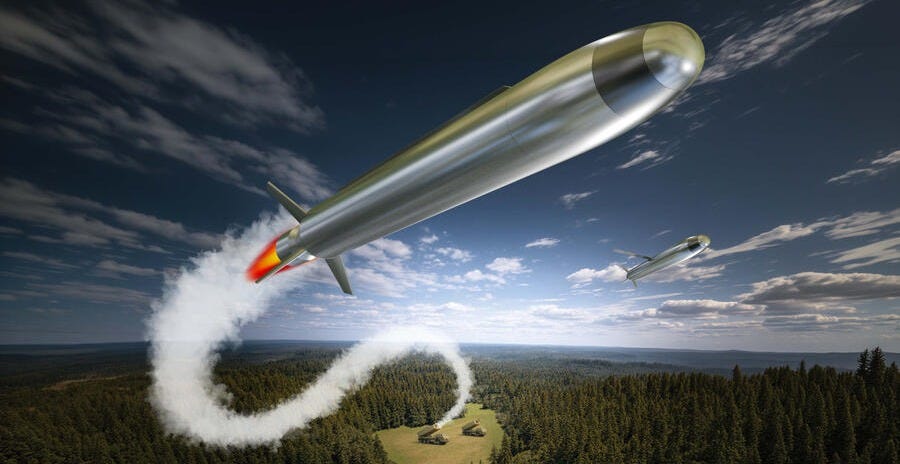
BLUF: Leidos is preparing to scale production of thousands of cruise missiles by coordinating suppliers across 14 US states.
The effort supports a May 13 framework agreement with DoW for an initial 3,000 Low-Cost Containerized Missile (LCCM) weapons.
Leidos is also preparing to increase production of the AGM-190A Havoc Spear, with initial deliveries to Air Force Special Operations Command already underway.
Production work will be concentrated in AL and TN.
The first LCCM missiles are expected to be delivered in 2027 for testing and evaluation, with full-rate production planned for 2028 and 2029.
Shield to Acquire Echodyne in a Transaction Valued at $5.3B and raise $2.5B at a $28.8B Valuation

BLUF: Shield announced it has entered into a definitive agreement to acquire Echodyne Corp., an industry-leading radar company, in a transaction valued at $5.3B.
Echodyne radars are built into hundreds of counter-drone and security systems used by defense, government and commercial customers in 40+ countries.
The acquisition builds out Shield’s Mission Systems business with software-defined radars.
Echodyne designs and manufactures compact, solid-state radars using its patented Metamaterials Electronically Scanned Array (MESA) technology.
Machina Selected to Build LUCAS Drones
BLUF: Machina, a leader in advanced manufacturing and robotics has been selected as part of DoW’s Organic Industrial Base Modernization Challenge to develop and qualify a RoboCrafted airframe for LUCAS and to deploy two pilot expeditionary robotic factories, known as Edge Factories, to support production.
The program will begin at Machina’s Los Angeles facilities with development and qualification of the metal-based airframe.
Machina will then deploy two Edge Factories—localized, rapidly deployable production sites—to manufacture airframes closer to the point of need.
Is Private Equity Cooked?
BLUF: Tech buyouts have historically been the “safe” bet within private markets analogous to a good house on an ideal street. Venture, in contrast, was always the undeveloped lot on the other side of town…until recently.
Tech buyout is a late-cycle asset class. It’s most effective once a technology wave has settled and when business models are predictable enough to borrow against.
When a new technology wave drops, all bets are off. By contrast, that’s when venture shines.
We’re likely still at the start of the next technological wave. LPs who commit across vintage investments catch the lags but can also catch the absurd highs.
Some indicators can be seen it in how funds value what they own: in the first half of 2026, venture funds marked their tech companies up 16%, while buyout funds only marked their tech holdings down 4%.
The conditions that made the 2010s are gone: a supply of fixer-uppers, a decade of falling rates, and funds buying from each other at higher prices.
a16z believes we’re at the beginning of a massive technological wave and the white space to build and innovate is boundless.



The Next Huntsville Is 70 Miles from the Pentagon
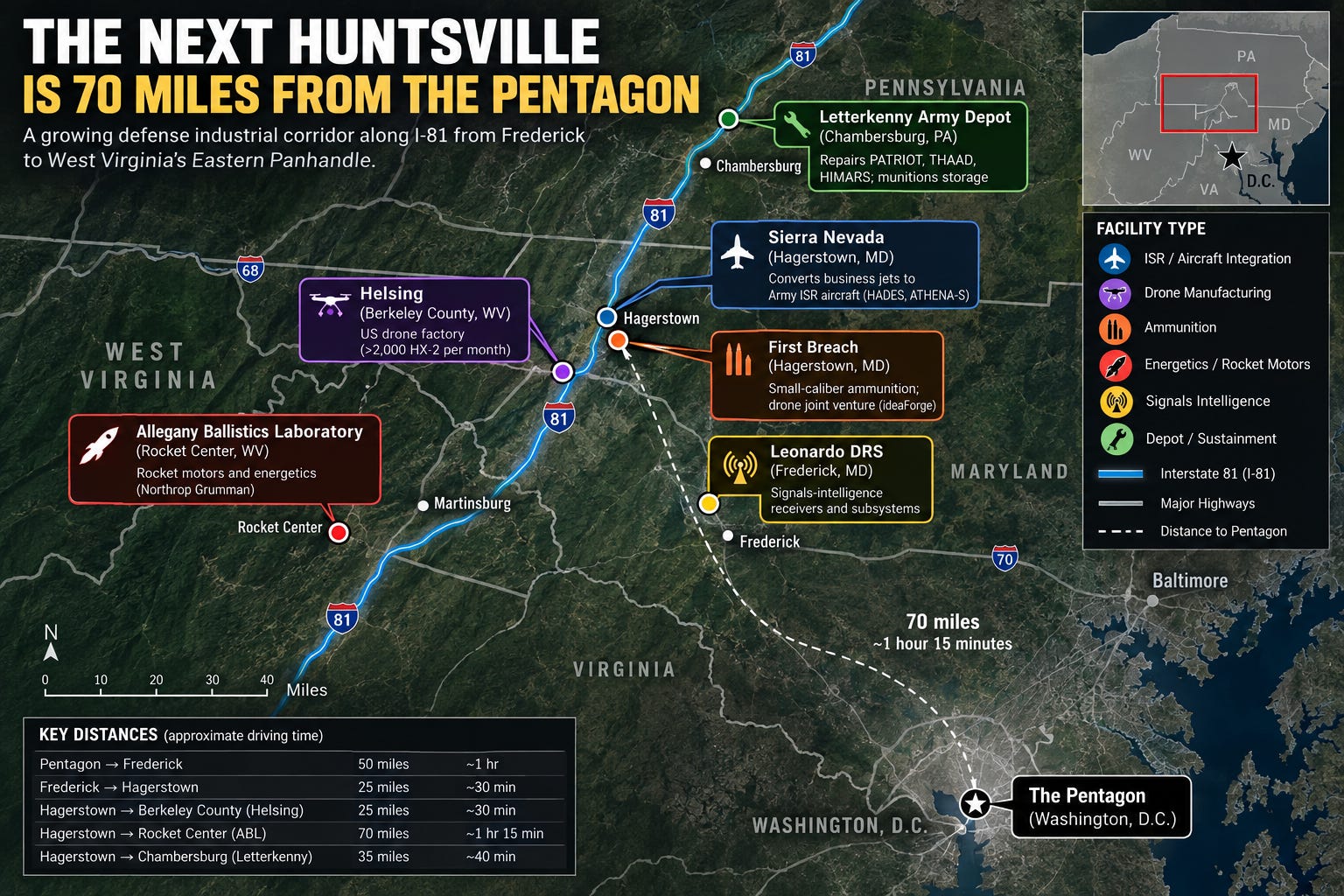
BLUF: The I-81 corridor across PA, MD, and WV is becoming a prime defense industrial base region.
Germany’s Helsing put $50M into Martinsburg, WV, for its first American factory. At full rate, the plant is built to turn out up to 2,000 HX-2 strike drones a month.
Sierra Nevada is turning Bombardier business jets into Army spy planes in Hagerstown, WV.
Letterkenny Army Depot in PA recertifies PATRIOT missiles.
Northrop Grumman is expanding rocket motor and energetics production at Allegany Ballistics Laboratory in PA.
The kill chain from sense, strike, energetics, and sustain are on this corridor.
This has land you can put explosives on, is close enough to the Pentagon, Fort Meade, Fort Detrick, and Aberdeen Proving Ground, along key truck routes, and with economic development and workforce support.
I-81 has the arsenals, the energetics, the sustainment, the spy jets and a new generation of drone makers. What it doesn’t have yet is a center of gravity.
Our Take: We love to see defense expand away from its typical hubs and build new tech hubs in high potential areas.
OSC Signs Conditional Loan Commitment of up to $450M With Neros
BLUF: Neros designs and produces low-cost, high-performance drones. The company’s manufacturing facility in Torrance, California will help onshore the production of complete drone systems as well as critical subcomponents including propulsion motors, flight stacks, radios, and thermal sensors.
Our Take: We note that Neros ranked #1 on Drone Dominance Close Quarters Battle leaderboard with 8,000 ordered and also #3 on Deep Strike Leaderboard with 6,000 ordered.
OSC Signs $250M Conditional Loan Commitment With 6K Inc.
BLUF: The loan with 6K is to scale the company’s domestic production of Nickel-Manganese-Cobalt (NMC) cathode active material (CAM) in Jackson, TN.
6K is a leading advanced materials company focused on critical energy and aerospace technologies.
OSC’s investment, which would catalyze an additional $250M in private capital, is intended to expand 6K’s domestic manufacturing, which would help secure American advanced battery supply chains.
OSC Signs $150M Conditional Loan Commitment With LeoLabs
BLUF: LeoLabs is a leading provider of Space Domain Awareness (SDA) and Space Traffic Management (STM) solutions.
This financing would accelerate the deployment of critical radar infrastructure and advanced decision science software.
OSC Signs $75M Conditional Loan Commitment With Halo Industries
BLUF: Financing supports scaling production of its innovative Silicon Carbide (SiC) semiconductor wafers. The OSC investment crowds-in an additional $75M in private capital and supports Halo’s domestic manufacturing expansion.
DLA Adds $2B in Critical Material Support to National Defense Stockpile
BLUF: The national defense stockpile reduces the risk of material shortages that could affect national defense and essential civilian industries.
Materials sourced for the stockpile can range from high-purity aluminum to vanadium pentoxide, with many elements, metals and compounds in between.


RADM Jonathan Rucker new PAE Maritime
SECNAV appointed RADM Jonathan Rucker to be PAE Maritime replacing RADM Casey Moton. RADM Rucker was previously Director for Design and Construction for DRPM Subs.
Acquisition Minesweeper

Ryan used one of his favorite AI tools to create Acquisition Minesweeper. If the user hits a mine, they are given an OTA or Tradewinds trivia question to defuse.
Acquisition Transformation Strategy
Today marks the one year anniversary to the rollout of the Acquisition Transformation Strategy. We’ll provide a heading check and our assessment in the next week.

Acting Army Secretary visits Arkansas to Strengthen Industrial Base, Forge Partnerships
BLUF: Adam Telle traveled to Arkansas to meet with leaders as the Army pushes to modernize the defense and organic industrial base, strengthen its global supply chain and build the intellectual and human capital required to ensure the U.S. Army remains the world’s most dominant land force.
The visit connected the Army’s modernization priorities with commercial industry and premier academic institutions.
A key focus of the trip was Pine Bluff Arsenal, a pillar of the Army’s organic industrial base for more than 85 years. It serves as the nation’s sole-source producer of vital white phosphorus munitions and a primary manufacturer of tactical smoke, pyrotechnics, and illumination rounds.
Telle met with leaders at Walmart’s corporate headquarters and visited their Global Security Operations Center for an open dialogue on how large-scale, globally dispersed enterprises maintain real-time situational awareness, operational resilience and rapid adaptability.
The discussion highlighted how both the Army and the private-sector could share lessons on managing complex global supply chains.
Telle also visited the University of Arkansas, an academic leader in supply chain management, contested logistics and advanced materials research.
Industry Needs Consistent Demand Signal to Scale UGV Production

BLUF: The Army’s goal of scaling unmanned ground vehicles is being sabotaged by its inability to provide clear, coherent demand signal to industry.
Oftentimes companies order parts and put stress on their supply chains before the Army has settled on a contract mechanism or specific capability.
The commitment from industry is there, but the commitment from the Army, or any service for that matter, is not distinct, which can be rather discouraging for companies.
Exercises also sometimes send a murky demand signal. While the Army has invited industry to demonstrate ground autonomy platforms at several events, the sheer amount of opportunities and unclear mission objectives leave companies unsure where to invest their time and money.
the Army’s venture capital acquisition hub, FUZE, has provided a strong example through its xTech competitions for how the service should focus its demonstrations on certain capabilities.
For example, xTech has held demonstrations, which are a part of larger competitions that will result in contract awards, for autonomous logistics and sustainment projects and for autonomous breaching.
The path to revenue is clear in such cases as companies know they could be the winner of an eventual contract.
“I think industry has the challenge of understanding what the demand signal is, and then again where to put their dollars. We do talk a lot about these capabilities that the Army has asked for, but they industry want to know what’s next" Warren Sponsler, COO of NAMC
Army Merges Aerial and Terrestrial Sensor Offices to Deliver Capabilities to Soldiers Faster

BLUF: PAE C2/CC2 merged Project Manager Terrestrial Sensors (PM TS) and Project Director Sensors Aerial Intelligence (PD SAI) to form Project Manager Aerial-Terrestrial Surveillance and Reconnaissance (PM ATSR).
PM ATSR will develop, acquire, field, and sustain aerial and terrestrial sensing capabilities that deliver actionable intelligence and enhance battlefield awareness for Soldiers.
Tom Dunaway, PM ATSR will support intelligence, surveillance, reconnaissance, target acquisition, and sensor integration.
The focus is to move faster, align requirements and resources, and continue advancing capabilities that support operations at installations and on the battlefield.
“Merging these project management offices maximizes our ability to rapidly and effectively equip Soldiers with the capabilities they need on the battlefield and at installations. This merger creates unity of effort across the portfolio so we can deliver integrated capabilities to Soldiers more rapidly.” Chris Manning, PME for Intelligence & Spectrum Warfare
Related: Army creates new office to run aerial and ground surveillance
Leonardo DRS Tapped to Support Army’s High-Energy Laser Program
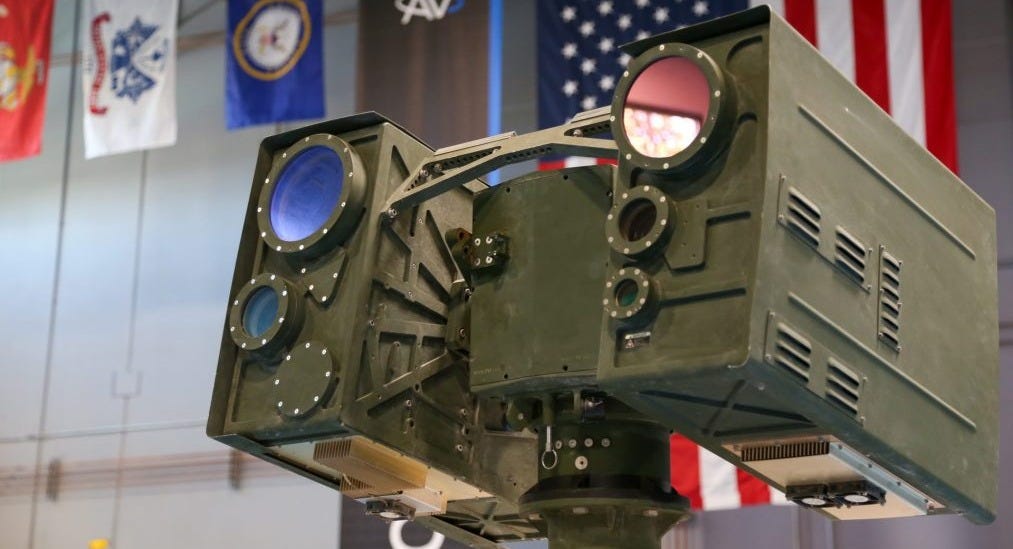
BLUF: Leonardo DRS landed a subcontract from AeroVironment to provide rugged integration expertise to support the Army’s Enduring-High Energy Laser production program.
The Army awareded AV a $500M contract for E-HEL Program in September with the intent of moving the system from a prototype phase into production.
However, there are technical challenges involved in fielding powerful lasers that can work effectively and reliably in real-world combat scenarios and meet military requirements.
Under its subcontract, Leonardo DRS aims to help address those issues.
“High-energy lasers and high-powered microwave systems are tools that can be effectively used in a layered drone defense. This pilot program will test these capabilities in an operational environment so we can understand how best to integrate and sustain them to defend the homeland.” BG Matt Ross, JIATF 401 Director
Related: The Army’s E-HEL Program Is Heating Up
Army Drops Mortar From Moving Drones with New Kit
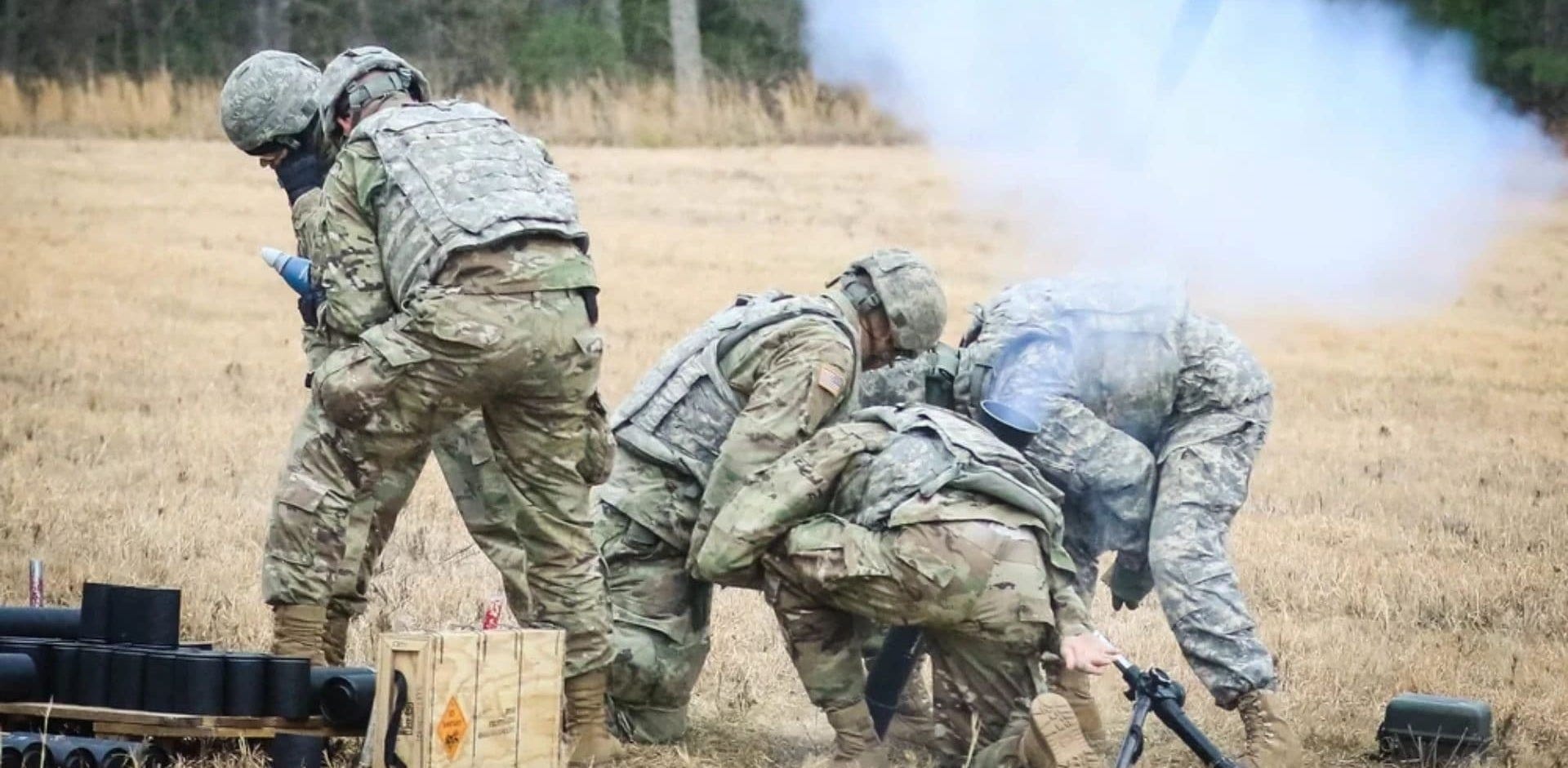
BLUF: The Army developed a new kit that lets unmanned aerial systems (UAS) deploy standard mortar rounds called the Munitions Air-dropped Lethal Effects Tool (MALET).
Army Combat Capabilities Development Command Armaments Center developed the system.
It is designed to convert existing 60mm and 81mm mortar rounds into drone-delivered munitions, reducing the need to procure specialized weapons for unmanned aircraft.
The technology could allow soldiers to make greater use of ammunition already available in their inventories.
CECOM ASIC and ATEC Centralize Test Range Booking to Fast-Track Lethality

BLUF: The Army faces an increased demand for cutting-edge weaponry, the speed at which industry can develop prototypes is critical to national security. The ability to experiment and operate on large government ranges unavailable in the commercial sector is critical to help private industry rapidly mature new military technologies.
In July 2026, then-Secretary of the Army Dan Driscoll directed the Army Test and Evaluation Command to build a commercial portal with a scheduling backend so technology providers in the UAS, counter-UAS, low-cost interceptor, and long-range fires spaces could quickly access ranges to conduct internal R&D.
The requirement included testing not just on ATEC ranges, but also on National Guard bases and international installations.
CECOM Army Software and Innovation Center partnered with ATEC to create a web portal that would speed up the process for all parties.
Standardizing the process was key as each range had its own booking process, industry didn’t know the mission of each range, and there were different types of requirements that each range had to provide.
CECOM ASIC stood up testrange.army.mil in three weeks.
From an operational lens, low-code development provides a broad spectrum of support options, enabling rapid development and deployment, utilizing a single authority to operate, and reducing the cyber burden and cost to customers.
How the Army Fights a Maritime War in the Pacific

BLUF: Rather than competing with the Navy or Marine Corps for maritime agency, the Army can enable these services to deploy into theater, maneuver against threat vulnerabilities, and reconstitute for prolonged operations.
The Army has new operational warfighting guidance. GEN Christopher LaNeve’s How the Army Fights organizes landpower around four interdependent elements that enable operational maneuver: convergence, strike, close battle, and endurance.
The framework has profound implications for maritime campaigns. Nowhere is this more apparent than in the contested zones of the northwestern Pacific.
Army leadership directs that theater armies and corps execute convergence by integrating sensors, command networks, long-range fires, cyberspace operations, and electromagnetic effects to shape opportunity and disrupt adversary systems across expansive horizons.
Applied to the Pacific theater, this concept positions the Army as an essential contributor to joint maritime operations by providing long-rage fires, counterfires, forward logistics, and continuous engagement.
Army forces positioned along the first island chain could contest these networks through distributed sensing, multidomain attack, multifaceted deception, and survivable fires. By degrading adversary targeting capabilities, Army forces provide staying power and create opportunity for joint forces to position, maneuver, and win in critical littoral zones.
Incorporating emerging technologies that are transforming target acquisition and strike potential, ground forces can exploit new opportunities to interdict maritime targets and destroy C2 infrastructure.
By preparing to “prevail in extreme environmental positions” in the “most intensely human-centric of all military endeavors,” the integration of fast-moving maneuver forces with multidomain fires would allow Army commanders to hold decisive ground and execute aggressive amphibious operations within a synchronized joint offensive approach.
The cultivation of operational endurance, as a primary concern of forward-deployed theater armies, requires forward-positioned ground forces to leverage industrial capacity, pre-positioned equipment, and durable alliances prior to conflict.
By integrating positional defense, mobile warfare, and multidomain attack with new and innovative approaches, the US Army will remain ready to fight and win in the most challenging of combat environments.

Building a Relevant Navy Fleet for 21st Century Deterrence and Combat
Bryan Clark, David Byrd, and Dan Patt
BLUF: The Navy should not sleepwalk into irrelevance. Instead of attempting to recapture the lost fleet and industrial base of a bygone era, the US needs to “right the ship” by building a force to compete rather than dominate. Private companies are accelerating production, defense spending is increasing, and lessons from Ukraine to Iran are fresh. It needs to exploit this opportunity or risk losing the ability to protect freedom of the seas or US interests outside America’s own hemisphere.
The US government’s response to the changing threat environment is surprisingly conventional. During the past 20 years, the Navy has published ever-increasing goals for fleet size, peaking most recently at 381 battle force ships by the 2050s, or about 100 more than today.
And the fleet’s composition largely resembles the force that won the Cold War 35 years ago. The only significant new platform is the proposed Trump-class nuclear-powered battleship (BBGN) in the Navy’s 2027 shipbuilding plan.
The government’s new technology investments are only a small fraction of the research and procurement funding devoted to ship development and construction.
This approach faces two fundamental problems.
It is unsustainable.
Thee government’s plan to massively increase shipbuilding funding is unlikely to expand the industrial base or accelerate construction.
The Navy needs a new theory of victory that exploits, rather than ignores, the opportunities in new technologies. The Navy could orient the fleet’s structure and operations toward countering the most likely or consequential enemy actions while retaining the capacity to address unpredictable crises.
The proposed general-purpose force incorporates today’s fleet but rebalances the mix to privilege sustainability and resilience over dominance.
It includes fewer aircraft carriers and surface combatants than in Navy plans and more logistics and support vessels. It also replaces the Trump-class BBGN that the Navy has proposed with a guided missile cruiser.
As a result, this study’s proposed fleet is more affordable and requires 50,000 fewer sailors than the Navy’s planned fleet.
Number and Mix of RAS Included in the Proposed Fleet Design
150-ton MUSV, 27 | 600-ton MUSV, 34 | Sail USV, 158 | sUSV, 119 | CCA, 75 | One-way attack UAS, 568 | MALE UAS, 19 | sUAS, 0 | MUUV, 88 | LUUV, 115 | ULUUV, 12 | XLUUV, 44 | Relocatable sonar, 144 | SHORAD, 6
Our Take: Bryan, David, and Dan once again produce another stellar report that is a must read for Navy leadership and those shaping defense budgets. OPNAV must pivot to truly invest in a hedge force that CNO and others champion. The Navy cannot afford to operate with a Cold War fleet design any longer.
Navy Unfairly Evaluated Saildrone MUSV Proposal, Court Finds

BLUF: The US Court of Federal Claims ruled the Navy unfairly evaluated maritime drone manufacturer Saildrone’s proposal for the MUSV program.
The Navy must reevaluate Saildrone’s proposal within the next two months, and is barred from spending more than $1.5B of its $2.1B MUSV budget until that process is complete.
Saildrone and Blue Water Autonomy filed lawsuits in June challenging the Navy’s decision to eliminate their respective proposals from the MUSV competition.
The companies argued that their platforms met the Navy’s requirements for the MUSV marketplace, which launched in March, and that the service didn’t stick to its own evaluation guidance in the RFP.
The Navy originally disqualified Saildrone from advancing to on-water testing due to discrepancies between the company’s proposal and a J-8 Placemat related to the maximum displacement of the design.
COFC determined that Saildrone received disparate treatment compared to other firms because the Navy advanced a proposal from Sea Machines despite similar issues involving maximum displacement.
COFC disagreed with Blue Water Autonomy’s protest concluding that representative unambiguously calls for comparing the test vessel with the production vessel, and noted that the solicitation did not exclude hull form or propulsion architecture from that comparison.
The Navy’s new leadership team already fixed the problems for the MUSV Phase II steering away from prescriptive, compliance-centric testing rules and open the aperture for new entrants.
Navy to Deploy 3,000-mph PAC-3 MSE Interceptor on Warships to Hunt Ballistic Missiles
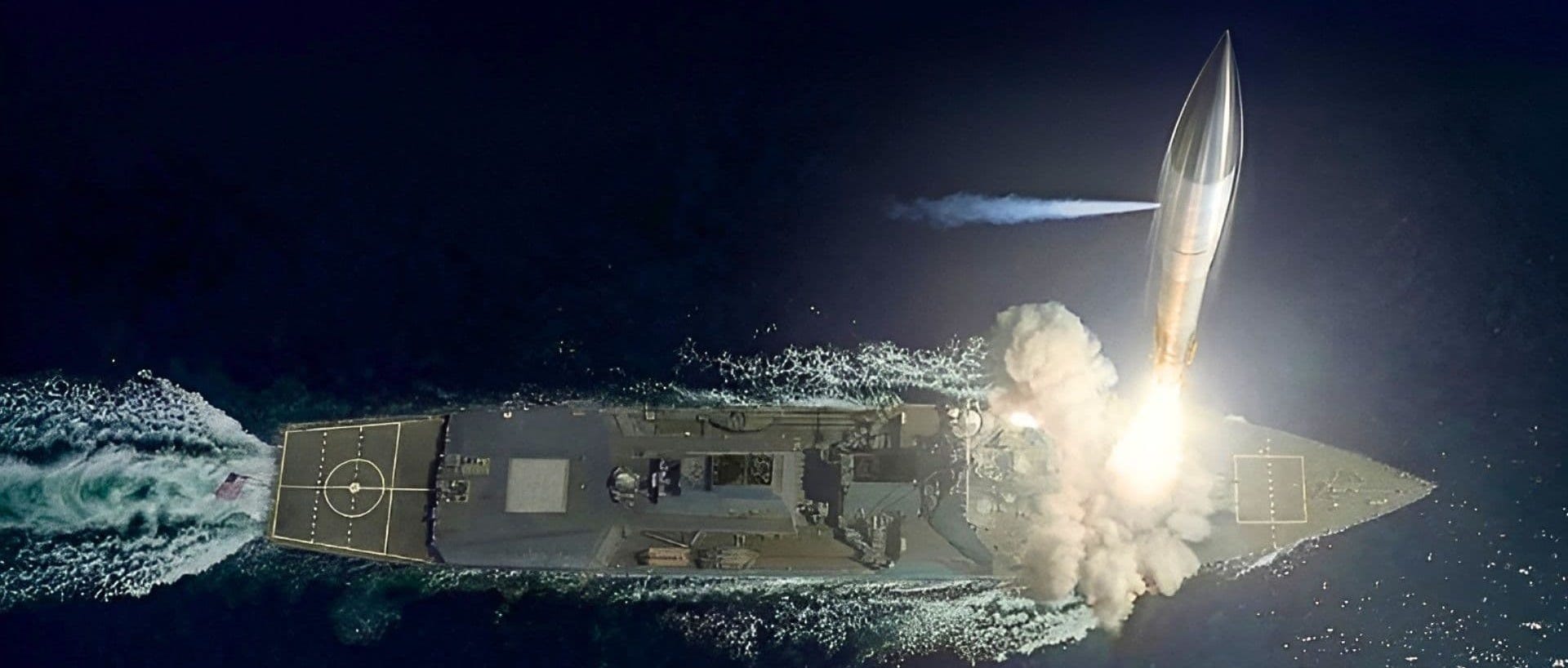
BLUF: The Navy is working to bring the Army’s PAC-3 MSE interceptor aboard its warships, giving the fleet another option against incoming missiles and other aerial threats. Lockheed Martin received a second-phase development contract in late September to integrate the interceptor with the Navy’s Aegis Combat System.
The effort will adapt the Patriot Advanced Capability-3 Missile Segment Enhancement (PAC-3 MSE) for launch from the Mk 41 Vertical Launching System (VLS).
Lockheed Martin is targeting land-based flight tests in 2027, followed by shipboard trials in 2028. The Navy aims to field the integrated system by 2029.
The award follows an earlier $93M contract that established PAC-3 MSE as an official Navy program. Lockheed Martin has also invested $120M of its own funding to prepare the missile for maritime operations.
The Mk 41 system presents a particular integration challenge. Its canisters must accommodate the interceptor without compromising the missile during launch.
Lockheed Martin recently completed a push-through test to verify that PAC-3 MSE could pass through the Mk 41 canister without sustaining damage.
The Hybrid Navy’s Hidden Constraint: Logistics
BLUF: The Hybrid Navy will not eliminate logistics, that will never go away, but it will certainly create a new logistics model. The decisive question is not just whether Navies can buy quickly develop and buy uncrewed vessels, but whether they can support, arm, repair and command them at realistic operational distances over normal deployment periods.
Irrespective of the hybrid concept the fleet will still needs fuel, spares, software updates, payload swaps, maintenance windows, recovery assets, data management, secure communications support and forward basing.
No Crew Does Not Mean No Support Construct
Forward Basing Becomes Critical
Re-Arming Is Not a Minor Detail
Payload Swapping Requires Infrastructure
The Hybrid Navy May Need a New Class of Support Ship
Navy’s New Innovation Unit Seen as Key Pipeline for Bringing Private Sector Talent into the Reserve
BLUF: The Navy is steaming ahead with an initiative that aims to tap into patriotism among private sector innovators and use direct commission officer programs to bring new tech talent into the Reserve force.
The Navy Reserve is looking to take exceptional private sector people who want to join the ranks but don’t necessarily desire to have a long career in the military, and slot them in in expanded ways via direct commission officer programs.
The Navy Innovation Unit will include 15 reservists who have jobs in high-caliber Silicon Valley organizations and putting them against the Navy’s harder problems and matching them with 10 folks to start who are directly from the private sector.
The founders and CEOs who are high agency, AI natives who understand the challenges of architecture, understand the challenges of reindustrialization will be brought in as lieutenant commanders or commanders.
“We have limited financial levers compared to the private sector to attract and retain folks. But at the end of the day, you know the military and the Navy and Marine Corps in particular have the hardest and, I would contend, most important problems to solve. And so, the reason that we attract or can attract great talent is to convince them that if you want to have high meaning and purpose, this is a great opportunity to serve your country.” Ben Kohlmann, ASN Manpower and Reserve Affairs
Navy Accelerates Warship Drive to Strengthen Naval Superiority
BLUF: The Navy is pursuing an ambitious shipbuilding expansion, from new nuclear-powered aircraft carriers and submarines to redesigned surface combatants and a proposed class of battleships. But as the Navy expands its fleet, construction delays, maintenance backlogs, and limited shipyard capacity continue to complicate its plans.
Maintenance delays and idle time for attack submarines cost the Navy more than 15,000 operational days over the previous decade, with an estimated $3.4B spent sustaining submarines and crews that provided no operational capability.
Adding ships to the construction pipeline does not automatically translate into more vessels available for deployment.
The Navy’s fiscal year 2027 shipbuilding plan requests a major investment in fleet expansion and the maritime industrial base.
The Navy’s Shipyard Infrastructure Optimization Program could exceed $200B and take more than 50 additional years to complete under current plans.
The coming years will test whether the U.S. can turn its shipbuilding ambitions into a larger, more capable fleet.
New carriers, submarines, and surface combatants remain central to that effort, but their strategic value will ultimately depend on whether the industrial base can deliver them on time and keep them ready for operations.
Navy Eyes Super Intelligence to Balance its Massive SSN(X) Submarine
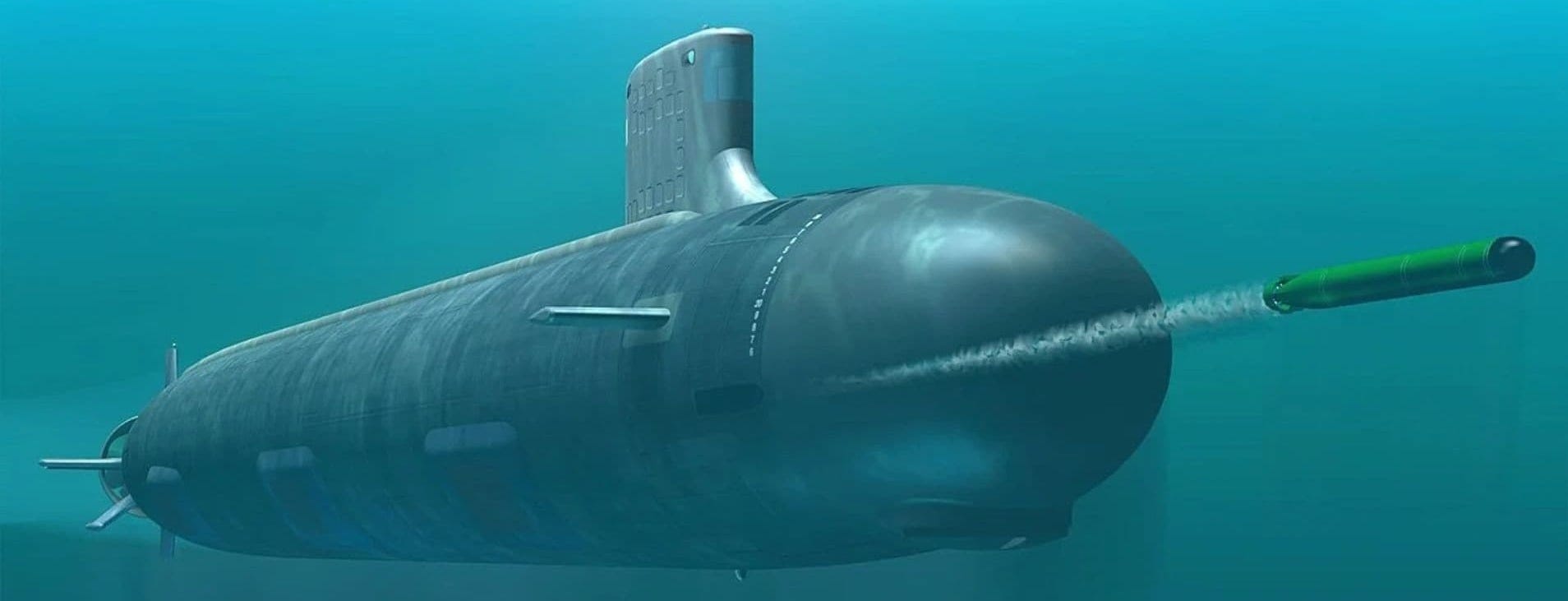
The Navy wants industry to explore Super Intelligence tools for designing the interior of its next-generation SSN(X) attack submarine.
Companies must submit non-proprietary expressions of interest by November 6, with a formal proposal call potentially opening the following week.
The proposed technology aims to improve internal equipment arrangements and reduce integration risks across the submarine.
The Navy’s Trainer is Now the Biggest Test of the Pentagon’s Acquisition Reform Efforts

BLUF: The Undergraduate Jet Training System (UJTS) competition appears to have only one bidder as Sierra Nevada Corporation decided it could not responsibly bid under the current contract structure.
What the Navy does now, more than the original competition, is the test of whether the acquisition reform it has been advertising has actually changed anything, or whether it is simply hot air.
In the acquisition transformation memo, SECWAR wrote speed to capability delivery is now our organizing principle, and directed a system that rewards early delivery and penalizes delay.
The Navy established PAEs who would bring urgency and a ruthless focus on accelerated delivery, with leaders empowered and expected to make disciplined, data-driven trade-offs across cost, schedule and performance, with a clear priority on time to field.
SECNAV said the Navy is locking in designs earlier, enforcing disciplined requirements and consolidating authority so decisions are made by leaders who own outcomes.
In May the Navy raised the price of UJTS EMD from $1.8B to $2.7B after industry pushback and the RFP changes allowed for more time to achieve IOC to give a newer design room to compete.
Lockheed Martin and Boeing dropped out of competition for various reasons.
UJTS has mature requirements and the Navy has three decades of what an advanced trainer has to do.
Do not reopen competition, nor treat a single bid as a win. Hold the date and name an owner. Protect the decision by doing it well and learn why bidders left.
Our Take: Framing UJTS as a referendum on Navy acquisition reform is premature and unnecessarily hyperbolic. Speed to capability is central to the Acquisition Transformation Strategy, but so are strengthening the industrial base, expanding competition, and delivering operational capabilities at scale. The Navy has engaged industry, adjusted its acquisition approach, and may ultimately receive only one viable proposal. The PAE and program manager are accountable for evaluating the trade-offs among competition, cost, schedule, performance, and operational risk, not simply accelerating an award to demonstrate reform. Empowering acquisition leaders means trusting them to make informed decisions, holding them accountable for outcomes, and learning why competitors chose not to participate.
PAE Aviation Autonomy and Super Intelligence Industry Day
Dec 8-9 in California, MD. The objectives of this event are to:
Align Government, industry, and academic capabilities with NAVAIR requirements.
Identify technical, operational, and mission capability gaps.
Increase awareness of commercial and academic tools relevant to current Navy development priorities.
Inform potential future acquisition approaches to support near-term warfighter needs.
Navy Demand Signal Forum

On December 11, Navy x Demand Signal and DoN Rapid Capabilities Office will be at the MIT Media Lab in Boston for a conversation on superintelligence and cyber in the maritime domain. Speakers include VADM Seiko Okano, Jim Juster, James Day, and Andrew Magliochetti.
Other Navy News:
Navy’s NATO SEASPARROW Program Marks Delivery of 1,000th ESSM Block 2 Missile
Thales subsidiary lands Navy contract for remote mine hunting modules
Advertise with Defense Tech and Acquisition to put your brand in front of the people driving the future of national defense.

Buying Fighters One Year at a Time Is Costing America More Than Money
BLUF: The U.S. is not acquiring modern combat aircraft fast enough and today’s Air Force inventory is too old, too small, and worn hard. Congress has an opportunity to reset an acquisition approach that relies heavily on uncertain, year-to-year purchases.
On October 22, 2026 DoW and Lockheed Martin announced a 10-year F-35 production and sustainment framework covering at least 850 U.S. aircraft, along with initial spares, modification kits, and sustainment.
It anticipates global production of 156 aircraft annually and at least $7B in company-funded F-35 initiatives.
This still requires congressional authorization, appropriations, and negotiated contract terms, including pricing and schedules.
While F-15 has an IDIQ for production, upgrades, modernization, and sustainment, it does not obligate the government to purchase a specified number.
Smaller, annualized procurement quantities do not yield proportional acquisition savings. Manufacturing overhead, supplier commitments, and other fixed costs must be spread across fewer aircraft, raising the price of each one.
Our Take: Unless the government negotiates specific company investments as part of the multi-year, we are skeptical of their true benefit particularly since they remove the one real negotiation lever the government has for non-performance. Through the F-35 history, when software deliveries have been delayed, delaying production and ramping down quantities has been the thing that ensures management attention. We are also skeptical of the purported cost savings since most past savings were derived from estimates and are rarely audited after the fact. Gen Deptula likely overstates the value here particularly given the Air Force already forecasts buying the F-35 and F-15EX as indicated by the Air Force’s fighter fleet mix plan announced recently.

Reentry Vehicle for 15,000-mph ICBM’s Nuclear Warhead Completes Successful Flight Test

BLUF: Lockheed Martin completed another flight test of a next-gen reentry vehicle (Mk21A) over the Pacific Ocean after launching from Vandenberg Space Force Base.
The test advances development of front-end payload section for the U.S. Air Force’s upcoming LGM-35A Sentinel missile.
The new missile will reach approximately 15,000 mph at burnout and its reentry vehicle must protect its payload as it travels through space and plunges back into Earth’s atmosphere at extreme speeds.
Drones Built to Look Like Birds Evaded Detection at Air Force Tech Exercise

BLUF: A wing-flapping drone appearing to fly like a bird evaded sensor detection at a recent Air Force tech exercise in the Mojave Desert.
Ornadyne’s small O1 ornithopter doesn’t use propellers like most drones.
Instead, it mimics the flight mechanics of a bird by flapping its wings to stay in the air. The sUAS is designed to resemble a bird, while it collects intelligence or surveys an area at low altitudes.
It was the first time that the U.S.-based drone manufacturer tested its ability to hide from detection systems built by other private companies.
The O1 drone weighs 1 pound and can fly up to 6 miles, for over an hour.
It can carry a small payload, like a camera used to do target recognition for surveillance missions.
F-35 JPO Announces Transition from ALIS to ODIN
BLUF: The transition to ODIN represents a comprehensive modernization of the digital backbone that enables maintainers, operators and logisticians to effectively support the world’s largest and most advanced fighter aircraft fleet.
The operating software delivery and validation by the operational test squadron satisfies the final major milestone for meeting the goals for the transition.
New ODIN hardware offers significantly higher processing speeds and computational power, has replaced legacy ALIS hardware across the fleet.
Our Take: This has been a long time coming and ODIN should provide a much more modern architecture for maintaining the F-35 through its lifecycle.
DAF Unveils Enterprise Blueprint to Field Operational SI Across 15 Mission Domains

BLUF: The Department of the Air Force is accelerating its push to operationalize enterprise intelligence and deliver combat-ready super intelligence capabilities directly to the warfighter, unveiling a comprehensive modernization blueprint Oct. 27.
The transition hinges on establishing these 15 operational domains — spanning core areas such as nuclear operations, intelligence and human resources.
Each domain is overseen by a dedicated senior leader, a general officer or SES member, tasked with operationalizing the strategy and making trustworthy, authoritative data available immediately.
Air Force Absorbs Lessons Learned From Operation Epic Fury

BLUF: The 38-day campaign in Iran that began in February left the Air Force with a wide range of lessons to consider as it pushes to meet the demands of modern battlefronts and modernize its aging fleets.
Operation Epic Fury as one of the most complex operations the Pentagon has carried out in decades. It involved servicemembers from all branches striking more than 13,000 targets, over 4,000 of which were dynamic, non-fixed targets.
The Air Force deployed 500 aircraft and flew an average of 250 sorties per day.
MQ-9 Reaper RPA was responsible for more than 800 of the total targets struck.
Air Force leaders say the campaign illustrated the need for readiness in advance of a crisis, as well as weapons, infrastructure and networks that can perform well while under attack.
One distinct takeaway from the operation is to write future contracts with industry in such a way that enables the Air Force to repair its own platforms when contractors can’t perform maintenance.
Beyond aircraft, the damage Iran inflicted upon U.S. bases begs a better installation defense strategy.
They also highlighted the imperative for fleet modernization programs to improve connectivity between platforms and to focus on long-range strike and low-observability capabilities.
Air Force Asks Industry for New Cruise Missile for Ukraine
BLUF: Potential contractors are asked to detail their capabilities to provide the Extended Range Attack Munition, a small, air-launched standoff missile intended for mass production.
The Air Force’s new Request For Information, which has a deadline of Nov. 19, offers some technical specifications for ERAM.
It should be a 500-pound class weapon with a range of greater than 250 nautical miles and a speed of more than Mach 0.6.
Terminal accuracy should be within 10 meters of the target even amid jamming, such as degraded GPS.
In addition to blast and fragmentation effects, the weapon should also be capable of limited penetration on impact.
Companies should begin delivering the first of more than 1,000 ERAMs no later than three months after the contract is awarded.
Deliveries should be complete within 15 months.
ERAM is part of DoW’s push for cheaper weapons developed more quickly.
In 2024, the Air Force awarded a contract to two small defense companies — Zone 5 Technologies and CoAspire — to develop ERAM prototypes.
In January 2026 — less than a year and a half later, the Air Force conducted a live warhead test.

Space Force Weighs Proliferated Cislunar Satellite Constellation
BLUF: The Space Force is considering launching up to five satellites to cislunar space as soon as 2029 to help lay the foundation for a future proliferated constellation between Earth and the moon.
In a Nov. 2 industry notice, the service said it is “notionally interested” in launching a handful of satellites to inform a future acquisition strategy for a Cislunar Space System to operate beyond geosynchronous orbit.
Spacecraft should be ready to launch by late 2029 for initial operations by 2031.
That momentum is in part driven by China’s move toward the moon, a vision that not only includes lunar landers and a military presence, but to establish models for PNT within 10 years, and launch an international lunar research station.
Space systems operating in the region must contend with the combined gravitational characteristics of both the Earth and the Moon as well as unpredictable orbits that require constant station-keeping.
Cislunar also lacks its own positioning, navigation, and timing grid—offices like the NGA are working to establish that framework.
“They’re not planning for a one-off demo. They are planning for sustained activity. It’s in their strategic documents … and they’re building the R&D and the S&T and the operational reps and set to get all those missions done.” Maj Gen Purdy
Related Article: Space Force Evaluating How to Defend Assets Near Moon
VLEO: How the Space Force Is Exploring Ops at Lower Altitudes

BLUF: As commercial companies, universities, and research agencies develop new approaches to operating satellites at lower and lower altitudes, the Space Force is considering how it might leverage those advances in both the near and long term.
Over the past decade, the Space Force has moved to augment its large, expensive, and highly capable satellites in GEO and MEO with proliferated constellations of smaller, more affordable satellites in low-Earth orbit.
While the service hasn’t made any decisions about whether or when it will start launching satellites in VLEO, the Space Force characterizes VLEO as an emerging area of interest.
The presence of atomic oxygen makes VLEO corrosive to most satellites and the density of the air contributes to extreme atmospheric drag, requiring novel propulsion solutions to maintain altitude. It also makes satellites difficult to track.
But flying at lower altitudes has benefits too: faster communication and data transmittal, more precise positioning, and higher-resolution imagery, whether sensors are observing events on Earth or looking up at activity in higher orbits.
“Fundamentally, when we look out to the future force, there is a place for VLEO. I can see it fitting into the overall architecture, but the question is to figure out exactly how and what.” Gillian Bussey, Deputy Chief Scientist, Space Force
Space Force Activates Special Operations Component Command
BLUF: U.S. Space Forces Special Operations Command, or SPACEFOR-SOC, formally activated today as the newest service component of U.S. SOCOM.
The command deploys small, modular teams integrating space, cyber, and intelligence specialists to deliver mobile, low-signature space capabilities in contested and communications-degraded environments.
“For the SOF enterprise, this activation provides an enduring and accountable way to integrate space power into special operations. For the Space Force, it provides a direct operational connection to one of the Joint Force’s most demanding mission sets.” Adm. Frank “Mitch” Bradley, commander of USSOCOM.
SpaceX Launches Classified US Military Mission, Falcon 9 Booster Nails Eighth Landing

BLUF: SpaceX has completed another national security launch for the U.S. military, sending its Falcon 9 rocket into orbit with classified payloads. The mission lifted off from Space Launch Complex 4E at Vandenberg Space Force Base on November 7.
Its first-stage booster subsequently returned to Earth and landed on the Of Course I Still Love You droneship in the Pacific Ocean.
Designated USSF-432 and R-4, the mission adds another classified payload to the U.S. Space Force’s growing orbital operations. Officials have not disclosed the spacecraft’s identity, capabilities, or exact mission objectives.
Analysts have linked the R-series missions to the military’s Space Based Sensing and Targeting portfolio. The program aims to strengthen the military’s ability to gather information and support operations from orbit.
Key Space Force Satellites Can’t Talk to Each Other, Likely Requiring $1B Solution

BLUF: The Space Force’s multibillion-dollar effort to build a satellite network that rapidly moves data over high-speed laser links will require an entirely new set of satellites and significant extra funding to connect with other military space systems.
In effect, this new group of satellites will serve as translators between different sets of optical waveforms in order to ensure systems can talk to each other.
That connectivity is a vital part of supporting Golden Dome missile defense initiative that the network is supposed to help speed into existence.
The Space Force plans to orbit an “operational prototype” of the Space Data Network Backbone being built by SpaceX by 2027.
The large constellation will serve as the data backhaul layer — the central communications traffic router — of the service’s planned SDN architecture, a space-based network of networks designed to connect sensors to shooters.
SDN will be a hybrid constellation comprising military and commercial communications satellites that will be able to share data across missions, including missile warning, tracking and targeting as well as AMTI/GMTI.
As a top priority, the SDN will focus on connecting to SDA’s Tracking Layer satellites for detecting and tracking missiles to be stationed in LEO and SSC’s similar Resilient Missile Warning and Tracking- Medium Earth Orbit (MEO) birds.
However, SpaceX is using proprietary OCTs on the SDN Backbone satellites, dubbed by the company as “Plasers,” that cannot directly exchange data with those equipping both the SDA and SSC missile warning/tracking satellites.
To complicate matters, OCTs used by SDA and SSC also are incompatible.
A constellation of 12 to 13 additional satellites could allow otherwise incompatible OCT payloads to exchange data.
The proposed satellites, known as Space Exchange Points (SEPs) or “translator satellites,” are expected to cost somewhere $12-14 million each.
The crux of the connectivity problem is that the SpaceX, SDA and SSC OCTs are based on different technical standards governing the precise optical waveforms used, and thus how many gigabits of data per second the laser links can transmit.
Our Take: We see this as initial constellations making tradeoff decisions before full-scale deployment, a normal evolution given the long path ahead. This could possibly have been mitigated if the two space communities had coordinated earlier but given that the plan is to incorporate other commercial satellites, this may have been needed anyway since they would not necessarily comply with some new gov standard.
Space Force chief: Intelligence officials ‘making sure we get lessons learned’ from recent Russian satellite maneuvers near commercial sat
BLUF: The Space Force was keeping a close eye on a Russian satellite that raised alarms recently as it maneuvered near a commercial synthetic aperture radar satellite.
The incident involving Russia’s Cosmos 2612 and a system operated by ICEYE — a company that owns a large constellation of SAR satellites and provides intelligence, surveillance and reconnaissance capabilities to governments.
This occurred amid growing concerns about Moscow’s space-based weapons that could threaten other platforms on orbit.
“The U.S. government, the U.S. Space Force, is the best there is in the world at space domain awareness and having the ability to know what’s going on in space, so obviously we were tracking that situation. We were working through that. Our component commander out at Vandenberg was working that and making sure that the commander of U.S. Space Command knew exactly what was going on, when it was going on.” We were watching that, and we will continue to learn from it. And our intel folks, along with the Intelligence Community, we’re making sure that we get lessons learned from that.” Gen. Schiess, Chief of Space Operations
Other Space Force News

Data and Communications Technology are the Hidden Keys to Success for Golden Dome
BLUF: With the basic requirements laid out, the GD community now must focus on developing, integrating, and fielding the C2 components of the program that will underpin the program’s success across the space, air, and sea domains.
The immediate challenge involves leveraging the proven technology we have, augmenting it with new capabilities such as high-speed space-based networking, and deploying it quickly.
Deploying GDFA in space will be an enormous undertaking when combined with interdependence on terrestrial sensors, sea-based sensors, and even subsea ones.
The best approach begins with establishing the foundation for the underlying infrastructure for communications and data processing.
That means moving some requirements from a purely centralized C2 system back to the edge – a complex combination of edge processing and careful autonomy. Even so, the architecture must retain a robust centralized C2 capability.
Another facet will be establishing an informed data communications and message-passing architecture to reliably move engagement quality information to and from sensors and shooters.
Given the broad range of components within the Golden Dome architecture, this will require modular core interfaces to enable the necessary communications.
It also has to allow for specialization to accommodate the range of sensors and devices within the architecture.
This problem of translating and standardizing must be tackled through a cooperative and carefully organized effort with the industry vendors who developed these distinct software programs, while using age-old guidance and standards from past efforts like Modular Open Systems Architecture (MOSA).
Simulation tools can also be used to build out system capabilities across a broad spectrum of sensors and vectors. These tools blend artificial intelligence, synthetic data and machine learning.
Our Take: General Guetlein has identified this as his most pressing challenge, and it was the core of the new consortium’s effort.

Strike Drone Turned into Weapon Carrier, Integrates Kamikaze UAVs

BLUF: A Turkish defense technology company has taken a significant step to expand capabilities of its unmanned combat aerial vehicles (UCAVs). Bayraktar has tested its TB2 drone carrying 16 Skydagger FPV kamikaze UAVs.
During a test flight conducted with Skydagger FPV kamikaze drones, Bayraktar TB2 struck targets with pinpoint accuracy using two air-launched FPV drones.
Our Take: This is the future. Different novel platforms delivering tailored UAVs in novel ways to achieve specific effects.
Naval Group Unveils New Drone Carrier Concept
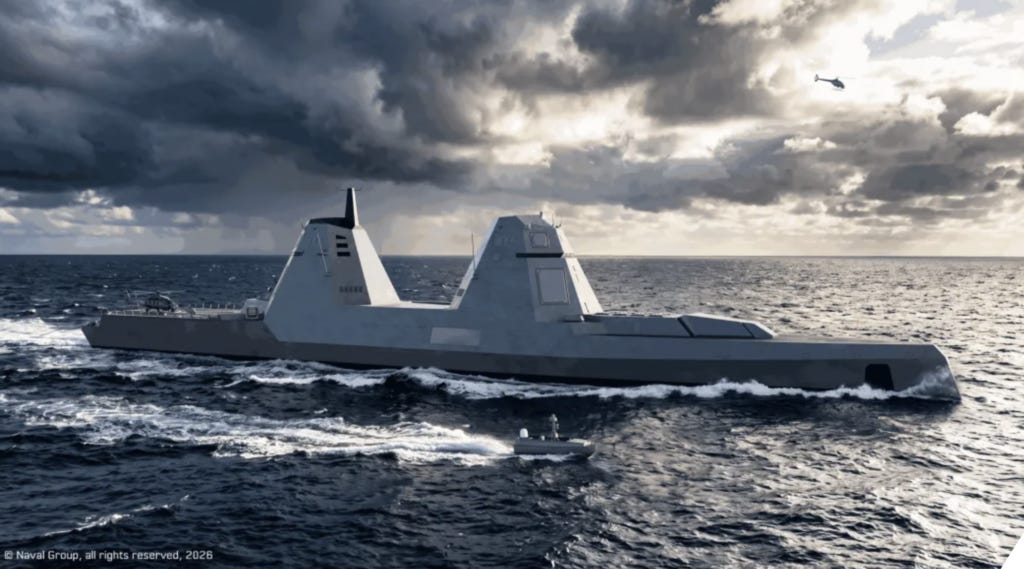
BLUF: French shipbuilder Naval Group has unveiled an 8,000-ton drone carrier concept designed to deploy fleets of surface, aerial and underwater drones.
The company said it developed the carrier based on new operational requirements, lessons learned from recent wars, and medium- to long-term technological advancements.
The idea is for the carrier to be what the French group calls an “operational hub of a hybrid fleet,” able to launch a variety of drones for missions ranging from intelligence gathering to anti-submarine warfare.
According to the theoretical capabilities outlined, the ship would measure 170 meters in length and weigh 8,000 tons, with a crew of 150.
The carrier is expected to reach a maximum speed of 30 knots and roam the seas for more than 8,000 nautical miles.
Naval Group plans for the ship’s core onboard weapon to be composed of 100 vertical launching system silos of various classes and an electromagnetic gun.
Our Take: This sounds like an MUSV with containerized capabilities to me.
Russia is Giving its Drones Bigger Antennas to Beat Ukrainian Jamming
BLUF: Russia is fitting drones with larger jam-resistant antennas, making it harder for Ukrainian forces to use electronic countermeasures to scramble their navigation signals
Russia’s Kometa navigation modules, produced by the company VNIIR-Progress, use arrays of small receiving elements called patch antennas to keep satellite navigation working through jamming.
They have been found on Geran drones, glide-bomb kits, Iskander-M and Kinzhal missiles and the new Filin cruise missile.
The Kremlin is using Kometa modules with 16-element antenna arrays at scale and is setting up serial production of 20-element arrays, increasing its capability to work out which direction jamming comes from and compensate for it.
Shaheds carrying antennas with 32 elements have been found attacking Kyiv.
Our Take: Power usually wins in the RF game. Good lesson learned for all.
New UK Policy Requires Foreign Defense Contractors to Invest Locally for all £50M+ Deals
BLUF: Foreign defense firms that secure contracts with the UK valued at £50 million ($67 million) or more will be mandated to establish British factories, invest in local suppliers and transfer technologies, as part of a newly launched offsets policy.
The offsets revamp “will encourage overseas defence suppliers to build enduring partnerships with UK industry, helping UK SMEs to access global supply chains and create new opportunities for growth.
Our Take: This is fairly common with any FMS sale or international cooperation, the UK here is just making it a more standardized approach.
Hypersonic Air-Defense Interceptor AQUILA Bets on 3-Stage Design Against High-Speed Threats
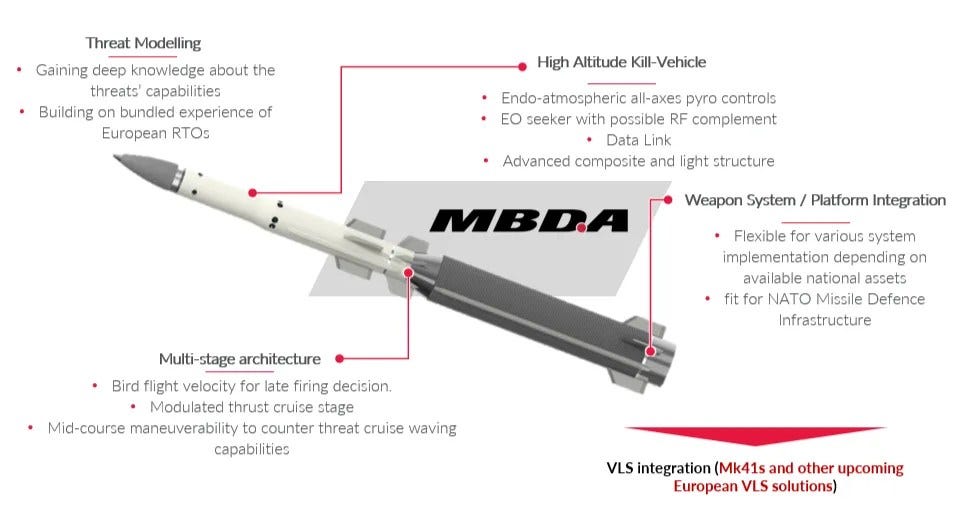
BLUF: European missile consortium MBDA is working on an endo-atmospheric interceptor built to dismantle both hypersonic weapons and medium-range ballistic missiles in one fell swoop.
The AQUILA interceptor will use a 3-stage architecture comprising a booster accelerator, cruiser, and kill-vehicle to perform long-range, high-altitude engagements against high-velocity maneuvering threats.
AQUILA forms the technological core of the European Hypersonic Defense Interceptor Study (HYDIS).
The Pentagon currently splits this operational burden across multiple platforms. It relies on the SM-3 and THAAD for ballistic missile defense and is developing the Glide Phase Interceptor (GPI) for maneuvering hypersonic glide vehicles.
Europe wants a single effector to handle the entire spectrum. To pull off this feat, MBDA finalized a 3-stage, all-rocket configuration.
Fincantieri Unveils New Multi-Mission Modular Vessel at Euronaval 2026
BLUF: The Multi-Mission Modular Vessel (MMMV) introduces a new approach to naval platform design: “one hull, many missions”: rather than building a vessel around a predefined mission.
Fincantieri has developed a platform designed to receive and adapt to multiple missions.
Through a highly flexible and open modular architecture, the vessel can accommodate different containerized payloads, allowing its configuration to be tailored to specific operational needs.
The modular payloads can integrate a wide range of systems including loitering munitions, aerial and underwater drones, launch-and-recovery systems, and other mission-specific support modules.
Our Take: This is very aligned with the Navy’s containerized approach.
Wingman Out, Ravenstorm In: Airbus Changes Tact to Meet Germany’s Accelerated Operations Timeline
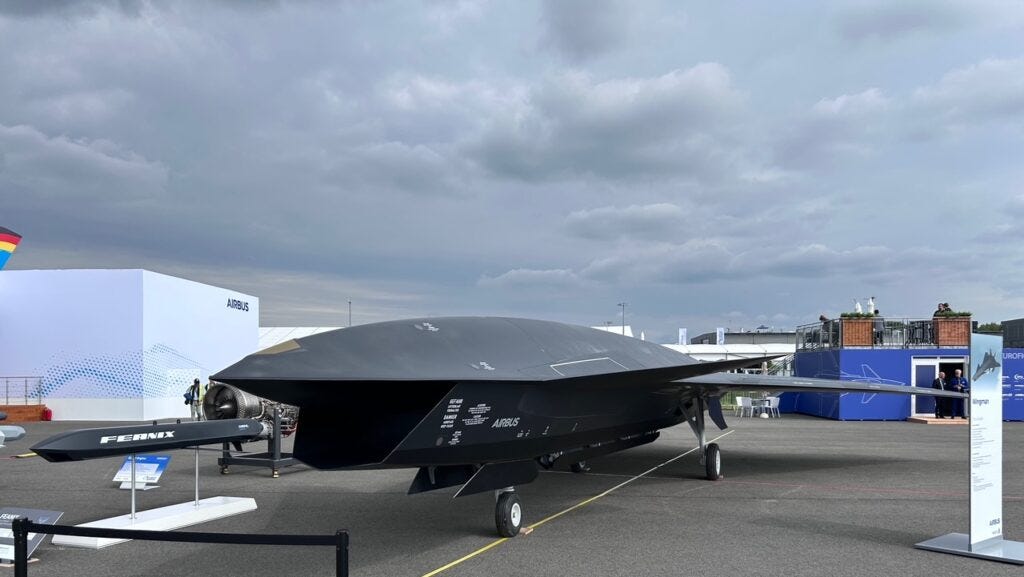
BLUF: Airbus has shelved the development of a futuristic, unmanned wingman concept aircraft in favor of a less exquisite, cheaper design, the result of Germany accelerating the timeline for the aircraft to potentially enter service.
The European manufacturer is moving away from its Wingman drone platform, first unveiled at the Berlin Air Show in 2024, to instead focus on developing the U760 Ravenstorm Collaborative Combat Aircraft (CCA).
The original timeframe for fielding the Wingman was “definitely not early 2030s,” and likely much closer to 2040.
In light of the tighter timeline, Airbus decided to pursue development of the U760 because it is an evolution of the company’s Barracuda drone demonstrator’s “trusted design.”
Our Take: Disappointing to hear any CCA would take until 2040 to develop but good lesson here to field what you can in a meaningful timeframe versus striving for perfection and leaving operators with huge gaps.
Saab Unveils New Speed Assault Boat for Swedish Navy
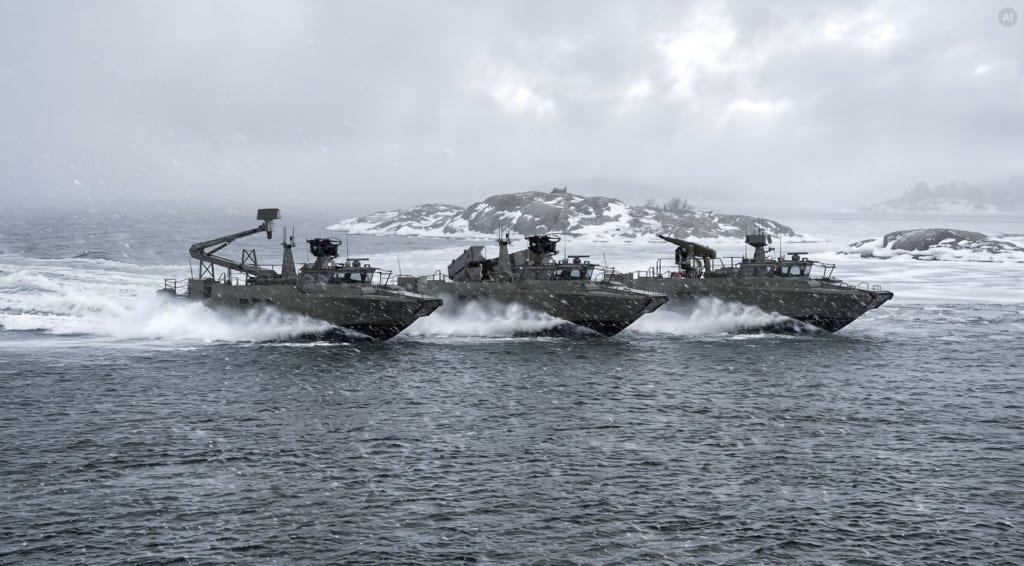
BLUF: Swedish defense manufacturer Saab has unveiled the Combat Boat 90 (CB90) CX, a drone boat designed to strike targets beyond the horizon and counter short-range aerial threats, to equip the Swedish Navy.
The CB90CX is 18m long and integrated with an entirely new vessel infrastructure, which includes an integrated ship automation and monitoring system, fire control system, and steer-by-wire technology.
It is envisioned to be available in three configurations:
an intelligence and surveillance variant relying on Saab’s Giraffe 1X radar
an anti-ship warfare role to enable beyond-line-of-sight strikes against surface vessels
a short-range air defense variant.
The craft is already under production, destined for the Swedish Navy as the launch customer.
Other International News:
Saildrone inks agreement with Norwegian shipbuilder Umoe Mandal to produce USVs
EU, France launch scheme linking French firms with Ukrainian defence startups

Democrats gained control of both the Senate and the House in the midterms. The Senate and House return Monday for a five-week lame-duck session. The current continuing resolution (P.L. 119-103) funds the government through December 11.
The four appropriations committee leaders plan to meet next week to try to lock in FY27 spending levels and decide whether any remaining reconciliation vehicle will be bipartisan or majority-only. The FY27 NDAA remains unfinished. The House passed its version; the Senate has not. Negotiators are expected to work toward a compromise text during the lame duck rather than restart the Senate floor process. All pending nominations must be confirmed before the end of the Congress or they die and must be renominated in the 120th Congress.
For PAEs, PMs, and industry, the practical effect is continued uncertainty on new starts, production rate increases, and any capability whose funding sits outside the FY26 baseline. The December 11 deadline and the change in chamber control compress the window for full-year appropriations and/or a durable reconciliation package.
Paid subscribers receive the full working analysis of the FY27 NDAA (SASC and HASC marks through conference) and the Budget and Appropriations (request through conference, including marks, plus-ups, reconciliation, supplementals, and CR impacts). That includes the practical effect of specific provisions and marks on pathways, industrial base capacity, and program execution. We will update them as the lame-duck bills move.

One Factory, Any Product | Lukas Czinger
Creative Defense Foundation
Ops Problems in the Pacific Drive New Approaches | MGen Joseph “Solo” Kunkel
Acquisition Talk
Insights from CENTCOM Commander | ADM Brad Cooper
Chemistry of Combat: Rebuilding America’s Energetics Base
Hudson Institute
Automated Target Custody for Timely Effects | Lt Gen Max Pearson, Lt Gen Christopher Niemi, MGen Christopher Povak, BGen Nick Hague
Air and Space Forces Association
Autonomy is a Software Problem | Paul Lwin
The Merge
What do the Election Results Mean for Defense?
Mitchell Institute for Aerospace Studies
Modeling and Simulation | VADM Sean Buck
NDIA Emerging Tech Horizons
Counter-Drone Defense, Applied Energetics | Chris Donaghey
The Startup Defense

AUVSI Defense
Nov 9-10 • Washington DC
Space and Satellites USA
Reuters • Nov 9-10 • Washington DC
Navy Outlook Summit
DLF • Nov 16-17 • Reston, VA
Loitering Munitions
SAE Media • Nov 17-19 • London, UK
Military Vehicle Systems Summit 2026
Nov. 18-19 • Detroit, MI
AFCEA Annual Data Forum
Nov. 19-20 • Alexandria, VA
Counter UAS Tech
SAE Media • Nov 30-Dec 2 • Washington DC
I/ITSEC 2026
Nov 30-Dec 3 • Orlando • FL
TechNet Transatlantic 2026
Dec. 1-2 • Frankfurt Germany
Tectonic European Defense Summit 2026
Dec 1-2 • Shangri-La, Paris
AUSA Landeuro 2026
Dec. 3-4 • Wiesbaden, Germany
Reagan National Defense Forum
Dec 4-5 • Simi Valley, CA
DOW Maintenance Symposium / Software Summit
Dec 8-11 • Ft Lauderdale, FL
AOC International Symposium & Convention
Dec. 8-10 • National Harbor, MD
Plan the quarter from the events page. It has the full year, so you can lock travel and decide which conferences are worth the pipeline before the calendar fills.