



Welcome to the latest edition of Defense Tech and Acquisition.
The biggest stories across the Department and the defense industry this week:
SECWAR Establishes the Autonomous Warfare Command, Future of Warfare Commission, and Fortress America.
Drone Dominance and JIATF-401 announce winners and competitions
Army establishes new autonomous command and PAE autonomy.
Navy awards major contracts for F/A-XX, MUSVs, and MCMs
Air Force demonstrates limits of VC funds with CR for CCA production
Space Force retires DSP but launches 21 more data transport SVs
Golden Dome pressed for details on what will / won’t be protected
Ukraine launches ballistic missile and launches robotic Manhattan Project

Project Agincourt: Pathway to the Autonomous Warfare Command

BLUF: SECWAR directed the Direct Reporting Portfolio Manager for Unmanned Systems (DRPM-UxS) to lead Project Agincourt to establish the Autonomous Warfare Command.
AUTOWARCOM will be a 4-star functional combatant command that will lead the Joint Force in unmanned and autonomous warfare.
The command will posses dedicated manpower, budget, acquisition authorities, and create dedicated military career pathways for Officers and Enlisted personnel.
Target establishment date of Oct 1, 2027 pending Congressional legislation.
Execute the existing DRPM-UxS mission while prototyping a new acquisition model for unmanned and autonomous systems.
Teaming operators with innovators and competitive manufacturers, DRPM-UxS will push decisions and dollars to the edge of our operational forces.
Owen West and Max Strasiser will serve as the Chief Executive Officer and Chief Operating Officer, respectively, of the DRPM-UxS. DRPM-UxS.
Within 30 days of this memorandum, DRPM-UxS, with the support of the CJCS, will submit a plan of action and milestones (POAM).
Related: Vision for New Autonomous Warfare Command Laid Out by Pentagon and Hegseth Unveils New Autonomous Warfare Command in State of the Force Address and Hegseth Announces New Four-Star Command for Autonomous Warfare and Hegseth Announces Plans for New 4-Star Drone Command, Among Other Initiatives
Commissioning of Project Meridian: The Future of Warfare
BLUF: SECWAR signed a memo directing the DoW's Chief Technology Officer, Emil Michael, to commission Project Meridian: The Future of Warfare, through a partner organization.
Project Meridian will be co-led by Elon Musk, Palmer Luckey, and Newt Gingrich.
Project Meridian will study the battlefields of the future, identify which weapons and technologies warfighters will need to harness to dominate in these environments, and propose actionable solutions to start developing, testing and fielding these capabilities such that America will have overmatch for the 21st century and beyond.
The Joint Staff and all services should be prepared to connect their future warfare efforts and research to Project Meridian. Project Meridian will leverage critical perspectives from outside the Pentagon, drawing upon a group of top technologists, innovators, business leaders, policy makers, and national security experts.
Project Meridian's primary function will be to map the trajectory of future warfare, identify critical capability gaps, and propose actionable solutions in furtherance of the identified goals in the 2026 National Security S&T Strategy.
Project Meridian's finalized findings and recommendations shall be submitted no later than 120 days after its announcement, or on January 28, 2027
Establishment of FORTRESS America as a DoW Program for the Defense of the American Homeland
BLUF: SECWAR memo establishing FORTRESS America that reinforces the U.S. military’s unmatched ability to fight and win under any conditions by securing sustained access to the critical capabilities, infrastructure, and resources on which it depends.
The program aligns basing and infrastructure projects to ensure they are collectively advancing toward greater independence.
Organized around five pillars: energy independence; supply-chain and defense-industrial base resilience; a strategic defense reserve; installation hardening and cyber resilience; and resilience in space and spectrum.
Together these pillars guarantee assured access to the materials, energy, industrial capacity, and secure infrastructure on which American military power depends.
USW(A&S) is directed to stand up the FORTRESS America Program Office within 30 days. The Program Office shall report directly to the USW(A&S) who will appoint a member of the SES to lead the day-to-day operations, assisted by a two-star Military Advisor, and shall begin as a lean core cell that scales to full operating capability within months - delivering results in weeks, not years.
Update on Implementation of the National Defense Strategy
Following the SASC hearing, a written status update on the NDS. Focused mostly around the four LOEs. The 4th LOE, Supercharge the U.S. Defense Industrial Base is the focus of summary below.
The DoW is supercharging the DIB by reviving production, reshoring strategic industries, accelerating tech adoption, and revamping procurement processes.
Deputy Secretary Feinberg has revamped the Department’s processes through requirement and PPBE reform, acquisition transformation, and key organizations including the OSC, BOND, and EDU.
Stood up the Munitions Acceleration Council in FY2026 to increase production and expand magazine depth and established MYP agreements with industry to expand production capacity for more than a dozen critical munitions
Invested in strategic industries from critical minerals including rare earths production, batteries, energetics, semiconductors, and naval shipbuilding.
To accelerate submarine construction, the DRPM Submarines has spearheaded a multi-billion-dollar Submarine Industrial Base (SIB) recovery initiative aimed at expanding domestic supplier capacity and modernizing production.
MYP and longer-term agreements provide predictable demand signal to build factories, hire workers, acquire specialized equipment, and establish supply chains.
Stimulate domestic critical mineral production of rare earths, tungsten, cobalt, aluminum, copper, antimony, and germanium. Production of critical military components such as space solar cell glass, chemical batteries, solid-state amplifier electronics, and solid rocket motors have also been primed for expansion.
Reducing barriers for nontraditional companies to enter the defense market.
Alternatives to the historic requirements, budgeting, and acquisition processes to develop and procure capabilities much faster than the previous decadal cycles.
Simplifying the critical technology areas to AI, directed energy, quantum technology, hypersonics, biomanufacturing, and contested logistics.
Related: Pentagon Doubles Down on Pacific Area Denial, Need for High-end Munitions
Pentagon to Announce Additional Cuts in Senior Officer Positions
BLUF: SECWAR announced a 20% cut in the number of positions for generals and admirals. This is an increase from the minimum 10% cut from last year. Rather than firing people, the rank of some future jobs would change while billets for others would be cancelled.
Nominations and Leadership Changes
Lt Gen David Miller to be Commander of US Space Command
VADM John “Brad” Skillman to be Vice CNO
DIU COO Travis Metz will be new Acting DIU Director as Owen West kickstarts Project Agincourt and Autonomous Warfare Command.

Convening in the Capital: Autonomy at Scale
Hosted by the Vanderbilt Institute of National Security | November 18 | Washington, D.C.
Drones and autonomous systems are changing the character of warfare. Join leaders from government, the military, industry and academia to explore what the United States must do to decide faster, defeat cheaper and deliver at scale.
The day features a keynote conversation with former Google CEO Eric Schmidt, KBE; a fireside chat with General David H. Petraeus, U.S. Army (Ret.); remarks from Oleksandr Kamyshin, former Minister of Strategic Industries of Ukraine; expert-led panels; technology presentations; and the launch of a formal research challenge.

Neros, Perennial Autonomy lead in Pentagon’s drone competition
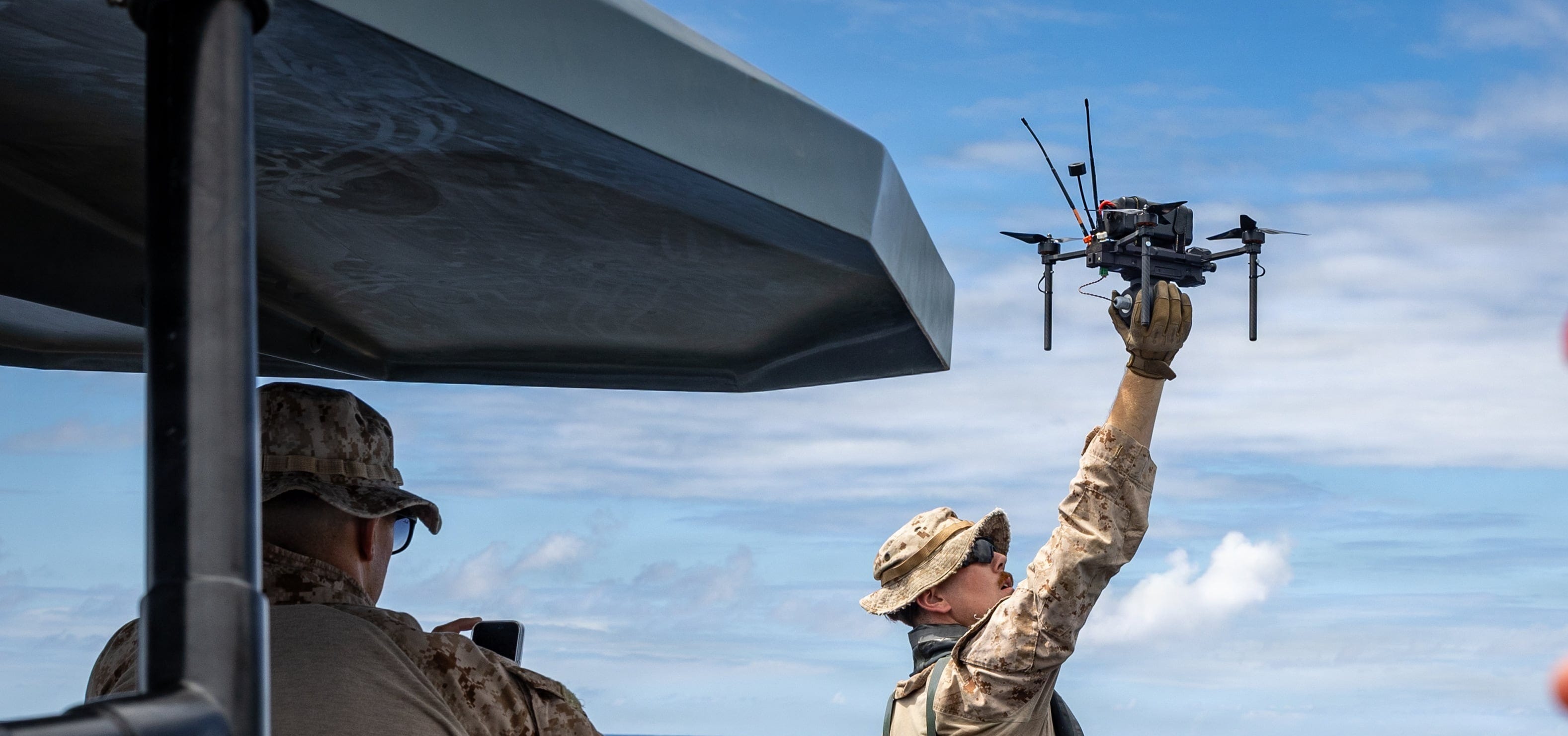
BLUF: Neros Technologies and Perennial Autonomy took top spots in the latest phase of the Drone Dominance competition. Neros scored highest in the confined-environment category while Perennial Autonomy claimed the top spot in the deep strike category.
In total, the department ordered 14,000 drones from Neros which also ranked third in deep-strike testing and 8,000 from Perennial.
The Pentagon has completed one-and-a-half gauntlets along with three operational tests. Neros has ranked second, third and first in those competitions, earning the company roughly $100M in orders.
Earlier this year, the DoW awarded Perennial a $500M contract through JIATF-401, which is responsible for researching, testing and procuring counter-drone technology for the department.
Drone Dominance Phase III – Deep Strike and Close-Quarters Battle
BLUF: The Phase III RFS continues two one-way attack mission areas: Deep Strike and Close-Quarters Battle, including urban and subterranean environments.
The RFS describes more complex mission scenarios and requirements for integrating commercial and Government-provided lethality solutions.
It sets out a standard path beginning with a pitch deck and live flight evaluation, and a separate path for eligible Gauntlet II winners.
Vendors advancing to the production sprint must deliver systems for Gauntlet III.
Related: Pentagon Opens $450M Attack-Drone Round with a 400-Drone Deadline
DoW Accelerates Counter-UAS Employment to Defend American Airspace Sovereignty
BLUF: SECWAR issued a memo on Accelerating Employment of Counter UAS to Protect American Airspace Sovereignty.
It seeks to accelerate the lawful, safe, and effective employment of c-UAS across the Department.
It directs the DoW to eliminate unnecessary barriers that delay c-UAS capabilities for forces, installations, and assets.
The memorandum targets four barriers that have delayed fielding of c-UAS capabilities:
Authorities to operate: CDAO and CIO establish single DoW-wide processes to reduce approval timelines for tested and validated systems to days or weeks.
Spectrum certification and frequency: The CIO will review the c-UAS spectrum-request process and recommend ways to accelerate approvals.
Weapons safety: JIATF-401 will synchronize c-UAS weapons safety reviews with the DRPM UxS.
Legal reviews: Required reviews for c-UAS weapons and weapon systems will be expedited, generally within 10 days after receipt of necessary information.
How AI Agents are Informing JIATF-401’s Procurement Plans After Falcon Peak
BLUF: Under BG Matt Ross’ leadership, JIATF 401 is cautiously applying AI to review heaps of data the military captured on commercial counter-drone products demonstrated at the recent, month-long Falcon Peak exercise.
JIATF 401 is turning to agentic AI to speed up and support procurement decisions following Falcon Peak 26.2.
This Army-led task force serves as a synchronizer and enabler for the department to conduct wide-scale technology tests, streamline safety standards and enhance its counter-unmanned aerial systems arsenal.
One of the elements of this Falcon Peak exercise that Ross is most excited about is the fact that we do have the codified test standards now across the entire DOW.
JIATF 401 established a tech arsenal and put all the data into a central repository, and then using agentic AI to be able to sort through that mass of data, to provide better results and relative comparison between systems that have been evaluated at different instances during Falcon Peak 26.2.
An example search: I’m looking for an active radar that can sense Group 1 and Group 2 UAS between one and four kilometers, and my price point is $15,000, and I can’t go above that. What have we tested in the last 10 years? Please provide me an output in a table that prioritizes or that rank orders by performance
JIATF 401 Launches C-UAS Mobile Training Teams
BLUF: JIATF 401 awarded OWT Global the Joint Counter-small UAS Mobile Training Team (MTT) Services contract with an estimated ceiling of $38.2M to support C-sUAS training requirements across the enterprise.
This contract will provide mobile training teams, develop curriculum, deliver instruction, and assist in synchronizing training of the Joint Services.
This contract accelerates JIATF 401’s effort to strengthen C-UAS protection for warfighters, installations, critical infrastructure, and Americans at home and abroad by providing training that applies the lessons learned from combat zones tailored to the warfighter’s specific operating environment.
Echodyne Lands IDIQ Contract for US Domestic Shield Programme
BLUF: Echodyne won an IDIQ worth up to $250M over a 36-month ordering period to supply MESA radars for JIATF-401’s Domestic Shield counter-drone mission, with the radars listed on the JIATF-401 C-UAS Marketplace for US and allied forces.
NNSA, Counter-Drone Task Force Create Framework for Data Sharing
BLUF: National Nuclear Security Administration expanded its partnership with DOD’s JIATF 401 to reduce duplicative testing and speed up drone defense deployments.
As part of the deal, the two entities created a framework for sharing counter-UAS test data and research in an effort to better understand evolving threats, reduce duplicative efforts and accelerate the deployment of drone defense capabilities.
“Protecting NNSA’s laboratories, plants, and sites from evolving threats is critical to our national security mission. This agreement strengthens our partnership with JIATF-401 and helps ensure we are moving quickly to put the best capabilities in the field.” - Brandon Williams, NNSA, Administrator
DOW CTO Partners With In-Q-Tel to Accelerate Technology From Non-Traditional Performers to the Warfighter
BLUF: OUSW(R&E)/ASW(CT) partnered with In-Q-Tel to give the Department's research and engineering enterprise structured access to IQT's global technology-scouting platform and its portfolio of early-stage companies, with the explicit objective of compressing the timeline to transition and rapidly field mature commercial solutions from non-traditional performers to the warfighter.
Under the agreement, IQT will conduct technology scouting and technical due diligence across all six CTAs, as well as across enabling technology areas, while the DoW identifies transition sponsors and pathways for validated technologies.
The integration leverages In-Q-Tel's proven venture capital methodology to vet early-stage commercial solutions that align directly with the Department's urgent mission requirements.
"In a contested global threat environment, technological superiority will not be determined by who invents a capability first, but by who delivers it to the warfighter fastest. The Department is fundamentally shifting its posture: we are moving from acting solely as a long-cycle technology developer to operating as an agile, credible, and rapid customer for America's most innovative non-traditional performers. Over the next 12 months, our benchmark for success is simple and unambiguous: moving validated commercial prototypes out of the lab and into active operational field evaluations with our combatant commands." Michael Dodd, ASW(CT)
Related: Pentagon partners with CIA’s In-Q-Tel for ‘technology scouting’
The Coming Wave of High-Powered Microwaves

BLUF: High Powered Microwave (HPM) weapons will play a central role in the anti-drone operations of militaries in the coming years as they are deployed onto battlefields. Its ability to bypass electromagnetic hardening methods and its practically unlimited magazine capacity makes it a key asymmetric weapon to counter the swarms of drones that modern militaries are beginning to field.
HPMs have emerged as the primary EMP weapon nations are pursuing to counter drones due to their effectiveness and practically infinite magazine capacity.
Once these systems enter the battlefield, HPMs have the potential to become the most capable and cost-effective anti-drone system in the near future.
High Powered Microwave weapons which are devices that convert electricity into concentrated beams of electromagnetic energy through a device called a vircator to induce electrical surges that can disable or destroy electronics.
HPMs are difficult to defend against.
The high cost of HPMs is reflective of the precision equipment and expertise required to produce such exquisite weapons. Therefore, the mass procurement and the broad deployment of HPMs to all areas of the battlefield are unlikely in the near future.
HPMs can disable or destroy large quantities of drones in single strikes, making it much more suited towards countering dense swarms of drone formations which will become more prevalent with the advent of AI-enabled drone swarms.
In a 2025 live-fire demonstration, Epirus’s Leonidas HPM system disabled 49 drones in one single EMP strike.
The ability to target a drone’s electronic components, of which are irreplaceable or difficult to defend, makes HPMs a long-term defense measure to the coming waves of ever more complex drone formations.
Its practically unlimited magazine capacity will reverse the asymmetric advantage drones have held over defending militaries, by dramatically lowering the costs of sustained anti-drone operations.
The Drone Wars Are Coming Update

BLUF: Mach Industries raised $600M this month in an extended Series C funding round that takes the company’s valuation to $3.7B. This sizable investment is a follow-up to the $300M round that made this fledgling startup a mil-tech unicorn in June.
Now armed with a fresh infusion of cash, Mach Industries plans to leverage solid rocket motor propulsion to take the company to new heights.
Ethan Thornton was just 19 years old when he quit MIT to create the defense engineering startup of his dreams.
In July, Mach Industries participated in a live international exercise know as MILEX VANGUARD 2026, where the company demonstrated the Viper’s capabilities for representatives of the Lithuanian and Estonian Armed Forces.
The Glide operates on a similar principle to the Viper, albeit in reverse. As Sun Tzu once said, “he who is skilled in attack flashes forth from the topmost heights of heaven,” and that is exactly the kind of tactical advantage the Glide provides.
The Stratos is a high-altitude “pseudo-satellite” that looks more like a hot air balloon than a weapon of war.
Mach Industries is also hard at work on Forge, a project that aspires to create a decentralized network of drone factories that will be faster, cheaper, and harder to disrupt than their centralized counterparts.
Mach Industries made its first corporate acquisition in May, when the company procured the rocket motor startup Exquadrum for $50M.
Mil-tech startups like Mach aren’t just building drones anymore, they’re advancing the art of rocket propulsion in the name of military defense.
Anduril Snaps Up Popoto Modem

BLUF: Anduril acquired Popoto Modem to accelerate their efforts to develop, produce, and deploy a fleet of autonomous underwater systems.
They have worked together for several years and have integrated the company’s acoustic modems into a variety of products across Anduril’s family of maritime systems, including their Copperhead UUV.
Popoto changes how a modem (the little device that converts data into signals that can be transmitted and received over a communications link) processes stuff.
Their modem automatically adapts how it sends data based on underwater conditions, trading speed for reliability when the acoustic channel gets worse.
It also deliberately sends redundant information. At lower data rates, it repeats/codes bits so that even if parts of the acoustic transmission get mangled, the receiver can reconstruct the message. That’s called forward error correction.
Now that Popoto is under the Anduril umbrella, the plan is to take that capability and scale it all the way up.
“Unlike drones that operate in the air domain or on the ground, or even space systems, we don’t have the luxury of using RF communications. That just simply doesn’t work subsea. The only way to communicate with systems subsea is through acoustic communications, and it’s a challenging physics problem.” Andrew Nuss, Anduril’s Managing Director for Maritime
Swarmbotics Unveils Its Fifth-Gen Mini Autonomous Ground Vehicle
BLUF: Swarmbotics AI unveiled the fifth-generation FireAnt, a sub-100-pound autonomous ground vehicle with new suspension, hardened weatherproofing and more onboard AI compute, after winning the Army’s xTech Overwatch competition and riding on Bradleys in a 1st Cavalry Division exercise.
Destruction on a Budget
BLUF: The key to UAS navigation and guidance is electro-optical navigation – comparing visual images of the terrain with map databases. Once an exotic superpower monopoly, this can now be done with consumer-grade sensors, ubiquitous terrain data and overhead imagery.
Ukraine was using slow, noisy but long-range FirePoint FP-1 propeller missiles to attack sprawling targets that could usually survive conventional missile attacks through size and redundancy.
Small and deep in ground clutter, the missiles ambled hundreds of miles to their targets overnight, visually identified critical aimpoints, using simple cameras and commercial satellite imagery.
Then they struck in high-angle Stuka dives, their extreme precision multiplying the effects of their small warheads.
In FY27 the Pentagon is funding the Family of Affordable Mass Munitions (FAMM), intended to deliver 28,000 guided weapons of 400 to 800 km range by 2033 (six funding years) at an average unit cost of around $20K
Contracts in FY27 for the Low-Cost Containerized Missile (LCCM) went to four companies, one traditional Leidos, and three non-traditional Anduril, CoAspire, and Zone 5.
Each come with novel designs, production, and employment techniques.
If we can cut guided-weapon cost by an order of magnitude, using machinery that can be accelerated into three-shift production overnight, the line of missile cost gets much flatter. Which changes everything.
“We’ve implemented map-matching on an inexpensive night-vision camera” - Denys Shtilierman, FirePoint, Chief Engineer
Boeing 777 Boosts Hypersonic Testing Capacity by 35% for US Defense Programs
BLUF: Stratolaunch is adding a Boeing 777-200ER to its Roc and Spirit of Mojave carriers, raising flight capacity 35 percent once modifications finish in 2027, after 10 successful Talon-A hypersonic flights and a $90.8 million contract under the DoW Test Resource Management Center’s MACH-TB program.
“As demand for hypersonic technologies continues to grow, we’re building the operational scale to make routine hypersonic testing a reality.” - Zachary Krevor, Stratolaunch, President and CEO
Quantum Technology Could Transform the Way We Detect Radio Signals With More Sensitive RF Sensors

BLUF: SwRI and Adelaide University signed a three-year MOU on superconducting quantum RF sensing and signal interpretation, covering kilohertz to terahertz with devices whose size does not grow as frequency drops.
“Unlike conventional antennas that get bulkier in size as frequencies get lower, quantum RF device size is independent of frequency.” - Michael Quinn, SwRI Staff Engineer
Other Defense Tech News:
Heavily Damaged Sub USS Connecticut Now Won’t Return To Service Until 2027
Shipbuilder Behind Failed Constellation Class Wants Back Into The Navy Frigate Business

YTD Stock Performance of the Big 5 Defense Primes
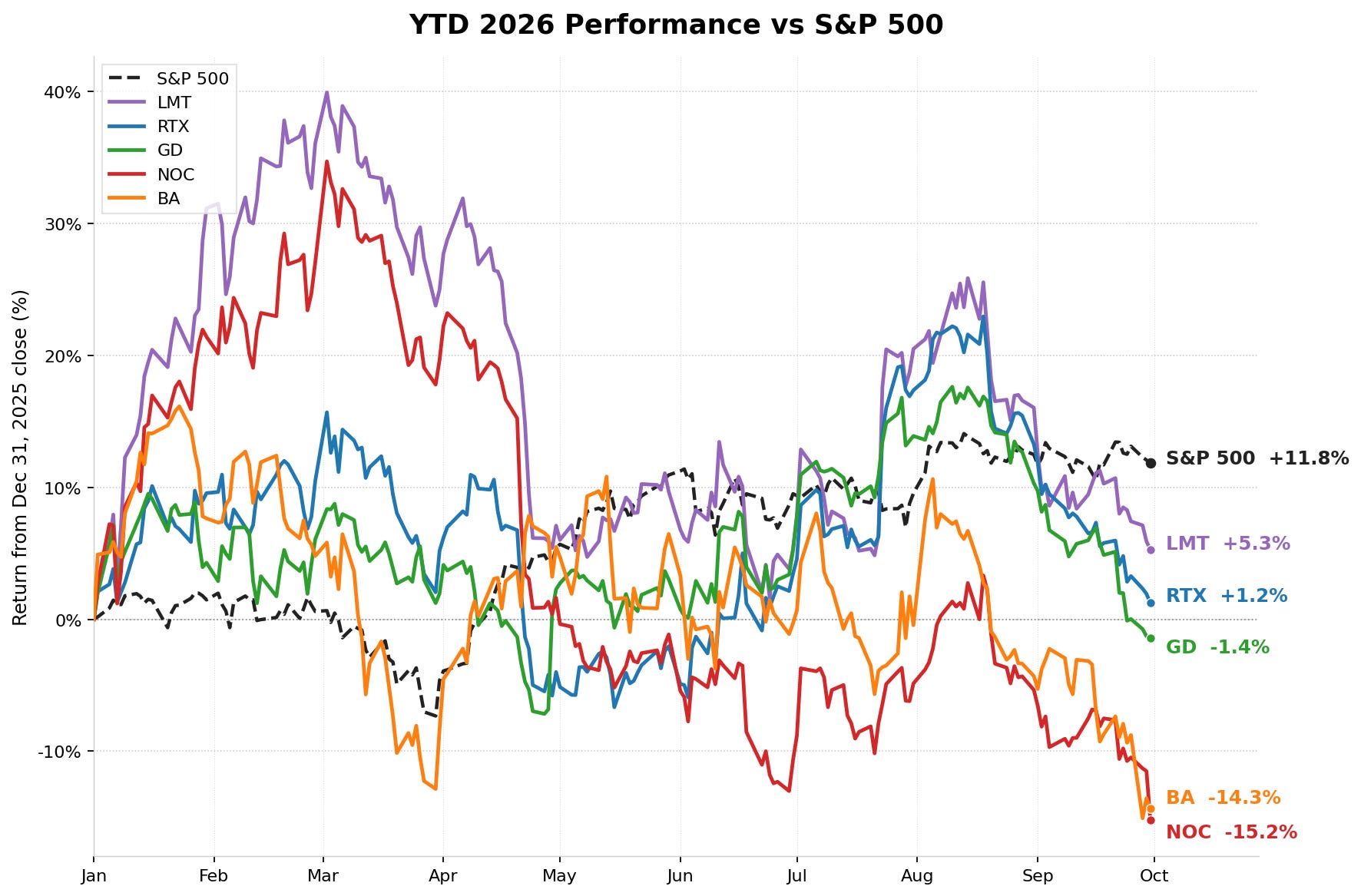
Our Take: Defense backlogs are at record levels, yet the primes stocks badly trail the market. Operations produced a classic conflict premium, then the market spent the rest of the year marking that premium back down. We see three distinct phases.
Operations Rally. Absolute Resolve in January and Epic Fury at the end of February led investors to quickly price in higher demand on interceptors, strike weapons, and sustainment. Lockheed and Northrop led, peaking 35-40% in March while S&P 500 was essentially flat.
The Fade. As the high-intensity conflict eased, so did stock prices. By May the primes had given back most of the first-quarter gain, and several were in the red for the year. The Pentagon later sought billions to replace expended munitions. Investors treated that as a future production problem, not a current earnings surprise.
False Spike: The Pentagon had the Summer of Love for the Defense Primes, awarding them many mega $20-70B contracts for major weapon systems helping drive a second surge in August. The January EO and DoW’s policies put limits on defense stock buybacks, dividends, and CEO compensation to focus investments on CapEx. DEPSECWAR issued a memo seeking greater cost and pricing transparency and the Pentagon establishment of fair and reasonable margins. Since that memo, each prime saw a consistent decline, while the S&P 500 is up 11.8%. Lockheed Martin is the only name still clearly positive. Northrop Grumman and Boeing are 27 and 26 percentage points behind the index. FY27 opens under yet another continuing resolution.
The big-5 primes have massive defense backlogs of hundreds of billions equating to 2-3 years of revenue. LMCO $230B | RTX $119B | NG $105B | GD $113B | Boeing $85B.
Investors want to see defense primes convert their backlog into higher production, margins, and free cash flow. Washington is constraining all three: a CR limits new starts, the margins memo pressures pricing, and the EO restricts cash returns to shareholders.
The State of Investment in Defense: Unlocking Growth
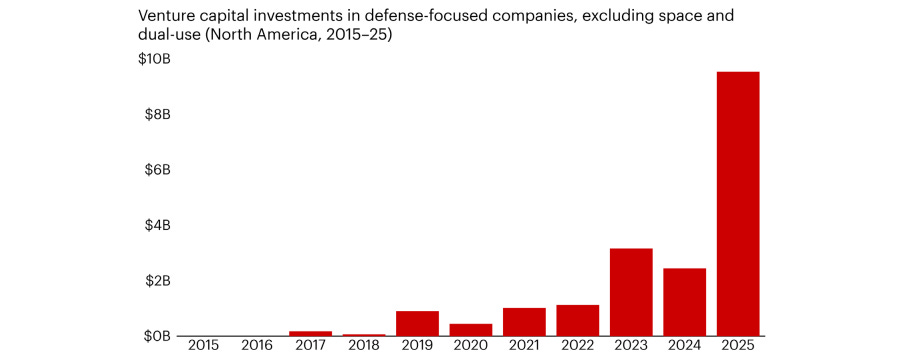
BLUF: The gap between US defense requirements and budgets is accelerating, and demand for both conventional systems and new lower-cost capabilities is surging. Current acquisition, business, and investment models are increasingly out of step with security requirements. Private sector investment is central to solving these challenges. Expanding production and driving rapid innovation require sustained investment, but key pockets of the defense sector struggle to attract it. It’s not an overall shortage of capital, but a shortage of investable opportunities.
Defense is becoming more attractive for private investment. Strengthened demand signals, the need to replenish stockpiles, and the potential for acquisition reforms have spurred growing capital inflows and higher defense-company valuations and capital expenditures.
Government defense spending, adjusted for inflation, has been flat since 2008.
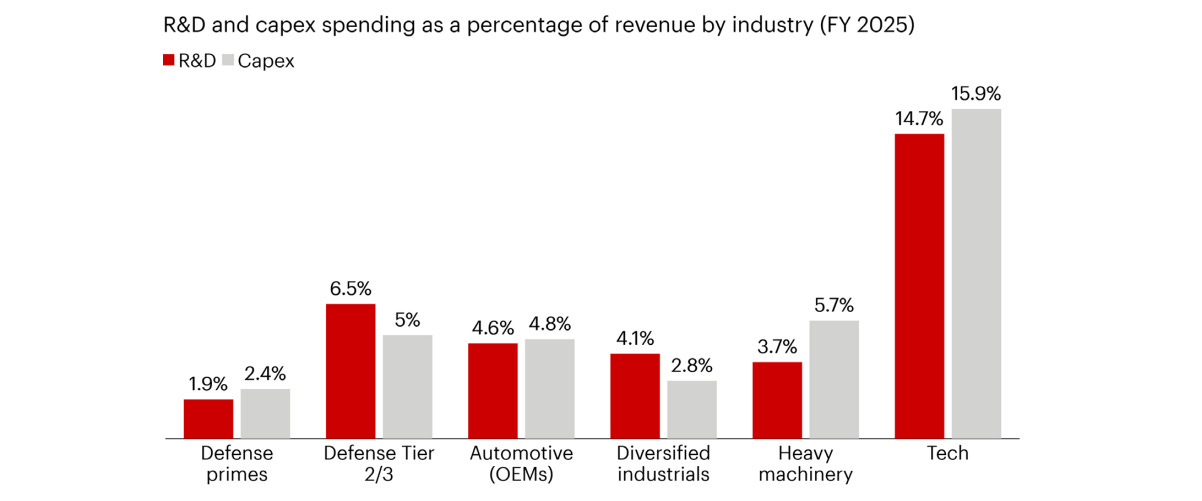
Profit margins for defense companies are among the lowest of US large capital goods industries, reinvestment ratios for public defense companies trail commercial counterparts, and rapid scaling of new technologies remains difficult.
As a result, earnings multiples for mature defense companies are similar to utilities: low risk, stable cash flows, and capped upside.
Overcoming enterprise challenges requires consistently higher levels of company at-risk investment and commensurate rewards to offset that risk.
But alternative procurement approaches designed to do those things remain a tiny fraction of defense spending.
How to encourage private investment
Back clear priorities with funding; link risk and reward; reduce buying and selling friction; grow market volumes; develop flexible sources of capital; and improve performance.
Market valuation of Aerospace and Defense Companies in 2025:
Public market $1.6T | Venture Capital $198B | Private Equity $150B
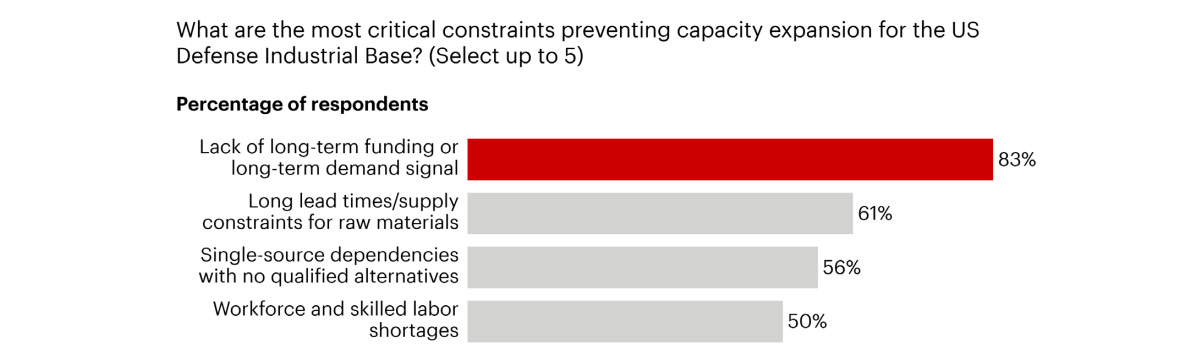
“Previous investment and business models must adapt for the new environment. Investment growth of all kinds is required to address capacity and innovation constraints—and that growth will occur when all stakeholders work in tandem.” Michael Sion, A&D Partner, Bain & Co.
“Across the defense industrial base, companies are investing billions in new facilities, production capacity, workforce development, and innovation to meet the nation’s security needs and deliver capabilities to the warfighter. Continued investment at that scale depends on a healthy capital environment, predictable demand, and policies that give businesses the confidence to invest for the long term.” Eric Fanning, AIA President and CEO
Our Take: This is an excellent report by Bain and AIA. We highly recommend reading their Exec Summary and Full Report as our summary above only scratched the surface. They reinforce that to attract private capital investments in defense, we need to rethink core acquisition models that reward defense tech companies investing in their own development, demonstrating performance, and earning production contracts.
Related: As private investment in defense increases, some bottlenecks in funding
Saronic Breaks Ground on New Port Alpha Shipyard in Texas

BLUF: Saronic broke ground on its Port Alpha shipyard in Texas, starting at roughly 800 acres with room to grow to 4,000 and a goal of about 10,000 direct workers building autonomous and manned vessels.
In attendance at the groundbreaking was VP JD Vance and Gov Greg Abbott.
Saronic’s Landing Craft Utility vessels will be built at the new shipyard.
Deliveries of the vessels, which are designed to shuttle personnel, weapons, and cargo, are expected to start in late 2028.
Starting January 1st Saronic will have the production capacity to build 20 Marauders per year for the Navy’s MUSV program.
“Port Alpha is designed from the ground up to produce both autonomous and manned vessels at scale, with modularity and throughput shaping the facilities architecture. This is one of the defining engineering challenges of our time, and we are building the team, partnerships, and capital base to meet it. There is a capacity problem in the U.S. Saronic and Port Alpha are solving it” - Dino Mavrookas, Saronic CEO and Co-Founder
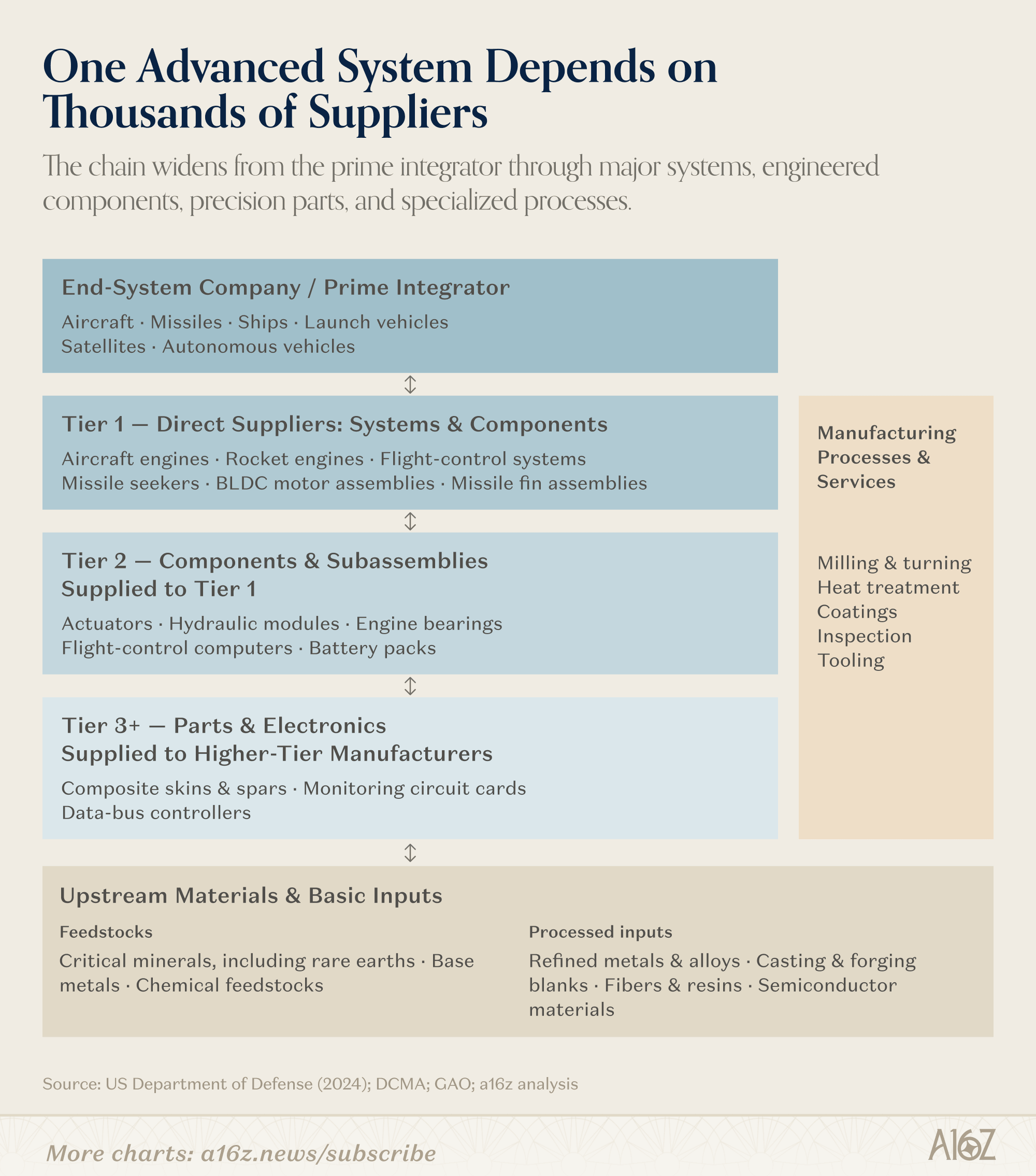
The Hidden Bottleneck Behind America’s Missile Production

BLUF: RTX received a $23B contract to ramp production up to 1,000 Tomahawk missiles per year, but RTX Chairman and CEO Christopher Calio needs more suppliers, including casting suppliers.
Castings are vital to the U.S. missile industry. They are at the very heart of Tomahawk production, and other critical defense munitions.
But the economics of producing them, especially low-volume and highly specialized castings, can be pretty rough on the casting companies making them.
Single-source supply chain risk is also prevalent, such as having one foundry for titanium castings. What’s more, the industry relies on old equipment, and it lacks sufficient post-processing capacity for value-added activities such as heat treatment, machining, and coating critical to producing a finished casting.
Casting is a foundational technology that is the backbone of American manufacturing.
The aerospace and defense side of the industry is defined by low volume, high product mix, and high specialization.
Not only are there not enough suppliers of castings, in many cases there is no one to supply them.

The Case for the American Manufacturing Asset Class
BLUF: To prevail in any large-scale conflict, America must build a durable industrial base capable of turning the past decade’s defense-tech renaissance into an overwhelming arsenal that makes clear a war with the U.S. is not a war worth starting.
To do this, we must rebuild our industrial base technology-first. We will not debase our Western ethics to chase Chinese labor costs, nor imitate a model that subsidizes uneconomic overcapacity to dominate critical supply chains and weaponize that dependence in a crisis.
We will win by leveraging frontier technology and the world’s deepest capital markets to build productive capacity that is economically durable on its own.
That makes this industrial build-out a national security imperative and, at the same time, a massive opportunity for American capital.
We are entering a new age of manufacturing, one that may be inspired by Silicon Valley, but will be built across Middle America, creating what will become a brand new American manufacturing asset class.

DoW and RTX Accelerate AMRAAM Production Through $20.7B Award
BLUF: DoW announces an award to Raytheon that consists of a five-year multi-year contract with two option years valued up to $20.7B to produce Advanced Medium-Range Air-to-Air Missiles (AMRAAM), a critical air defense capability for U.S. and allied forces.
This contract marks the latest victory in the Department's campaign to expand the munitions industrial base, nearly doubling AMRAAM production.
Ground Broken on Avio USA’s First US Manufacturing Site
BLUF: Avio USA broke ground on a roughly 900,000-square-foot solid rocket motor plant in Hurt, VA, to supply thousands of tactical missile motors a year to primes including Lockheed Martin and Raytheon, with production starting in early 2029.
“Our goal is to be an independent, open-source merchant supplier, able to support multiple customers and programs and provide major defence primes with an additional source for this critical capability.” - James Syring, Avio USA, CEO
Hertha Metals Raises $133.65M Series A
BLUF: Hertha Metals raised a $133.65M Series A, including $65M from the US government through the Industrial Base Analysis and Sustainment program, to build a plant making high-purity iron for domestic rare-earth magnet makers ahead of the 2027 ban on Chinese magnets in DoD equipment.
Counter-Drone Startup Fortem Raises $50M Series B
BLUF: Fortem Technologies closed a $50M Series B, including Unusual Machines, following a $25M Lockheed Martin investment in April and recent DHS and Army contract wins.
Aeon Brings Destinus’ Interceptors Stateside
BLUF: Aeon will build Dutch firm Destinus’ Hornet interceptor under license at a new 145,000-sq ft Texas facility, targeting 500 units a month once production starts in 2027.
“The bigger story is onshoring production through this license agreement with Destinus. xTech is a place to demonstrate it.” - Wes Shover, Aeon CGO
Why the Pentagon Just Dropped $450M on Tungsten Mining
BLUF: The DoW announced a $450M investment in The Elmet Group to strengthen the U.S. supply chain for tungsten, a critical mineral used for manufacturing military weapons ranging from bullets to missiles.
The Elmet Group is the only U.S.-owned, fully integrated producer of tungsten and molybdenum materials and components.
China dominates the global tungsten supply chain, while the U.S. has not mined tungsten since 2015.
China controls about 85% of the world’s tungsten supply and 40% of its molybdenum, a similar material that is often mined in the same areas.
“This investment reflects the Department’s commitment to rebuilding critical industrial capacity in the U.S. It will strengthen supply chain resilience, support high-quality manufacturing jobs, and reinforce the production base behind essential defense systems.” Michael Cadenazzi, ASW(IBP)
Defense Firms Plan Big AI Investments Amid Labor Challenges
BLUF: Aerospace and defense manufacturers are looking to make sizable investments in AI in 2027 despite persistent struggles to find skilled operators for automation and AI-enabled technology.
Half of aerospace and defense manufacturers said AI and automation operators were difficult to hire, and manufacturers across industries ranked them as the hardest-to-fill positions, beating out jobs such as engineers, maintenance technicians and machinists.
The manufacturing workforce of the future must be “bilingual, where they’re both fluent in shop floor as well as in the software.
Aerospace and defense companies have the most significant hiring goals among industries, with nearly 80% intending to add workers in 2027.
82% of A&D manufacturers plan to allocate more than $500K for AI in 2027.

Speed to the Warfighter Starts With the Problem, Not the Product
Ten years ago, Steve Blank and I made a bet. Put a real problem, owned by a real person in uniform, in front of a smart team. Force that team out of the building to talk to a hundred people who live with the problem. You will get a better solution, faster, than the requirements system produces. That bet became Hacking for Defense.
This summer I watched the strongest teams to come out of that pipeline go through a ten-week commercialization fellowship run by the DIU. They got advisors, a modest prototyping fund, and access.
What separated the most successful teams was the problem, not the product.
The sponsor suffered the problem rather than observed it.
The stakes were measured in lives, not efficiency.
The team validated its hypotheses in conversation, not in the lab.
A portfolio executive at headquarters, however empowered, cannot see the distinctions that matter without ground truth from the fight.
Stand up small, cross-functional problem discovery teams with operational units, scanning every week for how the adversary adapted since the last one.
Require a dated test with a named customer before a prototype is funded.
Einstein said that given an hour to save the world, he would spend fifty-five minutes on the problem and five on the solution. For a decade the department has spent its reform energy optimizing the five minutes.
Our Take: Listen to Pete and Steve. Get out of the office and talk to many operators. Understand their problems, their environments, and priorities. Bring the operators potential solutions to test in weeks, not long after they’ve rotated to new assignments.
The Imperative for Acquisition Reform
BLUF: Today, the U.S. faces two nuclear-armed peer competitors, and the submarine acquisition enterprise must deliver fast-attack and ballistic-missile submarines at a pace that matches the threat—but it is not. The reason is not a lack of effort. It is how the enterprise is organized, incentivized, and funded.
The Navy has been buying submarines one supplier proposal at a time, in a system that cannot scale. Fixing that starts with the Navy and industry being honest about what they are trying to produce.
As the DRPM, Submarines (DRPM SUBS) and PAE Undersea, my main objective is achieving the necessary rate of submarine production.
The first step in any reform is to understand the scale of the problem. My visits to the prime shipbuilders made clear how difficult submarine construction remains.
The Columbia- and Virginia-class submarines are extraordinarily complex machines. The yards are full of workers and supervisors who are working hard, learning, and innovating in a demanding production environment.
Today, the demand signal is three times the number of boats and more than five times the submarine tonnage per year compared with 20 years ago.
As we ramp up production of new submarines, the Navy must also do a better job maintaining the current fleet.
Current industrial and supply chain weakness makes the challenge harder. Sequence-critical material is a recurring barrier to production and maintenance.
Three Immediate Levers
Workforce growth. This requires strong recruitment and retention. At the same time, selected work is being outsourced and existing labor realigned to increase productive capacity where bottlenecks exist.
Productivity. This area provides the biggest near-term opportunity. Productivity improvement must come from coaching, mentoring, deckplate improvement, and incorporating new technologies and methods.
Industrial base and supply chain. The Navy must improve the delivery of sequence-critical materials, engage lower-tier suppliers early, and remove bottlenecks before they become schedule killers.
Four Pillars for Long-Term Change
Stabilize design. Every change introduces delay, confusion, rework, and cost growth. The objective is efficient, predictable production.
Empower shipbuilders to do what only they can do. Every hour a master shipbuilder spends on a commodity part is an hour not spent building a submarine.
Align and activate the industrial base. The Navy must provide the right incentives to the supply base by turning demand signals into multiyear contracts and aligning the timing of critical material orders.
Design future submarines for producibility and sustainability. The Navy must avoid designs that optimize performance but create barriers to on-time construction or maintenance.
I want the enterprise to understand the work ahead - not as a burden to be endured, but as the chance to reinvigorate the arsenal that once was.
Logistics: One Byte at a Time
Kevin Wheeler, Hannah Flynn, Ben Van Horrick
BLUF: An old adage holds: bullets don’t fly without supply. Today, bullets don’t fly without bytes. DoW’s fortification and digitization of its supply chains is a long overdue investment and especially logistics command and control (C2).
Logisticians still struggle like the Flintstones. Recent offerings from defense technology firms give joint force logisticians powerful tools to move planning from the stone age to the AI age.
That promise has yet to translate into uniform results as each service pursues its own Logistics C2, leaving the joint force without a coherent logistics picture.
Recent events in the Middle East, including the difficulty of resupplying aircraft carriers and gaps in the movement of wounded service members, bring this shortfall to the forefront.
The system must be service-agnostic, capable of integrating across Joint and Combined forces, and delivered to the tactical edge.
Today that demand signal resides on spreadsheets, PowerPoints, and siloed databases. These methods prevent cross-enterprise visibility, and slow resupply and decision making when speed proves decisive.
Building on the model of the U.S. Army’s Operation Jailbreak, every logistical data system should be required to prove its ability to integrate with the joint force, not just at the service level.
DCAA Audit Guidance on Conformance of CAS to GAAP
H/T: Moshe Schwartz
BLUF: The Cost Accounting Standards Board (CASB) published a Final Rule, effective October 1, 2026, to remove and reserve CAS 407 to conform to GAAP.
CAS 407 no longer applies to any contract or subcontract. However, any noncompliance that occurred prior to the effective date must still be resolved.
The CASB transferred six unique requirements from CAS 407 to CAS 418 Allocation of Direct and Indirect Costs.
The Strategic Technology Incubation Model
BLUF: AI exposes a structural flaw in how the U.S. turns technological innovation into national capability. A technology becomes strategically significant when its deployment makes failure, unauthorized use, or operation outside its intended boundaries a matter of national security.
America’s private sector builds the technology; government typically enters later as a buyer, attempting to append national security requirements to commercial systems that have already matured.
That sequence fails for dual-use technologies that can shift rapidly from commercial software into cyber capabilities, intelligence platforms, autonomous systems, and critical military infrastructure.
Strategic Technology Incubation Model: Government defines the mission, security parameters, and operational boundaries from the outset. Industry builds up to those requirements. Independent testing then verifies compliance before government adopts the system as a mission-critical dependency.
As AI embeds into high-consequence systems, the architecture must ensure operators can verify what the system was authorized to do.
The private sector should remain the engine of AI innovation, with government intervention sharpening only as the potential consequences of deployment escalate.
Five Stages
Government defines operational mission and security requirements.
Industry engineers work against those defined requirements.
Independent testing and verification occur prior to adoption.
Government acquires and deploys the validated capability.
Continuous verification tracks system updates and state changes.
America does not have an innovation problem. It has a technology-to-capability problem. Moving security upstream is how it closes that gap.
NPS Acquisition Research Symposium Call for Papers and Panels
BLUF: The Naval Postgraduate School invites paper and panel proposals for the 24th Annual Acquisition Research Symposium & Innovation Summit, to be held May 12–13, 2027 in Monterey, CA. Proposals are due Nov 17, 2026.
Centered on the theme Delivering Warfighting Capability, this year’s event will examine how the defense acquisition ecosystem can improve readiness, deter adversaries, and deliver operationally relevant capability at the speed and scale required to maintain warfighting advantage.
Topics include revitalizing the defense industrial base, reforming acquisition processes, accelerating the transition of emerging technologies, and increasing the capacity to field and sustain solutions that meet warfighter needs.
Our Take: NPS remains a valuable forum for sharing acquisition research and connecting with others committed to advancing the profession. We encourage researchers with novel ideas and rigorous methods to submit proposals, particularly work that acquisition professionals and executives can act on.
The most useful contributions translate findings into recommendations that practitioners can take back to their organizations. Applied research that stays grounded in operational acquisition problems, draws on data sufficient to support its conclusions, and offers clear implications for policy, process, or practice does the most to move the field forward. Proposals framed primarily as extensions of specialized academic inquiry, or that conclude mainly that more research is needed, are less likely to deliver that value.
Streamlining Access to Government Services Through America.gov
BLUF: The President directed GSA and OMB to establish and operate America.gov as the single point of entry for Americans to access covered services online and integrate Login.gov with America.gov as the authentication service for America.gov.

Army Announces Futures and Autonomous Systems Command
BLUF: Acting SecArmy Adam Telle memo SECARMY Army Autonomous Initiatives directing the establishment of Army Futures and Autonomous Systems Command (FASCOM) and changes to Army force structure, acquisition, and personnel.
The Army is moving quickly to implement SECWAR’s direction to expand autonomous and robotic capabilities across the Joint Force.
The Army will integrate autonomous capabilities into at least six formation areas, including aviation, armor, fires, sustainment, engineer and training formations.
Designate a PAE for Autonomy and prioritize the acquisition and fielding of autonomous fires, combat vehicles, watercraft resupply, breaching, reconnaissance, surveillance and target acquisition capabilities, as well as collaborative teaming between crewed and uncrewed platforms.
Soldiers and technical experts required to employ these systems. The Army will expand authorizations for 15X Tactical Unmanned Aircraft Systems Specialists and 390A Robotics Technicians across applicable units, increasing trained autonomy professionals closer to tactical formations.
"The Army is rapidly advancing to maintain our lethal edge. We are forging the U.S. Army FASCOM to get cutting-edge technology into the hands of Soldiers, while prioritizing autonomy in our formations, our acquisitions, and our training to dominate the future of warfare. This is about combat readiness to destroy the enemy and ensure our Army never enters a fair fight." Adam Telle, Acting Army Secretary
Our Take: We could not be happier to see the Army move out on establishing a PAE for Autonomy. This executes the recommendations we made in June 2025 on Establishing Dedicated Unmanned PEOs. Similarly a new command focused on employing autonomous systems can fuel future warfighting solutions, but it must be staffed with innovators. There must be friendly competitions and challenges for FASCOM to disrupt traditional Army operations through autonomous systems.
Related: Army to establish new autonomy command, acquisition executive
Task Force, Army Announce Billions in Counter-Drone Tech Awards

BLUF: DoW awarded 10 C-UAS contracts with a collective ceiling of $4.15B and fall under an IDIQ vehicle that officials expect to reach $7B by the end of next month. So far, however, <1% ($50M) of the new awards have been obligated.
$150-$500M awardees include Allen Control Systems | Digital Force Technologies | DroneShield | Echodyne Corp. | Napatree Technology | PVP Advanced EO Systems | RADA Technologies | SmartShooter | SRC | L3 Harris WESCAM
JIATF 401 and the Army shepherded the vehicle as part of an effort to identify distinct defense requirements for units and critical assets increasingly vulnerable to drones, hoping to flood money into a market that military and industry officials have said is moving too slowly to meet demand.
The awards support the DoW’s drone and counter-drone marketplaces.
“These vehicles we awarded yesterday span a range of counter-UAS capabilities, from sensors to effectors to C2 systems. We want to bring better technology forward every day, and we don’t want to be locked into a single vendor as that threat evolves.” - Brent Ingraham, ASA/ALT
“What we’re trying to do through the marketplace is to connect those producers with customers so they can see that true demand across the United States, then also with our partners and allies. A large IDIQ contract will allow companies to raise additional capital to build up their inventory because they have a reasonable expectation that we’re going to continue to partner with them.” - BG Matt Ross, JIATF-401, Director
Related: Army Awards Up to $7B in Sprawling Counter-Drone IDIQ
Related: JIATF-401 Advances Domestic Shield With Counter-UAS Contract Awards
Capacity, Partners and the Courage to Act
BLUF: We must move faster. We’ve changed structures, authorities, processes and organizations to give ourselves more room to move. The question now is whether we’ll use that room differently.
We need to understand the operational problem, bring the right expertise to it early, make the risks visible and decide when the evidence is sufficient to move.
That requires us to accept informed acquisition risk now to reduce operational risk later. It doesn’t mean lowering standards, and it certainly doesn’t mean compromising safety.
We can develop the best technology in the world and still fail our Soldiers if we can’t build enough of it, repair it, replenish it or keep it operating under stress.
We need to understand supplier depth, producibility, sustainment, personnel, tooling, technical data and critical materials before our options narrow.
The Pathway for Innovation and Technology (PIT) can help us reach firms that may not have worked with us before.
Operation Jailbreak showed companies that had never worked together integrate systems in a matter of days because Soldiers, engineers, acquisition professionals and industry were working the same operational problem together.
Foreign Military Sales (FMS) can’t remain something we account for after U.S. requirements, production quantities and configurations are already set.
Under the Portfolio Acquisition Executive construct, bringing contracting, testing, sustainment, programming and other functions closer to portfolio decisions creates value only if we use that proximity to resolve issues sooner and make decisions at the right level.
Army Dives Headfirst into New Strategic Capital Initiative

BLUF: A new Army Strategic Capital Initiative inviting industry to co-invest in modernization projects that could provide both commercial and warfighting benefits has resulted in several partnership agreements, but work remains to ensure the effort makes a lasting impact.
The goal of the initiative is to supplement traditional funding with strategic capital, creating commercially viable and self-sustaining ventures that ensure long-term success without relying on the Army as the sole source of ROI.
The program comprises six strategic pillars:
Energy resilience and dominance
Modernizing the organic industrial base
Strengthening logistics and supply chains
Advanced manufacturing and technology adoption
Real assets and facilities utilization
Critical minerals and resource development.
The Army wanted to prioritize ventures that require a significant financial outlay up front where the service could utilize private capital so it doesn’t have to appropriate $1-$2B every year for these projects.
Five Defense Companies Selected to Develop Precision Strike Missile Increment 4 Prototypes
BLUF: The Army awarded OT agreements for PrSM Increment 4 to Anduril, Castelion, Lockheed Martin Missiles and Fire Control, Mach Industries, and RTX.
Each company will develop prototype missiles capable of launching from the M142 High Mobility Artillery Rocket System (HIMARS) and striking moving maritime and relocatable land targets at ranges of 1,000 kilometers or greater.
FY27: Initial prototype development will culminate in a competitive fly-off and down-select.
FY28: Vendors demonstrating mature, successful designs will be eligible for follow-on agreements and a final competitive fly-off.
Related: Army Selects Five Companies for PrSM Development and Army Taps 5 Companies for PrSM Inc 4 Prototypes
Army Hopes Reorganizing Fires Office Solves Long-Standing Problems
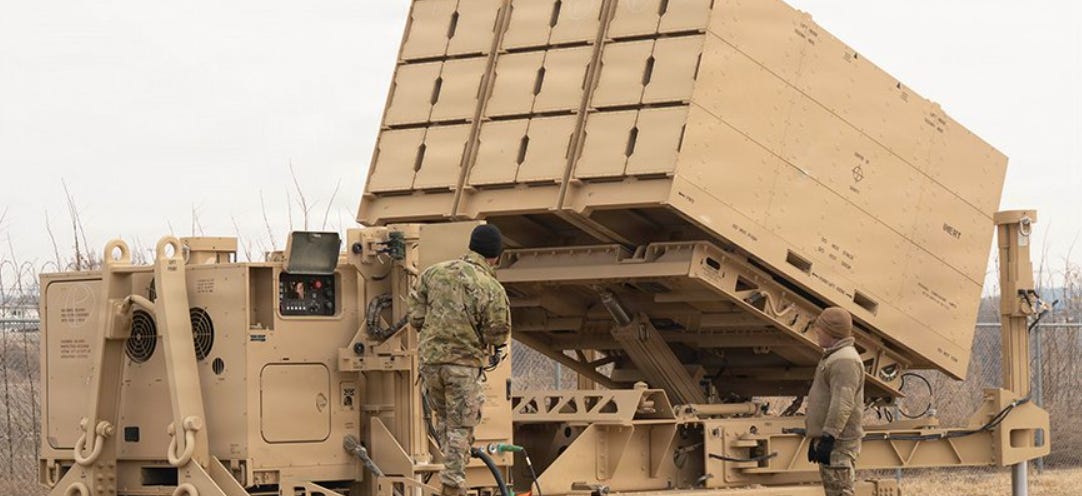
BLUF: The Army’s PAE Fires is rebuilding its entire enterprise to change not only how it buys weapons but what weapons it buys.
As part of SECWAR’s Acquisition Transformation Strategy replacing PEOs with PAEs, PAE FIREs implemented a fundamental shift in how it operates.
The goal is an organization that works together more seamlessly across its entire portfolio to offer more options to commanders faster.
LTG Frank Lozano, PAE Fires, in February activated the first three program management executives, at the time called capability program executives — offensive fires, defensive fires and integrated fires.
Each area is led by an acquisition executive with expertise in fires and represents a centralized approach to managing the Army’s fires portfolio.
The expansive fires portfolio includes 62 programs, both offensive and defensive. But the sheer number is why it also needs an eye on integration.
It has several ongoing competitions to create options, lower costs and help avoid dependence on a single provider.
Among its ongoing competitions are the Common Autonomous Multi-Domain Launcher, Indirect Fire Protection Capability Increment 2, Next Generation Short Range Interceptor, Low-Cost Containerized Munitions and Precision Strike Missile Increment 4.
Each addresses a different part of the battlefield — more autonomy, more affordability, greater range, greater capacity and greater mobility — to give commanders more options.
While the portfolio’s FY27 budget request jumped from $18B in FY26 to $47B, money alone does not solve its hardest problems. Energetics and propulsion currently require complex manufacturing and have limited capacity and constrained resources.
Everything is now viewed through a portfolio lens, and everyone is starting to ask questions and assess themselves as a portfolio, not through a soda straw of one product at a time.
“The value of this construct is that leadership can make decisions across the fires portfolio. We can look at the entire kill web, we can identify common requirements and we can align better across our sensors and shooters.” BG Robert Mikesh, PME for Offensive Fires.
Army Launches Night Court Review of Weapons Systems
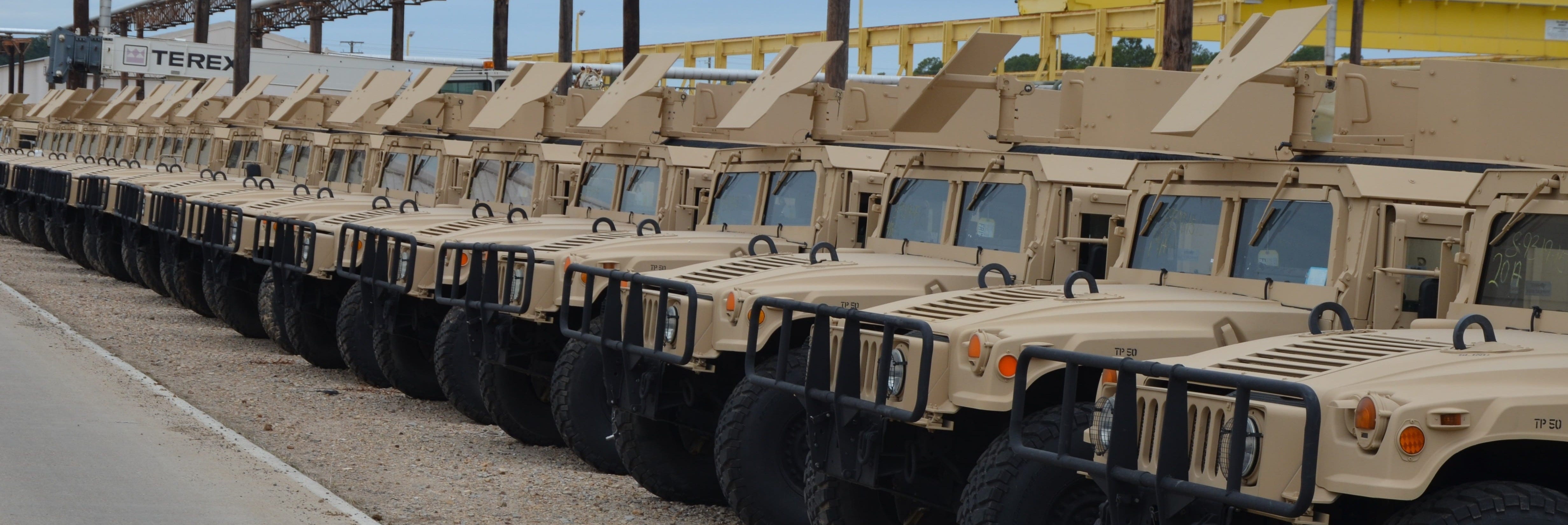
BLUF: The Army has begun Sustainment Night Courts and will continue over the next two months as Army leaders seek to secure a greater right to repair, prizing intellectual property protections away from manufacturers so soldiers can reset their own gear near the point of need.
The Army is looking at the logistics support plans and the source of repair for key weapon systems.
They are looking for opportunities to pivot certain systems from contracted logistics support to organic repair capabilities as well as shift source of repair decisions to the left.
“The holistic review of weapons systems will determine if we are postured appropriately, in terms of organic capability, and who has responsibility for our weapons systems and platforms. We talked about having multiple nodes distributing where we’re accumulating our materiel, so we’re not providing large targets for our adversaries, who have the means to disrupt our operations through long-range precision fire.” LTG Gavin Lawrence, Army Materiel Command Deputy
Robotics Competition Winners Advance Military Exploration of Humanoid Capabilities
BLUF: The Army named five companies as winners of its xTechHumanoid competition, capping an effort to assess how emerging commercial humanoid technologies could contribute to future military operations.
ACES Group: An integrated power system designed to address energy needs across humanoid robotic systems with scalable energy storage technologies.
IHMC Robotics: Alex, a humanoid robot featuring impact-resilient actuators, ballistic protection and hybrid autonomy combining AI and human control.
Hydroplane Limited: A lightweight, compact mobile power-generation system designed to provide long-duration power in contested logistics environments.
Ras Labs: Highly sensitive fingertip tactile sensors designed to enable robotic systems to detect force, object form, slip and other physical interactions.
Velocity Explorations: Software that builds on the company's C2 technology to translate information and command intent into discrete actions for robots.
“We are identifying the problems, mission needs, and opportunities to enable our formations with the right mix of tools. xTech is our method of surveying the industry landscape and fast-tracking promising technology rather than falling victim to years-long studies.” - Dr. Alex Miller, Army CTO
The Army’s Most Dangerous Logistics Problem Is Hiding Behind Motor Pools
Capt. Scottie Huggins
BLUF: The Army is quietly losing visibility of its own equipment due to disconnected property systems and fragmented asset management.
Errors in LINs, NSNs, and BOMs, plus excess and Found on Installation gear, trap serviceable equipment outside maintenance, redistribution, readiness planning.
CSDP enforces compliance, but no company-level leader owns end-to-end asset synchronization, so administrative accountability holds while ops visibility erodes.
Equipment that cannot be identified, tracked, or reintegrated is wasted readiness, not combat power, and will cost operational reach in large-scale combat.
A company Asset Management Chief, distinct from the PBO, should validate GCSS-Army data, recover FOI equipment, and synchronize the supply chain.
Army Acquisition Hall of Fame Welcomes Four New Inductees in 2026
The 2026 Army Acquisition Hall of Fame inductees are
Dr. A. Fenner Milton | Henry Muller | Chérie Smith | Lisa Stangle
Other Army News:
MG Michelle Link now PME Combat Sustainment within PAE Agile Sustainment
BG Ryan Howell now PME Acquisition Support within PAE Maneuver Ground
GDIT Secures $510M US Army Task Order for Global C5ISR-M Support

Boeing Wins F/A-XX Next Generation Navy Stealth Fighter Contract
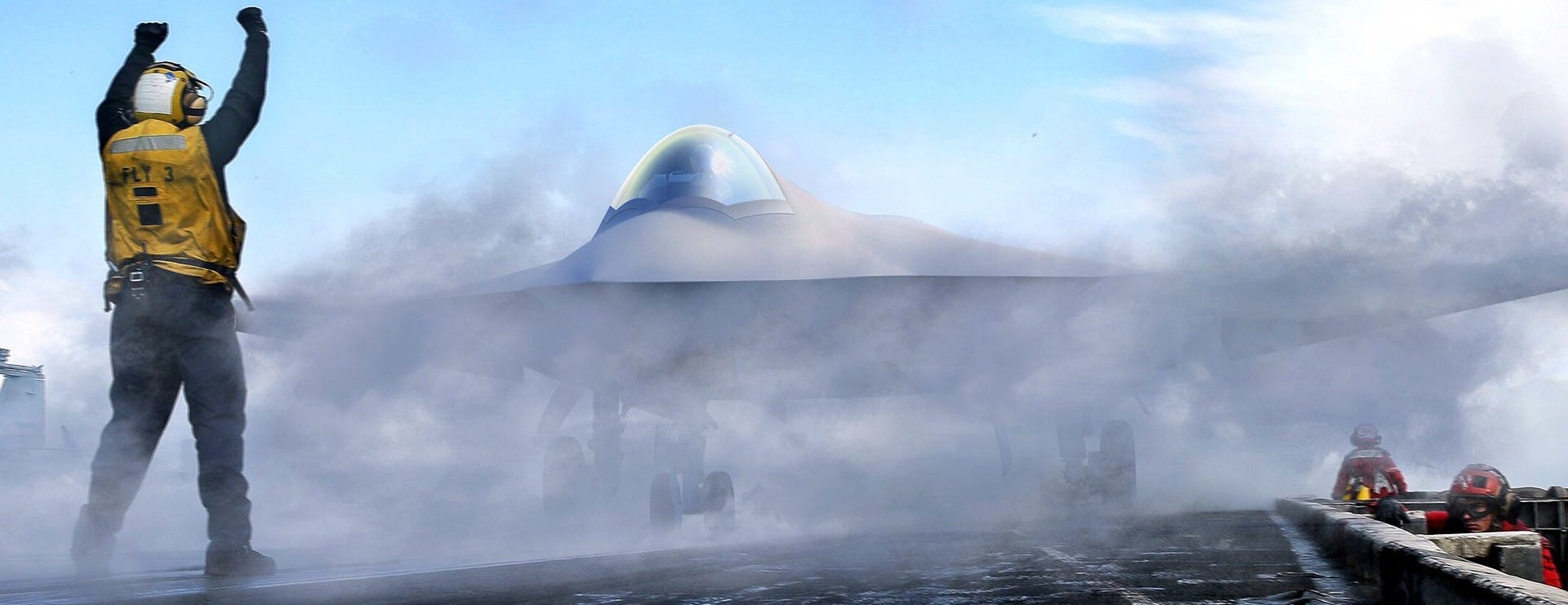
BLUF: Navy has finally announced Boeing as the winner of its F/A-XX next-generation carrier-based fighter competition.
F/A-XX has become one of the most hotly anticipated U.S. defense procurement decisions in recent memory after the Pentagon tried to shelve the program indefinitely last year.
Congress subsequently intervened to keep the F/A-XX program running, but its future had remained very murky until earlier this year.
The company will be able to leverage design work it has already been doing in relation to the F-47 program, as well as relevant production experience and supply chains.
We still have yet to learn just how closely related the two designs are.
“The F/A-XX is a critical pillar in our commitment to maintaining peace through strength. F/A-XX will dominate contested airspace, extend operational reach, and deliver a decisive combat advantage for the warfighter.” Michael Duffey, USW(A&S)
“Delivering two advanced fighters in parallel was always our plan, and we invested accordingly. We are ready and able to build multiple concurrent future combat aircraft franchise programs.” Steve Parker, Boeing Defense, Space & Security, President and CEO
Related: DoW Press Release, Boeing Wins Navy Next-Gen Fighter F/A-XX Competition, F-47 Maker Boeing Tapped for Navy’s F/A-XX Sixth-Gen Fighter, Navy Selects Boeing to Build Next-Generation F/A-XX Fighter, and Boeing Lands US Navy Contract for 6th-Gen F/A-XX Fighter
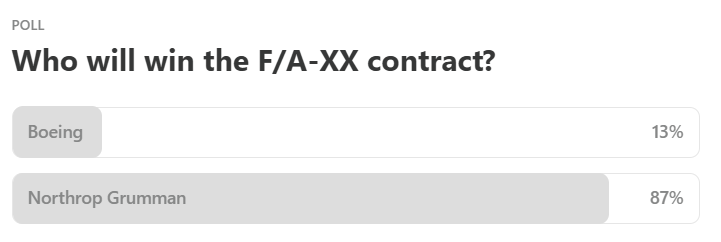
In April 2025, our subscribers predicted Northrop Grumman would win the contract.
What Boeing’s F/A-XX Win Means for the Company and What Challenges Come Next
BLUF: While the more than $20B win gives Boeing a stranglehold on America’s sixth-generation fighter fleets, the challenge now is making sure the company can execute.
Today’s win cements a major turnaround for Boeing’s defense arm. After years of struggling with major aircraft programs, including executing on the KC-46 tanker and T-7 trainer, Boeing’s March 2025 award of the Air Force’s F-47 fighter marked an earlier turning point for the company.
Winning F/A-XX represents a complete pendulum swing for Boeing, going from thinking that they’re going to be closing their fighter lines to having both of the big contracts for sixth-generation fighters.
If the two designs have a lot in common or were actually co-developed, we could see an F/A-XX fly a lot sooner than one might expect.
Ensuring that the early program workforce demand signal is adequately balanced between F-47 and FA-XX will have to be proactively managed.
Northrop Grumman, who was seeking to become a prime on a fighter jet for the first time since the venerable F-14 Tomcat.
Navy to Procure 30 MUSVs Following Completion of Phase I At-Sea Testing

BLUF: Galliano Marine Services, HII, and Saronic Technologies each received Production OT agreements for 10 MUSVs at an average procurement cost of $40M.
Saronic and HII submitted their Marauder and Romulus designs, respectively, to the MUSV Phase I competition. Galliano Marine Services, which does business as Edison Chouest, does not appear to have announced its entrant publicly.
At a unit cost of $40M, the total price tag for 30 MUSVs, regardless of type, would be $1.2B.
Production will begin immediately at shipyards in Loreauville, Houma, and Franklin, LA, with deliveries starting as early as the 4QFY27.
Threshold MUSV program requirements the service put out in March included a range of at least 2500 nm at 25 knots while carrying a 25 MT load on the payload deck in NATO STANAG Sea State 4.
Leidos, PAC MAR, and Sea Machines were determined to complete the project provided for in their prototype OT agreement and will receive a $15M award. Galliano, HII, and Saronic will also receive $15M awards and be included in the marketplace.
Birdon did not complete the required testing.
“What we learned from Phase I is that as you increase the speed requirements and some of these other things, it does present certain challenges for industry. So I’m trying to actually find the sweet spot in the market where there is healthy competition, and there’s opportunities, and we can have more things that potentially are dual use, both military and civilian. Proposals will be assessed on a continually rolling basis over the next five years.” - Chris Miller, Acting DRPM for Robotic and Autonomous Systems
“Our warfighters don't have time to wait on bureaucracy while our adversaries pace forward. Our message to the defense industrial base is simple: build fast, deliver on time, and match the urgency of the threat. This MUSV award is a prime example of how we are streamlining acquisitions to ensure our Sailors and Marines have the capabilities they need to fight, win, and come home safe." Hung Cao, Acting SECNAV
Related: Navy Orders 30 Drone Ships to Finally Advance Its Medium Uncrewed Vessel Ambitions and Navy to Purchase 30 MUSVs Following At-Sea Testing and Navy Taps 3 Firms to Build MUSVs for Around $40M per Vessel and Navy Launches Phase II for Medium Robo-Ship Project, Seeks Innovative Solutions and Saronic Wins Roughly $400M Production OTA for Marauder and HII Wins U.S. Navy Contract for 10 ROMULUS USVs and Saronic Awarded Production Contract for Marauder Under U.S. Navy’s MUSV Marketplace and Navy Plans 30 New MUSVs and US industry urged to ‘build fast, build on time’ after MUSV award
DIU and Navy Accelerate Mine Countermeasure Modernization Through Prize Challenge
BLUF: DRPM RAS and DIU announced prizes to BeeX, BlackSea Technologies, and Vatn Systems following their successful demonstrations in DIU’s Mine Countermeasure (MCM) Modernization Prize Challenge.
The timeline from the prize challenge announcement to an active Navy contract was just 92 days.
DIU received 80 submissions, selected 11 vendors to compete, and scored performers using a rapid assessment framework developed with multiple DoN organizations.
Commercial shippers rely on uninterrupted freedom of navigation. The prize challenge demonstrated the ability to quickly locate, identify and neutralize diverse underwater mine threats.
Winning systems demonstrated in the prize challenge will be integrated into the Fleet’s autonomous MCM kits, keeping warfighters out of harm’s way.
“Through the partnership with DIU, in less than four months we were able to quickly move from open call to on-water testing, to contracting options and initial operational planning.” George Saroch, PM for Mine Warfare.
“Fleet involvement was integral throughout the process. By accelerating the transition of commercial technologies into operational use, DIU and the Navy are helping deliver a new generation of MCM capabilities aligned to current fleet needs.” Dr. Jarred Conley, DIU Portfolio Director for Autonomous Warfare.
Related: Navy selects 3 companies to develop mine countermeasure technology
William Mahan to Perform the Duties of Under Secretary of the Navy
William Mahan, currently PTDO ASN/RDA will move up to be PTDO of UNSECNAV.
VADM Seiko Okano will be filling in the roles and responsibilities of ASN/RDA.
DoN Rapid Capabilities Office, Industry Advance Next-Gen Technologies at September Disruptor Days

BLUF: The Department of the Navy Rapid Capabilities Office (DONRCO) put cutting-edge passive decoy and EO/IR technologies to the test during the office’s first two Disruptor Day events, held simultaneously at NSWC Crane, IN, and NAWC Aircraft Division, MD, from Sept. 21-24.
In coordination with the Fleet, the PAE for Mission Systems, and teams at Patuxent River and Crane, the DONRCO hosted about 20 vendors who demonstrated next-generation, rapidly deployable technologies that address Navy operational needs.
Disruptor Days unite innovators (including traditional and non-traditional partners) with Navy experts to solve critical operational challenges through real-world evaluation of emerging technologies.
The EO/IR Disruptor Day examined technologies capable of detecting a specific target against a backdrop of multiple other targets.
“Disruptor Days give us a front-row look at what these technologies can do. These events let vendors put skin in the game to prove they can tackle the challenges of the moment. Speed is not about being efficient, it is about being relevant in combat. Disruptor Days shake up the status quo to find innovative operational solutions that pace the threat.” VADM Seiko Okano, DON RCO Director
Navy AI Hackathon
DoN is calling on interested participants to engage in the second iteration of the DON AI Hackathon Series, FleetHacker, scheduled for November 4-6 in Norfolk, VA.
This event will focus on topics spanning efficient agentic AI, human-machine teaming, and workflow automation. Participation from across the Navy and Marine Corps is encouraged regardless of technical skills. Additional information is provided in the memo below, signed by Justin Fanelli and Dr. Ciro Lopez.
C-NOte #12: Navy Expeditionary Forces
On October 1, Navy Expeditionary Combat Command (NECC) will be redesignated as Commander, Navy Expeditionary Forces (CNEF). The new name formally recognizes the command’s established role as the Navy’s expeditionary Type Command (TYCOM) and more accurately reflects the breadth of forces and capabilities required for the Navy to operate, sustain, secure, and fight from austere maritime environments.
Navy, RTX Strengthen Munitions Production Through SM-6 Award
BLUF: Navy awarded Raytheon a five-year contract, with two additional option years, valued at up to $24.4B to accelerate production of the Department’s critical anti-air and anti-surface warfare munition, Standard Missile-6.
The SM-6 contract establishes a multi-year procurement commitment that provides industry with the stability and predictability needed to expand production capacity while delivering cost savings through a negotiated, long-term agreement.
The investment will support increased manufacturing throughput and strengthen the industrial base supporting this critical capability.
“This award demonstrates what is possible when the Department leverages innovative acquisition approaches to deliver capability at the speed of relevance. Through PAE Munitions, we are bringing together the authorities, resources, and partnerships needed to accelerate production, reduce costs, and strengthen the industrial base that supports our warfighters.” Ms. Van Hendrey, PAE for Munitions.
US Navy Signs Off on Preliminary Acceptance of Aircraft Carrier USS John F. Kennedy
BLUF: The Navy took preliminary acceptance of the future USS John F. Kennedy (CVN 79), about 99% complete, so the crew can operate at sea while Newport News Shipbuilding finishes final systems testing, including four remaining Advanced Weapons Elevators, ahead of formal delivery in Spring 2027.
“Achieving preliminary acceptance marks a new phase for the ship and her crew, allowing them to get more water under the keel as they test and train underway.” - CAPT Mark Johnson, PM for Gerald R. Ford-Class New Construction
HII Snaps Up $5.1B Deal for USS Harry S. Truman Overhaul
BLUF: HII’s Newport News Shipbuilding received a $5.1B contract (up to $5.2B with options) for the refueling and complex overhaul of USS Harry S. Truman (CVN 75), the eighth Nimitz-class RCOH at the yard.
“Our team has been diligently working to get ahead on this critical engineering and construction project that will prepare USS Harry S. Truman for the second half of her service life.” - Bryan Caccavale, Newport News VP of Program Management
Related: USS Harry S. Truman Starts Major Mid-Life Overhaul at HII
Related: Aircraft Carrier USS Harry S. Truman to Undergo $5.1B Mid-Life Overhaul
The Maritime Dominance Fantasy
BLUF: The American shipbuilding industrial base has reached an inflection point. The U.S. must pursue a realistic, concrete, and historical baseline: 5% market share in global commercial shipping tonnage. The U.S. should utilize construction-differential subsidies, payments to offset the additional cost of building a ship in the U.S.
The Liberty and Victory ships of World War II were built quickly and in great numbers, but this resulted from massive government investment, not market forces.
After the war, the US share of commercial shipbuilding fell rapidly. Indeed, from the advent of steel ships, American shipbuilding has never thrived without federal intervention.
China’s dominance in this industry lets it funnel massive commercial efficiencies and international profits directly into military expansion.
A strong commercial maritime industrial base is essential for national security because without it, shipyards become entirely dependent on fluctuating defense budgets, creating a non-competitive monopoly that kills innovation, inflates costs, and leaves the nation unable to scale up production in an emergency.
As of 2026, it costs around $330M to build a 3,600 TEU containership at Hanwa’s Philadelphia Shipyard. A comparable Chinese vessel would cost only $60M. To make an American-made ship cost competitive, the government would, at first, have to offer $270M in subsidies per vessel. Some argue the cost is too high, especially given the deficit. However, the benefits far outweigh the price tag.
The benefits include learning by doing and restoring market accountability to the shipbuilding sector. Industrial strategy is always a long game.
This will be expensive, but if the U.S. does not pay the price for maritime readiness today, it will surely pay a far steeper price tomorrow.
Other Navy News:
RADM Benjamin Nicholson to VADM to be Military Sealift Command
RADM Benjamin Reynolds to VADM as Deputy CNO N8
GAO Report on the Navy’s Shipyard Infrastructure Optimization Program
Navy Advances First New Nuclear Warhead Programme In Nearly 4 Decades

The Great US Marine Corps Reboot Has Arrived
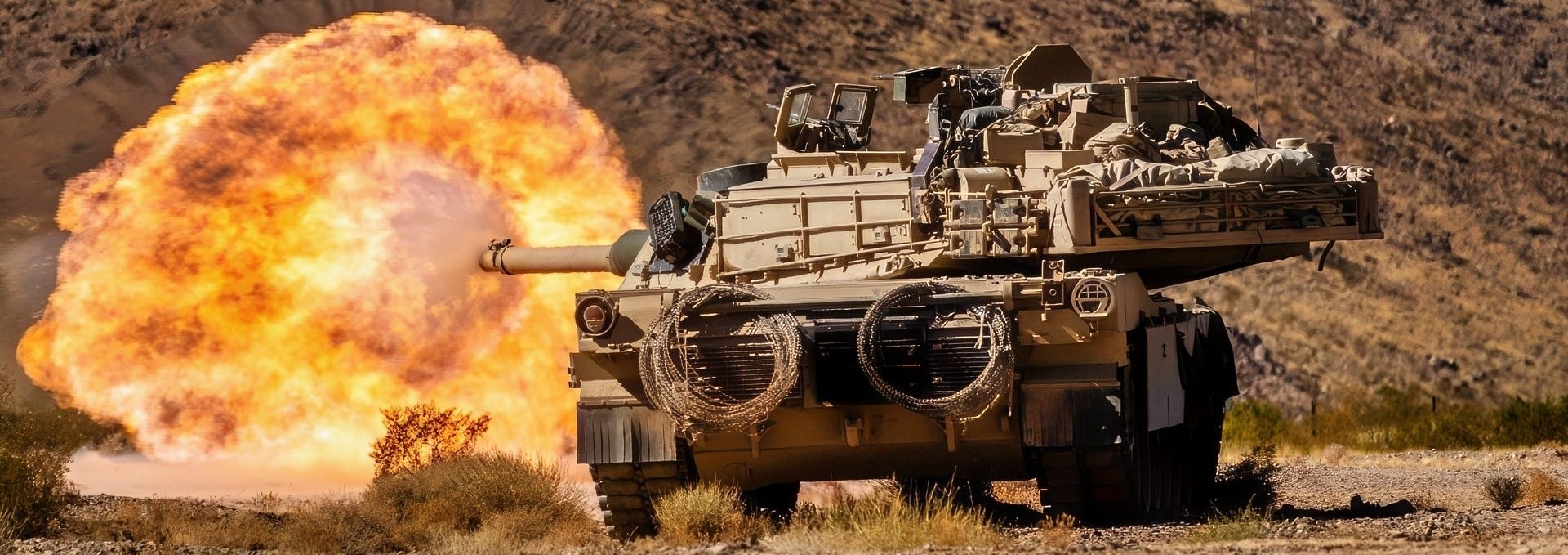
BLUF: Six years after Force Design 2030 began stripping out its tanks, the Marine Corps is looking even further ahead.
Its Ground Combat Element 2040 roadmap, released this summer, keeps the Corps built around light, dispersed units capable of threatening Chinese ships from islands and coastlines.
It then layers on counter-drone defenses shaped by the war in Ukraine, uncrewed systems, and AI-enabled command networks by the late 2030s.
The idea is a force that can hide, survive, and strike when called upon, rather than one that simply looks formidable on paper.
Beyond the Rear Area: Integrating Supply Chain, Infrastructure, and Military Logistics Under Adversarial Threat

BLUF: The commercial supply chain is now contested terrain. Logistics has always been contested at the tactical level but the reach of modern weapons extends well beyond what planners once called the rear area.
Kinetic and non-kinetic means alike, from drone-delivered munitions to offensive cyber capabilities, can now touch the civilian systems that underpin military capability: raw material production, domestic manufacturing, and the transportation networks that move goods to the force.
Yet there are no tools designed for this environment that are available to military planners.
Three Connected Failures: No multi-layer integration; no adversarial intent; and no cross-layer cascade tracing.
The Contested Sustainment Analysis Framework (CSAF) is a requirements specification defining the architecture a contested sustainment planning capability must satisfy.
Multi-layer integration; adversarial decision modeling; cascading effect propagation; operational output metrics; adaptability and speed.
Great power competition, lessons from Ukraine, and adversaries’ demonstrated willingness to target civilian infrastructure have effectively eliminated the rear area.
The consequence is not merely tactical, it is analytical. Planners lack tools designed for this environment, and the tools they have are structurally incompatible with it.
From Force Design to Force Drift: The Challenge Facing the 40th Commandant
BLUF: The inadequate approach of the Campaign of Learning will not fix the underlying problems of force drift, which will soon fall to the 40th Commandant.
Among other exigencies, he will face the overriding challenge of organizing, training, and equipping the Marine Corps for the sureness of an uncertain and increasingly dangerous future.
To meet this Title X, United States Code mandate, he must: develop an operating concept that better defines the role of the Marine Corps in national security than Force Design and build a combat development process capable of translating that concept into needed capabilities.
Failing to do both will risk committing the Marine Corps to four more years of rudderless drift.
Marines to Support NATO Security Initiative in Baltic Sea
BLUF: A specialized team of Marines deployed to Europe will be redirected to the Baltic Sea region to support the NATO-led enhanced vigilance activity Baltic Sentry.
Approximately four dozen Marines assigned to the 2nd Reconnaissance Battalion, 2nd Marine Division, II Marine Expeditionary Force Information Group, based at Marine Corps Base Camp Lejeune, North Carolina, will operate alongside Finland's Coastal Brigade to provide advanced expeditionary surveillance and tactical reconnaissance capabilities.
The activity is designed to enhance maritime domain awareness to protect critical undersea infrastructure and support overall security in the region.

Air Force Names 7 to Vie for New MMA Drone Program
BLUF: The Air Force and DIU picked seven companies to compete for the low-cost, semi-autonomous Massed Modular Aircraft meant to replace the MQ-9, with a goal of 500 fielded by 2032.
Winners included Anduril, Chaos Industries, General Atomics Aeronautical Systems, Grid Aero, Otto Aerospace, Shield AI, and Swarm Aero.
The solicitation followed the loss of dozens of MQ-9s in operations against Iran earlier this year.
The military’s reliance on aircraft that cost $30M or more per tail has become unsustainable against adversaries utilizing layered defenses,
DoW expects to pay about $10M per MMA airframe, plus whatever sensors or other capabilities are added to it.
The Pentagon wants to see a prototype within a year of issuing a contract, and field it at scale as soon as 2029.
“The Air Force’s partnership with the Defense Innovation Unit is accelerating requirements development and rapid prototyping by leveraging commercial innovation and reducing timelines. We continue to work with industry to inform requirements and assess potential solutions as we shape the future MMA capability.” AF Spokesman
Pentagon Hands Out $20.7B Contract for AMRAAM Missiles to RTX
BLUF: The Pentagon announced a contract worth $20.7B for RTX to build AMRAAM missiles used by Navy and Air Force aircraft and for ground-based interceptors.
The latest contract award does not make clear whether the $20.7 billion is funding for the framework agreement or a separate deal.
The level of acceleration or increased quantities was not articulated.
Apart from air-to-air combat, the AMRAAM is used as part of the National Advanced Surface-to-Air Missile System, a midrange air defense system built jointly by Raytheon and Kongsberg Defense & Aerospace.
Ukraine has more than 10 NASAMS in operation.
Related Articles: Raytheon Nets Potential $20.7 Billion AMRAAM Deal and Raytheon Receives Up to $20.7 Billion AMRAAM Production Contract
DAF Awards F-15EX Lot 7 Contract for 22 Aircraft
BLUF: The Air Force awarded Boeing a contract for 22 F-15EX Eagle II aircraft under Lot 7. Through focused, complex negotiations, the F-15 Program Office and Boeing reached an agreement that maintains all 22 Lot 7 aircraft within available funding.
Our Take: Reading through the lines here, there must have been some risk that with inflation and other pressures, the Air Force might not have been able to afford all 22 aircraft as anticipated.
Related Article: Air Force Awards $2.38B Contract to Boeing for 22 F-15EX and Boeing Nabs $2.4 Billion Deal for More F-15EX Fighters
Full F-47 Production Line Not Too Far Away
BLUF: Work is underway for a full production line for the F-47 with Boeing in the midst of a nearly $2B expansion to its facilities in St. Louis, Missouri.
The F-47 program otherwise continues to progress along an aggressive schedule, with a first flight still being targeted for 2028 and the goal of production jets entering operational service in the early 2030s.
Phase 1 includes the construction of:
an 880,000 sq ft aircraft assembly building
an 185,000 sq ft hangar
an 80,000 sq ft radar cross-section test facility
+ open aircraft shelters, hush house, maintenance building, fuel calibration building and fire house totaling 90,000 sq ft
CCAs and Autonomy Gain Momentum as Focus of Future Force
BLUF: For the past four years, the idea of autonomous drone warfare like CCA has been discussed as a future concept, rather than near-term reality. Now that promised vision appears imminent, with the Air Force promising at least 1,000 a/c by 2032.
The Experimental Operations Unit at Creech Air Force Base, Nev is operating CCAs “multiple times a week” as it develops and applies new thinking.
CCAs will be the Air Force’s first dip of the toe in an actual force integration.
EOU members have been “pleasantly surprised” by the ease of maintenance of the CCAs, and what a comparatively small footprint they require to a manned jet.
In a series of recent Agile Combat Employment exercises, there was a one-to-one maintainer-to-airplane ratio, which is small fraction of what a manned fighter jet typically requires.
“That will, in [my] mind, be the first time that we will ever do some CCA end-to-end kill chain live. That’s the first time we’ll ever be integrated in a fourth- and fifth-gen combined [offensive counter-air] push. It’ll be small, but those type of building blocks are where, I think, you get the intangibles like trust in the CCA.” EOU commander Lt. Col. Lyndon Bartlett
Air Force Prepares to Put Its CCAs to the Test
BLUF: Air Force is preparing to wring out its two collaborative combat aircraft (CCA) as part of the Emerald Flag exercise at Eglin AFB, Florida later this year, putting the uncrewed systems to the test in an operationally relevant scenario as it charts its path forward on creating a common autonomy software for the systems.
Related Article: USAF Plans Participation of Early CCA Production Aircraft In Emerald Flag
Air Force, Industry Fear Continuing Resolution Could Hinder CCA Production
BLUF: The Air Force’s emerging Collaborative Combat Aircraft program would suffer delays if Congress fails to pass a budget before the end of this calendar year.
“You can’t go do production without production funding. So that does provide limitations on what we can execute.” Brig. Gen. Timothy Helfrich
“We will not have a cold start to [launch] production in ’27. We will have assets rolling through. That said, even a company like ours can only do so much without procurement dollars.” Erin Simpson, Anduril’s vice president of strategy execution for air dominance and strike
Our Take: It appears that GA-ASI will self-fund the first few production aircraft but unclear how far that will extend if the CR is not resolved soon. Anduril has already bet the bank on its facility build and advanced parts buys, so it seems likely to stick to its guns here.
Anduril and the Limits of Build First, Buy Later
BLUF: This week, Anduril announced that they were no longer able to work at risk on the FQ-44. This is one of the clearest examples those inside the bubble are starting to realize the limits of private capital.
Private capital can finance prototypes, facilities, and even some low level production at risk, but it is not a indefinite substitute for Pentagon appropriations.
Anduril helped lead the neo-prime assault on the primes’ old ways. Much like Palantir, they deployed engineers, built systems based on observed needs, then took those systems to the Pentagon as prototype solutions.
They contributed to a growing belief that the Pentagon would soon be able to simply buy future weapons off the shelf.
Except there is no shelf. The Pentagon is directly responsible for designing future warfare and building the plans for contingency operations. The emergence of the neo-primes did not change the need to fill those requirements.
The right model for defense acquisitions is not the way the U.S. has procured things in the past, that is cleary true.
Flipping this exactly 180 degrees and moving away from requirements to a build-then-buy mentality does not fix the core issues. This is what Anduril is seeing now.
As capital becomes more expensive the risk associated with carrying government procurement risk becomes less attractive.
Anduril, and much of defense tech, neo-prime or not, are now beholden to a set of forces that they cannot control.
These forces, the long procurement times, rising interest rates, and budget challenges in a split congress, are the reason being in defense tech is hard.
The Pentagon cannot expect the industry to act like a commercial market when all of the incentives are still aligned to a centralized management approach.
Our Take: Very well said!
Hunt For MQ-9 Reaper Successor Surprisingly Includes Exotic Aircraft Manufacturer Otto Aerospace

BLUF: the inclusion of Otto Aerospace in the MMA selectees is particularly unexpected and interesting to examine. Otto has made bold, but still unrealized pronouncements about disrupting the aviation industry with potentially revolutionary high-efficiency designs that could have civilian and military applications.
The company’s core design philosophy centers around what is called laminar flow. Broadly speaking, this refers to liquid or gaseous “fluids,” including air, flowing in smooth, regular layers across a surface with little to no mixing between them.
With this in mind, all of the designs that Otto has shown to date, starting with the Celera 500L, have been based around teardrop-shaped fuselages to maximize laminar flow benefits.
A relevant patent held by Otto also describes a novel exhaust system with a heat exchanger that provides an additional boost in thrust.
It is also worth noting here that Otto has already developed a drone with a “highly laminar-flow efficient airframe” for DARPA.
DARPA plans to use that drone to demonstrate laser-based power beaming technology that could be used to relay electricity to forward operating locations.
Our Take: The ability to burn a third of the fuel of other aircraft is going to be particularly attractive to the Air Force given the realities of resupply in a contested theater. Expect Otto to get a serious look.
Air Force Pushes Open Architectures Across Fighter Fleet
BLUF: The Air Force would like to see the EW/SATCOM/Radar upgrades being brought to individual fighters applied in a more horizontal way across platforms to onboard new functionality quickly as soon as it develops.
To ensure horizontal development, the Air Force is working across integrated capability teams targeting electronic warfare, infrared, line-of-sight and beyond-line-of-sight communications, compute and software, and exportability.
This helps ensure that new functionality isn’t siloed into a single fighter program.
Underpinning these efforts is a push to adopt open compute that will allow the Air Force to effectively plug and play new capabilities once they are developed.
Our Take: This makes a lot of sense if the software baselines of these legacy aircraft can be architecturally updated to support that vision within a reasonable timeframe and cost. It still seems unclear how widely employed some of these legacy systems will be in a conflict even if they received every upgrade available. If they are really only going to be used in low-level engagements (like counter drone and homeland defense), then it might be a questionable investment.
Why the Air Force Needs to Invest in Electronic Warfare
Lance Landrum
BLUF: U.S. air forces are engaged in combat operations today, and not all the aircraft are modern stealthy platforms like the B-2, F-22, or F-35. The F-16 will be in service for two more decades, yet combat operations in Operation Urgent Fury prove it needs electromagnetic warfare (EW) upgrades to survive in modern threat environments.
To survive and accomplish combat missions, F-16 pilots need to detect enemy threat systems, like surface-to-air missiles or air-to-air radars, via a Radar Warning Receiver (RWR) and then counter the threat with Electronic Countermeasures (ECM) that manipulate radio signals to jam or deceive guidance systems.
International partners have invested over $1B in procuring Viper Shield systems for their F-16s over the past seven years. The Air Force could add EW pods and leverage foreign investment to save taxpayer money.
Our Take: Sounds like a reasonable idea. I’m sure it just hasn’t made the cutline in an extensive rack and stack of priorities.
F-15EX May Finally Get Missile Warning System the USAF Originally Skimped on Buying
BLUF: The Air Force is looking at adding a missile warning system (MWS) to its new F-15EX Eagle II fighters. This will give the aircraft a way to optically detect incoming missile threats, especially passively guided ones like heat-seeking infrared-guided missiles, which they currently lack.
The omission has been glaring for years now, especially given that the aircraft has all the provisions for such a system, including blanked-over spots for the sensors.
The Eagle II does already have an extremely powerful self-protection suite, including the Eagle Passive/Active Warning Survivability System (EPAWSS).
However, it is heavily geared toward defending against radar-based threats that pump out signals that can be detected and jammed. Infrared-homing anti-air missiles zero in on their targets passively.
Lessons Learned from Getting an SR-71 in the Air Again May Be as Valuable as Its Flight Test Data
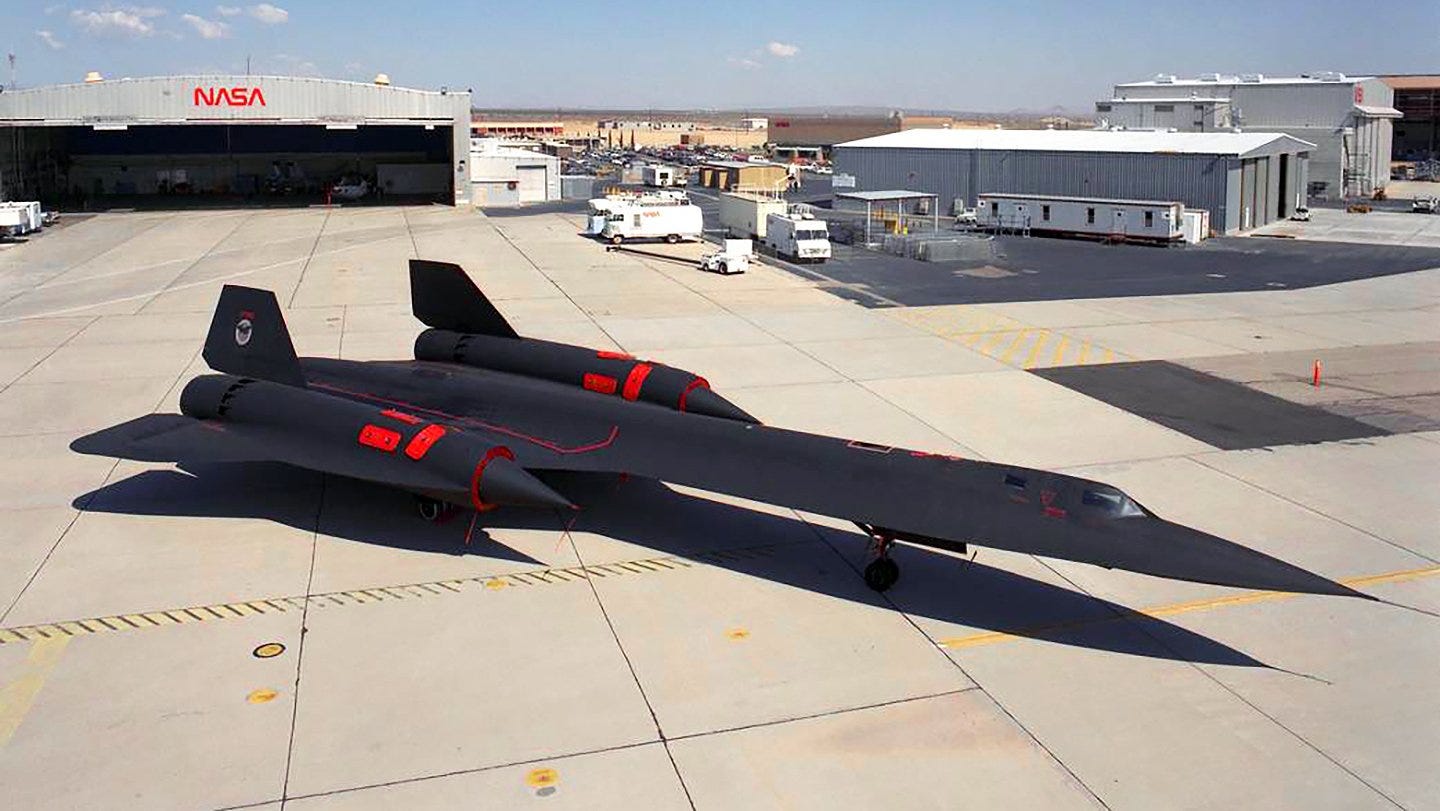
BLUF: There is serious discussion of bringing back the SR-71 Blackbird to flight status given its potential to inform high-speed aircraft flight and the system for launching effectors from high altitudes at high speed.
B-52s Get Prototype System for Beyond-Line-of-Sight Communications
BLUF: Air Force Global Strike Command has fielded a new prototype system for beyond-line-of-sight communications on the B-52H Stratofortress in a step forward for modernizing the Cold War-era heavy bomber.
IRIS, a communications system developed by Outerlink Global Solutions, integrates a satellite communication terminal with other components both on the bomber itself and on the ground.
While IRIS is fielded operationally, it remains a prototype, and more testing and evaluation will come as the system matures.
“The ability to communicate reliably across vast distances is foundational to our global operations. Fielding IRIS gives our crews a modern tool to stay connected, share information, and execute the mission in dynamic and contested environments.” Maj. Gen. Ty Neuman, commander of the 8th Air Force and the Joint-Global Strike Operations Center
Other Air Force News:
X

DIU, Space Force Team Up to Kick-Start Buys of Commercial Sats for Monitoring GEO
BLUF: DIU and the Space Force have joined forces to more rapidly develop and field next-generation, commercially developed satellites to monitor GEO.
DIU’s Geosynchronous High-Resolution Optical Space-Based Tactical Reconnaissance (GHOST-R) project is now going to serve as a feeder for the Space Force’s nascent RG-XX program to replace the venerable Geosynchronous Space Situational Awareness Program (GSSAP) satellites.
Two companies have been chosen to develop and fly GHOST-R prototypes by 2028, the release said: Northrop Grumman and True Anomaly.
DIU announced its GHOST-R effort in February, while SSC stood up the RG-XX effort in April as part of a wider GEO monitoring effort called Andromeda, setting up a pool of 14 vendors to compete for $1.84 billion over the next decade.
“This approach burns down technical risk, drives down lifecycle costs, and gets vital capability to the warfighter faster to ensure a more resilient architecture. Successful prototypes will have a direct path to transition into the program of record,” Col. Bryon McClain, acting PAE for Space Combat Power
Our Take: This is good to see as it never really made sense to have both efforts going simultaneously. The key will be to keep other vendors engaged through this process so that they can contribute to the constellation that Northrop and True Anomaly initially builds out.
Related Article: Space Force Picks Two Companies to Build New Space-to-Space Satellites by 2028
Drowning in Data: New Report Says Space Force Needs Lasers Comms to Beat the Bottleneck
BLUF: The Space Force is preparing to launch hundreds of satellites with countless sensors into orbit over the next few years that will generate vast troves of data.
The long-standing method for communicating data down from space via radio frequencies has the potential to create deadly data bottlenecks that could slow and stymie future operations.
A report, to be rolled out Oct. 1 by AFA’s Mitchell Institute for Aerospace Studies, makes the case for combining RF with optical communications technology, or laser comms, for a “hybrid” system.
Her findings show that the military’s space-based sensors and communications systems are generating 200X more data than the force had two decades ago.
Laser comms can transport data 10 to 40 times faster using a beam nearly 1,000 times narrower. But that precision comes with reliability tradeoffs as even small vibrations can disrupt the signal. This is why RF needs to still play a role.
Additional efforts needed are around edge processing and self-healing networks.
USSF’s work building the Space Data Network aims to standardize optical intersatellite links and edge routing.
Our Take: There is a lot of truth in this report, and it seems the Space Force has a path towards fielding solutions that address many of these challenges as slow as it may be in some areas.
Space Force Sunsets 1970s-Era Missile Warning Satellite Constellation
BLUF: More than 50 years after the U.S. military launched its first Defense Support Program satellite, the Space Force has officially decommissioned the missile warning constellation as it prepares to start fielding its next-generation architecture.
In early September, after helping Space Force demonstrate dynamic maneuvers across multiple orbits, the satellites were decommissioned into a supersynchronous—or graveyard—orbit.
The first DSP satellite was launched in 1970 to geosynchronous orbit, providing key ballistic missile warning capabilities amid Cold War tensions between the U.S. and the Soviet Union.
The constellation grew to 23 satellites, the last of which launched in 2007.
DSP’s immediate successor, the Space-Based Infrared System, is on orbit today and consists of six satellites in GEO as well as four in a highly elliptical orbit.
The Space Force is launching the first of two Next-Generation Overhead Persistent Infrared satellites in the coming months which will augment the SBIRS constellation with improved, more sensitive sensors to detect dimmer threats.
Our Take: Farewell to an incredibly reliable and important constellation that served the nation well.
SDA to Launch 21 More Data Transport Satellites Next Week
BLUF: SDA is set to launch 21 Tranche 1 data transport satellites on Oct. 5—its fourth Tranche 1 mission since last fall and the first to carry Northrop Grumman satellites.
Once in orbit, the 21 spacecraft will join 63 Tranche 1 satellites built by York Space Systems and Lockheed Martin.
Following the Oct. 5 launch, SDA is eyeing its first Tranche 1 tracking layer mission either in December or early next year. Beyond that flight, it’s hoping to finish the last four launches and have all Tranche 1 satellites in orbit by late spring 2027.
Other Space Force News:
X

What Will Golden Dome Actually Defend? Senators Press for Answers
BLUF: CBO analysts have finally been briefed on the Pentagon’s classified Golden Dome architecture, six months after producing a $1.2T estimate that has become a flashpoint in the debate over the missile-defense program.
The Pentagon has put the cost of Golden Dome’s objective architecture at about $185B over the coming decade.
That is intended to deliver an initial capability in 2028, followed by a transition to an objective architecture in 2035 that is designed for homeland defense.
A broader problem that dominated much of Tuesday’s hearing is that lawmakers are still struggling to establish what Golden Dome will defend, how much protection it will provide and how much it will ultimately cost.
Some argue that the Pentagon can protect classified operational details while explaining enough about Golden Dome’s purpose and limitations to build congressional and public understanding.
One expert argued that Congress could eventually merge the Golden Dome organization with the Missile Defense Agency, arguing that the current structure is temporary and the program will need a durable institutional home.
Our Take: There are no clear answers to what exactly will be protected and what they will be protected against because the options are infinite and will likely come down to a controversial prioritization schema. Large ports, command centers, strategic sites military bases and critical industrial elements will likely receive first billing. There will likely be border capabilities to defend against long-range cruise missiles being launched from different vectors. Space-Based interceptors combined with GBI/NGI interceptors will protect against most ICBMs and new capabilities like the Glide Phase Interceptor will provide some protection against hypersonic threats. However, when it comes to threats that can be launched within the homeland or drone attacks from ships, there will be a lot more variability. That is the long-term challenge and the likely tipping point that could drive the GD4A bill closer to the $1T mark.
Related Article: Golden Dome Secrecy Fuels Debate Over Cost, Effectiveness of System

Rewiring the Arsenal of Democracy
BLUF: The effectiveness of Ukrainian hobby-shop technology to destroy Russian strategic bombers worth billions demonstrated the radical change needed in the U.S. defense ecosystem. Less appreciated, however, is how this new era is also changing the currencies of international statecraft.
Since the end of World War II, the United States’ greatest deterrence factor has been unified alliances whose combined military might is preeminent. But this allied might is only as dominant as the sum of the parts.
The U.S. strength depends on strong alliances, with a shared defense industrial base that can aggregate capabilities for a new era of warfare.
To get there, Washington must encourage a free-market, international defense ecosystem defined by open architecture and industrial, software, and hardware compatibility.
The primary factor in the U.S. ability to win on the modern battlefield this next century will be its collective allied industrial capacity and military interoperability.
The model generally involves U.S. defense companies creating small batches of exquisite equipment that is operated with proprietary, siloed software.
Contrast this dynamic with private technology companies, which are racing toward minimally viable products, tighter innovation cycles, and ever-evolving and improving offerings with open data architectures.
Digital compatibility would allow for real-time artificial intelligence fusion of sensor data and link battlefield lessons back to the factory floor.
Because the systems are compatible by design, adaptations can occur in days and be diffused throughout the alliance network rather than waiting for a prime contractor to push a proprietary update.
Russia Raises 2027 Military Spending by 27%, Budget Documents Show
BLUF: Russia plans to spend 17.1T roubles ($202.58B) on defence in 2027, around 27% more than the 13.5T roubles originally budgeted and the highest figure since the start of the war in Ukraine in 2022.
The documents showed that in 2026 the government will increase its net borrowing plan by 26% to 5 trillion roubles and spend 459 billion roubles - about 11% of the liquid part of its National Wealth Fund.
Historic First as Royal Navy Launches Torpedo From Uncrewed Submarine, XV Excalibur
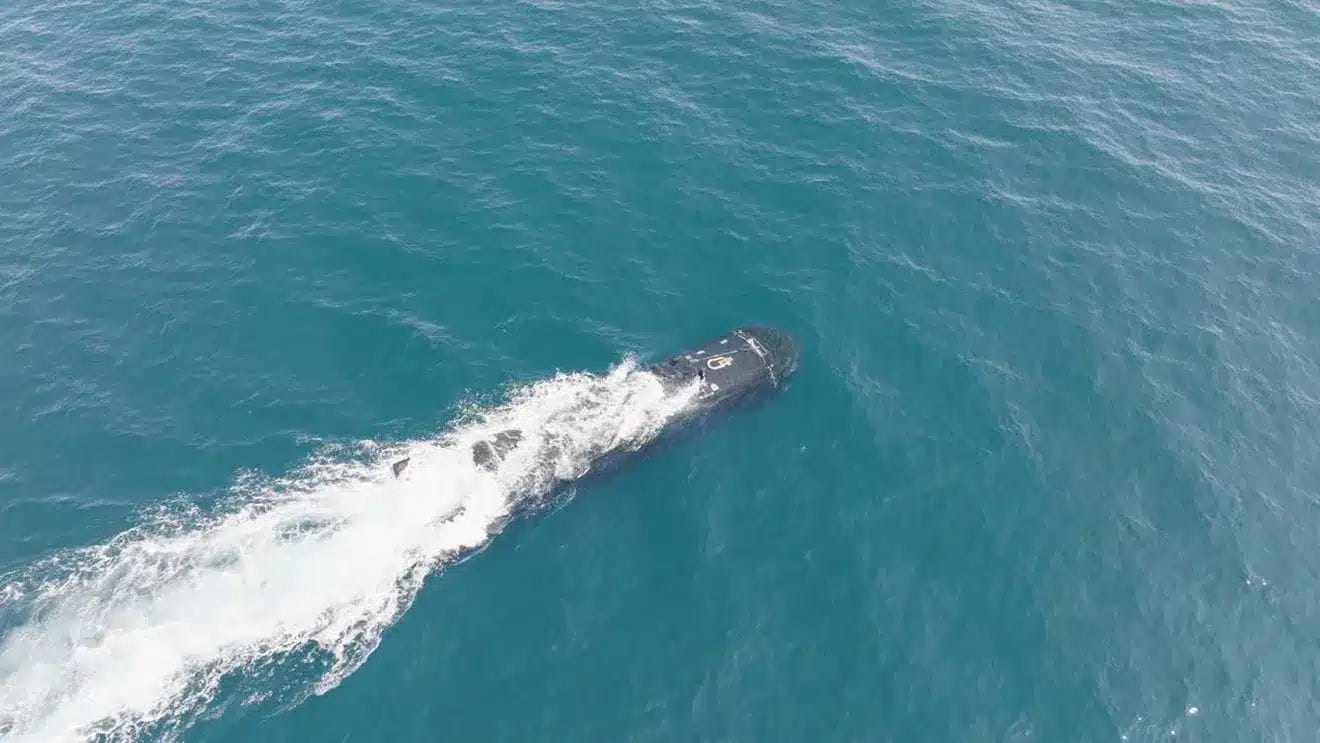
BLUF: XV Excalibur, an Extra-Large Uncrewed Underwater Vessel was adapted with a specialist management system to successfully fire and control US Navy Mk48 Mod 4 Heavyweight Torpedo at the British Underwater Test and Evaluation Centre.
The trial became a reality in just six months and was completed as part of work under the AUKUS agreement between Australia, the UK and USA that is aimed at developing advanced military capabilities together.
This launch is the first in a series of trials initiated by the United States that will increase in scope and complexity – ultimately aiming to get torpedo-launching uncrewed vessels on to operations around the world.
Diggers and Leathernecks
BLUF: Beijing’s military expansion, the growing reach of its surveillance and strike systems, and its ability to disrupt allied logistics are forcing the U.S. and Australia to prepare to fight side by side as allies along the First Island Chain.
For the U.S. and Australia, achieving that level of survivability and lethality cannot depend on separate, parallel national logistics chains but rather an integrated sustainment architecture built around industrial advantage and mutual support.
The modern battlespace requires a move from mere allied interoperability to enduring operational interchangeability: the ability to draw upon one another’s ammunition, maintenance, medical support, and sustainment across the combined force under fire.
Requirements cooperation creates the opportunity to align investments and deliberately build complementary capabilities rather than discover incompatibilities after systems are fielded.
Policy and law should enable what strategy demands. AUKUS has already made meaningful progress.
Export control is only one layer to consider. The larger challenge is whether allied personnel can actually access the classified information and technical data rights required to sustain one another’s systems.
If the countries have to fight together in the Pacific – we must learn how to develop, manufacture, operate, and sustain together closely enough that we are able to keep one another in the fight.
Ukraine’s Former Defense Minister Launches Manhattan Project for Killer Robots
BLUF: Ukraine needs a “new Manhattan Project,” according to former Defense Minister Mykhailo Fedorov for an Army of Robots, a force of two-legged upright and other ground robots that would take over many of the front line’s most dangerous but necessary jobs from soldiers.
To get there, Fedorov is calling on specialists in robotics, AI, sensors and autonomous systems to pool their talent in the kind of concentrated wartime push he says will one day replace Ukraine’s infantry.
He aims for the group to have its first confirmed battlefield result from a humanoid-like robot within six months and, within a year, an assault in which robots take on the most dangerous parts of a mission with no human infantry.
To make the deadline, he will begin by investing in companies with weapons that have already been tested and shown some market viability.
Under Fedorov’s plan, members of the Army of Robots will identify a battlefield problem, find a technical solution and a team, provide resources for development, test the product with troops in real conditions and scale what works.
Ukraine’s F-16 Fleet Is in a Readiness Crisis
BLUF: Ukraine’s F-16 fleet is facing growing pressure from the demands of the air war, with a shortage of air-to-air missiles now compounded by what appears to be a serious bottleneck in the critical maintenance system supporting the aging aircraft.
Ukraine is struggling to maintain adequate stocks of air-to-air missiles for its fighters. AIM-9 Sidewinders and AIM-120 Advanced Medium-Range Air-to-Air Missiles (AMRAAM) have been heavily used against Russian cruise missiles and drones, and Ukrainian F-16 pilots have reportedly had to ration their missile shots.
As the aircraft accumulate hours, they reach scheduled inspection and maintenance intervals, increasing demand on a maintenance network that is already supporting a fleet operating under wartime conditions.
Regeneration is done by a Belgian contractor and while a typical phase-inspection that would normally take approximately two to six weeks in the United States is reportedly taking as long as 40 weeks in Belgium.
Ukraine Deploys FP-7 Tactical Ballistic Missile in Combat for First Time
BLUF: Ukraine has deployed its FP-7 ballistic missile in combat for the first time which is described as a short-range missile with a range of about 200 km (125 miles).
Restoring Shipbuilding Quickly Requires Allies
BLUF: The Trump administration is seeking to expand military shipbuilding capacity to bolster maritime security, but doing so in a timely fashion will require leaning on and learning from allies according to Russ Vought.
Last year, a partnership was struck with Finland aimed at equipping the Coast Guard with 11 medium-sized icebreaking vessels.
The deals with foreign firms will result in ships delivered before President Donald Trump’s term is through, whereas adding another contract on top of backlogged U.S. shipyards would have only increased backlogs.
There are also plans to implement similar cooperative agreements with Japan and South Korea.
China Opens Training Center with Laos, Marking Third Overseas Military Base
BLUF: China has announced the opening of a new airbase in Laos, described as a joint training center but marking its third overseas military base, and the second in Southeast Asia.
The new facility, located at Ban Keun some 25 miles north of the Laotian capital Vientiane, would be jointly operated and maintained by both countries and used to train Laotian pilots.
Other International News:
U.S. to Transfer Surveillance Aircraft to the Philippine Coast Guard
Metal Shark Awarded Contract for 13 Patrol Boats for Vietnam

The Department begins FY27 once again under a continuing resolution, with Congress extending funding through December 11 after the midterm elections. The President requested roughly $1.5T for defense (~$1.15T in base funding + $350B in reconciliation) alongside a supplemental package to offset war costs and replenish critical systems. House appropriators, advanced a $1.072T defense bill.
Instead, the CR holds the Department near the FY26 enacted level of $838.5B on an annualized basis, with roughly $165.4B available on a prorated basis through December 11. The greatest pressure under a CR typically falls on new starts, production increases, and emerging capabilities. These are the very investments intended to accelerate modernization, creating additional risk of delays, reduced quantities, and deferred fielding.
Paid Subs: Watch for FY27 Defense Budget Status Update next week.
See our NDAA and budget posts for the latest insights and analysis.

Revitalizing the Shipbuilding Industrial Base | OMB Director Russell Vought
Hudson Institute
Sustaining Forces Through Acquisition and Innovation | Gen Dale White, Dr. Eric Hernandez-Baquero, William Bailey, and Rob Wavra
2026 Air, Space & Cyber Conference
Air Force Fighter Acquisition Portfolio | BGen Timothy Helfrich
Mitchell Institute
Minute with the CNO: Nuclear Power | ADM Daryl Caudle
CNO
Weapons in Space, AI Predictions, and F-35 Readiness Gains
Mitchell Institute
Boeing F/A-XX: The Navy’s Next-Generation Fighter
Sandboxx
Capital Markets and the Future of the Defense Industrial Base | Frank Fanelli
NDIA Emerging Tech Institute
Manned-Unmanned Teaming in Epic Fury
2026 Air, Space & Cyber Conference

Resilience Conference
Oct 5-6 • London
Land Forces
Oct 6-8 • Perth • Western Australia
DEFCON
Stanford • Oct 7 • Silicon Valley, CA
Apex Europe
Oct 7-8 • London
AUSA Army Annual Meeting and Expo
Oct 12-14 • Washington DC
Scaling Our Industrial Foundation
Wharton Aerospace Ventures • Oct 12-14 • Washington DC
Mission Engineering and Integration Activity TEM
USW(R&E) • Oct 15 • TBD
Counter UAS Indo-Pacific
SAE Media • Oct 19-20 • Honolulu, HI
Unmanned Technologies for Earth and Space (UTES 2026)
Oct 26-27 • Sweden
Silicon Valley Space Week
Oct 27-29 • Mountain View, CA
TechNet Indo-pacific
AFCEA • Oct 27-29 • Honolulu, HI
Ironclad Maritime Summit
Oct 27 • Norfolk, VA
Defense Conference
PSC • Oct 30 • Crystal City, VA or Virtual
See our Events Page for all the other events over the next year.
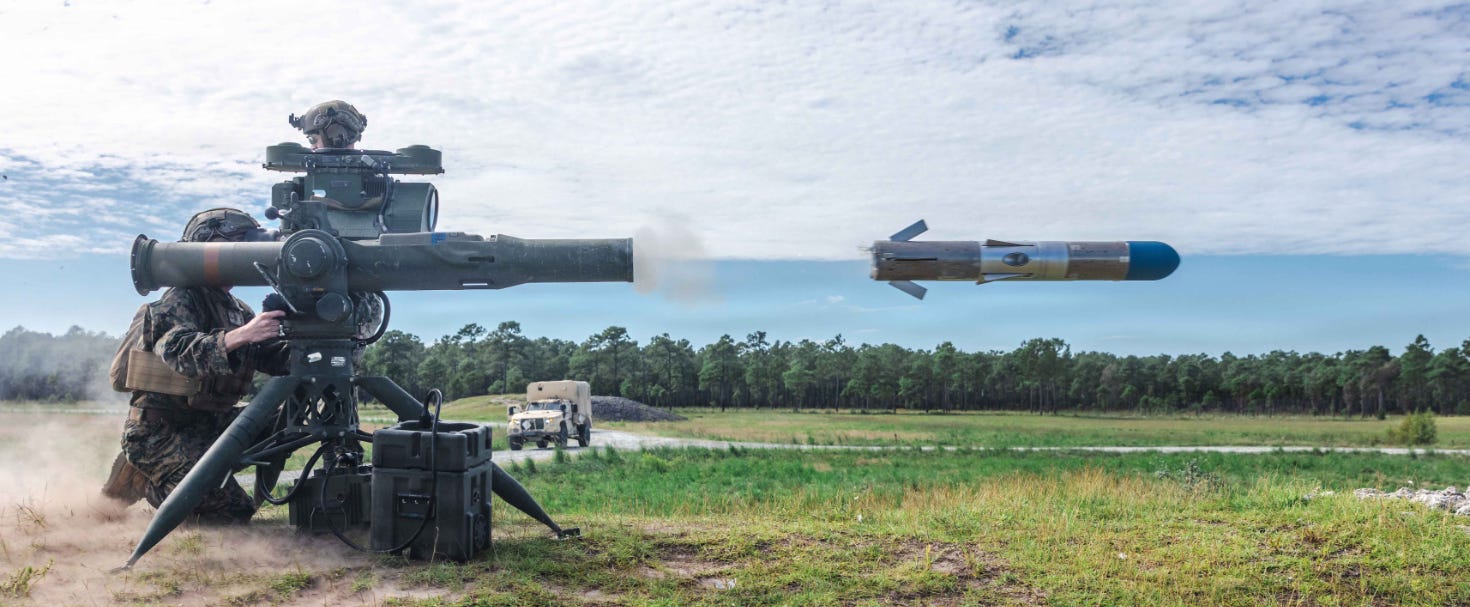
Pete Newell’s article is spot on —but when is someone at the service or DOD level going to get serious about addressing the fight beyond the IV line? So focused on the near-term we are missing the far-term.