


Welcome to the latest edition of Defense Tech and Acquisition.
The biggest stories across the Department and the defense industry this week:
DoW makes progress towards a clean audit and rethinks budgeting processes
7 industry teams selected for high-energy laser interceptor shoot out.
Military needs more missiles and adopting more competition would solve it.
Army working to improve fully mission capable (FMC) rates for its aviation fleet.
Navy pushes foreign companies to build shipyards in U.S. and cuts submarine maintenance delays by 40%.
B-1 carries hypersonic missiles as Air Force pursues more low-cost missiles.
ULA failure + supply chain challenges have long-term implications for Space Force
CR not slowing Golden Dome progress for MVP but long-term is a problem.
Ukraine uses 11 weapon types in Kerch attack and triples long-range drones.

Report Shows Progress Toward DoW 2028 Clean Audit Goal
BLUF: For the first time, clean audit opinions will cover more than 56% of the department’s assets and more than 90% of its liabilities.
A clean audit opinion, also called an unmodified audit opinion, is a determination that financial statements are presented fairly and supported by sufficient evidence.
A new strategy aligns the entire department behind common audit priorities and uses advanced data tools (such as War Data Platform) to improve the accuracy and supportability of financial reporting.
Officials are consolidating the approach into eight major audit structures, allowing leaders to focus resources on the accounts, systems and transactions integral to the department’s financial statements.
The consolidation streamlines a decentralized approach that previously involved 25 separate audit efforts.
“This is a really big deal for us. For the first time, we will have clean opinions on a majority of our assets and over 90% of our liabilities. The most significant change for us is our audit strategy. Ultimately, it is what will put us on the path to achieving a clean agencywide opinion in 2028.” Jules W. Hurst III, War Department Comptroller
Related Articles: New DoW Audit Progress Marks Breakthrough Toward a Department-Wide Clean Opinion
The Pentagon Is Rethinking How It Spends Billions, and the Changes Are Already Underway
Jules Hurst, USW(Comptroller) sits down with Francis Rose on Fed Gov Today
AUTOWARCOM Debate: Bryan Clark and Mark Cancian
Pentagon CIO Davies Tapped as Acting National Cyber Director
BLUF: Kirsten Davies is taking over the role for Sean Cairncross at the White House.
Davies is moving into the White House role, which was created in 2021 to serve as the top advisor to the president on cyber matters and coordinate cyber activities and responses across the myriad government agencies.
It is not clear who is assuming the duties of Pentagon CIO.
“Our nation stands in the crossroad of analog, digital, and quantum technologies, our American way of living increasingly interconnected. Our opportunity is to dominate the cyber landscape for generations to come, but only if we modernize and drive resilience into the foundations our great nation runs on, as well as build cyber talent for our future.” Kirsten Davies

From Venture Capital to the Arsenal
Dan Berkenstock, Maggie Gray, and Walter Manuel
BLUF: This paper examines public federal procurement data to explore whether the success of headline examples, such as SpaceX and Saronic, is an outlier or indicative of a broader shift within the defense acquisition system to procure more capabilities developed by venture-backed companies.
The R&D ramp is real and steep. Annual DoW R&D obligations to the cohort grew from roughly $33M in FY15 to $1.8B in FY25 - Over 50X, driven by OTs.
A growing number of companies graduated from R&D to procurement funding. Cohort procurement obligations >2X, from $200M in FY24 to $492M in FY25, and the partial FY26 has already reached $859M.
The wait for first dollars has shortened sharply. Companies founded before 2015 took a median of seven years to reach $1M of cumulative DOW R&D funding. For 2015–2020 founders, the median fell to four years, and for companies founded since 2021 it is two.
Contract dollars are highly concentrated. Five companies account for ~29% of the cohort’s cumulative R&D and procurement dollars.
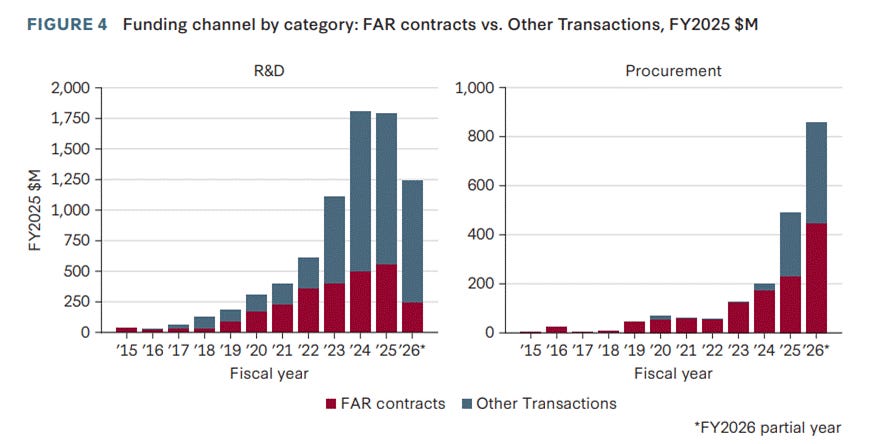
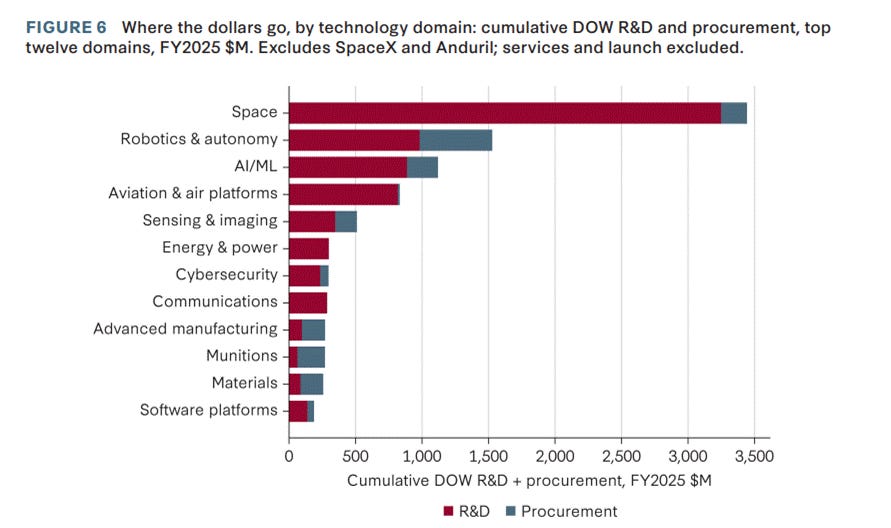

Our Take: Excellent analysis. We highly recommend reading their full paper, as these charts only scratch the surface. The conditions are ripe for a wave of venture-backed defense companies to graduate from prototype OTs and R&D funding into production contracts, but the real test is whether the Department can turn promising prototypes into sustained procurement at scale. Consider the broader picture: nearly $80B in venture capital invested in defense tech since 2020, yet this cohort captures just 0.6% of DoW procurement obligations. The Pentagon has gotten much better at funding innovation, but not yet at buying it in meaningful quantities. Can PAEs, DRPMs, and DAWG help these companies capture 5% of procurement spending over the next several years? That would represent a fundamental shift in the defense industrial base, deliver substantially more capability to warfighters, and help justify the enormous capital investors have put at risk.
Seasats Adds Firepower to Its Quickfish USV With Anduril

BLUF: Seasats integrated and launched Anduril’s Altius-600M loitering munition from its Quickfish USV, aiming to equip the go-fast drone boat with long-range strike capability against higher-end maritime targets.
The announcement comes a week after the company integrated Neros’ Archer Strike and Archer AI FPV drones onto the Quickfish.
Seasats is best known for its headline-snatching flagship small USV, the Lightfish, which has developed quite the knack for running into Chinese warships during long-distance voyages in the Pacific over the past year, snagging some big-time US Navy orders along the way.
Adding Neros’ Archer FPV drone and Anduril’s Altius-600M loitering munition to the Quickfish is all about turning the platform into a sort of teeny-tiny aircraft carrier, able to launch a range of UAS while keeping the operator far away.
Anduril’s Altius-600, with a 233-mile range (100 miles with a warhead), is a clear match for what Seasats has in mind for the Quickfish. The loitering munition is in high-rate production, on big contracts with the US and allied militaries (including Taiwan, which is buying more than 2,000 of ‘em), and can be adapted for both ISR and strike missions.
Last month, the DIU, in partnership with the DRPM UxS, posted a solicitation for the Suitable Warfighting Adaptive Payloads (SWAP)-USV prize challenge, seeking production-ready USV and effector platforms with demonstrated integration, active manufacturing capability, and verifiable production capacity.
Regent Wing-In-Ground Effect Drone To Patrol Middle East Waters
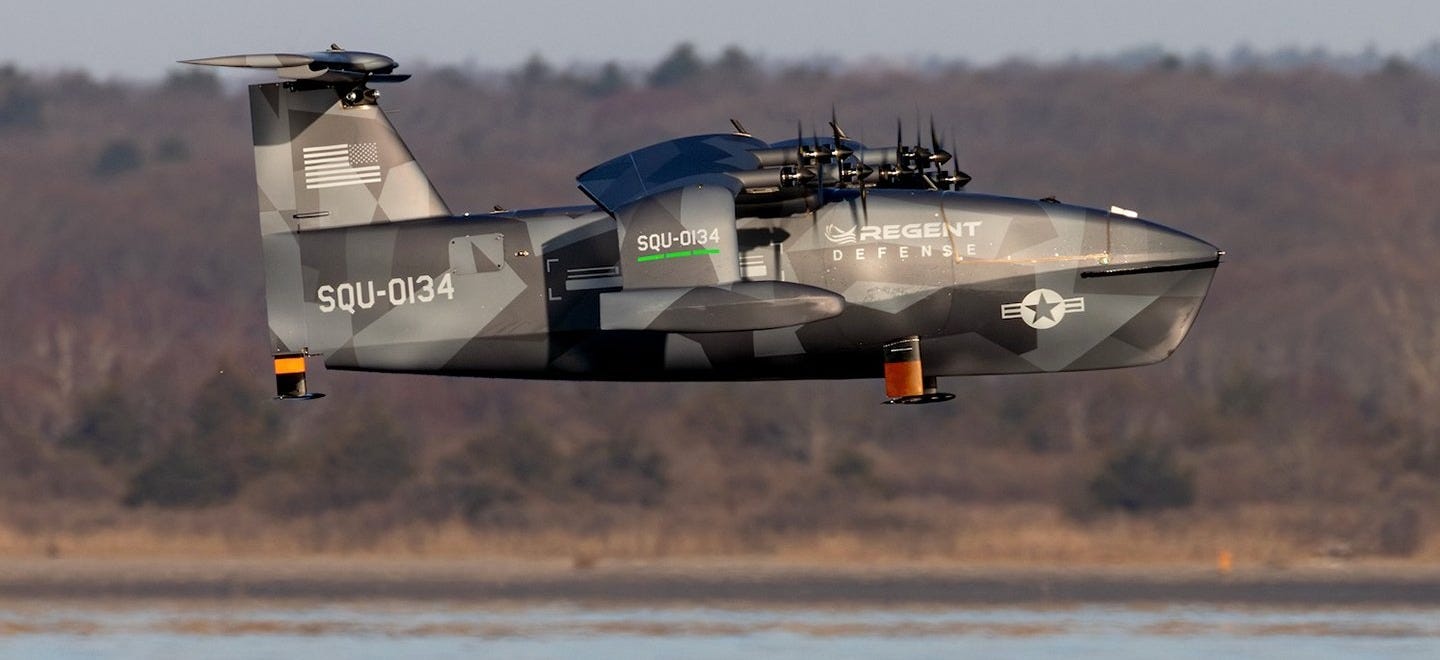
BLUF: Regent’s Squire Seagliders are being sent to the CENTCOM area of responsibility as the Pentagon continues to surge uncrewed systems into the region.
What makes the Squire unique is that it is what is known as a hydrofoiling wing-in-ground (WIG) effect craft.
The WIG drone uses a hydrofoil to get airborne and then cruise in the air at an altitude of about one wingspan above the water.
These ground-effect flights are designed to take advantage of the cusion of air compressed between the wings and the surface, providing a sweet spot of increased lift and reduced drag.
In theory, this should provide the Squire with high efficiency and relevant speed, all without needing to operate from a traditional runway.
Regent describes the Squire as a drone that flies in ground effect below radar line of sight at up to 70 knots, with a planned range of more than 100 nautical miles and a 50-pound configurable payload for ISR, logistics, search and rescue, and anti-submarine warfare.
“Combined with various sensors, Squire can do multiple on-water perception and comms missions, separated by distances far greater than a USV could quickly cover, all without specialized launch and recovery equipment. While flying between sites, Squire can continue sensing. Air and sea: multi-domain perception. Squire has to operate completely autonomously, which it does running on our in-house vehicle control software. Squire can also be plugged into mission-management and multi-asset coordination autonomy systems, which we’ve already demonstrated with TAK and Anduril’s Lattice.” Billy Thaalheimer, Regent CEO
Our Take: We are very bullish on wing in ground effect (WIG) drones the because they do combine some characteristics of a USVs and UAVs. The ability to move quickly between maritime locations, operate close to the water, and support both surface and subsurface sensing without a traditional runway is a real advantage in an area where many bases have been hit and capabilities are coming from further away. We see roles for WIG like mine/countermine (dropping sensors), maritime ISR, mobile comms gateway for unmanned forces, resupply and possible CSAR. The Marine Corps has recognized their potential and now they will be able to show what they can do in a an operational environment for the rest of the joint force.
DoW Invites Seven Industry Teams to Participate in Phase II Directed Energy Shoot-Off at Dugway Proving Ground
BLUF: JIATF 401 reviewed 13 technical white papers and invited the seven industry partners and High Energy Laser (HEL) platforms to participate in Phase II of the Directed Energy Counter-UAS technology evaluation. Phase II plans to include a live-fire technology evaluation at Dugway Proving Ground in mid-December.
Following successful verification and integration, live-fire target vignettes are scheduled to begin by mid-December. During the evaluation, systems will execute live-fire engagements against representative unmanned aerial targets in planned test scenarios, assessing target tracking and defeat capabilities both above and below the horizon.
"Scaled Directed Energy is one of the Department's six critical technology areas, and we are partnering with industry to rapidly deliver a low cost per shot defense capability to the Joint Force and accelerate the fielding of deep magazine systems that can be seamlessly deployed across multiple domains." Emil Michael, USW(R&E)
Ghost Radar Tracks Enemy Drones and Aircraft from SUV Without Revealing Location

BLUF: BAE Systems developed a new cheap radar that can detect drones and track hostile aircraft from an SUV without revealing its location to the enemy.
It uses existing TV broadcasts, radio transmissions and mobile networks in order to monitor the skies rather than emitting its own signals.
The new passive radar costs up to 10 times less than many existing systems. It is also compact and can be deployed from SUVs. This makes it suitable for both military operations and urban environments.
The system analyzes how these signals interact with objects in the air. It then detects and tracks potential threats without actually revealing its own location through radar emissions.
While initially designed for military use, the new radar could also be deployed to protect civilian infrastructure. BAE Systems identified airports, power stations and other critical sites as potential applications, particularly where conventional radar emissions may be restricted.
“The system can detect targets ranging from small drones to larger aircraft. It also provides detailed data about their speed, direction, distance and altitude along with a boost for armed forces, allowing a soldier to monitor the battlefield undetected.” Chris Shepherd, BAE Systems’ Product Manager for CUxS
DoW Advances Orchestration for Unmanned Vehicle Fleets
BLUF: The DoW advanced its Autonomous Vehicle Orchestrator (AVO), the software development program designed to enable a single operator to command a mixed fleet of unmanned vehicles across multiple domains.
AVO is software designed to orchestrate non-collaborative unmanned systems into a coordinated team, giving warfighters greater speed, flexibility and control over autonomous vehicles in the modern battlespace.
The AVO Challenge brought industry together to develop and demonstrate market-ready software for coordinating unmanned vehicles. The evaluation focused on scalable, vehicle-agnostic technologies that allow operators to seamlessly task, manage, and understand autonomous systems across diverse platforms and complex operational environments.
Rather than advancing a single platform, AVO focuses on the software needed to connect unmanned systems into an operational capability. The challenge evaluated how well competing solutions integrated diverse systems, reduced operator burden, while validating capabilities during live testing.
"AVO places the operator at the center of autonomous operations. Maj. Zach Laser and his team are leading the effort to move autonomous systems from standalone platforms to a coordinated operational force. Together with industry, we are building capabilities that cut operator workload, increase operational responsiveness and expand commanders' options in complex, multi-domain environments." Senior Chief Petty Officer Max Strasiser, Project Agincourt and DRPM(UxS) COO.


America Can’t Build Missiles Fast Enough. Competition Can Fix That
Shyam Sankar and Madeline Hart
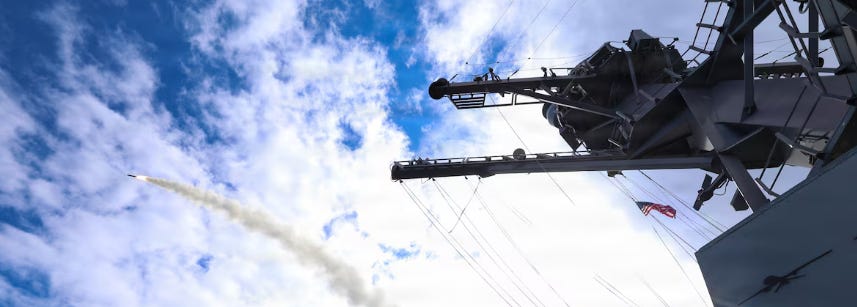
BLUF: The U.S. military is consuming missiles much faster than it can produce them, but it’s the production, not the consumption, that’s the problem.
Insufficient missile production has been a problem for over a decade, and recent operations against Iran have exposed the depth of that longstanding shortfall. U.S. stocks have also been reduced by transfers to Ukraine.
A willingness to use arms when necessary is central to the U.S.’ ability to deter adversaries, but so is its capacity to regenerate the stockpile during conflict.
Deputy Secretary Steve Feinberg implored industry leaders to drive significantly faster and push for more aggressive delivery schedules for critical capabilities.
Several multibillion-dollar contracts were awarded to RTX and Lockheed Martin, the nation’s main missile suppliers.
Money helps, but more funding alone will not solve America’s missile production woes. The lead time for priority missiles is two to four years. That’s nowhere near fast enough. The solution is greater competition among suppliers.
The Pentagon relies on production strangleholds that were created by its own procurement choices.
Legacy missile producers essentially have government-sanctioned monopolies on decades-old designs whose research and development were funded by taxpayers.
For a better model, military leaders should look to the astonishingly successful National Security Space Launch program, which broke the ULA monopoly and delivered cheaper, more frequent launches for America.
In 2014, ULA (Boeing/Lockheed Martin) sent 23 rockets into orbit at a cost as much as $435M each and relying on Russian rocket engines. SpaceX sued to enter the market followed by Blue Origin and launch costs dropped to 1/8th and the U.S. launches more rockets annually than the rest of the world combined.
For munitions:
Define clear requirements. Carry a standard payload a specified distance without specifying manufacturing approach or specific components.
Shorten the missile procurement calendar and guarantee production orders. MYP of 5+ years are increasingly common. More frequent competitions every 1-2 years would prevent incumbents from locking renewal contracts and send a clear demand signal to new entrants to make the capital-intensive investments required.
The DoW has started that for the Low Cost Interceptor program.
Our Take: America’s defense industrial model rewards exquisite performance, protects incumbents, and treats production capacity as an afterthought. We agree that competition is essential, but the real breakthrough is shifting from buying specific missiles to buying military effects at scale. The DoW should define mission outcomes, establish open interfaces, and challenge traditional primes and emerging defense tech companies to deliver affordable, producible alternatives. Not every mission requires a multimillion-dollar interceptor, nor should every new capability require a decade-long development program.
Competition must extend beyond contract awards to competing designs, manufacturing approaches, and production capacity. The DoW must sustain multiple qualified suppliers, commit to predictable production demand, and reward companies that continuously drive down unit costs and delivery timelines. Munition PAEs should manage dynamic portfolios, balancing high-end weapons with lower-cost alternatives while measuring inventory depth, production surge capacity, and cost per effect. The ultimate measure is how quickly and affordably America can replace what it fires.

Raytheon Taps Ursa Major, Avio USA as Second Source for Tomahawk Solid Rocket Motors

BLUF: Ursa Major and Avio USA have been tapped to jointly produce a solid rocket motor for the Navy’s Tomahawk cruise missile, adding a second supply source as the Pentagon seeks to ramp up munitions production.
RTX’s Raytheon, which makes the Tomahawk, selected the two companies to be strategic partners on the multi-year program for the solid rocket motor.
Both firms are somewhat recent entrants to the American market.
Ursa Major, founded in 2015, has since established itself as a viable military supplier, winning Pentagon contracts for weapons like missiles.
Avio is a long-established European vendor that opened its US office in 2022, and has since won its own deals for American missile production.
In August, the Navy awarded Raytheon a massive, $22.9B multi-year deal to scale up output of the Tomahawk to 1,000 rounds annually.
“Tomahawk is a critical capability for the warfighter, and meeting growing demand requires more capacity and a stronger, more resilient supply chain. Our partnership with Avio USA brings together complementary capabilities to create additional reliable sources of solid rocket motors for Raytheon and the U.S. Navy.” Jason Meredith, Ursa Major President
Related: RTX Taps Ursa Major and Avio for $80M+ Tomahawk Booster Award and Raytheon Awards Ursa Major and Avio USA Contract for Tomahawk Booster
US Missile Shortages Create a Range Problem
BLUF: The U.S. has burned through stockpiles of critical long-range missiles, which may force military forces to fall back on munitions with ranges of under 300 miles.
A new CSIS report Munition Inventories: An Update Amid Renewed War Risk by Mark Cancian and Chris Park analyzed data on munitions expenditures to provide estimates of how missile usage against Iran is affecting U.S. defense posture globally.
While the Pentagon has made agreements with manufacturers to boost production rates and Congress may provide funding, time is of the essence to rebuild the U.S. arsenal, as the current strain on stockpiles has created vulnerabilities.
Does the United States have enough munitions to renew the fight? The short answer is yes, against Iran. Against China, there is great concern.
CSIS produced a list of missile types sorted into nine categories. Seven of the nine categories were classed as having detrimental effects in terms of resupply capacity.
Patriot, THAAD, and Standard Missiles, which are vertically launched surface-to-air missiles have stockpiles are in dire condition.
Long-range ground-attack missiles including Tomahawks, AGM-158 JASSM cruise missiles, and PrSMs are heavily used with some substitutes.
Short range munitions including air-to-air missiles and short- and medium-range missiles, including GBU-39B small-diameter bombs and the AIM-120 AMRAAM have no significant constraints.
US Firm to Support Development of High-Performance Propellants to Boost Missile, Aircraft Range
BLUF: CycloKinetics received an $86.3M contract award from the DoW to advance the development of alternative fuel sources.
The latest contract will support the development of advanced, high-performance propellants designed to enhance aircraft range, missile capabilities and space launch performance.
CycloKinetics specializes in developing advanced, drop-in replacement fuels and propellants for aerospace and defense applications.
Its proprietary technologies are designed to deliver improved energy performance while remaining compatible with existing propulsion systems.
The Defense Industrial Base is a Diamond, Not a Pyramid
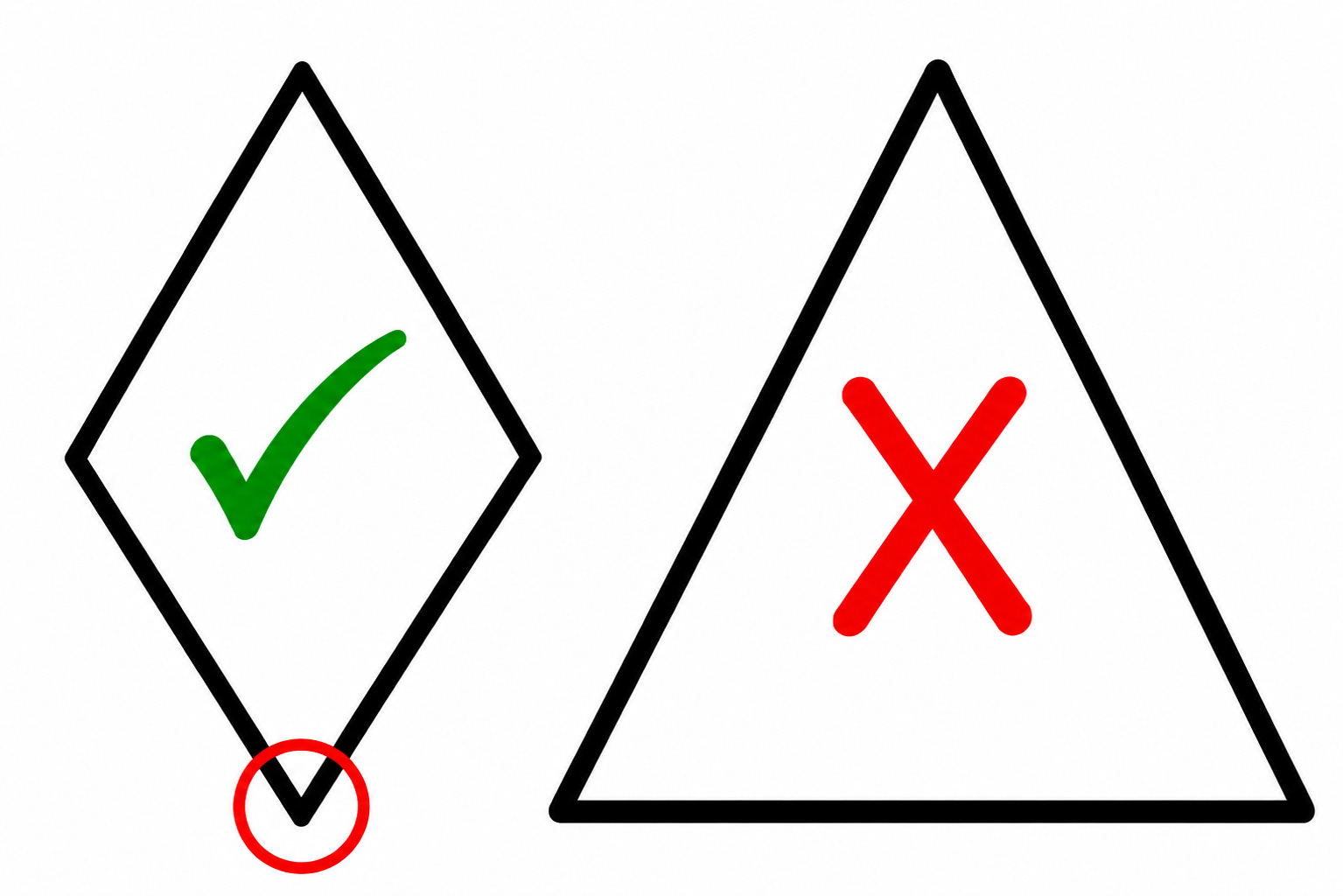
BLUF: The defense industrial base supply chain is not what you think it is. It’s a diamond, not a pyramid.
Most people think the defense industrial base is a pyramid, with a few large companies at the top and a swath of companies under them continually feeding the manufacturing base. I wish it were true. It’s not.
The defense industrial base supply chain is shaped like a diamond. There are a few large companies at the top with a wider base of 1st, 2nd, and 3rd tier suppliers in the middle. It’s the bottom where we run into challenges.
That bottom part of the supply chain diamond, where it starts to narrow, which has raw materials providers, critical minerals, single-shop component manufacturers, etc. is where we all get tripped up.
For defense, it doesn’t matter if you’re the largest company or the newest defense tech firm. Chances are, unless you’re building for the consumer market that’s used in defense (like attritable drones), or making your own supply chain separate from the one that currently exists (it’s prohibitively expensive and I really haven’t seen that), you’re pulling from the same defense supply chain.
That supply chain at the bottom of the diamond is already under stress. So, the more companies you add at the top and middle, if you don’t add more companies (or capacity) at the bottom, you’re going to be frustrated with the pace of production.
What we can do is give the supply chain we have now regular, consistent orders with reliable funding streams coupled with outside investment. They can use that investment to either expand capacity and/or maintain what we have to meet the existing need at pace. Right now, all of what I just mentioned is uneven (at best). The boom-bust cycle is alive and well.
Our Take: Dak nails it. We cannot build the arsenal of the future on the fragile supply chain of the past. The Department is aggressively pursuing new entrants, competition, and production at scale. Industrial base transformation must extend beyond the primes to the thousands of small manufacturers that actually make the arsenal possible. This is what OSC and OUSW(A&S)/IBP are focused on. PAEs should aggregate demand across their programs, identify critical bottlenecks, and establish predictable purchasing commitments that enable suppliers to invest in capacity. The Department must also leverage commercial manufacturing networks, private capital, and modern production technologies to expand the supplier base rather than simply subsidize existing bottlenecks.
Solving the Defense Industrial Base’s Capacity Problem

BLUF: America’s A&D industry is struggling to convert unprecedented demand into production. The industry surpassed $1T in annual revenue for the first time in 2025, while defense and commercial aerospace backlogs reached historic levels. Yet a recent AIA and PwC survey found a meaningful gap between demand and the industry’s ability to respond.
While 85% of A&D executives believe their organizations can increase production by 25% within 18 months, confidence drops sharply as the required ramp approaches twice current output.
At 3-4X existing production, 33% to 42% say they cannot, or will not, achieve those rates on any timeline.
Installed manufacturing capacity and qualified production capacity are two very different measures. Buying another machine tool, adding a metal additive manufacturing system or expanding a facility can increase theoretical capacity.
None automatically increases the number of conforming parts available to a defense contractor or ultimately to a warfighter.
A qualified manufacturing process requires experienced operators and engineers, approved materials, tooling, inspection capability, validated processes, qualified suppliers, traceability rigorous quality systems, and secure systems.
The pressure on the supply chain becomes especially clear when production requirements increase dramatically. A production ramp of that magnitude travels through the entire supply chain.
Increasing production does not always require increasing physical capacity. In many cases, manufacturers can unlock additional output by identifying where existing operations are creating constraints.
Printing a successful component is an important milestone, but consistently producing that component economically and within the quality requirements of the application requires a much broader manufacturing process.
The industry has spent considerable time asking, “How much capacity do we have?” The better question is, “How much qualified product can we reliably deliver and how quickly can we increase that number when it matters?”
Launch Of Nationwide Assessment to Dismantle Barriers to Additive Manufacturing in Defense Production
BLUF: The DoW in partnership with the Commerce’s Bureau of Industry and Security (BIS), launched a comprehensive national assessment to identify and dismantle the qualification cost and timeline barriers hindering the scaling of additive manufacturing across the defense industrial base.
AM enables on-demand, distributed production of mission-critical systems and components, supporting applications from point-of-need fabrication of sustainment and repair parts to production of low-volume, hard-to-source, and obsolete components across air, land, maritime, and space domains.
Conducted under the statutory authority of Section 705 of the Defense Production Act (DPA) of 1950, as amended, this joint assessment initiative will survey roughly 500 key manufacturing entities across the nation.
The resulting data will directly shape future defense procurement policies, drive common qualification standards across the Military Departments, and inform targeted capital investments to scale domestic industrial capacity.
The survey evaluates capital expenditures, machine utilization, powder and feedstock supply lines, and software integration across aerospace, maritime, munitions, space, and ground vehicle sectors.
"Rebuilding our military and restoring deterrence require a modern industrial base that can move emerging technologies from prototype to production at speed. This partnership with the Department of Commerce will help reduce regulatory bottlenecks, shorten certification timelines, and lower barriers for the companies strengthening America's strategic arsenal." Michael Duffey, USW(A&S)
Pentagon Looks to 3D Print Tomahawk Missile Parts

BLUF: The DoW is moving out on 3D printing parts for its Tomahawk Land Attack Missile using a contracting method designed to fast-track manufacturing capabilities.
Nikon Advanced Manufacturing secured a $23.5M Cornerstone OTA award through the Pentagon’s IBAS program to deliver multiple additive manufacturing systems specifically designed to create Tomahawk mid-bodies.
The 3D printers are a customized variation of the company’s Nikon SLM Solutions NXG 600E, designed for large-scale industrial production.
It uses a laser that is precisely guided to a bed full of powder where it melds material to form metal parts layer by layer based on the design fed into the system.
The technology specializes in large-format manufacturing, and the new systems can produce parts up to two meters in height. That enables missile components to be made monolithically, improving physical strength and weight, as well as reducing production timelines and cost per part.
Our Take: Improved strength, weight, time, and cost, while expanding the supplier base. What’s not to love?
DOW Looks for Next Great American Base, Challenges States to Think Futuristically
BLUF: A vision of future needs and unparalleled capability, the "Next Great American Base" initiative seeks to create an adaptable platform for next-century missions and emerging domains. It also intends to be livable for warfighters and innovators alike.
DoW calls on state governors and adjutants general to help design the high-tech, futuristic, all-domain fortress of tomorrow, a community of operational excellence designed for 2050 and beyond.
From hypersonic kinetic strikes and directed energy to cyber intrusions, orbital surveillance and electromagnetic warfare, this installation must possess layered, self-healing defenses capable of repelling simultaneous, multivector assaults.
State and local officials shouldn't just scratch the surface when it comes to real estate; they should think three-dimensionally.
"We are not here to build another traditional garrison, flight line or concrete office park of the 20th century. We are not building an installation for today's operational doctrine. We are engineering a platform postured for the next century, built to adapt dynamically to missions, threats and emerging domains that don't yet have names." Dale Marks, ASW/EIE
US Opens Radar Factory to Churn out 44,000 Sensors a Year for Drones and Cars

BLUF: Ainstein, a radar sensor firm, launched a new factory in Lenexa, KS capable of producing 44,000 radar sensors for drones, autonomous vehicles, and other advanced technologies, annually.
It is expected to increase the US’ domestic production capacity and meet the growing global demand for advanced radar technology.
The sensors are already in use in over 40 countries. The firm has reportedly deployed more than 150,000 units globally. They support the safety and autonomous operations of UAS, construction vehicles, agricultural equipment, and commercial fleets.
The Pentagon’s Next Readiness Test Should Begin When the Cloud Goes Dark
Colin Overcash
BLUF: The Pentagon spends enormous amounts of time determining whether a weapon works, a contractor can deliver and a network can withstand a cyberattack. But there's another question it should be asking: Can the companies supplying America's national defense still operate when a technology provider they depend on suddenly stops working?
Modern defense manufacturing increasingly relies on commercial software for everything from production planning and quality control to procurement, inventory management and communications with suppliers.
When those systems become unavailable, the consequences can extend directly to production schedules and the delivery of critical equipment.
America's defense industrial base increasingly depends on commercial technology infrastructure that individual contractors neither own nor control.
Having multiple vendors or backup systems doesn't necessarily provide the independence needed to keep essential ops running during a major disruption.
The Joint Warfighting Cloud Capability program awarded contracts to Amazon, Google, Microsoft and Oracle.
Purchasing services from four companies doesn't automatically mean systems can move between them when one goes down. That requires deliberate planning, compatible technology and the ability to maintain operations.
The Pentagon should make operational continuity a measurable requirement for its most consequential contracts, particularly those involving specialized components, limited suppliers or production delays that could affect larger defense programs.
That means identifying which functions must remain operational, which outside providers support them and how long a disruption could continue before it affects delivery.
If a future national security crisis requires the U.S. to accelerate weapons production, it should not be that a critical supplier has the workers, machinery and materials to meet demand but cannot access the systems needed to complete the job.

Other Defense Industry News
Hadrian Buys Pennsylvania Foundry, Plans $300M Investment in Submarine Component Production
The Pentagon Urgently Needs More Patriot Missiles. It’s Running Into a Rayon Problem.

Defense Acquisition and Construction Must Move Together
Matt Russell and Michael Carvelli
BLUF: DoW is now capable of buying equipment faster than it can build the supporting facilities. In 2023, they set a goal to field thousands of autonomous systems within 18 to 24 months. Few construction schedules are capable of matching that today. Closing the gap is a planning problem as much as it is a funding one.
Construction delays affect every service. Some of the main causes include poor initial planning, design errors, and changing requirements.
DoD’s process is to select a builder before finalizing the design and price. It then refines the design in the open before agreeing on a guaranteed maximum price.
Leaders should set facility schedules at the same time they set equipment schedules.
Progressive design-build under title 10 section 2808a gives military construction a practical tool to better align schedules by selecting a builder early and refining the design before finalizing the GMP.
Congress can help by asking to see construction dates listed next to equipment fielding timelines, where they can spot gaps early and better direct funds.
The Defense Department should treat construction as a standard part of every fielding decision.
Our Take: This makes a really good point that as we more rapidly field different lower cost systems, the infrastructure to support them needs to keep up. In the past, major programs would budget for MILCON that would align with their needs, but larger infrastructure investments could be on their own timeline. With smaller drones that are not structured as ACAT programs, the situation becomes even more complicated. The distributed nature of unmanned systems will also present a challenge in that the investments will not be constrained to a few bases but theoretically to all installations.
Major Changes to Pentagon’s Financial Auditing Strategy Hinge on War Data Platform
BLUF: Senior defense officials emphasized that the department’s War Data Platform — a recently rebranded version of Advana — is at the heart of this transition and the audit process it’s eyeing for the future.
The WDP merges terabytes of data from historically fragmented military and commercial sources into a single core integration layer and foundational hub.
“At the core is Databricks software, which allows us to ingest data from multiple systems. We identified 70 critical systems that account for the majority of our financial data, brought those data sets together, and established recurring data feeds. We then bring that information into Palantir Foundry to reconcile transactions and verify that each transaction moves accurately and completely from its source system into the financial reports.” Shawn Lennon, Assistant Deputy CFO
Streamlining Contractor Business Systems
John Tenaglia, OUSW(A&S)/DPCAP
BLUF: The memo implements changes intended to reduce administrative burdens, consolidate audits, and increase reliance on commercial accounting practices across the defense industrial base moving DoW away from repetitive, compliance-driven business system audits toward risk-based oversight and consolidated reviews.
Consolidates Business System Audits: Combines estimating, accounting, and material management system audits into a single review, reducing duplicative oversight and administrative burden.
Raises Audit Thresholds: Establishes a $100M annual business threshold for estimating, accounting, and material management system audits, with audits triggered by risk assessments rather than automatically.
Allows Third-Party Audits: Permits qualifying contractors with clean GAAP financial statement audits to use independent public accountants instead of Government auditors.
Reduces Earned Value Management (EVM) Oversight: Eliminates routine compliance reviews for approved systems on contracts between $100M and $275M unless risks justify them. Exempts software-focused contracts and nontraditional defense contractors, subject to a limited waiver authority.
Simplifies Purchasing System Reviews: Establishes a $100M projected annual Government sales threshold for considering contractor purchasing system reviews, with the decision based on contractor risk and vulnerability.
Streamlines Contractor Business System Requirements: Reduces requirements for certain SBs and NTDCs while retaining corrective-action obligations. Contractors with material weaknesses remain subject to payment withholds of up to 5% for one deficient system or 10% for multiple systems.
DISA’s OTA Calls on Industry to Offer New Approach to ICAM
BLUF: DISA has cobbled together an effective ICAM system over the last decade. It’s a combination of commercial technologies and DISA developed components, but the time is right to explore new options.
A new Other Transaction Agreement (OT) is asking industry that question.
The current approach to authentication relies on over 300 servers that are costly to run both in terms of real money and people to manage.
The approach also is on-premise and can’t easily be moved to the cloud.
Closely connected to the ICAM update is DISA’s continued implementation of its zero trust architecture under the Thunderdome program.
“This effort will modernize legacy identity infrastructure with a modular, cloud-hosted commercial off-the-shelf/software-as-a-service solution operating across IL5 and IL6 environments. The prototype must address the federated identity provider, automated account provisioning, master entitlement record and federation hub core capabilities.” SAM Announcement

LaNeve Formally Nominated for Army Chief of Staff
GEN Christopher LaNeve nominated for Army Chief of Staff
He has been services as acting Chief of Staff since April.
LTG Marcus Evans is nominated for Army vice chief of staff
He previously led the 25th Infantry Division in Hawaii
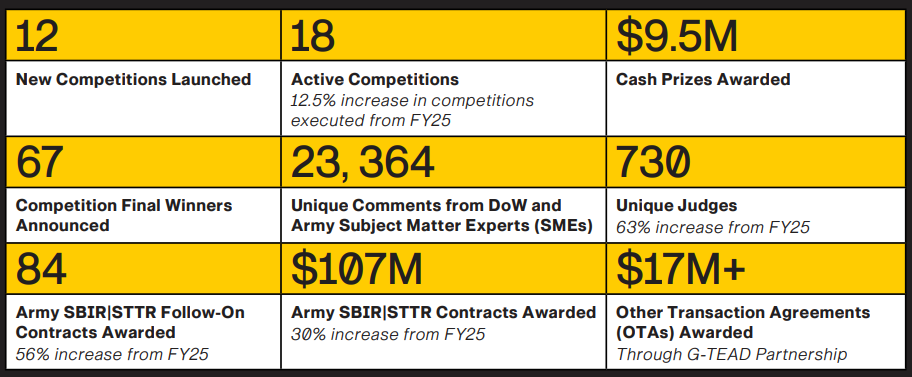
Army FUZE xTech Closes FY26 with Growing Impact Across Army Acquisition

As the Army works to accelerate modernization and expand its defense industrial base, xTech is helping connect commercial innovation with operational demand. Throughout FY26, the program built on its established competition model to bring promising technology into alignment with Soldier needs and create opportunities for evaluation, development, and transition.
Recent Competitions: Phantum, Inversion, Humanoid, and Disrupt Endurance
Active Competitions: Adaptive Strike, Kinetic Reach, Apex Intercept, Search 10, Disrupt Fires, Autonomous Sustainment
10 Competitions | 820+ semifinalists/finalists/winners | $14M in cash prizes | 1,900+ submissions
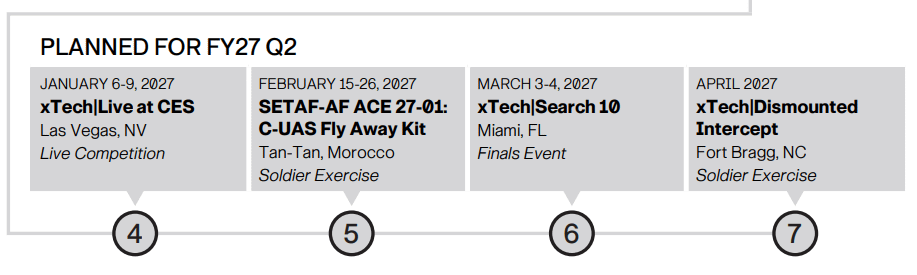
Our Take: The xTech Team is having a massive ROI for engaging industry and fueling new solutions for the Army. They are a model for the broader DoW to follow.
xTech|Kinetic Reach Competition Seeks Next-Generation Agile Sustainment Solutions
BLUF: The Army FUZE xTech Program, in partnership with the Global Tactical Edge Directorate (G-TEAD) and U.S. Army Europe and Africa (USAREUR-AF) has launched the xTech|KineticReach competition focused on agile sustainment and mobility technologies for future operations.
Conducted as part of G-TEAD’s new Accelerated Capability Event (ACE) framework, the competition is seeking commercially developed capabilities related to autonomous resupply, battlefield recovery, power generation, payload movement, and forward arming and refueling operations.
The effort supports sustainment priorities identified by USAREUR-AF and is intended to rapidly identify technologies capable of supporting distributed operations at the tactical edge.
Army Kicks Off Manufacturing Rodeo with Focus on Small Drones
BLUF: The completed drones will compete at the Army’s third Drone Dominance Gauntlet event in March where the systems will face complex obstacle courses, heavy electronic jamming and live target arrays.
The Army’s first iteration of its manufacturing rodeo will focus on vendors’ ability to rapidly build and scale one-way attack drones that cost no more than $3,000 each, according to a solicitation.
To achieve strategic overmatch in prolonged combat operations, the Army requires a paradigm shift toward Affordable Mass.
This is not a theoretical study; it is an execution-oriented prototype and industrial stress drill designed to vet both platform performance and domestic supply chain robustness under compressed timelines.
10% of the drones and ground stations must be delivered by Feb. 15 for testing and operator training.
The Army is looking for a variety of Group 1 one-way attack drones including those capable of: precision strike, flying in contested environments, incorporating a variety of commercial kinetic and non-kinetic payloads, and more.
All systems must also have an open systems architecture
Army Plans to Work with OpenAI on Project Gatekeeper

BLUF: The Army plans to work with OpenAI as it moves forward with a new initiative to accelerate the accreditation process for commercial vendors looking to offer their software to the military.
Project Gatekeeper, which was unveiled last month, aims to automate the traditionally burdensome authority to operate (ATO) process, which often stretches on for months, allowing commercial vendors instead to submit code to an Army DevSecOps platform for quick validation.
The Army is working with the other military department CIOs to try to establish “reciprocity” so that they don’t have to build their own systems for this type of process.
Vendors with a DoW Common Access Card can log in to Gatekeeper to use the system. Officials are working to open it up more widely and allow companies to access it via the Login.gov platform.
“What Gatekeeper was all about was taking that same experience that we built on the DSO platform, bring it to a commercialized space and say, hey, we’ll get you that first initial vetting that says you get the green check mark, that you are actively good enough for our networks. Get their code through, and then that kind of alleviates that relationship barrier between industry that doesn’t have a relationship with the government.” Gabe Chiulli, Acting CIO of the Army
Army Aviation Fleet Facing More Accidents, Lower Readiness Rates
BLUF: The Army’s manned aviation fleet’s fully mission capable (FMC) rates are sitting at “a norm” of <60%, well below the service’s goal of 75%.
Army aviators are also facing an accident rate that’s gone up exponentially, which is linked to insufficient flight time for pilots and crews to maintain proficiency.
The Army had more accidents this year, and flew 150,000 hours less than three years ago. So more accidents, less hours, less readiness.
The readiness picture has been less encouraging.
To improve readiness, Obadal said the Army is turning to its Weapons 360 platform, which provides real-time readiness data on the service’s major weapons systems and helps identify bottlenecks down to the part and supplier level.
The Army is also going to transfer both commissioned and warrant officers back into aviation formations where they belong and out of staff jobs to help address the increase in accidents.
“What we are doing is looking at the trends, and year over year, our trends of fully mission capable are going down. We have to change something.” - Michael Obadal, Army Undersecretary
Northrop Grumman Secures $1.6B PAC-3 MSE Propulsion Order

BLUF: Northrop Grumman secured a $1.6B contract to increase its production of solid rocket motors and related components for the Army’s Patriot Advanced Capability-3 (PAC-3) Missile Segment Enhancement (MSE) program.
Stop Gutting the Conventional Army
BLUF: In wars fought principally on land, the Army’s conventional forces – its maneuver brigades and divisions – are the primary agents of victory. They take and hold territory and play by far the most important roles in engaging and destroying enemy forces.
The quality and numbers of their leaders are all-important in setting conditions for success in land wars. If so, why are the Army’s best leaders regularly siphoned off in huge numbers to other communities that cannot play decisive roles?
If the true priority is an Army postured for large scale combat operations, a more rationalized approach would look something like this:
Three Special Forces Groups of three battalions, each with three companies
One Ranger Regiment of three battalions, each with three companies
One Civil Affairs Brigade and one Psyops Brigade of three battalions, each with three companies
No Security Force Assistance Brigade
Pruning excess or overstaffed headquarters in these communities can also go far to rebalance the force. Deactivated formations may migrate to the reserve component.
These changes would preserve needed capabilities while returning thousands of quality combat leaders to Active Army brigades and divisions badly in need of their talent, where the demand is greatest and the stakes the highest.
Other Army News:

A US Navy Fleet for Twenty First Century Deterrence and Combat
BLUF: Bryan Clark presented his new report, Righting the Ship: Building a Relevant US Navy Fleet for Twenty-First-Century Deterrence and Combat. He discussed the challenges facing the US Navy and how a new fleet design could help it address its missions within likely future budget and personnel constraints.
Toti Pushes New Foreign-built Shipyard in the US to Focus on Frigates, Large Surface Combatants
BLUF: William Toti, who has been nominated to serve as undersecretary of the Navy, has jumped off the bandwagon of building ships in foreign yards, instead pitching a new foreign-built shipyard in the US to construct frigates and other vessels.
Toti said he backs using foreign shipyards, but only to construct auxiliary vessels.
As for building more frigates and other surface combatants, he said the fastest way would be to have a foreign shipyard invest in a new shipyard in the US focused specifically on those vessels.
According to the August memo, if foreign shipbuilders agreed to several strict conditions to move future work to the US, they could build up to two ships in three different ship classes at their home yards before moving to the US.
Additionally, the Trump administration has requested Congress to authorize the Navy to commission foreign shipyards to build two surface combatant and two non-combat auxiliary vessels in the fiscal 2027 National Defense Authorization Act.
“We need a full portfolio of tools at our disposal. We have destroyers today doing frigate work, and the quickest way to get frigates in the U.S. Navy is to establish a new shipyard, world-class shipyard that’s focused just on those ships.” William Toti at SASC Confirmation Hearing
Related Article: Navy Wants New U.S. Frigate Shipyard Paid for by Foreign Shipbuilder
Navy Tests GPS-free Camera Navigation System on ScanEagle Drone Over Open Ocean

BLUF: The Navy tested a camera-based navigation system that allows drones to fly without relying on GPS signals.
A ScanEagle UAV completed a six-hour flight over open ocean near Southern California, navigating to designated waypoints using cameras and motion sensors.
Developed by Rhoman Aerospace in collaboration with the Naval Postgraduate School, the system was tested in a simulated GPS-denied environment with satellite navigation and ground links switched off.
The drone maintained closed-loop flight with less than 0.5% position drift relative to the distance traveled.
The new technology combines visual-inertial odometry (VIO), onboard cameras, motion sensors, and flight telemetry to estimate an aircraft’s position and movement.
Rhoman adapted its VIO technology with sensor-fusion methods designed specifically for maritime environments. The system combines camera observations with onboard sensor measurements and aircraft telemetry to generate navigation estimates. It can also operate with or without preloaded terrain maps..
Director of PAE SSP Outlines Strategic Deterrence Roadmap at Naval Submarine League Symposium

BLUF: VADM Douglas Williams, PAE Strategic Systems Programs provided his roadmap of how PAE SSP is partnering with industry to power the nation’s sea based strategic deterrence mission.
Williams zeroed in on the requirement of maintaining the superiority of the nation’s sea-based deterrent in an environment of rapid tech advancement.
Williams underscored the need for robust partnership between the industrial base and PAE SSP. The Navy needs more production capacity, visibility into supply chains, understanding of how you get what you need to deliver capabilities ahead of schedule and under budget.
By taking advantage of new tools enabled by the Acquisition Transformation Strategy like OTAs, PAE SSP is accelerating contracting and utilizing both traditional and non-traditional partners. Use of OTAs reduces bureaucratic burden and provides the tools, flexibility, and authority to outpace evolving global threats.
That agility directly fuels PAE SSP’s three primary lines of effort: sustaining and modernizing the sea-based strategic deterrent through the Trident II D5 life extension (D5LE) and D5LE2 programs, delivering rapid, non-nuclear hypersonic capabilities through Conventional Prompt Strike, and providing a future regional deterrence capability in the nuclear-armed sea-launched cruise missile (SLCM-N).
“The world looks different today, with the widespread use of super intelligence, digital engineering, and autonomous systems, but our fundamental mission is the same – to preserve peace through strength, and to ensure that the U.S. has a sea-based deterrent that is so reliable, so credible, and so ready, that no adversary dares move against us. We are being asked to engineer faster, think smarter, and deliver capabilities at a rate that surpassed what we thought was possible a decade ago.” VADM Douglas Williams, PAE Strategic Systems Programs
“We are on the dawn of another technological revolution.” ADM (Ret) John Richardson, Former CNO
Navy Selects RADM Patrick Finney to Lead Hypersonics, SLCM-N Office
RADM Patrick Finney is the Navy’s first flag officer in the post
Finney’s portfolio covers the SLCM-N program, estimated at up to $20B.
Related Article: Navy Taps One-Star Admiral to Advance Hypersonic Weapons, SLCM-N Integration at Crane
Navy Cuts Submarine Maintenance Delays by 40% as Output Surges
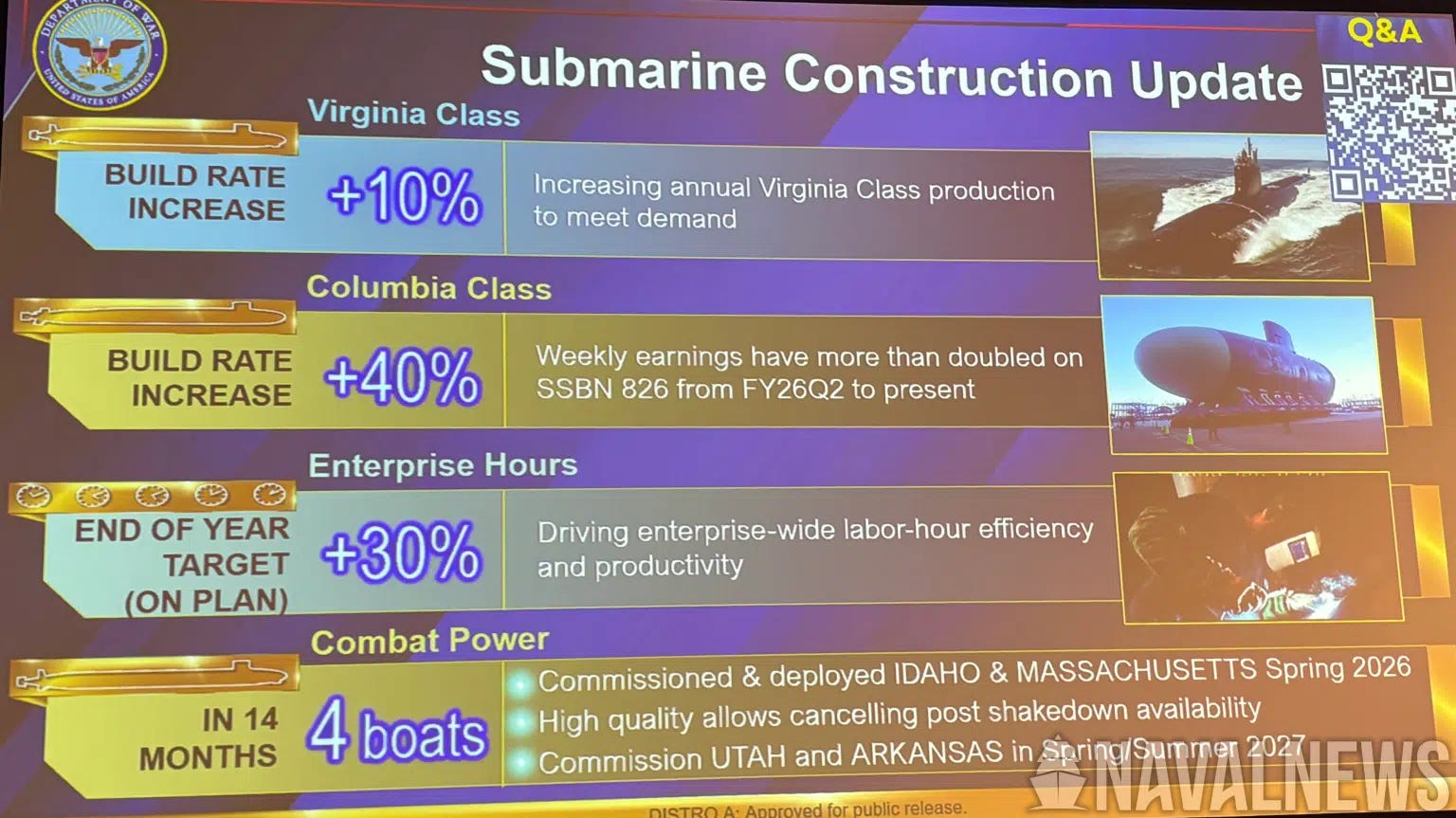
BLUF: The Navy has cut submarine maintenance delays by 40% and returned or delivered 10 submarines over the past 12 months.
VADM Rob Gaucher, Director, Submarine Programs and the Submarine SRPM, highlighted progress on the next two Block IV boats: the future USS Arkansas (SSN-800), which is on the precipice of sea trials, and the future USS Utah (SSN-801), which is nearing its fast cruise.
Both boats are scheduled for delivery within two months and commissioning in Spring 2027. On-time delivery of Arkansas and Utah would mark four new-build Virginia-class deliveries within a 14-month span.
The effect of drastically reducing delay backlogs and the amount of time taken to produce or retrofit submarines come from a dedicated effort and sweeping reform, especially as it relates to how the Navy, funding bodies, and industry interact and work together to solve issues.
In particular, Gaucher noted that reforms such as prior investments into Virginia-class parts and ensuring a stock of spare material over the past 3 years yielded dramatically positive effects on ensuring maintenance continued even through potential issues.
Part of ensuring availability of materials also stems from Gaucher’s efforts to remove administrative bottlenecks for a supplier base totaling ~27,000 separate suppliers through responding efficiently to industry feedback.
Eliminating administrative barriers remains a high priority, with reduction in vendor certification times by up to 60% in some areas.
Rapid funding mechanisms also helped to improve prospects, as 11 OTA agreements were implemented in the past year.
Gaucher also underscored the impact of a new internal scorecard tracking individual submarine programs across production milestones. Early warning indicators prompt direct engagement with prime contractor executives before schedule slippage compounds.
Under the current assessment, two submarine shipbuilding programs are ahead of schedule, six are on schedule, and only one is behind.
“10 boats returned, all those boats are combat surge ready. Each availability completed represents a combat hull put back into the hands of fleet commanders to generate combat readiness.” VADM Rick Seif, Commander, Submarine Forces.
Navy CCA Plans Will Not Wait For F/A-XX Next Generation Fighter

BLUF: One of the key roles envisioned for the Navy’s F/A-XX fighter is serving as an airborne controller for advanced unmanned aircraft. However, the Navy does not need to wait for F/A-XX to begin adding Collaborative Combat Aircraft (CCA) type drones to its carrier air wings. The service could pair CCAs first with its F-35C Joint Strike Fighters.
In September 2025, the Navy announced it had hired Anduril, Boeing, General Atomics, and Northrop Grumman to develop conceptual designs for future carrier-based CCAs.
Lockheed Martin has also been working to develop the underlying control architectures. The Navy’s first fixed-wing carrier-based drone is currently set to be the MQ-25 Stingray, an uncrewed aerial refueling platform.
the Air Force currently expects its F-22 Raptors to be its first aerial ‘quarterbacks’ for its forthcoming CCAs. Other platforms, including the F-35 and the F-47, are expected to follow. The Marine Corps is separately planning to pair its first CCAs with F-35s.
Lockheed Martin, the prime contractor for the F-22 and the F-35, has been working to lay the groundwork for both platforms to serve in the airborne drone controller role.
“CCA aircraft are an element of the future air fleet, the future combat capability of our aircraft carriers. The Air Force has been leading this issue. We are following closely behind, but the integration of CCA aircraft in the Air Wing is critically important as we go forward.” William Toti at SASC Confirmation Hearing
F-35C Completes First Launch and Recovery Trials on a Ford-Class Carrier
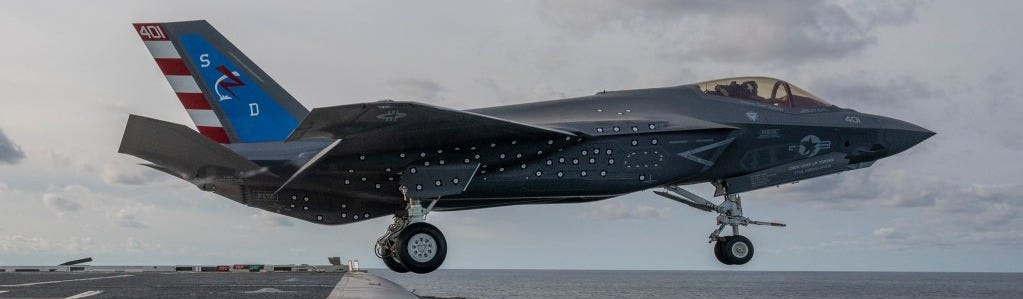
BLUF: Two Navy F-35C Lightning II fighters have completed the jet’s first round of launch and recovery testing aboard the future USS John F. Kennedy, the Navy’s second Gerald R. Ford-class aircraft carrier.
Over 11 days, the two jets made 34 flights and logged 122 catapult launches and 122 arrested landings.
Ford-class carriers use the Electromagnetic Aircraft Launch System and the Advanced Arresting Gear.
Navy’s shipbuilding plan would require massive hike in annual appropriations
BLUF: Per the CBO, the Navy’s shipbuilding plan released in May would average out to an annual cost of roughly $53.8B in shipbuilding appropriations, a 41% increase from the last five years.
This estimate factors in costs stemming from refueling nuclear-powered ships, and procuring non-battle force ships such as used sealift ships, among other things — costs that are not factored into the Navy’s 2027 shipbuilding plan.
As a result, those factors increase the CBO’s estimate of the Navy’s average annual shipbuilding costs by roughly $4.6B in comparison to the Navy’s shipbuilding plan.
Why Build a Billion-Dollar Warship if a Cheap Drone Can Sink It?
BLUF: Many have come to believe that swarms of cheap unmanned vessels can replace conventional warships, a belief that could push navies to shift billions in shipbuilding investment. However, current USVs have limits on reliability, range, and ability to gain sea control. Therefore, rather than replacing warships, USVs should be used for what they do best, as tools of distributed sea denial alongside conventional vessels.
Several factors make USVs attractive to navies. Although USVs cost far less than large manned vessels, they can impose disproportionate costs on high-value warships, ports, and logistics assets that are much more expensive to replace and protect.
Beyond cost, USVs can lower the risk to manned forces, multiply the strength of a fleet, and carry out tasks that manned vessels cannot.
One fundamental weakness of the replacement argument is that it relies on technology that has not yet matured. It rests on a fragile assumption that unmanned systems will advance as quickly and reliably as digital technologies such as microprocessors.
USVs also face practical engineering limits. With no maintenance crew, every system must be designed to run continuously on its own. If a vessel has 30 critical subsystems, each with 95% reliability over a two-week mission, the chance that all of them work without failure for that period drops to only about 21%.
USVs have not changed the older requirements of war; high-end naval assets remain vital for deterrence, command, logistics and strike, but their survival increasingly depends on integration with unmanned platforms.
The solution is not to choose between manned and unmanned platforms, but to combine them in a way that amplifies the strengths of both
Other Navy News:
Navy Orders Four Additional 40 PB Flight 2 Patrol Boats from Metal Shark
U.S. Navy Prepares 600-Ton Hypersonic Launch Module for Second Zumwalt Destroyer

Saronic Wins Deal to Build Autonomous Resupply Vessel for USMC
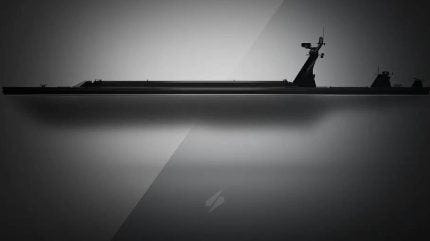
BLUF: Saronic Technologies has been awarded a prototype OT agreement with the DIU to deliver Saronic’s Autonomous Low Profile Vessel (ALPV), a long-range autonomous logistics connector that enables resilient, low-cost maritime resupply for dispersed U.S. Marine Corps forces.
The long-range autonomous vessel is intended to move food, fuel and other supplies to dispersed US Marine Corps forces operating within the reach of hostile weapons.
Saronic said it would work with the DIU and the Marine Corps to develop a capability that can be produced at scale.
The ALPV is designed for manoeuvrability and beaching, allowing it to support ship-to-ship and ship-to-shore logistics. Its autonomy systems include navigation and collaborative operating functions, while its modular open architecture is intended to support different integrations.
Marine Corps Leaders Discuss Expeditionary Medical Capabilities During Media Roundtable
BLUF: PAE Marine Corps hosted a media day and roundtable to discuss medical capabilities, acquisition priorities, and challenges and solutions to providing care to Marines in contested environments.
PAE MC’s mission is to improve accountability and accelerate the fielding of urgently needed capabilities to the warfighter.
Modernizing expeditionary medical systems involves more than fielding equipment; it also requires an integrated approach that ensures that forward deployed forces have access to reliable power, fuel, potable water and consumables to sustain medical operations before the shooting begins—while also reducing the logistical footprint.
The roundtable highlighted four key devices from the sets: the Marine Corps Squad Power Manager Medical Kit Variant, the Expeditionary Medical Refrigeration Unit (EMRU), the KOSMOS Point of Care Ultrasound (POCUS), and the MEQU Blood Warmer.
During the roundtable, Col. Paul Gillikin, Program Manager, Combat Support Systems, emphasized the importance of equipping medical teams for austere environments and operations across the vast distances of the Pacific, where logistics and casualty evacuation will likely be contested.
“Our mission is clear, we’re here to deliver mission-ready capabilities at the speed of relevance.” Brig. Gen Tamara Campbell, Deputy PAE
Marine Corps Acquisition Leaders Strengthen Partnerships With Australia
BLUF: PAE Marine Corps officials traveled to strengthen military partnerships and explore how Australia’s industrial capacity could help sustain U.S. Marines operating across the Pacific theater.
The visit focused on assessing Australian production capabilities, identifying prospective industry partners, and strengthening military-to-military cooperation in support of shared modernization and expeditionary sustainment priorities.
For Australian Diggers and American Leathernecks, decades of military cooperation provide a foundation for closer collaboration in developing, fielding, and sustaining the capabilities both forces need to meet shared challenges in the Pacific.
Industry engagement extended beyond the exhibition floor. During a visit to an Australian munitions manufacturing facility, the delegation toured the production floor and met with industry representatives to discuss domestic production capabilities and opportunities for industrial cooperation, including existing manufacturing relationships with the U.S. Army.
"Our partnership with Australia is built on decades of shared service and mutual trust. Meeting the challenges of the Pacific theater requires us to build on that foundation. Industry is critical to our ability to sustain forces forward. If the capabilities and support networks we need aren't already positioned in the region when hostilities begin, we cannot assume we'll be able to get them there." Col. Paul Gillikin, PM for Combat Support Systems.
Advertise with Defense Tech and Acquisition to put your brand in front of the people driving the future of national defense.

Air Force’s Containerized Surface-to-Air Missile Program Comes into Sharper Focus
BLUF: The Air Force has awarded a flurry of contracts to support its pursuit of a new, lower-cost, long-range, anti-air missile, as well as containerized launchers to fire them.
The Counter-Air Missile Program (CAMP) is targeting designs that cost no more than $500,000 apiece and can be produced at a rate of at least 1,000 per year.
CAMP also aligns with Air Force efforts to expand its organic ground-based air defenses, which it has historically relied on the Army to provide.
Sierra Nevada Corporation (SNC), in partnership with Specter Aerospace, received a $124M award from the Air Force to develop an anti-air missile under CAMP.
Castelion received two separate CAMP contracts covering work on an interceptor, as well as a launch pod to load them into a containerized launcher.
Anduril also secured a deal to develop a launcher in support of this program.
CAMP is an outgrowth of a ‘family’ of programs that have been focused primarily on the development of lower-cost and readily producible cruise missiles, including ERAM and FAMM programs.
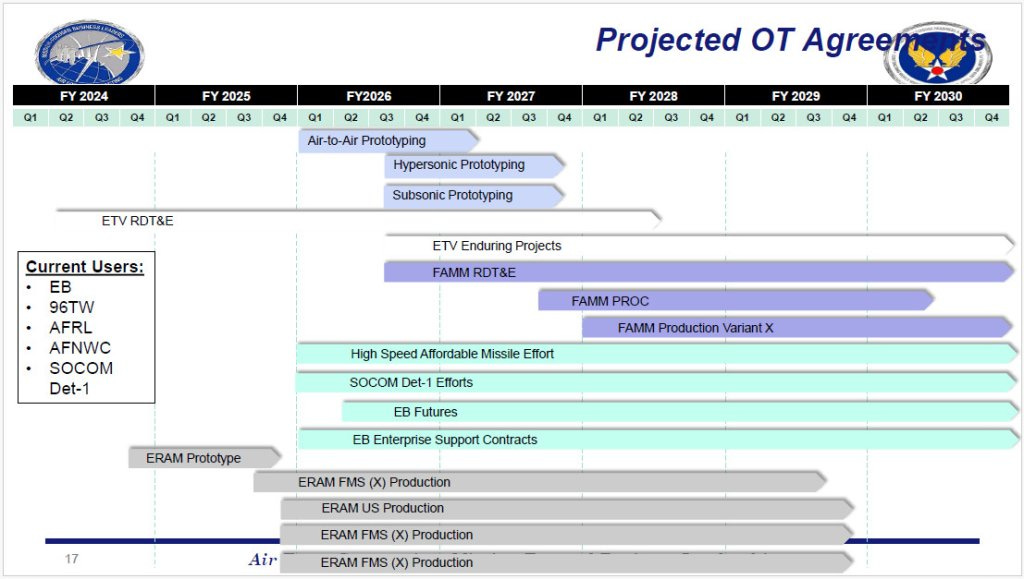
Our Take: Given the likely pressures on the AMRAAM and AIM 9X lines, this is a critical effort to produce weapons that can attrit adversary air forces using ground forces which supports Air Force efforts like IFPC and the general ACE construct.
Related Articles
Castelion Awarded Two Air Force Prototype Contracts Under Counter-Air Missile Program
Air Force Awards Sierra Nevada $124 Million for Counter-Air Missile, Company Says
Air Force to Turn Cold War B-1B Bombers into a Hypersonic Missile Carrier with Boeing
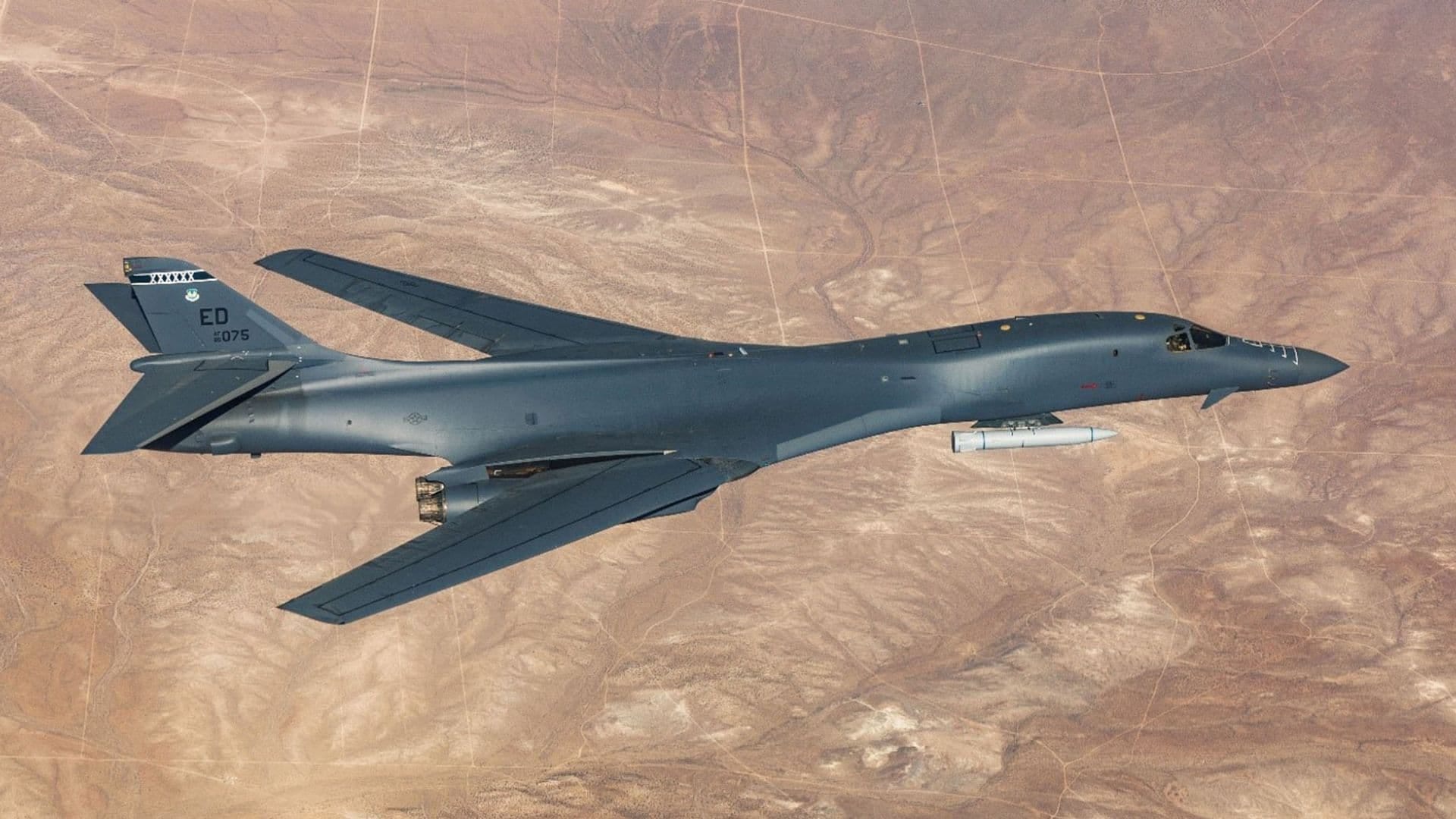
BLUF: Boeing’s Load Adaptable Modular (LAM) external weapons pylon for the Air Force’s B-1B Lancer strategic bomber has cleared its critical design review, marking a key milestone to move towards hardware manufacturing and flight testing.
The modular pylon bolts onto six dormant fuselage hardpoints, enabling the bomber to carry hypersonic missiles and potentially double its overall payload.
While the B-1B already carries the largest internal payload of any bomber in the Air Force inventory (up to 75,000 pounds), those enclosed bays restrict the length and diameter of next-generation standoff weapons.
Expanding external carriage allows the Air Force to use the B-1B as a hypersonic testbed and strike platform until the B-21 Raider fleet reaches full strength.
Related Article: B-1B Bomber’s New External Pylons Clear Critical Design Review
Holy S—, That’s Tehran!: B-2 Pilots Tell the Story of Operation Midnight Hammer

On June 21, 2025, seven B-2 Spirit stealth bombers departed Whiteman Air Force Base in Missouri on one of the most ambitious bombing missions in modern American military history. Their destination was Iran, nearly halfway around the world.
Their objective was to destroy deeply buried nuclear facilities that American military planners had spent more than 15 years studying.
The mission, later named Operation Midnight Hammer, was the culmination of years of intelligence, weapons development, testing, and planning. At the center was Iran’s Fordow nuclear enrichment facility, buried deep inside a mountain.
The Air Force had developed the 30,000-pound GBU-57 Massive Ordnance Penetrator (MOP) specifically to defeat hardened underground targets.
Designing the weapon had required years of experimentation, with repeated testing and modifications to ensure it could penetrate the facility.
By early 2025, planning accelerated. Teams of 50–60 tacticians worked across multiple commands to coordinate the bombers, fighter escorts, communications aircraft, and dozens of aerial refueling tankers. T
The scale of the operation was extraordinary: ~125 aircraft supported the mission, including F-22s, F-35s, F-16s, A-10s, and KC-135 and KC-46 tankers.
Israel’s June 13 attacks on Iran eliminated many air defense threats, creating a more favorable environment for bombers but Iranian efforts to reinforce Fordow’s ventilation shafts with concrete forced planners to revise the attack sequence.
The first bombs would now have to break through the new protective barriers before subsequent weapons could penetrate deeper into the facility.
To mislead observers, additional B-2 bombers flew west toward the Pacific, attracting public attention while the actual strike force headed east.
The flight itself became a test of human endurance. Fourteen pilots spent approximately 37 hours aboard seven B-2s, relying on short naps, coffee, snacks, and repeated aerial refueling to remain operational.
Radio silence was maintained for much of the journey. As the aircraft approached Iran, crews prepared for enemy fighters or surface-to-air missiles.
Six B-2s were assigned to Fordow, while the seventh continued toward Natanz. The bombers had to arrive within seconds of their assigned times because the weapons were intended to produce a carefully coordinated sequence of effects.
At ~2:10 a.m. local time, the lead B-2 released the first two MOPs. The pilots watched anxiously as the weapons descended.
Seconds later, an enormous explosion illuminated the mountains below. The first strike had opened the way for the remaining bombers.
One by one, the following aircraft released their weapons, with each crew depending on the previous strike to achieve its intended effect. The final B-2 attacked Natanz.
In total, seven B-2s dropped 14 MOPs weighing a combined 210 tons.
Separately, sub-launched Tomahawk missiles struck the nuclear facility at Isfahan.
The operation inflicted substantial damage on Iran’s nuclear enrichment infrastructure, although the precise extent remained uncertain.
More broadly, it demonstrated America’s ability to coordinate stealth aircraft, specialized weapons, global aerial refueling, intelligence, and allied military operations into a single long-range strike.
Our Take: This operation shows the immense challenge of launching an operation like this with the combined effects of the joint force and allies. Now imagine a PLA conflict where this operation might need to occur a dozen times a day to service all the reinforced targets - over the most highly contested territory in history. It’s very indicative of the strain on the force it would present with the current forces or even with more B-21’s. To us it conveys the need to think very differently about how we achieve the effects needed.

Space Industrial Base Stretched Thin Amid Low-Orbit Satellite Constellation Shift

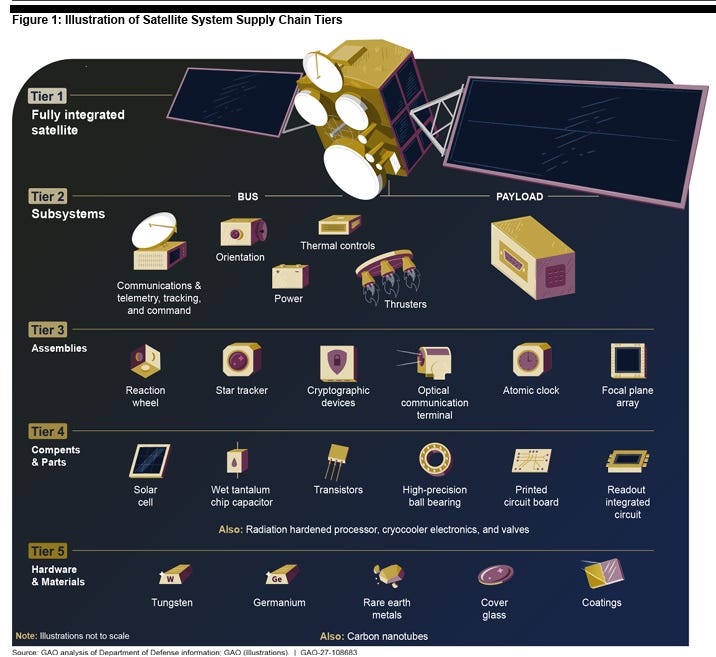
BLUF: The Pentagon’s preference for large groups of massed, small satellites in low-Earth orbit to help counter Chinese and Russian threats is stressing a specialized industrial base consumed by competing markets and imbalanced commercial output.
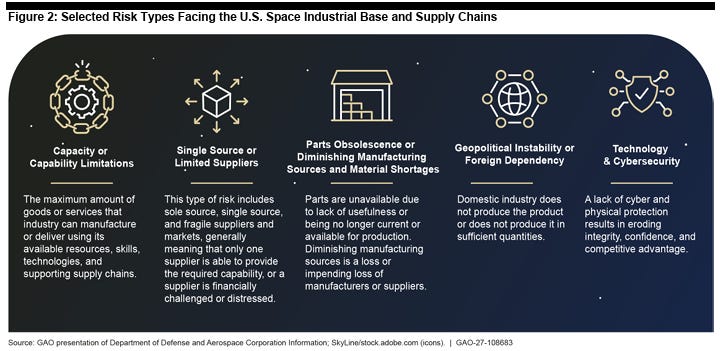
The simultaneous growth creates intense competition for critical assets and triggers shortages for semiconductors, electronics, raw materials, and manufacturing capacity.
GAO recommended the SECDEF centralize enterprise-wide oversight of supply chain holes across the DAF and NRO.
The Air Force did set up an “enterprise risk management service” in an April memorandum, but it neither established a leader or agency in charge nor did it “clearly define roles and responsibilities” according to the report.
Space Systems Command similarly put together a supply chain risk identification guide in April but the guide has no authority outside of the Space Force.
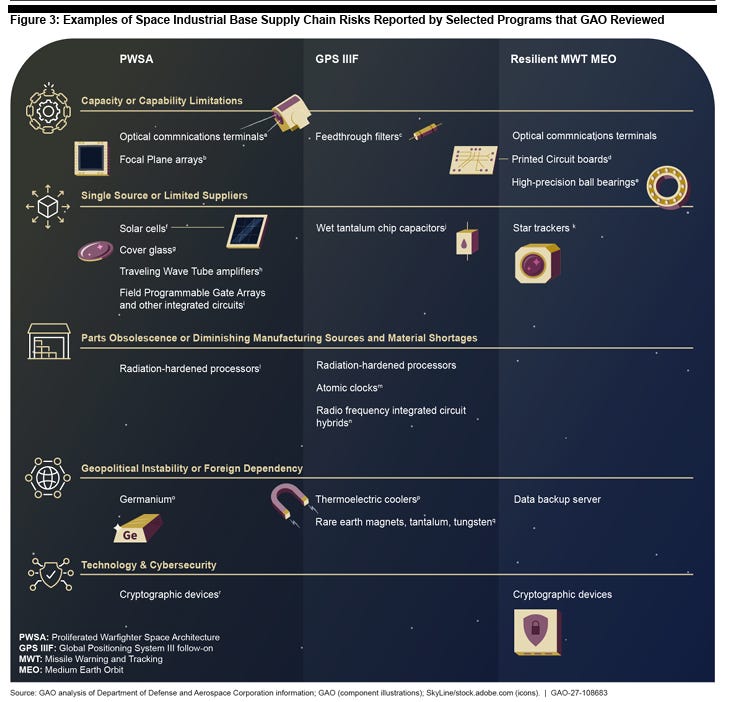
Three programs were identified at being at risk: the Proliferated Warfighter Space Architecture (PWSA), the Global Positioning System III follow-on (GPS IIIF) and the Resilient Missile Warning and Tracking (MWT) Medium Earth Orbit (MEO).
PWSA, which is expected to cost the Pentagon $15.6B over the next five years, has already suffered missed demonstration deadlines, scaling challenges and delivery delays, which GAO attributed to supply chain disruptions.
MWT MEO, which carries an $8.3 billion cost over the next five years, has seen launch delays prompted by printed circuit board shortages.
Our Take: This was a really well-done GAO report that is proactively identifying areas that deserve focused attention from Space Force and IC leaders.
ULA’s Latest Launch Failure Spells Trouble for Space Force
BLUF: When a ULA rocket failed Nov. 15, the explosion did more than destroy one rocket and the 40 Amazon LEO satellites it was carrying: It tightened the bottleneck already constraining Space Force launch capacity and ramped up pressure on ULA.
The Vulcan Centaur launch, the first in nine months, followed a lengthy investigation after the nozzles on the Northrop Grumman-made solid rocket boosters suffered an anomaly during a February launch, prompting a grounding.
This time, the launch began well enough but went sour about 10 minutes into the flight when, having failed to reach a high enough altitude and develop sufficient velocity, it failed to reach orbit.
ULA statements indicate the problem this time was with the fuel supply to the first stage’s BE-4 rocket engines, built by Blue Origin.
Those engines also power Blue Origin’s New Glenn heavy-lift vehicle.
ULA blamed the failure on “inadequate fuel supply from the vehicle to the BE-4 engines, not from the performance of the engines.”
Blue Origin has been planning to launch a New Glenn in January 2027, and there is no indication of any change to that schedule.
“It’s existential pressure for them. This is their only launch vehicle going forward, and every day they’re grounded, they are falling further and further behind on the orders they already have, which is preventing them from taking on any new orders.” Todd Harrison
Related Article: Low Earth orbit is becoming critical infrastructure
Our Take: We feel confident that Blue Origin and ULA will eventually figure this out, the question is how many Space Force programs will be delayed in the interim if the problems continue. We need the Vulcan Centaur and New Glenn to be successful so let’s all wish them good luck in 2027.
SpaceX, ULA & Blue Origin Receive $985M Space Force NSSL Contract Modifications
BLUF: The Air Force has awarded contract modifications to SpaceX, United Launch Alliance and Blue Origin under the National Security Space Launch, or NSSL, Phase 3 Lane 2 program.
The companies will provide launch services under the modifications, with work taking place at their respective facilities.
Cape Canaveral Space Force Station and Kennedy Space Center in Florida
Vandenberg Space Force Base in California.
The work is expected to conclude by April 2033.
The NSSL Phase 3 acquisition strategy divides launch missions into two lanes based on the level of risk the government can accept.
Lane 2 covers missions with the highest reliability requirements and supports launches carrying critical national security payloads.
SSC awarded the three companies Lane 2 contracts in April 2025, with a combined anticipated value of $13.68B.
The awards included $5.92B for SpaceX, $5.37B for United Launch Alliance and $2.39B for Blue Origin.
In October 2025, SSC assigned seven Lane 2 missions with SpaceX receiving $714M for five missions, while ULA received $428M for two missions.
Rocketdyne Adapting Propulsion Tech for Maneuverable Military Satellites
BLUF: Rocketdyne is looking across chemical, electric and nuclear propulsion to meet emerging requirements for spacecraft that can change orbits quickly, evade potential threats and operate for longer periods without exhausting their fuel.
Rocketdyne became a standalone company in August. AE Industrial Partners owns 60% of the business carved out of L3Harris Technologies.
Rocketdyne is examining ways to bridge a fundamental engineering trade-off.
Chemical propulsion provides the high thrust needed for rapid maneuvers but consumes propellant relatively quickly.
Electric propulsion uses propellant far more efficiently, providing greater endurance, but typically takes longer to move a spacecraft.
“We need the high thrust systems. We need the high delta V systems so that we can keep everyone guessing and really evade any of our adversaries.” Kristin Houston, CEO Rocketdyne
Map Shows States Battling to Host New Space Academy
BLUF: Several states are competing to become the permanent home of the proposed United States Space Academy, pitching their existing aerospace companies, NASA facilities, military bases, and universities as reasons why they should be the state to host the new federal institution.


CR Not Slowing Golden Dome Progress
BLUF: Golden Dome for America is trekking along with previously obligated dollars despite a continuing resolution fencing off funds.
Congress poured nearly $25 billion in reconciliation funding into the program through last year’s One Big Beautiful Bill Act, which is “colorless” money that the Pentagon can spend over multiple years.
A financial reckoning of some kind may soon await the program after Senate defense appropriators called out the program’s unorthodox funding approach in their fiscal 2027 spending bill.
ppropriators also called for an independent Golden Dome cost estimate delivered to the congressional defense committees within 90 days of enactment.
“This funding incongruence and overreliance on mandatory investments in the President’s budget request threatens the success of this important, long-term homeland defense initiative.” Senate Appropriators
“We know what we want to deliver in [20]28, and we are marching down that path today. We have 100% of our funding obligated.” Marcia Holmes
The Real-World Missile Defense Lessons from Ukraine and Iran, and How They Matter for China
BLUF: Militaries around the globe have been studying the Ukraine and Iran conflicts to learn about the impacts of missile technologies, drones and air defense systems. But every conflict is different, and every region has different needs.
See video here.

China Has Not Changed Its Mind on Using Military Force to Take Taiwan, the Danger Is Still Trending Higher
BLUF: While testifying before Congress in March 2021, then-Commander of U.S. Indo-Pacific Command Adm. Philip Davidson warned that China’s Secretary General Xi Jinping had instructed his forces to possess the capability to seize Taiwan by 2027.
Current world events, however, warrant an update to said window, with some U.S. officials recently signaling that Xi may not meet his 2027 goal.
While this may be good news, it doesn’t mean the danger of a Chinese invasion of Taiwan, thus precipitating a large-scale U.S.-China conflict, is gone. Indeed, the danger may persist or only be deferred.
Xi has been less restrained in displaying China’s national power than his predecessors.
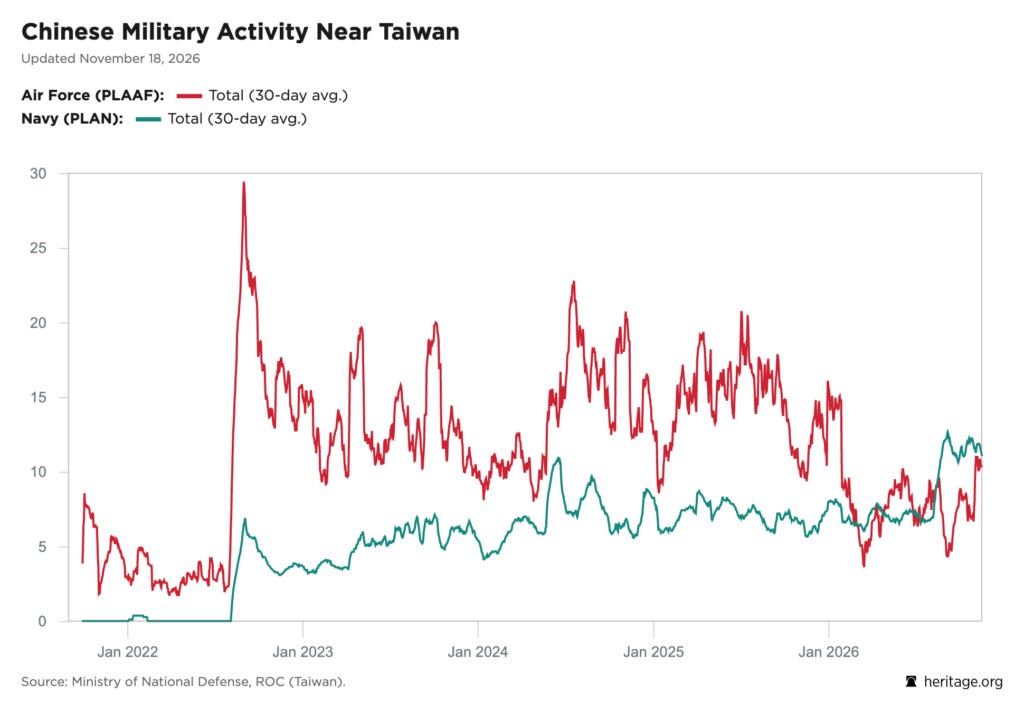
During Xi’s term, China has been unabashed in its maritime challenges to neighbors like the Philippines, Japan, and Vietnam. It has also been engaged in prolonged and heightened military activities around Taiwan.
The most recent example is an unprecedented 100 naval vessels conducting an exercise that appears to be a dress rehearsal of a blockade of Taiwan.
These Are the Weapons Ukraine Used to Drop the Kerch Bridge

BLUF: Ukraine has revealed a diverse collection of domestically developed weapons, and at least two foreign-supplied ones, used in its latest attack on the Kerch Bridge.
The operation, coordinated by Ukraine’s Security Service (SBU) and the General Staff, unfolded over several weeks and involved seven stages.
As well as the bridge itself, Ukrainian forces systematically targeted Russian air defense systems, radars, electronic warfare equipment, and other installations before moving against the main target.
The final assault, conducted on November 16-17, involved a combination of long-range attack drones, cruise missiles, and shorter-range drones.
Palianytsia drones struck the bridge’s road section, while FP-5 Flamingo, Neptune, and Ruta cruise missiles were used against the railway section.
The Ukrainian president named 11 weapons systems involved in the operation:
Dovbush UAV: family of Ukrainian-developed uncrewed aircraft, with variants intended for reconnaissance and strike missions.
Vendetta FPV Attack Drone: Ukrainian FPV loitering munition, with thermal-imaging capability and a range of between 12 and 43 miles.
Da Vinci Long-Range OWA Drone: Manufactured by Netherlands company Destinus, it is a propeller-driven drone which can travel 621+ miles, carry an 88 and 220lb warhead weighing and operate in contested EW environments.
Sichen Long-Range OWA Drone: Ukrainian long-range strike drone designed to attack targets deep behind enemy lines with a range of 870 miles, and an 88lb warhead. Owes lineage to the Iranian-designed Shahed-136.
MICH-2000 Long-Range Attack Drone: Another Shahed-lookalike, MICH-2000 is a Ukrainian long-range one-way attack drone with a 1,240mi range associated with the SBU’s Alpha special operations unit.
Ruta Cruise Missile: Destinus-developed and manufactured low-cost cruise missile optimized for high-volume salvo attacks. It is designed to fly at low altitude, using terrain masking to help penetrate enemy air defenses.
Palianytsia Long-Range Drone: Ukrainian turbojet-powered drone designed to attack targets at long distances.
An-197 UAS: Ukrainian deep-strike unmanned aircraft. Not a lot is known about this weapon system.
FP-1 Long-Range OWA Drone: Long-range Ukrainian attack drone developed by Fire Point.
R-360 Neptune Anti-Ship and Land-Attack Cruise Missile: Ukraine’s cruise missile, originally designed to attack naval vessels. It is essentially a Ukrainian version of the Soviet-era Kh-35 anti-ship missile. The baseline R-360 has a range of ~186 miles and a warhead weighing ~331 pounds.
FP-5 Flamingo Ground-Launched Cruise Missile: Manufactured by Fire Point, theFP-5 is designed to attack fixed targets at ranges of ~1,864 miles with a warhead weighing up to 2,646 pounds.


Related Article: Ukraine Deploys Destinus Ruta Missiles to Collapse Crimea Bridge
Our Take: The use of such a wide range of UAS and missiles reflects the complexity involved in executing this operation which Russia was likely defending heavily against. This is a huge embarrassment to Russian forces and Putin personally so bravo to the Ukrainian planners and drone operators who pulled this off successfully.
Ukraine Plans to Double Drone Supplies, Triple Deep Strikes
BLUF: Ukraine plans to double its drone supplies and more than triple its long-range strike capabilities next year as Kyiv presses ahead with its long-range strike campaign.
The British government said it will also send Ukraine more than 1,000 long-range strike drones, some able to fly more than 620 miles.
Drones will make up more than half of Ukraine’s weapons needs in 2027.
Europe Is Exploring Orbital Deep Strike Weapons

BLUF: Europe is beginning to explore the possibility of delivering conventional military payloads from orbit, with MBDA and space transportation company ATMOS Space Cargo teaming up on a concept known as Precision Orbital Deep Strike (PODS).
The proposal involves putting military payloads into space before sending them back through the atmosphere when commanded, potentially offering a radically different approach to long-range precision strike.
Getting a payload into orbit and returning it to Earth is a very different problem from developing a reliable weapon capable of striking a designated target with precision and at a predictable time.
PODS appears to be pursuing a different approach from past efforts, drawing on modern commercial orbital transportation and atmospheric re-entry technologies to potentially deliver conventional military payloads.
It is unclear if the plan is to:
Use a recoverable capsule that carries a weapon, releases it during re-entry or before reaching the target, then continues to a separate recovery area OR
if this is a one-way payload delivery, with the capsule and its payload expended in the strike.
ATMOS CEO Sebastian Klaus reportedly described a system intended to reach targets anywhere on Earth in less than 60 minutes.
Our Take: While this is ambitious, the fact that gives it great odds of success is that there are numerous dual-use applications. It still is probably not likely to be very cost-effective but would provide a significant deterrent in being able to deliver an effect nearly anywhere on the globe.
Saab-Led Consortium Completes First Phase of NATO Underwater Network
BLUF: Dubbed Allied Underwater Battlespace Mission Network (AUWB-MN), the project is intended to enable NATO members to share information and co-ordinate crewed and uncrewed maritime systems across multinational operations.
Rather than requiring individual connections between each system, AUWB-MN seeks to establish shared technical standards and security principles to support integration.
Phase 1 focused on the network’s architecture, technical approach and governance arrangements.
It also established the basis for a Test and Reference Environment, which is intended to support future experimentation, capability development, compliance assessments and operational exercises.
Led by Saab’s Naval business area, the consortium includes Fincantieri Group companies CETENA and IDS, along with FlySight, GraalTech, Miraya, Saab UK, S2IX and the University of Plymouth.
U.S. and Australia Should Give ANZUS Teeth
BLUF: With a U.S. foreign policy that expects allies to shoulder more weight, Canberra and Washington should pivot ANZUS into a deterrence network that is open to other partners and built around hardware that can be deployed quickly.
Canberra, cannot afford to wait for hardware that takes years to build but should prioritize capabilities deployable today.
AUKUS Pillar One’s industrial foundation is fragile as U.S. shipyards suffer constraints that threaten Virginia-class delivery schedules and Australia is grappling with defence workforce shortages and inertia in U.S. export controls.
To ensure that deterrence works in the years before the submarines arrive, the alliance should execute six upgrades.
First, Australia should transition from importing munitions to making them.
Second, Australia should harden vulnerable northern airbases while bolstering dual-use civilian infrastructure to absorb potential strikes.
Third, the alliance should strengthen conventional-nuclear integration as regional nuclear arsenals grow.
Fourth, Canberra and Washington should anchor a broader coalition in Australia’s neighbourhood.
Fifth, AUKUS partners should ensure that Pillar Two – covering technologies other than nuclear submarines – delivers near-term, practical capabilities quickly, avoiding broad tech lists that blur focus.
Finally, the alliance should cultivate its people by establishing dedicated pipelines for defence, diplomatic and tech experts – through expanded bilateral fellowships, joint planning exchanges and multilateral postings.

$350 Billion Reconciliation Bill Not Going to Happen: HASC Chair
BLUF: According to Rep Mike Rogers, a $350B reconciliation bill is “not going to happen,” however a “skinnied down” version of the bill may still be possible.
This comes as Republican lawmakers grapple with two looming deadlines.
The continuing resolution that is funding the Pentagon runs out on Dec. 11,
Democrats are poised to take over both chambers on Jan. 3.
With weeks left in control, the GOP-controlled chambers are weighing their options for a $1.5T FY27 Defense Department request.
They are also sitting on a $87.6B supplemental request that includes $67.1B in defense funds to cover expenses associated with the war in Iran.
Those three moving pieces could combine in various ways over the coming weeks.
Report to Congress on the Defense Innovation Ecosystem
Key Takeaways:
While some level of redundancy and duplication may be necessary, the sheer number of DOD innovation-related organizations and their potentially overlapping missions, functions, and responsibilities can pose challenges both within and outside of the department.
While the January 2026 memorandum seeks to unify the DOD innovation ecosystem by establishing six execution organizations and requiring the military services to create service-level innovation plans, the memo lacks “clear goals or benchmarks” and does not “immediately confront and work to minimize the front door problem that exists for industry.”
According to the DIB, the loss of innovators within DOD “is not a lack of dedication to the Department’s mission but burnout due to lack of top cover, the cumbersome bureaucracy, and the stale processes.
Groups identified consolidation of budget program elements, higher reprogramming thresholds, and the use of capability portfolio management as actions that could increase DOD’sflexibility during the year of budget execution and the adoption and integration of new technologies.
Confirmation Hearings
Confirmation Hearing Hung Cao for SECNAV | SASC | Nov 17
New Congressional Leadership
SASC Chairman: Sen Jack Reed (D-RI)
SASC Ranking Member: Sen Roger Wicker (R-MS)
HASC Chairman: Rep. Adam Smith (D-WA)
HASC Ranking Member: Rep. Trent Kelly (R-MS) or Rep. Ronnie Jackson (R-TX)
SAC-D Chairman: Sen Brian Schatz (D-HI), Sen Tammy Baldwin (D-WI), or Sen Chris Murphy (D-CT)
SAC-D Ranking Member: Sen Lisa Murkoski (R-AK) or Sen Jerry Moran (R-KS)
HAC-D Chairman: Rep. Betty McCollum (D-MN)
HAC-D Ranking Member: Rep. Ken Calvert (R-CA) seeking a waiver and if denied then Rep. Steve Womack (R-AR)
Last Week’s Poll Results
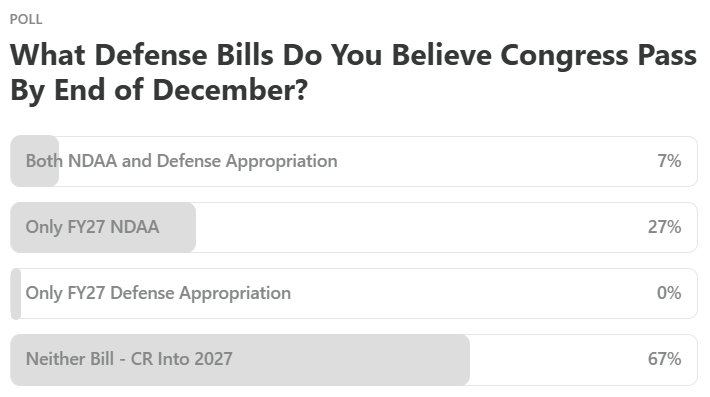
Paid members watch for our SAC-D Defense Appropriations Bill Analysis post soon.
See our NDAA and budget posts for the latest insights and analysis.

Use Case, Mission Case, Business Case | Jeremy Verbout
Creative Defense Foundation
Innovate or Die | Adam Fife
Creative Defense Foundation
Rebuilding the Arsenal of Freedom, Reindustrializing America | Rep Mike Rogers
Hudson Institute
Pentagon Rethinking How It Spends Billions, Changes Underway | Jules Hurst
Fed Gov Today
Golden Age of Space | MGen. Stephen Purdy
Threat Status
Next Generation of Shipyards and Anduril’s Arsenal 2 | Chris Brose
Midrats
How AI, Data Analytics, and Emerging Tech Transform Gov’t | Eric Schwartz
NDIA Emerging Tech Horizons
Expanding the Defense Production Base: It Takes Commitment | Manica Noziglia
Mitchell Institute for Aerospace Studies
Why new stealth fighter designs are constrained by VERY OLD missiles
Sandboxx
Airshow China 2026: What Beijing Wants the World to See
Mitchell Institute for Aerospace Studies
Armed Robot Dogs, Ukraine, and C-UAS | Chris Klatengger
Drone Wars
CMMC on Hold: Charting a Path Forward | Dr. Jerry McGinn
CSIS All About the Base
Ops Center Could Solve the Army’s Data Management Problem | LTG Jeth Rey
Fed Gov Today

Counter UAS Tech
SAE Media • Nov 30-Dec 2 • Washington DC
I/ITSEC 2026
Nov 30-Dec 3 • Orlando • FL
TechNet Transatlantic 2026
Dec. 1-2 • Frankfurt Germany
Tectonic European Defense Summit 2026
Dec 1-2 • Shangri-La, Paris
AUSA Landeuro 2026
Dec. 3-4 • Wiesbaden, Germany
Reagan National Defense Forum - POTUS Speaking
Dec 4-5 • Simi Valley, CA
DOW Maintenance Symposium / Software Summit
Dec 8-11 • Ft Lauderdale, FL
AOC International Symposium & Convention
Dec. 8-10 • National Harbor, MD
Plan the quarter from the events page. It has the full year, so you can lock travel and decide which conferences are worth the pipeline before the calendar fills.