


Welcome to the latest edition of Defense Tech and Acquisition.

The biggest stories across the Department and the defense industry this week:
Multiple strategic reflections on defense tech’s progress and challenges
New partnerships in munitions, drones and a right to repair debate
The Army awards Lockheed Martin multiple major munition contracts
Navy Carriers are operating with new air and surface drones
Air Force needs new tankers and scales ARRW hypersonic missile
AMTI program launches prototype and the argument for more VLEO capabilities
Investors losing faith in Golden Dome and looking for a better demand signal.
UK funds its defense plan and China develops more on-orbit space weapons

Caine Says Super Intelligence Is a Strategic Priority
BLUF: Gen Dan Caine, CJCS, said super intelligence is one of his strategic priorities. Using SI effectively will be essential for the joint force to win in tactical engagements with the enemy, logistics and sustainment, and command and control by protecting the functions the military needs to be victorious and dominate on the battlefields of the future.
"I have three strategic priorities right now, separate from others.
Making sure that we have a budget.
Super Intelligence
Ongoing operations.
That's how much emphasis, potential, I think SI has in transitioning the way that we fight our wars in the future, and it extends across all of the joint functions.
SI going to be a game changer as we move forward, and the number of things that are going to go back and forth between an adversary and the U.S.
Need to train leaders, systems and models to support future commanders' decision-making while maintaining appropriate human involvement and balancing the opportunities and risks associated with SI.
Gen. Caine Urges Defense Logistics Leaders to be Creative and Entrepreneurial Ahead of Future Fights

BLUF: Gen Dan Caine encouraged hundreds of military personnel and commercial logistics insiders to embrace more entrepreneurialism as they prepare for future wars.
Gen Caine described expanding the nation’s industrial capacity and the military’s strategic mobility as essentials to ensuring combat power in the years ahead.
As military leaders hustle to ensure the joint force is properly armed in the modern era, he noted, they need to adopt the right mix of high-end capabilities and autonomous, attritable assets at scale ahead of U.S. adversaries.
“As you consider your business models of the future, whether you’re one of the component commanders or you’re in industry, I ask you to be very creative and entrepreneurial in starting to think about how we’re going to move forces and sustain forces in contact in both the physical domain and then the information domain, as well.” Gen Dan Caine, CJCS,
The Defense Reformation Turns Two

BLUF: Two years ago, Shyam published the eighteen theses of The Defense Reformation. Today, America is still in a state of emergency, but the hard work to fix it has begun. America’s limited magazine depth has gone from an obscure think tank topic to a weekly mainstream news story and an urgent political priority. If the strategic picture is still stormy, the action and progress inside the Pentagon and across America is a source of light.
The Last Supper of defense consolidation is over and a new era has begun.
Where clear vulnerabilities exist, like solid rocket motors and rare earths, capital and founders are flooding the space to build new solutions.
It’s not just that unprecedented levels of venture capital continue to flow into defense companies. Startups are delivering and leveling up and forcing legacy companies to step up their game.
The last two years have been an incredibly dynamic environment for talent.
BOND brought the best executives from the private sector.
Army Reserve’s Detachment 201: Executive Innovation Corps
Investment bankers are joining OSC and EDU.
Project Meridian is reimagining the future of war.
The infusion of new talent and new thinking has led to ambitious projects that are changing the way America innovates and fights.
Project Agincourt to stand up an Autonomous Warfare Command
Army’s Manufacturing Rodeo to stress the industrial base, supply chains.
All across the defense industry, new entrants and legacy contractors are moving at unheard-of speed to ramp production of munitions.
Drone Dominance program gauntlets challenge where a company’s ability to mass manufacture its drones with results on a leaderboard.
Pivoting from cost-plus to fixed price contracts and OTAs.
People. Production. Paying for results. These are the core principles driving the Defense Reformation. In just two years, we’ve made progress on all three.
The next hill is the budgeting and appropriations process.
The admin took big swings with the abolition of JCIDS, the restructuring of PEOs to PAEs, and a visionary budget request.
Bill Greenwalt was among the biggest champions of dropping a bomb on JCIDS. Now he proposes killing the PPBE process in much the same way.
America still needs scale. There are technology challenges and supply chain bottlenecks, but mainly we need more competitive opportunities with real production orders attached to them.
Too many of our most important weapons systems are effectively government-sanctioned monopolies on taxpayer-funded designs from the Cold War.
A Dickensian Take on the Coming Years in Defense Tech
BLUF: It’s a strange time for the defense technology sector. Despite the headlines of record capital, valuations, and defense budgets, there is a growing unease among investors and leadership teams. Production contracts remain as elusive as ever, and a generation of startups is struggling to extend their runways across the valley of death, risking not just those businesses but capital flight from the broader sector. There is little point in trying to decide which one of these diverging narratives is real, or if a defense technology market collapse is imminent.
To understand what’s really happening, we should recognize that things are getting Dickensian. In A Tale of Two Cities, Dickens described the winners and losers in the years before the French Revolution.
Defense technology has evolved into two distinct markets. London is the land of production contracts and annually recurring revenue. Paris is the ever-churning metropolis of prototypes, pilots, and discretionary funding.
The best of times: Trillion-dollar defense budget, $49B in venture investment in defense tech, SVDG 100 raised $118B. Valuations break records. Palantir is greater than Lockheed Martin, Northrop Grumman, and General Dynamic combined.
DoD obligates $450B annually and top 5 primes receive 30%. SVDG 100 received $4.3B combined. Only 14% of DIU’s 450 prototypes transitions to production.
Only a small number of new entrants are benefiting from production. Palantir, Anduril, and Saronic to name the few.
Prototype funding is constantly at risk of sweeps and reallocation to current operations and continuing resolutions that prohibit new starts. However in munitions startups like Castelion and Covenant have huge opportunities.
Prototype-dependent companies will quietly run out of money, and no failure will count as news. For production startups, individual failures will be more noticeable.
Four categories are emerging for winners and losers. The Deserved Few (leaders), The Deserved Losers, The Undeserved Losers, and the Opportunistic Acquirers.
Focus maniacally on clear assessments of the viability of production contracts.
Start thinking seriously about mergers and acquisitions, though the vision startups sell doesn’t align with the contracts primes buy.
If the DoW and the services are truly concerned about the health of the defense technology sector and associated capital markets, all they need to do is award production contracts at scale.
Our Take: Shyam and Ben offer complementary perspectives on a defense revolution gaining momentum but still struggling to convert innovation and investment into meaningful production at scale. The influx of private capital, entrepreneurial talent, and competitive pressure is transforming the defense industrial base, but without predictable demand, sustained production orders, and pathways for new entrants to compete, we risk squandering this once-in-a-generation opportunity. The next phase of acquisition reform must shift to empowering PAEs, reforming PPBE, Service requirements, and rewarding companies that deliver capabilities at speed and scale.

Convening in the Capital: Autonomy at Scale
Hosted by the Vanderbilt Institute of National Security | November 18 | Washington, D.C.
Drones and autonomous systems are changing the character of warfare. Join leaders from government, the military, industry and academia to explore what the United States must do to decide faster, defeat cheaper and deliver at scale.
The day features a keynote conversation with former Google CEO Eric Schmidt, KBE; a fireside chat with General David H. Petraeus, U.S. Army (Ret.); remarks from Oleksandr Kamyshin, former Minister of Strategic Industries of Ukraine; expert-led panels; technology presentations; and the launch of a formal research challenge.

Strategic Capabilities Office Expanding Scope in 2027

BLUF: The Strategic Capabilities Office (dedicated to delivering battlefield priorities within five year timelines) is planning an uptick in new projects for 2027 as its coffers rise and warfighter challenges evolve.
SCO executed $1.7B budget in FY26, a bump from $1B in prior years and with other people’s money, over $2B.
In FY27, SCO is projected to receive $2.6B which it plans to significantly ramp up the number of new projects it takes on in 2027 from its usual five-to-seven-per-year quota to up to 17 new initiatives.
With a staff of fewer than 40 civilians, ramping up amid funding uncertainty means the office is a small team with a tremendous challenge ahead.
The office is organized into three portfolios: long-range fires; autonomy and artificial intelligence; and special and enabling capabilities, which includes emerging mission areas such as cyber. Much of the office’s work is classified.
An example of the type of challenge the office will pursue is the Ghost Fleet Overlord program, aimed at repurposing commercial vessels into uncrewed ships.
Project Pele to demonstrate the Pentagon’s first small nuclear reactor that can be transported with ease for expeditionary missions is another noteworthy project.
SOUTHCOM Seeks Unmanned River Solution That Embraces Autonomy
BLUF: Autonomous systems are not just for testing anymore but taking the fight to the enemy.
Gen Francis Donovan, SOUTHCOM Commander is in the market for new, bespoke unmanned and autonomous maritime systems for the counter-drug fight.
He’s interested in a unique river reconnaissance system, representing a tailorable mix of unmanned surface, air and sub surface autonomous platforms.
The idea is for an autonomous vessel to sail through South American and Central American rivers for reconnaissance missions and to collect data.
SOUTHCOM Autonomous Warfare Command (SAWC) is dedicated to employing autonomous, semi-autonomous, and unmanned platforms and systems to counter threats and challenges across domains, linking tactical missions to long-term strategic effects.
The ultimate goal of SAWC is to accelerate autonomous warfare across the Command’s AOR for us to carry out our missions and to assist our partners, in areas like domain awareness.
U.K. Startup Demonstrates Controlling Drones via Brain Signals

BLUF: NeuroDoctrine is able to command multiple drones through a headband that reads a pilot’s thoughts and transmitting his commands to the small, commercial drones.
The user’s headband that day had tiny pins that sensed electrical activity in the visual cortex. The sensors read the brain activity, and signal processors on the device translated them into commands, which were communicated to the drones via Bluetooth.
Since everyone has different brain patterns, calibrating the device to an individual takes about six hours of training.
The need to control drones via neurolinks is twofold.
Fully autonomous systems cannot be trusted with weapons, so there needs to be a human in the loop.
Unlike humans, robots cannot learn in real time. Operating on a battlefield requires immediate assessments and adjustments.
The company has controlled up to 10 drones, but as yet they are flying collectively, not all doing individual tasks. For beyond-line-of-sight applications, the user can look through a screen. The company is also developing goggles that can show the pilot on microscreens where the drone is flying
“We can literally record, process and interpret complex, noisy brain signals in real time.” Zied Tayeb, NeuroDoctrine Founder and CEO
What the U.S. Military Should Learn from Ukraine’s Rapid Adaptation

BLUF: In Ukraine, I saw a defense innovation ecosystem in which the daily imperative to survive drove rapid learning and adaptation. It also exposed a serious weakness in the American model of military technology development. That gap is more than a bureaucratic frustration. It is a strategic vulnerability.
The problem is that we do not evaluate our defense industry, or our own institutions, based on how well they adapt when conditions change. We evaluate them based on how well they perform against requirements written in advance.
Even our existing rapid acquisition pathways, including the Middle Tier of Acquisition and urgent operational needs processes, still largely judge solutions against requirements written in advance.
If the threat changes in real time, DoW’s evaluation model must change with it.
Under Project Agincourt, the Direct Reporting Portfolio Manager for Unmanned Systems (DRPM-UxS) is directed to lead the near-term transition and develop the pathway to the Autonomous Warfare Command. The DRPM-UxS can pilot a revised acquisition model for testing adaptability.
if the DoW demands adaptability from industry while exempting itself from the same standard. The department is emphasizing adaptation, but meanwhile, regulations and policy lag.
During my time in Special Forces acquisition we had a simple motto: Fail fast. Learn quickly whether something works, stop funding what does not, and move resources to what does.
The central question is no longer whether America can build advanced systems, but whether those systems and the institutions behind them can evolve fast enough to matter.
AD 50 2026: Production is Deterrence
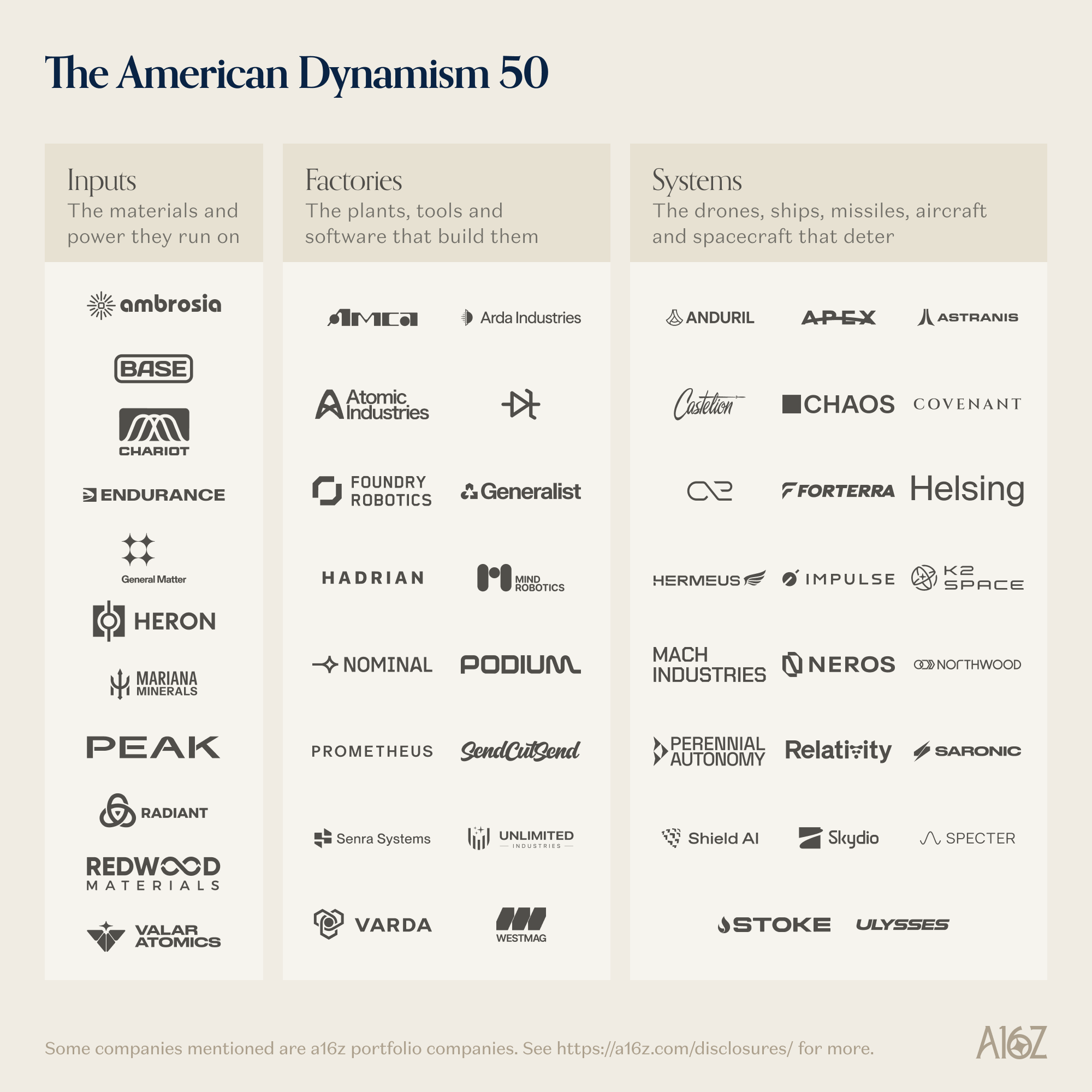
BLUF: Andreesen Horowitz released its American Dynamism’s annual list of 50 companies that are rebuilding and protecting America.
America’s ability to prevent conflict depends on what it can build, how fast it can deliver and how long it can keep going.
A new generation of defense companies is moving advanced systems from testing prototypes to full-scale production.
Now the industrial base has to keep pace. That means factories that build at scale, suppliers that ship on time, and domestic sources for critical materials and energy.
The theme behind this year’s American Dynamism 50 is Production is Deterrence. The list is organized around three connected pillars: Systems, Factories and Inputs.
The companies on this list are rebuilding the industrial foundation that protects America and strengthens her allies.
Uncrewed MQ-9B Tests Long-Range Radar to Track Multiple Aircraft and Maritime Targets

BLUF: General Atomics Aeronautical Systems (GA-ASI) and Saab completed flight tests of an airborne early warning (AEW) system aboard an uncrewed MQ-9B aircraft, demonstrating its ability to track multiple airborne and maritime targets simultaneously at long ranges.
The tests used Saab’s LoyalEye radar, installed in external payload pods on a GA-ASI-built MQ-9B. The trials tracked instrumented fighter jets, commercial aircraft, and maritime targets.
The demonstration combines Saab’s radar technology with the MQ-9B’s long endurance, offering a way to extend airborne surveillance without placing an aircrew aboard the aircraft.
Airborne early warning systems use radar-equipped aircraft to detect and track potential threats across large areas. Their elevated position extends surveillance beyond the line of sight of many ground-based sensors, providing earlier warning of approaching aircraft and other targets.
Shield AI and Leonardo Team Up for Heli-Drones

BLUF: Shield AI and Leonardo announced partnership to integrate Hivemind autonomy stack onto Proteus uncrewed rotorcraft.
Shield also says the partnership provides a pathway for greater future collaboration across Leonardo’s portfolio.
The heli-drone would be able to carry out missions including anti-submarine warfare and logistics—particularly dangerous operations that would otherwise require crewed helicopters.
Hivemind will give Proteus more advanced, mission-specific autonomy.
Who’s Actually Getting Paid in Defense Tech?
Across 95 NatSec100 companies, about $73.4B of private capital sits against $14.2B in visible federal obligations since FY2020, roughly 5.2 private dollars per government dollar. Only 8 have been obligated more than they've raised. Raft, Govini/Air, X-Bow, JetZero, Lunar Outpost, Vannevar Labs, SimSpace, and ThinkOrbital.

Data Readiness is the Foundation for AI-Enabled JADC2
BLUF: Defense organizations don’t lack data. The problem is making the right information usable across the systems and organizations that need it, moving it without losing the context, security controls and provenance that make it trustworthy.
That challenge is central to Joint All-Domain Command and Control (JADC2). The DoW’s framework is intended to improve how information is shared across military services, operational domains and mission partners, so commanders and warfighters can understand the operating environment and make decisions faster.
AI raises the stakes. As defense agencies incorporate AI into analysis and decision-making, the effectiveness of those capabilities will depend on the information they can access.
Models working with incomplete, outdated or poorly governed data risk producing an equally incomplete picture of the mission; AI doesn’t fix underlying data limitations, it turns them into analytical limitations at machine speed.
Defense agencies are implementing JADC2 across technology environments built over decades. Mission data is spread across legacy and modern systems, data centers, public and private clouds, secure enclaves and tactical platforms.
JADC2’s interoperability challenge reaches across hundreds of critical systems developed for different services, missions and technical requirements. CJADC2 compounds that challenge by extending the information-sharing environment across the intelligence community, international allies and coalition partners.
For JADC2, the data architecture more than an IT consideration, it is part of the mission infrastructure.
How the Pentagon Wants to Buy Cyber Outcomes, Not Equipment

BLUF: The Pentagon has been exploring a new paradigm dubbed Cyber Effects-as-a-Service, aiming to purchase specific outcomes as opposed to bespoke capabilities.
The new paradigm that calls for more direct contractor involvement in operations.
The desired framework moves from a contractual relationship to an operational partner with industry and relying more on their know how in the technology space to push concepts and ways of thinking about things that are out of the box and bringing new ideas way more quickly than we can.
The current model for conducting cyber operations is too antiquated in the modern world and against modern threats.
The emerging CEaaS model aims to solicit specific outcomes as opposed to bespoke tools, under the direction and oversight of the government sources indicated.
Outcomes could be a requirement to gain access to a particular network, for example, in which the company performs that operation using its own people, tools and infrastructure or in concert with military operators.
“I’m focused on one single priority, and that is building a more robust set of capabilities for the SECWAR and the president. The demand signal that we see across all of our leadership in the department, our combatant commanders far exceeds the supply we have.” Katie Sutton, ASW for Cyber Policy
Remote-Controlled Combat Robot Tested with Machine Gun and Grenade Launcher

BLUF: ARX Robotics and ROBONEERS have completed initial integration tests of the SABER weapon module on GEREON uncrewed ground vehicle.
The planned configurations include a .50-caliber M2 heavy machine gun and a 40 mm MK 19 automatic grenade launcher.
The companies plan to integrate the first armed configurations by the end of 2026, with deliveries aligned with the operational needs of Ukraine’s Defense Forces.
Tesseract Ventures Unveils Lego-like Modular Kits to Build Tailored AI, Robotics, and Drone Hubs
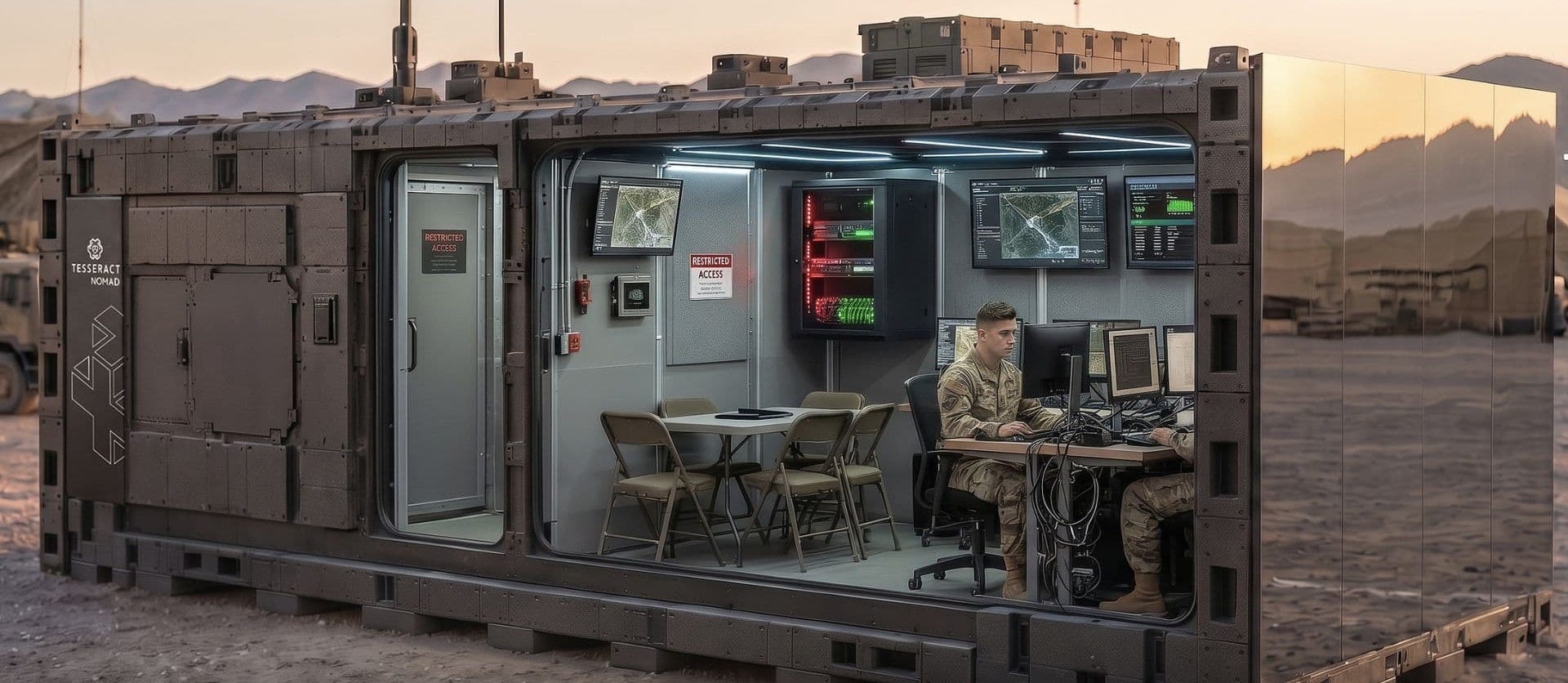
BLUF: Tesseract Ventures announced an initiative to develop modular technology-enabled infrastructure in partnership with Lok-N-Blok that can be rapidly deployed and customized for different applications.
Rather than adding technology to conventional buildings or shipping containers, the kits are designed with the technology built into the structure from the start.
The infrastructure, called Tesseract Synthetic Brick Technology Kits, will use Lok-N-Blok’s modular building components, which resemble Lego-like blocks.
The systems can be digitally designed, packaged for transport, assembled near the deployment site, expanded as requirements change, and dismantled and redeployed elsewhere.
Standardized technology components can be reused to create different configurations without redesigning an entire system for every deployment.
New Tactical Comms System for US Ground Troops Aims to Break Network Silos
BLUF: GDIT unveiled Vion, a suitcase-sized, AI-enabled Mission Partner Environment kit built to link ground units with command centers and coalition networks.
Vion uses open architecture and AI to connect to outside networks and translate text, voice memos and video while keeping zero-trust protections. It was used in Olympus Fires, a Joint Staff J6-led demonstration where DISA explored improvements to the Coalition Information Environment.
GDIT is still working through the acquisition process and declined to name a potential customer.
“We have to converge networks. We have to plug and play.” - Jason Martin, DISA, Component Acquisition Executive
Related: GDIT Puts Vion Mission Partner Environment Technology Through Its Paces During Pacific Exercise
DoW Awards $150M to Multidisciplinary University Research Teams
BLUF: DoW awarded $150M for basic defense-related research projects as part of the Multidisciplinary University Research Initiative (MURI). These awards, which average $7.5M over five years, will support 20 teams at 57 U.S. academic institutions, subject to satisfactory research progress and the availability of funds.
After a merit-based review of 451 white papers, a panel of experts narrowed the pool to a subset of 74 full proposals, from which the 20 (or 22?) final awards were selected. The list of winning teams is available here.
90 Days No Help: Fortress America’s Goal To Make Bases Resilient

BLUF: The Pentagon is reportedly aiming for U.S. military installations to be able to continue essential operations for at least 90 days, or roughly three months, without any external support.
The installation of new small nuclear reactors and other infrastructure is key to this part of a larger plan called Fortress America. The main intent is to ensure America’s armed forces can remain functional and ready to protect the homeland in the face of any massive disruptions to power grids and other supply chains due to major conflicts or other crises.
There are glaring vulnerabilities of America’s critical civilian energy infrastructure, including to drone swarms and cyberattacks, which could cripple key military capabilities right where they live.
Under FORTRESS, every major military installation in the continental United States would be expected to sustain essential operations independently for at least 90 days, including access to electricity, water, fuel and communications.
Other Defense Tech News:

Is the Pentagon’s Demand Signal for Drones Working?

BLUF: As the Pentagon ramps up drone production, industry and military officials say they are divided over whether the department’s approach can generate the sustained demand needed to build a lasting domestic drone industry.
The Pentagon has created multiple funding avenues and acquisition competitions to encourage companies to develop drones and expand production, without guaranteeing the longer-term orders needed to justify those investments.
The department’s primary approach is its Drone Dominance program, a gauntlet-style competition billed as a way to give companies repeated opportunities to win smaller deals that will collectively amount to $1B over two years.
Under Gauntlet 1, the Pentagon has selected 11 companies to deliver 30,000 small drones through a combination of initial and “bonus” orders.
Drone Dominance awards do not guarantee future orders, leaving companies without a commitment to sustain production beyond their initial contracts.
“There’s a lot of positive signaling, but we need to see the whites of the eyes: We need to see sustained, normalized demand. What does that look like? If you win an award and then you’re providing 1,000 drones a month for a year, that’s a very healthy demand for us.” James Slider, CEO of Performance Drone Works
Our Take: This has been one of our concerns with Drone Dominance partially driven by awards to such a high number of companies which diffuses the scaling potential. We found this particularly odd since the goal was to build a new DJI. Not having the POM follow-up with Gauntlet awards is key to industry reluctance before we can even think about numbers in the DJI realm (3-4 million a year). There’s a lot of hope on DAWG reconciliation funding coming through to maybe kickstart the demand signal to the next level, but that has a tough road ahead.
Decoding the Right-to-Repair Debate
Jerry McGinn, Patrick Armstrong, and Alek Jovovic

BLUF: The experts answer some general questions on the contentious right to repair proposal which centers on whether DoD should have greater access to contractor-owned intellectual property (IP) and technical data to independently maintain and repair military equipment.
Contractors rely on IP protections to preserve competitive advantages and sustainment revenue, while DoD seeks greater rights to enable organic maintenance, third-party competition, and reduced costs.
The FY27 NDAA proposals would expand government IP rights, with the House shifting the burden to contractors to justify restrictions and the Senate making government access a condition of contracting.
Government Purpose Rights (GPR) allow DoD to use and share technical data with third parties for government purposes, potentially enabling greater competition in maintenance, production, and sustainment.
Default GPR could reduce sustainment costs and increase competition but would likely raise upfront acquisition prices as contractors compensate for reduced IP control and future revenue.
DoD generally receives unlimited rights to operations and maintenance (OMIT) data, while detailed manufacturing and process data (DMPD) has stronger protections, creating disputes where the categories overlap.
DoD has struggled to inventory and manage its existing technical data rights, limiting its ability to use available IP effectively and identify where additional rights are needed.
Data-as-a-Service (DaaS) would allow DoD to pay recurring fees for access to contractor IP rather than purchasing broad rights upfront, potentially reducing initial costs but creating long-term dependencies.
Potential solutions include limiting third-party access under GPR, DaaS subscriptions, separating production and sustainment contractors, distinguishing software from hardware IP, and using escrow or negotiated access agreements.
Congress: Don’t Let the NDAA Hand China Our Defense Blueprints
Lt. Gen. Richard Newton (USAF, ret.)

BLUF: Proponents of “Right to Repair” argue it is necessary to ensure warfighters can repair their own equipment, but the legislation goes well beyond that.
Chief among the many problems is that the more widely sensitive technical information is shared, the more opportunities America’s adversaries have to obtain facts and/or data and use them against our own warfighters.
Passing "Right to Repair” legislation would turn a known national security vulnerability into federal policy. That would be a costly unforced error.
Congress should strip the “high risk” right-to-repair provisions from the NDAA.
Our Take: We’re not sure we totally track the logic here. If appropriate security provisions are maintained based on the sensitivity of the data, then we’re not sure the fear here has to be realized. The recent F-35 example with the cargo bay door is used but we’ve seen major primes have cybersecurity issue which is more attributed to how China has some designs to our latest platforms.
Boeing Bullish on Defense Sector After Fighter Wins, Shunning Fixed-Price Deals
BLUF: A year ago, Boeing expected its Defense, Space, and Security division to see revenue growth in the low single digits. Now, the company is projecting defense revenue growth in at least the mid-single digits or higher.
Both the $20B F/A-XX contract and a $2.38B Air Force contract for 22 more F-15EX Eagle II fighters as the tailwinds boosting Boeing’s defense portfolio.
The F/A-XX win followed the Air Force’s 2025 selection of Boeing to build its F-47.
The company’s decision to swear off risky contracts—such as the fixed-price contract for Boeing’s KC-46 Pegasus program, which has lost the company billions—has helped put its defense sector back on course.
Our Take: We dislike this perspective a lot. Handing all these huge deals to Boeing who has been massively underperforming on multiple programs (KC-46, T-7, VC-25B, MQ-25, B-52 CERP, B-52 RMP, MH-139A, and E-7A) is just perplexing to us. Allowing them to do it on cost-plus terms and not capping DoW liability is beyond perplexing. This is all good for Boeing investors, we hope it winds up being good for operators.
Helsing Rolls Out Contra Air Defense Design, Plus Two New Interceptors
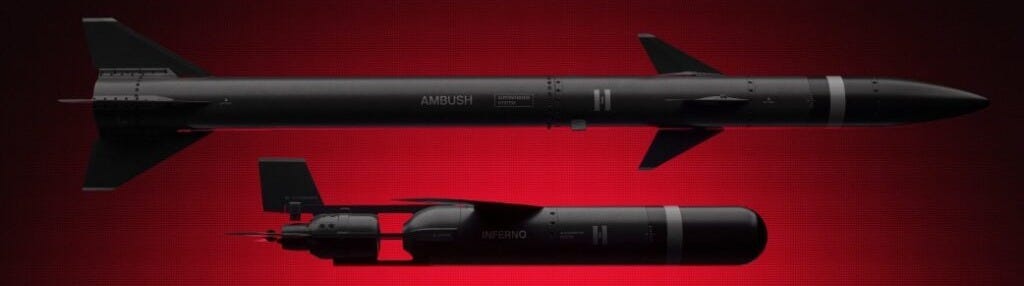
BLUF: Helsing is billing its design as an “AI-controlled autonomous air defence system designed to protect countries from scaled drone and missile attacks.
Helsing also claims the system can track and engage “hundreds or thousands of drone and missile threats at the same time.”
Contra can integrate with existing air defense interceptors and counter-drone systems. However, the firm also rolled out two new, container-launched interceptor designs it hopes customers will purchase with Contra.
The AD-1 Inferno is jet-powered, “capable of aerial loitering, swarming, and repeated re-engagements.”
The AD-2 Ambush uses a solid-rocket motor and can reach Mach 2.5, with a 20 km (around 12.5 miles) range.
The company did not provide hard cost estimates for the two missiles, saying only that the price will “significantly [undercut] those of existing missile interceptors.”
Our Take: Nicely done here!
CoAspire Taps X-Bow for SRM Boosters for CHAOS
BLUF: just a few short weeks after scoring a $69.7M contract with the Navy to develop SRM boosters for the Modular Missile (NMM) program, X-Bow has been tapped by CoAspire to develop and produce the ground-launched SRM booster motors for the Navy’s new CHAOS program.
CHAOS is the Navy initiative to develop low-cost, ground-launched cruise missiles for allies and partners through the Foreign Military Sales (FMS) process.
The idea is to give partner nations an affordable long-range precision-strike capability—particularly against maritime targets.
Related Article: X-Bow to build boosters for CoAspire’s CHAOS cruise missile
Re:Build Raises $2.1B for New-Age Manufacturing

BLUF: The funding will enable the company to scale up production capacity, spin out more product-based startups, and buy up more companies.
A big part of the company’s approach is called Manufacturing Constrained Design (MCD)—essentially, a way of designing products around how they’ll actually be manufactured, rather than figuring out how to mass-produce them after the fact.
The company can take an existing production line at, say, a prime and modernize it, or build components for existing production lines.
We Cannot Build Tomorrow’s Weapons with Yesterday’s Alloys
BLUF: In aerospace, relying on decades-old materials is normal. But the next generation of military capabilities will demand performance that existing materials cannot deliver.
Hypersonic vehicles must withstand extreme heat and oxidation.
Directed-energy systems, next-gen armor, and advanced reactors all require materials we don't have yet.
We don't have a manufacturing problem. We have a discovery problem.
Moving a new structural material from the laboratory to a qualified, flight-ready part can take two decades or more.
Qualification can take years, depending on the application and safety needs.
there are roughly 10^40 possible alloys. At human speed, testing them would take millions of years.
What can change the timeline is pairing AI with a self-driving lab.
AI agents review the literature and past experiments to propose new compositions.
Robotic systems synthesize those candidates, characterize them and test their properties.
Every result, including every failure, feeds back into the models overnight. The failures matter most.
This is the moment for private industry and public research to build this capability together. Two steps would get us there.
First, when a program defines a capability, it should set the material property targets the same day and begin discovery in a self-driving lab alongside the engineering.
Second, the U.S. should treat self-driving labs as national infrastructure and work with the national labs already building them. Materials can’t keep arriving a decade after the design.
Our Take: This is incredibly enlightening and deserves attention and focus from DoW.
General Atomics Developing Strike-Recon Flying Wing Called NextGen That Uses Hybrid-Electric Propulsion

BLUF: General Atomics says it is working on a new hybrid-electric-powered flying-wing-type strike/reconnaissance drone called NextGen that could be able to stay aloft for more than 60 hours.
Work on NextGen will also feed into one of the designs within the company’s Gambit family of drones, which are based around a common modular core chassis.
Separate progress is being made on the newest member of that family, the air-to-surface optimized Gambit 6, with plans now for a live-fire air-to-ground ordnance demonstration early next year.
Other Defense Industry News

Portfolios Not Programs
Matt and Pete spoke with WAU on transitioning to the new paradigm. How PAEs and PMs can adopt portfolio approaches within existing authorities to move beyond isolated program execution and manage capabilities as an integrated portfolio.
Delivering Capability Through Portfolio Management
Lt Gen Jason Voorheis, AFLCMC Commander and lead for PAE Implementation joined WAU for a discussion on portfolio management and the evolving PAE structure.
Acquisition Talk Is Back Online!

Eric Lofgren returns to his Acquisition Talk podcast with Matt MacGregor to discuss the week’s top stories. Three and a half years ago we paid tribute to Eric’s work in a Best of Acquisition Talk that featured his best among 1,400 posts and 160 pods.
New Guide Equips Army Finance Officers to Fund the Fight Faster
The new Financial Management & Comptroller Officer’s Guide establishes a single, authoritative standard for finance and comptroller officers across the Army.
Pentagon Will Pick New US Base by June, Prioritizing 4 Requirements
BLUF: DoW plans to select a site for a new, highly hardened homeland joint installation by June 2027, with state nominations due Dec. 1, 2026.
The four requirements: roughly 100,000-250,000 acres; support for 15,000-25,000 service members (80,000-100,000 people total); 30 continuous days of grid-independent power within 24 months, using small modular reactors and microgrids; and public-private partnerships to cut cost.
The base would host autonomous uncrewed strike wings, directed energy and counter-drone brigades, hypersonic units and AI-driven joint task forces.
The FY28 request will carry start-up funding; no cost estimate has been released.
“We talk about this as a base, but this is building a city.” - Dale Marks, ASW for Energy, Installations, and Environment

Army Announces Selection for Future Interceptor Program

BLUF: The Army awarded Lockheed Martin an OTA for the Future Interceptor to strengthen the Integrated Air and Missile Defense (IAMD) portfolio against advanced air and missile threats, with an estimated total project value of $1B.
Funding splits into $660M from the government and a $423M Lockheed Martin cost share. The goal is more range, altitude, velocity and maneuverability against evolving air and missile threats.
Work covers prototype development and T&E against operational requirements. No schedule was released; development and production decisions will depend on prototype performance, requirements and available resources.
“The Future Interceptor is exactly the type of cutting-edge technology we need.” - GEN Christopher LaNeve, Acting Army Chief of Staff
“This contract for the Future Interceptor program marks an important step forward in the Army’s efforts to address emerging threats by accelerating innovation and strengthening partnerships with industry. We are empowering the Army to make informed decisions, reduce acquisition risk.” - Brent Ingraham, ASA/ALT
“Developing advanced interceptor capabilities is essential to maintaining our nation's defensive advantage against increasingly sophisticated threats. The Future Interceptor program reflects the Army's commitment to accelerating innovation, leveraging proven technologies and strengthening the layered defenses that protect our forces and national interests at home and abroad.” LTG Frank Lozano, PAE Fires
Related: Army selects Lockheed Martin for billion-dollar Future Interceptor program and Army announces selection for Future Interceptor program
Army Awards Next-Gen Missile With Advanced Ramjet Propulsion
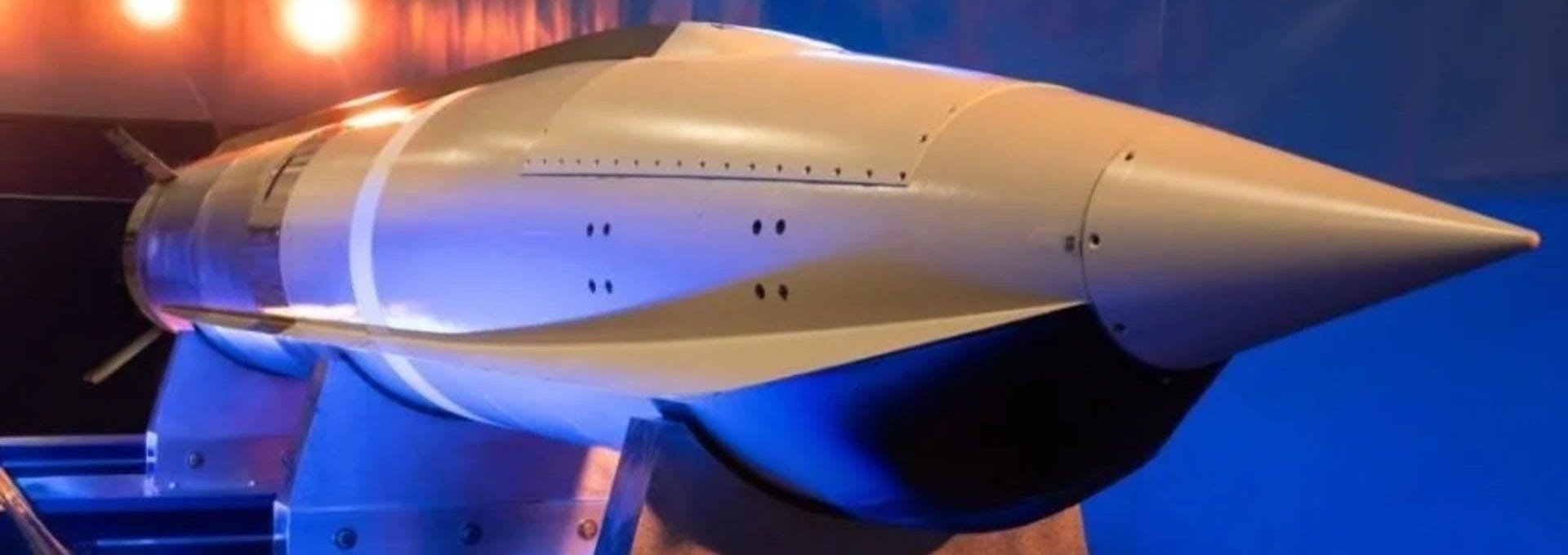
BLUF: Lockheed Martin has been selected by the Army to develop and test a longer-range version of the Precision Strike Missile (PrSM), PrSM Increment 4 aims to strike land and maritime targets at least 1,000 km away.
The PrSM Increment 4 variant is intended to engage moving maritime targets and relocatable land targets when launched from the High Mobility Artillery Rocket System (HIMARS).
The missile will use an advanced propulsion system supplied by L3Harris, which Lockheed Martin says could roughly double the range of the baseline PrSM.
Existing launchers and expanded production facilities support the missile’s development.
Lockheed Martin has invested more than $300M with industry partners to mature technologies intended to extend missile range.
They also brought a $300M additive-manufacturing and automation line online. The facility produces airframe and propulsion components while maintaining the dimensional precision required for ramjet performance.
Lockheed Martin has invested $250M in its Strigo Product Center, which develops radio-frequency sensors, missile datalinks and seeker technologies.
Flight competitions planned for 2027 and 2028 will evaluate the competing designs, with Lockheed Martin developing prototypes and investing in propulsion, sensors, and manufacturing capabilities.
Our Take: Lockheed Martin putting over $800M of its own capital at risk across these efforts is a welcome shift from decades of government-funded tech development This demonstrates the kind of industry investment and shared risk the Department should encourage. The Army should reward companies willing to invest ahead of contract awards with faster acquisition decisions, clear performance objectives, and credible pathways to production. The real test is whether this model accelerates fielding, expands production capacity, and delivers more capability per taxpayer dollar while preserving meaningful competition.
Related: Lockheed Martin Showcases 1000 km PrSM Inc 4 Prototype
Army Rocket Changes Targets Midair and Destroys a Moving Threat

BLUF: Lockheed Martin has demonstrated a new way to redirect a rocket after launch, potentially giving Army units greater control over precision strikes. The test showed that an existing Guided Multiple Launch Rocket System (GMLRS) rocket could change targets during flight and destroy a moving target.
The demonstration took place at White Sands Missile Range in New Mexico. Lockheed Martin worked with the Army to integrate a communications link and guidance system into the rocket’s existing architecture.
The approach could help the Army adapt its precision fires capabilities without requiring a fundamental redesign of the weapon.
Conventional rocket artillery missions rely heavily on targeting information established before firing. Updating that information during flight introduces another layer of flexibility, particularly when a target changes position or battlefield conditions shift.
Army Looks to High-Flying Balloons to Help See, Strike Along Front Lines with China

BLUF: To burst China’s anti-access/area-denial bubble, the Army is looking at using high-flying balloons with payloads that can monitor the battlefield, relay communications and strike adversaries.
Against China’s growing arsenal in the vastness of the Pacific, high-altitude balloons could provide a cheaper, lower-signature platform that can be employed from dispersed positions.
PHABs would give MDC-P soldiers more ways to employ attack drones and munitions that are cheaper than exquisite missiles, available in greater numbers and harder for adversaries to spot.
HABs can stay aloft for weeks or months at a time and give operators more control over where they go.
That enhances balloons’ value as platforms for radars and other sensors which, at operating altitudes above 60,000 feet, can see far into rival territory while remaining in international airspace.
They also offer a cost-effective complement to satellites, which are more expensive and whose orbits limit their time over any one area.
High-altitude balloons as part of “an ecosystem” of data-collecting assets in space, in the air, on land and at sea.
Our Take: We see great promise in leveraging HABs for critical ISR, comms, and other effects. This helps shift the cost curve, provides a valuable hedge against exquisite platforms, and provides another capability that changes adversaries’ defense calculus.
Army Leader Calls on Private Capital to Rebuild Arsenal of Democracy
BLUF: The Army is overhauling its Cold War-era funding framework to partner directly with private capital markets. The primary strategic challenge in modern multi-domain competition is institutional velocity.
The nature of modern conflict has shifted toward software deployment, commercial technology, rapid capital allocation and industrial agility.
Foreign adversaries are already executing economic and technological warfare by systematically buying up and weaponizing international supply chains, rare earth minerals, microelectronics, maritime shipping networks and domestic energy grids to degrade American surge capacity before forces can deploy.
Under the Strategic Capital Initiative, the Army is repurposing a vast footprint of real property from an overhead burden into a secure, shovel-ready platform for national industrial revitalization by aligning VC and PE with long-term demand.
Immediate priorities under the initiative are led by investments in digital computing infrastructure. Under the public-private model, private developers finance and build the facilities at zero upfront taxpayer construction expense, operating a commercial side to generate steady revenue from these partnerships while providing the Army the potential to secure classified computing capability as in-kind value and surge support during national crises.
"The Army is open for business, and we’re moving out fast. I urge investors to partner with the Army to ensure American warfighters never enter a fair fight.” Marc Andersen, ASA/Financial Management and Comptroller
Related: Army’s Strategic Capital Initiative is Not Slowing Down Under New Leadership
Taiwan 2027 Conflict Window Remains Valid Per USARPAC
BLUF: The head of Army Pacific says his command is still preparing for the potential Chinese invasion of Taiwan that US officials warn could occur as early as next year.
Known as the “Davidson window,” the timeline is named for retired ADM Phil Davidson, former head of INDOPACOM. In 2021, Davidson told the SASC that China could develop the capability to invade Taiwan within the following six years.
USARPAC is working to move forces and equipment in the region to deter conflict.
The need for both advanced capabilities and affordable systems that can be produced at scale are what operational challenges industry could help address over the next six months.
DoW has begun emphasizing a commercial-first approach, trying to adopt good enough solutions that soldiers can immediately use during operations.
That approach also calls for fielding capabilities at scale, including large numbers of low-cost drones that can overwhelm an adversary.
“It’s not a date that we think that conflict will happen. It is a period of time for which we’re snapping the chalk line to say we need to be ready by this date. But we’ll continue to prepare, we’ll continue to modernize, we’ll continue to posture ourselves for the business of deterring war well beyond 2027.” GEN Ronald Clark, USARPAC
Army Researchers Test Arctic Camo That Adapts to Landscapes

BLUF: Army researchers tested adaptive camouflage coatings in Greenland meant to hide equipment from aerial and multispectral surveillance, including small drones.
CRREL and the Army Research Laboratory tested several new coatings at Pituffik during ship-to-shore operations, part of a series organized by the International Cooperative Engagement Program for Polar Research (ICE-PPR) and ONR.
Next is a rapidly deployable coating on Cold Weather All-Terrain Vehicles in Alaska, which the Alaska National Guard will assess with helicopters and thermal imaging.
Researchers are working during ship-to-shore operations to test a number of novel coatings, using sensors to assess the effectiveness of concealment.
“If you go beyond the visible, which our adversaries can do, snow in certain wavelengths looks black.” - Anthony Fragoso, CRREL, Cold Regions AI Lead
Other Army News:
Army Tests Tactical Google Maps to Help Troops Move Undetected
Army Launches Spectrum Warfare Innovation Challenge in Europe
Project Gatekeeper: Army Plans Integration with Frontier AI Models
Army’s MV-75 production award could slip due to CR, raising program costs

CNO Outlines Vision for Fleet Adaptation

BLUF: ADM Caudle outlined a strategic vision for the future Fleet centered on continuous modernization. He emphasized that to maintain a decisive advantage in the fight, the Navy must be capable of changing itself as problems change, utilizing software, modularity, and uncrewed systems.
To build this self-adapting force, the discussions highlighted the necessity of a highly responsive industrial base and a robust foundry of manufacturing capacity.
Caudle called for stronger collaboration with industry partners to accelerate the transition of commercial technologies, open architectures, and software-defined capabilities directly into the fleet.
Long-term operational success depends heavily on the Sailors who generate combat power.
Caudle expanded on his vision for an adaptable force, challenging the traditional reliance on rigid carrier strike group deployments to solve diverse global challenges.
The engagement reinforced the Navy’s commitment to building a force that learns from real-time global operations, reconfigures quickly, and regenerates combat power to maintain a decisive advantage in any future conflict.
“When I think about the Navy, we will need in the decades ahead, I keep coming back to two words: Adaptation and Endurance. Our advantage cannot depend on getting every prediction right. Our advantage must be our ability to adapt faster than the threat and endure longer than the fight.”
“Innovation that cannot transition to the Fleet, scale in production, or be sustained in combat is not yet the warfighting advantage we need. Speed is a weapon. And in the next fight, the side that can translate learning into fielded combat power faster will create advantages its adversary struggles to overcome.” ADM Daryl Caudle, CNO
Two Aircraft Carriers Ready to Operate New MQ-25A Tanker Drones

BLUF: The Navy now has two aircraft carriers equipped with the command infrastructure needed to operate its future MQ-25A Stingray tanker drone, after USS Ronald Reagan (CVN-76) joined USS Theodore Roosevelt (CVN-71) with an integrated Unmanned Air Warfare Center (UAWC).
The installation expands preparations for unmanned aerial refueling, a capability intended to extend the reach of carrier aircraft.
The UAWC serves as the carrier’s control hub for unmanned aviation and houses the MD-5C ground control station used to command the MQ-25A.
Its operator consoles and mission systems support flight planning and execution while connecting the unmanned aircraft to the carrier’s wider aviation operations.
The operational objective is to introduce a dedicated unmanned tanker into the carrier air wing.
The Navy plans to acquire 76 MQ-25A drone tankers: 67 operational and nine test and developmental aircraft.
Navy Wants More Visible Role for Drone Boats as One Deploys for the First Time
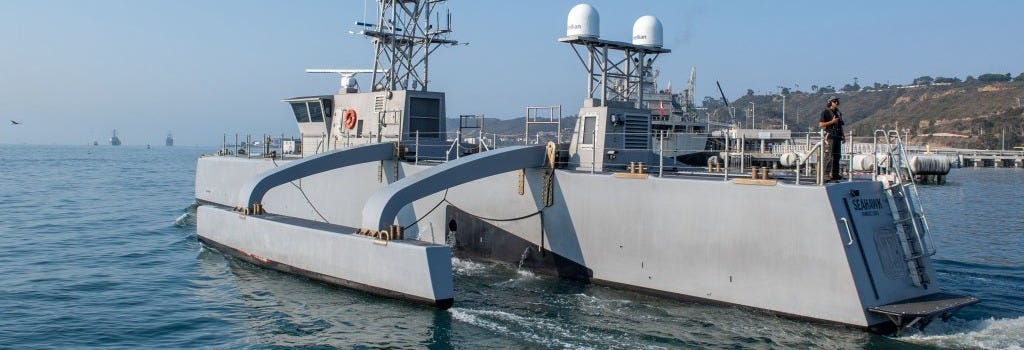
BLUF: An MUSV deployed to the Pacific with the Theodore Roosevelt Carrier Strike Group, the platform’s first operational deployment, and Navy leadership wants the vessels built into routine fleet certification and operations.
The Navy operates four MUSVs and has selected three companies to build 30 more, with the first formal delivery expected by the end of FY27.
The Navy stood up a Robotic and Autonomous Systems Warfighting Development Center (RASWDC) at Joint Expeditionary Base Little Creek-Fort Story, modeled on Top Gun.
The Navy is expected to receive its first delivery of 30 MUSVs by the end of FY27.
While the Navy is making progress on training, it had ground to cover to make the systems an integrated part of the fleet.
“I see a world where it’s part of your certification exercise. You know, there’s elements that we introduce in that exercise where you’ve got to demonstrate that capability, because it’s probably not going to go over with you. You’re going to pick it up over there, and you’ve got to be certified to use it.” - ADM James Kilby, Vice CNO
Navy to Build Hypersonic Weapon Facility at NWS Yorktown for Zumwalt and Virginia Classes

BLUF: Navy plans for a hypersonic missile storage facility at NWS Yorktown to support CPS-equipped Zumwalt and Virginia classes.
NAVFAC Mid-Atlantic published its requirements for the construction of a new facility at Naval Weapons Station Yorktown, just north of Newport News Shipbuilding and the main Naval Station Norfolk base complex.
Once completed, the facility will service Conventional Prompt Strike (CPS) weapons used aboard DDG-1000 Zumwalt-class destroyers and Block V and VI Virginia-class submarines.
The U.S. Navy currently views installation and conversion efforts aboard the Zumwalts as risk mitigation for future endeavors to mount CPS aboard Virginia-class submarines, as both mounting systems share a large amount of commonality.
If successful, the Virginias will avoid the same kind of delays currently impeding the Zumwalts, and the technology related to the CPS weapon system itself will likely mature by the time the first Block V Virginia enters service.
Navy Shipbuilding: The Good, the Bad and the Ugly
Brent Ramsey
BLUF: It should be clear to all we need a larger Navy. The oceans are vast and the U.S. Navy has a global mission. We currently have only 286 ships, a third of which may be at sea or forward deployed on any given day. 50-60 are in long term maintenance at any given time and are not deployable. The rest are in home port for crew rest and shorter-term maintenance, training, and upkeep, or are ramping up to deploy.
The Navy has a goal of 80% of ships deployable of available ships (i.e., those not in long-term maintenance) but admit their actual capability is far short of that or approximately 60-70% depending on what class of ships.
In the worst crisis one can imagine (think war in two theaters at the same time) the U.S. can put a maximum of ~180 ships at sea.
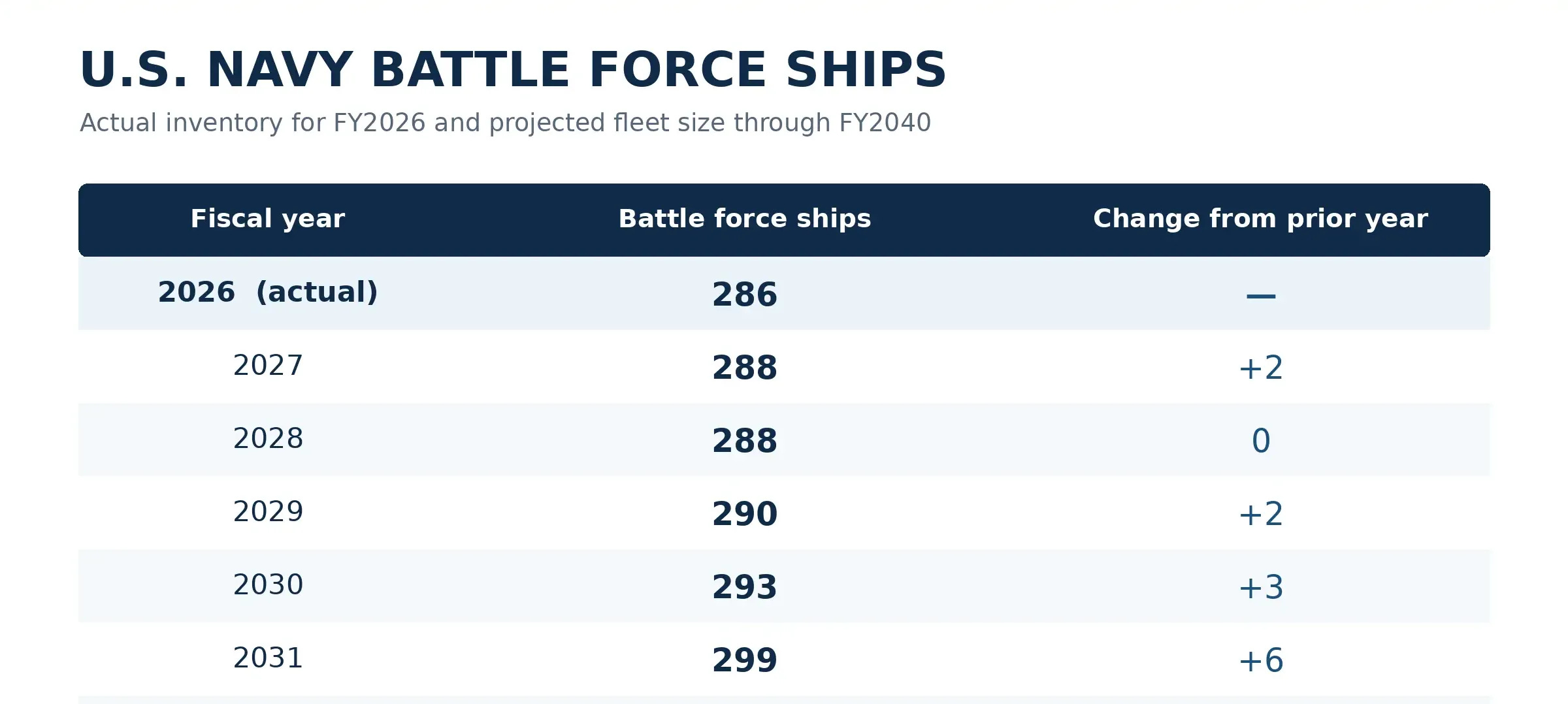
FY2027–2040 figures are Navy projections, not actual inventories. This schedule shows three distinct periods:
2027–2030: Little net growth. The fleet stays below 300 ships.
2031–2035: Sustained expansion, reaching 317 ships if construction goes ahead as scheduled.
2036–2040: Faster expansion, reaching the longstanding 355-ship goal.
The Navy has an array of shipbuilding reforms proposed and underway.
Acquisition simplification and regulatory reform; greater use of proven designs; foreign shipbuilder participation and tech transfer; new shipyard and component facilities; NAVSEA reorganization; workforce recruitment, compensation, and training; AI, automation, and digital manufacturing; and increased shipbuilding investment.
While the above are now policies, it will take years to see if these reforms result in the faster delivery of more ships.
Best practices from Elon Musk that Navy shipbuilding could adopt include:
Rapid development and production; vertical integration; stable leadership and accountability; manufacturing innovation; and freedom to challenge traditional practices.
BAE Systems Completes First Live-Fire Test of Adaptable Deck Launcher for Naval Missiles
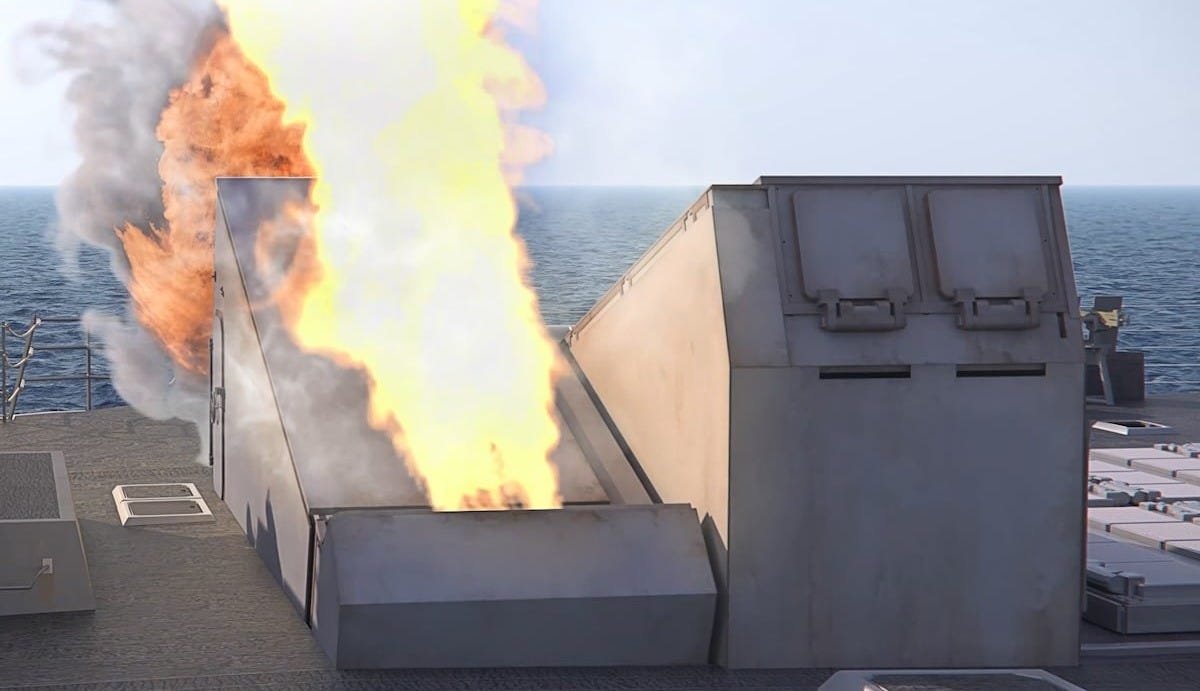
BLUF: BAE completed the first live-fire test of its Adaptable Deck Launcher, a deck-mounted system compatible with Evolved SeaSparrow Missile Mk 25 Quad-Pack canisters.
Developed under a DoW contract for the NATO Seasparrow Project Office, it reuses Mk 41 VLS electronics and logistics and is meant to let ships reload missiles at sea.
BAE designed it for carriers, amphibious ships and other surface combatants, with compact configurations for MUSVs.
Related: BAE Systems Successfully Tests Adaptable Deck Launcher
Iran War Teaching Navy to Prioritize Sustainment, EW for UxS

BLUF: The Navy’s deployment of uncrewed vessels in the conflict with Iran has generated headlines, but the fight is also teaching the ways to improve on its unmanned fleet.
While USVs performed their missions effectively recently, the Navy also learned the hard way what capabilities its unmanned fleet must have going forward.
Number one on that list is thinking about sustainment earlier.
Uncrewed systems must be able to survive the congested and contested EW environment of the modern battlefield, such as having PNT alternatives to GPS.
Navy must ensure that lessons learned from the battlefield continue to inform the development and production of future systems as the scale of fielding grows.
By working more closely with industry, the Navy has also learned how to use its current uncrewed fleet for a wider variety of missions than it originally intended.
“I've got craft out there that are pushing over 1,000 hours now that were never intended for that, and we are being creative, we're being adaptive, but we should have been thinking about sustainment sooner. We have learned some hard lessons in the CENTCOM area about making sure that our stuff can really operate in that difficult EW environment.” Christopher Miller, DRPM RAS
Our Take: We’re happy to see these core principles articulated. Thinking about sustainment early, active operator and industry engagements to explore novel employment of unmanned systems. Key insights for UxS and many other systems.
Hanwha Philly Shipyard to Build Navy Landing Ship Mediums

BLUF: Hanwha Philly Shipyard has won a $269M contract to build the Marine Corps’ Landing Ship Medium. TOTE Services, which won a $2.2B contract in July to function as the LSM vessel construction manager, awarded Hanwha the contract.
This is the first time the Navy has opted to use a vessel construction manager, which runs the program on behalf of the service.
Other Navy News:
NUWC Division, Keyport saves millions through parts reclamation
Navy Warship Power Systems to Get Zero-Trust Shield to Protect Fleet From Cyberattacks
Fairbanks Morse Defense Wins Contract to Extend Submarine Service Life into the 2030s
Navy boosts Northrop Grumman bomb fuze production as plant capacity hits 85,000 a year

Navy, Marine Corps Simulate Coordinated Strikes on Target at Sea

BLUF: Navy aircraft and Marine Corps ground launchers simulated missile launches during a weekend antiship training exercise coordinated with Japanese forces
The Keen Sword drill simulated a response to an approaching naval threat in the Sea of Japan, also known as the East Sea.
F/A-18 Hornet and F-35 Lightning II fighters operating from Marine Corps bases and the aircraft carrier USS Theodore Roosevelt participated in the drill alongside ground-based launchers,
The Japan Maritime Self-Defense Force guided-missile destroyers JS Kongo and JS Maya served as the opposing force.
The Space Force also participated, helping protect communications and ensuring that international and inter-service components remained open and free from adversary interference.
AI, Robotics, and Marines
Gary Anderson

BLUF: Force Design gutted the Corps’ ground combat power, and that building hybrid human-robot infantry units could restore most of it by 2030.
From 1998 to 2000, the Marine Corps Warfighting Lab tested UAVs and UGVs to build a combined arms team of robots and infantry Marines. The concept used:
Robotic skirmishers to scout and protect a platoon’s or squad’s flanks and rear
Micro-robots to get inside enemy fortifications and buildings
Non-lethal directed energy weapons to clear buildings where non-combatants were present
In 1999, the Lab and the Office of Net Assessment ran a simulation set in 2030 in which a high-tech U.S. force fought a Chinese force trying to take Taiwan. Blue Force used autonomous surface and subsurface vessels, kamikaze drone swarms, autonomous smart mines, and autonomous armored vehicles.
After 9/11, autonomous systems were used mostly for counter-IED and ISR in COIN operations, not for combined arms.
NMESIS is becoming obsolete as it is fielded, while the Army tests and fields better systems such as long-range hypersonic missiles.
Apart from small drones, loitering munitions, counter-IED robots, and counter-drone systems, Marine infantry units remain largely unchanged.
Hybrid units of Marines and robots could reduce how many Marines tank, engineer, and artillery units need. Done thoughtfully, this capability could be in place by 2030.
Advertise with Defense Tech and Acquisition to put your brand in front of the people driving the future of national defense.

Resilient Reach: Redesigning Aerial Refueling for Contested Global Operations
Timothy A. Walton & Shane Dennin
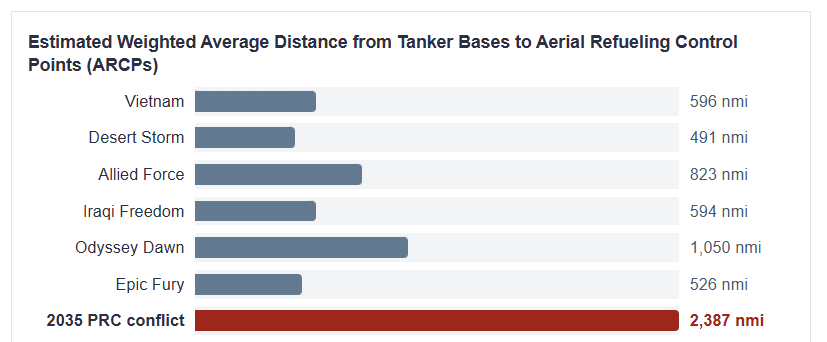
BLUF: Aerial refueling is an unmatched U.S. military advantage, but it currently depends on vulnerable forward bases and medium-range tankers that could be neutralized. Suppression of this critical capability could collapse US air operations and heavily contribute to US defeat in a war against China.
To generate a force ready for contested global operations, the Air Force can transform its aerial refueling architecture within planned budget levels by:
Boosting the resilience of its most important tanker airfields
Incorporating adaptive mission systems on current tankers to increase their effectiveness and survivability and unlock options for future tankers
Fielding a medium-sized, long-range, high-offload tanker capable of flying a modest distance into contested airspace, such as a Medium-sized Blended Wing Body (Medium BWB) tanker
By 2035 the PLA could potentially suppress large-scale, sustained tanker operations from forward airfields in the Western Pacific.
A medium-sized, long-range, high-offload tanker such as the Medium BWB could sustain orbits from more than twice as many airfields as alternatives.
Compared to 250 KC-46As, acquiring and operating 250 Medium BWB tankers could:
Refuel more than twice as many force packages or refuel force packages more than twice as far
Deploy forces across the Pacific more than twice as fast
Sustain large-scale protracted operations under attack
Cost $15.5 billion less over 30 years.
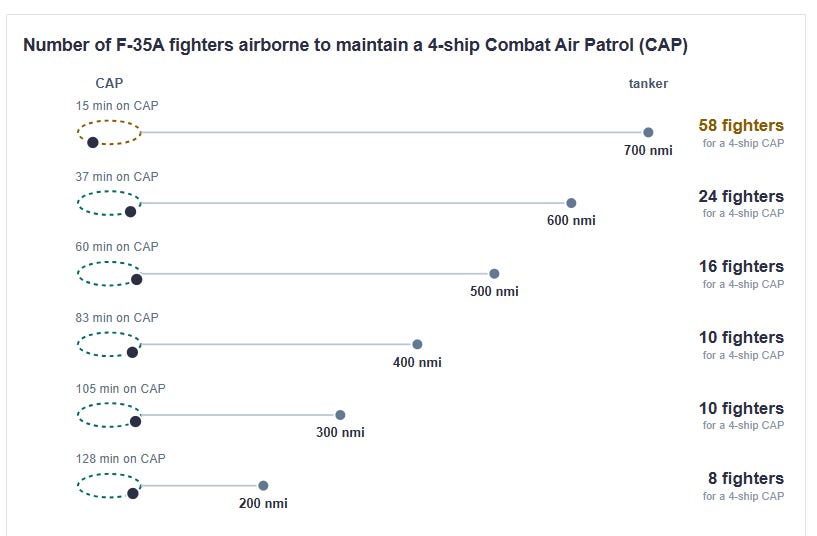
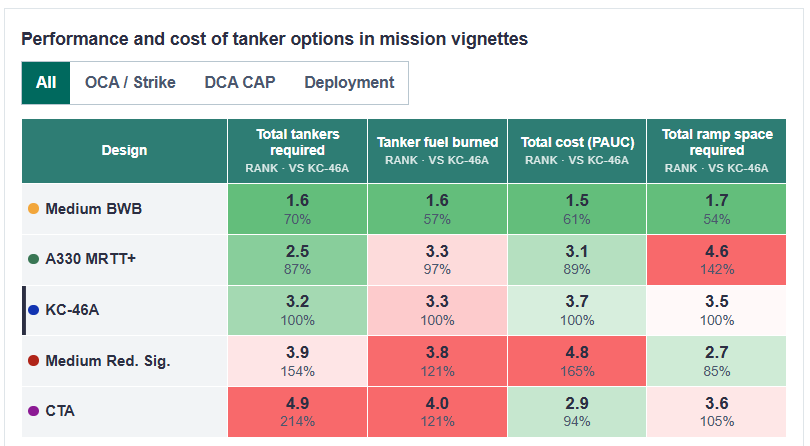
Our Take: We are big fans of Tim and Shane and recommend everyone to read the full report (and engage with the interactive features). While we don’t disagree with the conclusions here, we are more bullish on an autonomous Medium Reduced Signature option in terms of it being more survivable closer to the fight where it’s more efficient for sustaining combat sorties. We think the BWB, even with defensive measures, will present a key target for adversaries. We do however like a plan where once BWB becomes a viable commercial platform (given their focus is on the airline sector), to phase out KC-46 aircraft over time in favor of BWB aircraft. Whichever approach the AF decides to go forward with, they need a plan for tankers and they aren’t going to sustain the numbers with the current KC-46 delivery plan. Deferring NGAS in our opinion is going to be viewed as a major strategic error.
Air Force Should Buy 250 Blended-Wing Tankers, as 2027 Demo Looms

BLUF: Blended-wing body aircraft blur the line between wings and fuselage for a design that is more aerodynamically efficient and has a large cabin/cargo space.
Since 2023, the Air Force has been developing a BWB demonstrator/prototype program with startup JetZero, which is partnering with Northrop Grumman.
That aircraft, dubbed Z4, is expected to make its first flight in 2027.
JetZero has proposed a tanker variant, dubbed KC-Z4, though the demonstrator will not be a refueler.
The Air Force was exploring concepts through the Next-Generation Aerial Refueling System program, but they shifted gears in the 2027 budget request, saying they would focus on protection systems over a new aircraft.
Pentagon Funds Natilus Kona BWB Freighter For Contested Logistics Demo

BLUF: Natilus has received $3.5M in funding from the Pentagon and Air Force to help advance its Kona blended wing body (BWB) freighter toward full-scale flight testing and a Joint Force operational demonstration focused on contested logistics.
Kona is an optionally piloted twin-turboprop regional freighter with a 3.8-ton payload and 800-nm range, burning 30% less fuel than conventional aircraft.
Natilus has completed in-house manufacturing of the vertical tails and flight control surfaces, received the cargo loading system from Collins Aerospace, and sourced and ordered the Pratt & Whitney Canada PT6 engines.
Natilus is targeting first flight of the Kona in 2028, aiming for FAA Part 23 certification and entry into service by the end of the decade.
“Kona's overall aircraft configuration and outer mold line have been finalized, and we've transitioned into full-scale prototype manufacturing. The full-scale wing shipset has been released for production and placed on order with our carbon-fiber manufacturing partner.” Nolan Giblin, CEO Nautilus
Our Take: We are big fans of Nautilus and glad to see them get a government contract after the government has essentially been funding their competitor the last few years. They are well positioned to deliver on the logistics mission.
AFRL Completes Flight of XQ-67A, Advancing Autonomous Technology

BLUF: AFRL and ACC’s Experimental Operations Unit recently flew the XQ-67A Autonomous Collaborative Platform (ACP) in the Nevada Test and Training Range marking a technology milestone in autonomous capabilities for the future fight.
The flight was completed under the Demonstration of ACP Performance and Effectiveness (Demon APE) project.
This demonstrated integration of several advanced mission systems including state-of-the-art sensors, mission computers and power and thermal management hardware, working together collaboratively in demanding combat environments.
Additionally, the integration of BLOS datalinks and LVC simulations during the flight demonstrated management of uncrewed platforms across distributed theaters, bolstering deterrence through resilient, layered command and control.
Our Take: The Air Force is billing this both a demonstration of the success of their government reference architectures and extending the reach of manned platforms. They didn’t give enough details to understand exactly how the GRA played a role and it’s still not clear why the framing is extending the reach of manned fighters and not just an autonomous combat capability in its own right. It’s like the Air Force has to tie everything back to a manned fighter to not offend the pilot mafia.
DUNE Project Aims to Unite Legacy and Cloud Tools in Air Ops Centers
BLUF: After decades of building isolated, vendor-locked systems to run the AOCs that serve as the Air Force’s “combat brains,” the program office tasked with creating the next-generation AOC is working to fold those systems into a new cloud-based system.
Starting this spring, Kessel Run launched the Dynamic Unified Net-enabled Environment (DUNE), which merges cloud and on-premises capabilities for AOC operators, commanders, and their customers—the rest of the Air Force.
Essentially, DUNE standardizes how legacy and current software communicates across the Air Operations Center’s systems.
Currently, Our Take: AOC operators must choose between using real-time, cloud-based tools or sticking with the often aged, legacy hardware they have on hand.
“Evolving the architectural foundation is vital because the information our warfighters rely on depends on the integrity, speed, and agility of the underlying domain. We are rapidly entering the era of software-defined warfare, where tactical superiority belongs to the force that can iterate, secure and deploy code faster than the adversary can adapt.” Col Brian Viola
Our Take: While this seems like an excellent strategy, it does seem a bit shortsighted to keep the focus on AOCs when the long-term reality seems clear where machines will be required to process reams of data from across a dynamic theater and generate combat COAs with TOCs as the likely execution agents as warfare becomes more distributed and comms become more constrained - and also where large command centers become key targets (as we saw with 5th Fleet HQ during the Iranian conflict).

The Machine Staff
BLUF: At Nellis Air Force Base last year, an AI system was tasked with building courses of action, a complex operational problem that military planners have spent generations learning to perform. The AI system took less than a minute to complete its task with solutions rated at 97 percent viable and tactically valid.
By contrast, their human counterparts took roughly 19 minutes and only reached 48 percent viability.
What the Nellis sprint demonstrated is that once a problem is prepared for them, machines can weigh competing constraints and produce usable options for a commander at a speed that changes the underlying assumptions of HQ staffing.
AI creates an opportunity to build smaller, more expert staffs that can disperse more easily and reduce their physical and electromagnetic signatures.
If you remove too much human expertise and redundancy, the same headquarters may become less resilient to the stressors of combat.
Military staffs exist because no commander can absorb the sheer amount of data needed to understand what is possible:
intelligence that shifts by the hour
the changing status of friendly forces
the terrain and logistics constraint
AI can search across large bodies of material, reconcile competing inputs, and revise analysis continuously as conditions change.
As machines increasingly perform tasks that once consumed an entire section’s day, the staff can immediately evolve from a large production bureaucracy into a smaller organization built around expertise, judgment, and combat effectiveness.
Our Take: This is our point on the above AOC approach. The Next Gen AOC needs to reimagine how the AOC is organized and how its authority is distributed across TOCs. Mission command is a huge piece of this puzzle - it’s not clear the AF has solved this.
Air Force Plans $1B Campus for Testing F-47 at Nellis
BLUF: The Air Force is taking the first steps to build a $1 billion campus including hangars, laboratories, maintenance and training facilities, and more to test the F-47 at Nellis Air Force Base, Nev.—and the service plans to finish construction by 2031.
The project would include a nearly 117,000-square foot facility, largely on the east side of Nellis, combining flightline operations and maintenance.
It would also have a specialized laboratory for reprogramming, an aircraft apron with sunshades, and a nearly 41,000-square foot simulator facility.
Air Force Awards Lockheed Martin ARRW Production Contract, Establishes New Hypersonic Capabilities

BLUF: Air Force awarded Lockheed Martin a $694 million contract for the production and fielding of the AGM-183A Air-Launched Rapid Response Weapon.
"This is a turning point in our advanced weapons roadmap. By moving ARRW from test to production, we’re providing our combatant commanders with a credible, high-speed strike weapon capable of penetrating the most advanced anti-access and area-denial systems." Secretary of the Air Force Troy Meink
Related Articles:
Mach 5 air-launched missile for B-52 bomber moves closer to US military service
Air Force launches next phase of hypersonic missile program with $694M contract award for ARRW
Air Force Orders ARRW Hypersonic Missile Into Production, The Same Weapon It Nearly Cancelled
Air Force Launches ARRW, Its First Hypersonic Weapon, into Production
1000-mile range: Air Force moves hypersonic missile into production after tests
F-16 Jets to Add Startup Castelion’s Hypersonic ‘Blackbeard’ Missile
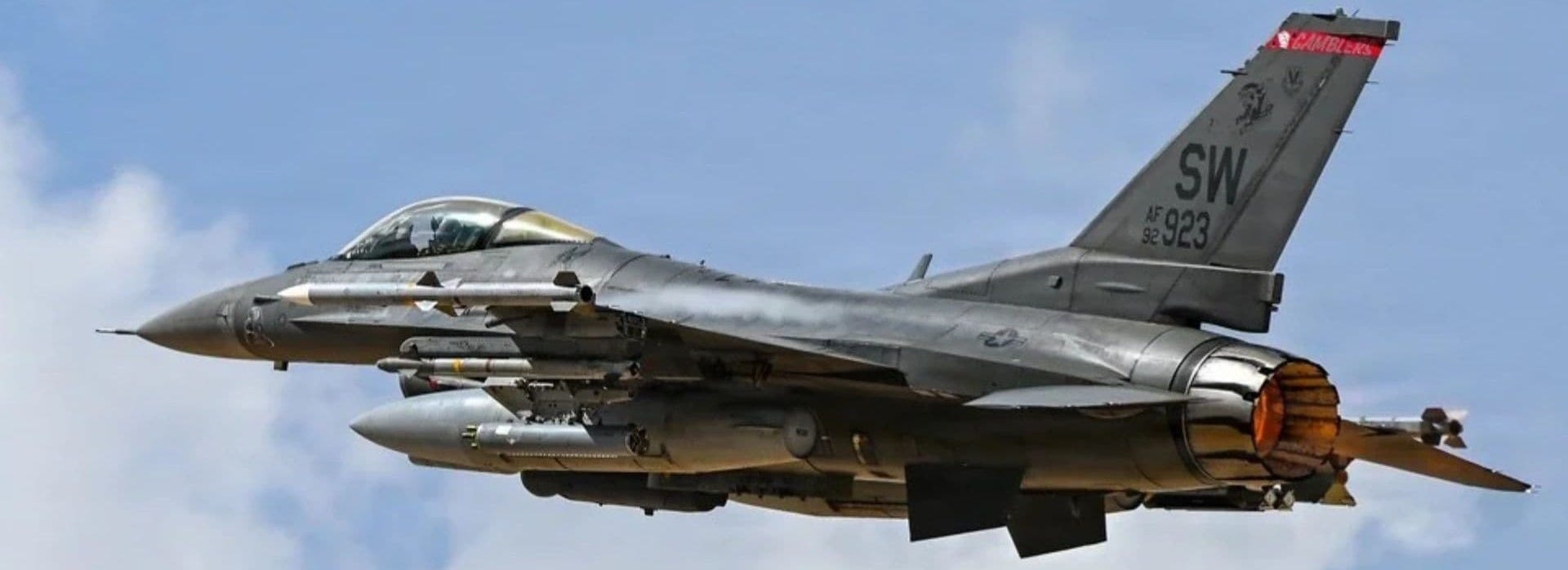
BLUF: The Air Force has awarded Castelion, a VC-backed defense startup founded in 2022, a contract to integrate its hypersonic Blackbeard missile onto the F-16.
The Blackbeard missile has drawn strong interest across the Pentagon, with the Navy pushing to field the rocket-powered, boost-glide strike weapon with a nearly 500-mile strike range on the sea service’s F/A-18 Super Hornet.
The Navy selected Blackbeard as the winner in its Multimission Affordable Capacity Effector (MACE) program, which shifted it to a program of record under framework contract orders of up to $200M.
The MACE initiative sought an affordable hypersonic missile about the size of an AIM-120 AMRAAM air-to-air missile.
In June, the Navy awarded Castelion its first production contract, worth $23.4M, for 50 early operational capability pre-production prototype Blackbeard missiles.
The Air Force now has a three-pronged approach to hypersonic munitions.
the Castelion Blackbeard, an air-to-air missile
the Lockheed Martin AGM-183A ARRW, a strategic strike-focused, exquisite, long-range hypersonic missile
the Raytheon/Northrop Grumman Hypersonic Attack Cruise Missile, a cruise missile option to strike ground or maritime targets.

Related Article: Air Force Advances to Fit Mach 5 Hypersonic Missile on F-16 Fighter Jets
AFRL Targets New Hypersonic Engine Tech Prototypes Within 4 Years
BLUF: AFRL wants industry to advance concepts for affordable hypersonic munition engines to prototype demonstrations within three to four years.
AFRL released a request for information early this month, seeking white papers on technical requirements by Nov. 16.
The Hermes Rocket Lab effort began in 2020 in AFRL.
The latest white paper notice focuses on a specific kind of tech called rotating detonation rocket engine combined-cycle, or RDRE-CC.
RDRE-CC systems use continuous detonation waves rather than deflagration, the combustion process used in conventional engines.
AFRL wants the prototype demonstration to be a ground-launched, sounding-rocket-boosted flight demonstration to validate the system’s operational viability for future High-Speed Affordable Mass Munitions.
Air Force Exploring Creative Ways to Produce More Pilots
BLUF: The Air Force has been battling a chronic pilot shortage for the better part of a decade, and its leaders have said it will take at least that long to fill.
The service currently has a deficit of 2,500 pilots. Air Force leaders have indicated the shortage is largely in staff officer positions that could take 15 to 20 years to fill.
One resolution action includes partnering with commercial training schools to provide basic airmanship expertise before students move on to military training.
AETC began implementing the new model — called the Future of Undergraduate Pilot Training initiative — in 2025, partnering with Federal Aviation Administration-certified civilian aviation programs across Texas, Arizona, Florida and Georgia
Other Air Force News:

New Space Force Program, Capability Take Flight
BLUF: The Airborne Moving Target Indicator (AMTI) program officially got off the ground as officials recently conducted the first launch of a prototype associated with the framework.
Space Force personnel completed a competition and source selection in under 60 days for the launch.
AMTI is a mission the Space Force is delivering to the Joint Force through a system-of-systems architecture.
Space Force wants the AMTI to consist of multiple sensor phenomenologies that work together in the space and ground layers.
They envision that these sensors, which a variety of vendors can develop and provide, will share data from any number of sources,
“It is not a monolithic system. It is not just the system that we put on contract with a large vendor back in May. [We must] stop accepting historical norms that source selections take a year. Just start challenging the status quo and driving. Industry has a lot to do with that as well, because you get less time to do proposals…we couldn’t have done it without you.” Brig Gen Ryan Frazier
Our Take: Good to see this critical effort launch a prototype and get underway on its aggressive timeline to get this capability fielded.
Space Force Missile-Tracking Satellite Launch Slips to 2027 as SDA Reassesses Acquisition Approach
BLUF: Space Force’s first operational missile-tracking satellites are now expected to launch in spring 2027, nearly two years later than planned, as they consider additional flight demonstrations before committing to follow-on purchases.
SDA originally planned to begin launching the satellites in April 2025 under contracts awarded to L3Harris Technologies and Northrop Grumman in 2022.
The target subsequently slipped to early 2026 and then late 2026 as the agency encountered production, testing and integration challenges.
SDA has launched 84 Tranche 1 Transport Layer satellites, which are intended to form the communications backbone of the LEO network.
The delay comes as SDA is preparing to buy its 4th generation of missile-tracking satellites and reassessing how much testing should precede production orders.
The current PAE favors limited on-orbit demonstrations of advanced technologies before the government commits to buying entire orbital planes of satellites.
Related Article: SDA Seeking Industry Input on Tracking Layer Tranche 4 Demos
The Missing Puzzle Piece in Space Superiority: Why it’s Time for the U.S. Government to Prioritize VLEO
David Rothzeid and Matt Kaplan

BLUF: Over the past decade, the U.S. has come to recognize that space is no longer a sanctuary. China and Russia are developing weapons to disrupt, disable and destroy American satellites.
In response, hundreds of new satellites are being deployed to make our space architecture more distributed and resilient.
With space more accessible and affordable, the Space Force and commercial companies alike are proliferating the Low Earth Orbit (LEO) layer, which demands large numbers of spacecraft for persistent coverage over a given region.
However, this space superiority strategy does not account for the most significant threat in space: a nuclear detonation that makes LEO unusable for up to a year.
It’s not hypothetical given in 2022, Russia deployed a test-bed satellite to learn how it could deploy a nuclear weapon in space.
A nuclear detonation in LEO would inject high-energy electrons into Earth’s magnetic field, creating artificial radiation belts that persist for up to a year.
Most commercial-style LEO satellites, designed for the natural radiation environment, would begin failing in days or weeks.
The good news is that the U.S. has an alternative: building infrastructure in a lower, more resilient orbit (VLEO).
Very Low Earth Orbit (VLEO) refers to the region below roughly 350 kilometers, where the Earth’s atmosphere is dense enough to absorb the harmful radiation.
A nuclear detonation could still destroy some satellites within line-of-sight of the immediate detonation, but VLEO would largely remain reusable after an attack.
China recognizes the advantages of VLEO. Its state-owned aerospace industry is pursuing a planned 300-satellite VLEO remote-sensing constellation by 2030.
The Space Force and Intelligence Community should treat orbital diversity the same way military planners treat geographic diversity.
A VLEO layer could replicate a subset of the most essential missions so that losing access to conventional LEO would not mean losing those capabilities altogether.
Beyond redundancy, flying below other satellites offers a useful vantage point for sensors looking upward into LEO.
Proximity to Earth brings secondary advantages including stronger signals, higher imaging resolution and lower communications latency.
The downside of VLEO has been its punishing atmospheric drag and atomic-oxygen exposure, which has historically made long-duration operations difficult.
Commercial flight demonstrations have now validated key technologies for sustained operations in the regime at a price point that is competitive with LEO offerings and much less expensive than MEO or GEO.
DARPA is developing new propulsion approaches to make VLEO more tractable.
The Space Force does not need to move everything into VLEO. It needs to ensure that the U.S. can maintain critical operations from space if it loses access to LEO.
Our Take: This is a really good article. Multi-year VLEO operations have already been demonstrated in the above 200Km orbit so there is viability here. One challenge with this orbit not mentioned is that a lower altitude also means smaller ground coverage per satellite, which can drive up the number of satellites required for global coverage. Having more diversity in this region for resiliency and also to optimize for certain missions where smaller satellites and sensors can deliver the same or better quality just makes sense though. We’ll see if/when the Space Force prioritizes this.
The Pentagon’s Message to Space Startups: Show Us Something That Works
BLUF: Pentagon officials at the MilSat Symposium gave startups the same advice: bring something that works.
Too many companies arrive with ideas rather than mature technology and the small-business research awards many of them live on rarely produce winners.
To get companies across that gap, DIU’s Bridge program offers firms on DIU contracts concierge services for the usual walls: facility and personnel clearances, SCIF access and authority to operate on government networks.
“You need to know who your customer is, and we’re not your customer. DIU prototypes and validates. The portfolio acquisition executives buy.” MajGen Bucky Butow
AFRL Moves Cargo Through Space with SpaceX Demonstration
BLUF: SpaceX launched a capsule containing, among other things, a reverse osmosis desalinator, survival gear, and emergency medical equipment into space as part of a demo advancing AFRL’s Rocket Cargo initiative started in 2021.
The idea is to move large amounts of cargo through space, that would both be faster and allow the Pentagon to more easily reach remote or contested areas.
SpaceX, Blue Origin, Sierra Space, and Rocket Lab, have since signed on as well, but AFRL never announced any experiments or tests for the project—until now.
In June, SpaceX launched what it called a “Starfall Demo Mission,” ending with the capsule splashing down into the Pacific.
Space Force Wants Cislunar Kit Ready to Launch by 2029
BLUF: For years now, Space Force officials have said the service is getting serious about defining its role and crafting an architecture for future cislunar capabilities.
Now, they are taking steps to realize that vision, asking industry to rapidly invest and develop satellites and software that could be ready for operations by 2029.
The action is in part linked to China’s lunar ambitions. Beijing has a cislunar roadmap of its own and has already landed several uncrewed spacecraft on the lunar surface. Now, it plans to launch a crewed Moon mission by 2030.
In April, the Space Force set up a new Cislunar Coordination Office, within PAE, Advanced Programs and tasked with crafting a roadmap for cislunar technology and a future space architecture.
In partnership with AFRL and SpaceWERX, it plans to launch an industry challenge called Lunar Prime to pursue more nascent technology and research needs.
The effort has $30M in funding and is targeting flight demonstrations within two years of contract award.
“This is a warfighting domain. I would ask you all, please jump on my cislunar bandwagon because I need more friends here, along with our deep, passionate crew that have been working on this for years. We’re looking for existing commercial or near-commercial means, non-developmental solutions, hardware with actual relevant evidence behind it, software that doesn’t need a huge amount of work … and ground systems. This isn’t a four- or five-year science project. This is about getting capability out soon.” MajGen Purdy
Related Article: AFRL Plans to Award $30M for Cislunar Project Starting Next Spring
Our Take: It’s great that there is a clear goal set for this mission set. We will be curious to see how much industry invests on its own for this rather niche mission set.
Pentagon to Give Startup Stoke Space $150M Loan for New Launch Pad
BLUF: The Pentagon plans to issue a $150 million loan to Stoke Space Technologies, an emerging space launch provider, to help it expand its footprint at Cape Canaveral Space Force Base, Fla.
The loan, managed by DOD’s Office of Strategic Capital, is contingent on Stoke clearing various financial, legal, and technical requirements.
Stoke’s first launch pad, located at the Cape’s Space Launch Complex-14, is slated to host the debut flight of its Nova rocket in “the first part of 2027.”
That vehicle is a pathfinder for the firm’s future Nova Block 2 rocket—a fully reusable rocket designed to deliver 15 metric tons to low-Earth orbit.
Stoke plans to fly multiple Nova missions in 2027 and 2028 to fuel its plans for Block 2, which it expects will log its first flight in 2029.
Related Article: Department of War’s Office of Strategic Capital Signs $150 Million Conditional Loan Commitment with Stoke Space Technologies, Inc.
The Pressure is on to Find a Home for a New Spaceport
BLUF: Leaders in the US Space Force would like to have a new spaceport up and running in four years, adding a third heavy-lift launch site to relieve pressure from bases in Florida and California.
The obvious problem with that ambition is 2030 is four years away, and Pentagon officials have not determined where the new spaceport should go or how to acquire land for it.
There are also commercial options that might be available for a new military spaceport.

Defense Investors Wary of Golden Dome Revenue Prospects as Pentagon Pushes to Cut Costs
BLUF: Companies are growing cautious about betting on the Pentagon’s $185 billion Golden Dome missile defense initiative even as the U.S. military seeks to expand its supplier base to support the program.
Industry executives said uncertainty over future congressional funding and unresolved acquisition challenges are making it difficult for companies to justify investments in manufacturing capacity and technologies.
While the Pentagon has begun awarding contracts and soliciting proposals, companies must make investment decisions well before the government establishes firm, multiyear demand for the equipment it expects them to produce.
A former official questioned whether acquisition organizations have fully accepted the authority granted to Golden Dome director Gen. Michael Guetlein.
Executives also said Golden Dome faces difficulties integrating missile defense capabilities developed by different military organizations under separate acquisition programs.
Our Take: It is an understandable fear that with the consternation on the Hill with Golden Dome both in communicating a clear strategy and having alignment on a cost estimate, that an incoming political party could pull back on some aspects and the program survives but at a significantly lower funding level.

Canada Unveils First National Security Strategy in More Than 20 Years
BLUF: Canada has released a national security strategy today focused on sovereignty — marking the first time Ottawa has released such a document in more than 20 years.
The strategy drives home that Canada “controls its own destiny,” and comes amid tension between Canada and its North American neighbor.
The proposal emphasizes that Canada aims to foster stability with international partners though a “global system” of partnerships.
USS Colorado Becomes First US Nuclear-Powered Sub for AUKUS

BLUF: Australia will host USS Colorado, the first U.S. nuclear-powered attack submarine under the AUKUS (Australia-UK-U.S.) defense pact from late 2027, strengthening military cooperation among the three allied nations.
The deployment marks a step toward establishing a regular American submarine presence in the country and expanding the three nations’ collective deterrence capabilities in the Indo-Pacific.
The deployment will establish the first submarine assigned to Submarine Rotational Force-West (SRF-West), a planned rotational force based at HMAS Stirling in Western Australia.
UK Commits to 3% GDP on Defense by 2030, New Investment Partnerships With Industry
BLUF: The UK’s recent Defence Investment Plan would be “fully” funded, indicating the money for defense would come from cuts to other priorities.
Next year’s spending review will spell out exactly how the UK plans to hit the NATO commitment of spending 3.5 percent GDP on defense by 2035, and how the UK will be at 3 percent by 2030.
Other defense-related announcements in budget documents include:
The standup of a new Innovative Defence Financing Taskforce to “maximise the contribution of private and international finance to UK defence;”
The opening of discussions with Finland, Poland and the Netherlands to pool funding for “defence investment and joint procurement across NATO allies;”
A plan for the “National Wealth Fund and British Business Bank to deploy up to £5 billion over the next four years into defence, dual-use and other sectors.
The creation of a Ministry of Defence-led “drone regulation unit” which will work across different agencies to cut” red tape and create clearer routes for testing uncrewed and autonomous systems.”
KONGSBERG Secures US Government Contract for Underwater Capabilities

BLUF: Kongsberg Gruppen ASA (‘KONGSBERG’) has been awarded a $54M contract modification by DIU for autonomous underwater capabilities, specifically for the delivery of a broad range of autonomous underwater vehicles (AUVs).
DoW Selects Poland for New PAC-3 Maintenance Facility
BLUF: The facility will provide maintenance, repair and overhaul capabilities for Lockheed Martin’s PAC-3 missiles, which will dramatically shorten turnaround times and further secure critical supply lines.
Germany, the Netherlands and Sweden will also provide support to the new facility via “critical supply chain” integration.
US, Japan Reach Agreements for AMRAAM Assembly, SM-3 Production Boost
BLUF: The US and Japan have finalized a plan to assemble the Advanced Medium-Range Air-to-Air Missile (AMRAAM) in Japan amid a crunch for munitions.
The defense minister did not share which Japanese industry partner was picked to assemble the missile.
the US and Japan “agreed to share the necessary technical information to achieve increased production” of the Standard Missile-3 Block IIA, a primarily ship-based interceptor used to bat down ballistic missiles.
The SM-3 Block IIA is a joint program between the US and Japan, though it’s not clear how much the agreement may raise the interceptor’s production rate.
The AMRAAM and SM-3 agreements were both part of “Operation Supercharge,” a joint US-Japan effort to boost defense technology cooperation.
Related Article: Japan To Assemble AMRAAM Missiles as U.S. Moves to Dramatically Boost AIM-120 Production
China Developing More On-Orbit Space Weapons
BLUF: China is expanding the arsenal of counter-space weapons it could use in a potential conflict with the U.S., to include on-orbit systems.
The DIA released its “Challenges to Security in Space” report update on Oct. 26.
The report repeats previous warnings that China has ground-based laser weapons that can “disrupt, degrade, or destroy” satellites in low-Earth orbit.
It goes further in adding that, by the late 2020s, “China may field space-based directed energy systems and higher-powered ground-based directed energy systems capable of threatening satellites in higher orbits.”
Directed energy weapons could include anything from microwaves to high-powered lasers—the most common are lasers that can “dazzle” satellites with electro-optical sensors.
It’s the first time DIA has noted the existence of on-orbit jammers.
The new report also notes that the Chinese military “probably intends to deploy more ASAT missiles that can destroy satellites in low, medium, and high orbits.
Our Take: Sadly, it’s an increasingly dangerous world in space.
Related Article: U.S. Intel Warns China’s Space-Based Directed Energy Weapons Could Soon Threaten Satellites
Trouble is Brewing Under the Ice: The PRC’s Use of Science to Gain Military Advantage in the Arctic
BLUF: The PRC’s security goals include denying the U.S. unchallenged freedom of maneuver under the Arctic ice and the northern approaches to China’s home waters.
The PRC is systematically using instruments of national power flexibly to:
gain access to scientific treaty memberships,
enter denied areas via scientific missions
obtain comprehensive seafloor topographic data through undersea mining, commercial undersea cable ventures, and clandestine mapping missions.
The Bering Strait chokepoint connects the Arctic Ocean and the Bering Sea and is key terrain for any conflict between underwater naval forces in the future.
The United Nations Convention on the Law of the Sea (UNCLOS) specifies that that states must grant permission for research, resource prospecting,, or exploration in their Exclusive Economic Zones (EEZs) or continental shelves.
The U.S. rejects this position and conducts military surveys and routine oceanographic data collection.
This presents the PRC with a justification for its own surveys and exploration based on United States practice.
Other International News:
Destinus’ Monthly Output Tops Europe’s Pre-War Annual Cruise Missile Production
NATO allies double down on Schakal vehicles equipped with anti-tank missile systems

DoW Achieves 97.5% Obligation Goal of FY 2026 OBBBA Funding
BLUF: The DoW obligated 97.5% of the One Big Beautiful Bill Act (OBBBA) prior to the close of FY26. This aggressive, disciplined execution ensures that the majority of authorized resources have been rapidly deployed to support immediate combat readiness and force modernization.
Army: $10.5B (98.1%)
Navy $48.7B (99.2%)
Air Force $34B (99.2%)
Defense-Wide $55.2B (94.9%)
"The DoW successfully obligated $148.5B of the $152.4B authorized by the One Big Beautiful Bill Act. This record-high execution rate demonstrates our unwavering commitment to rebuilding our military and delivering immediate lethality to the warfighter. Following communications with Congress, the DoW chose to reserve portions of funding provided to OSC, DIU, and EDU to preserve investment options into FY27 and maximize use of those dollars.” Jules Hurst III, USW (Comptroller)
See our NDAA and budget posts for the latest insights and analysis.

Acquisition Talk | Eric Lofgren and Matt MacGregor
Faster Yeses, Faster Noes w/HON James Mazol | Mike McKay
Creative Defense Foundation
Drone Dominance | Travis Metz
China Talk
Nodes in the Network | John Conafay
Creative Defense Foundation
How to Build the Next SpaceX or Tesla | Erin Price-Wright and Connor Love
a16z
Has China Become an Innovation Giant? | Josh Lerner and Amit Seru
Hoover Institute
Why SpaceX Outsourced 95% of Its Wire Harnesses | Jordan Black
Crossing the Valley
How AI is Revolutionizing Intelligence Analysis | Jesse Kallman
Mission Matters
Defense Industry: How to Increase Production and Integrate AI
Defense News
Here's what we should learn about CHINA'S new SPACE PLANES
Sandboxx

Global MILSATCOM
SAE Media • Nov 2-5 • London, UK
Space+Defense Investor Summit
Teconic x Payload • Nov 3-5 • Beverly Hills, CA
Euronaval 2026
Nov. 3-6 • Paris, France
International Fighter Conference 2026
Nov. 3-5 • Berlin, Germany
AUVSI Defense
Nov 9-10 • Washington DC
Space and Satellites USA
Reuters • Nov 9-10 • Washington DC
Navy Outlook Summit
DLF • Nov 16-17 • Reston, VA
Loitering Munitions
SAE Media • Nov 17-19 • London, UK
Military Vehicle Systems Summit 2026
Nov. 18-19 • Detroit, MI
AFCEA Annual Data Forum
Nov. 19-20 • Alexandria, VA
Counter UAS Tech
SAE Media • Nov 30-Dec 2 • Washington DC
I/ITSEC 2026
Nov 30-Dec 3 • Orlando • FL
Plan the quarter from the events page. It has the full year, so you can lock travel and decide which conferences are worth the pipeline before the calendar fills.