



The House released their first volley of marks for the FY27 NDAA last week and will debate them tomorrow. Given the massive changes made in the FY26 NDAA, along with many executive orders, and the Acquisition Transformation Strategy, this year’s bill is not as ambitious. We support a constrained FY27 bill to allow the Department to focus on incorporating the major changes from FY26 to include training the acquisition workforce. However, there are several complex provisions in this bill.
Cyber, IT, and Innovation | Intel and Special Ops | Military Personnel | Readiness | Seapower and Projection Forces | Strategic Forces | Tactical Air and Land Forces
High Impact Provisions
These are the provisions we believe will have the greatest impact to the Department by addressing a core issue, expanding authorities/roles, and enabling the acquisition transformation.
Sec. 818. Transfer Authority for Rapid Transition of Other Transaction Authority Prototypes
Authorize a PAE to transfer 10% of total RDT&E to a procurement program to accelerate production.
Transfers can only be made within the same PAE portfolio and can only be used for mature technologies that were executed under an OT.
Requires written notification to Congress and DoW 15 days before the transfer.
These amounts are excluded from General Transfer Authority (which means it can’t be capped by Above Threshold Reprogramming activities).
Our Take: This could be highly impactful to prevent the typical 2-3 year wait to get procurement funds programmed for a successful prototype. To date, the only recourse has been to petition for APFIT funds which we have been big fans of as a way to get at least initial production underway. To show a scenario of how this could work:
A PAE collectively has $500M in RDT&E funds across her portfolio (say in 20 different budget line items).
She has 10 different prototypes for different capabilities being executed under OT agreements at differing levels of maturity.
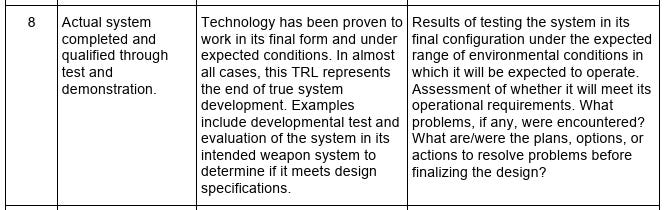
Two of the 10 projects hit some key milestones (and presumably satisfy their completion criteria on the OT contract) that can justifiably be characterized at a TRL 8 level of maturity (see details below).
If funds are not already committed to projects that are high priority, she could commit up to $50M to the one or both projects to get production underway as long as she can justify that the operational timing requires it.
Sec. 1511. Software Planning, Programming, Budgeting, and Execution Reform
Requires DoD to revise Financial Management Regulations to allow any of the Department’s primary appropriation funds to be used flexibly across the full lifecycle of software capabilities, regardless of appropriation category.
Our Take: This should have been done years ago. Software is different from hardware. Attempting to plan and budget for software 2-3 years in advance between development, production, and operations & maintenance is foolish. The SECWAR Acquisition Transformation memo (7 Nov) directed cutting regulations and guidance to enable speed within 150 days and specifically called out the 7,324 page FMR.
Sec. 813. Amendment to Other Transaction Authority
Expands the justification for using OT authority to include when:
Innovative business arrangements or structures would not be practical or feasible under a FAR contract.
An innovative or novel product, service, or business practice is offered that is more practicable to acquire under an OT.
It is expected to accelerate delivery of capability compared to other procurement methods.
It works to expand or strengthen the defense industrial base in a manner not practicable under a FAR contract.
It would expand participation by one or more nontraditional defense contractors or small business.
It would reduce technical, schedule, or performance risk, or accelerate transition to production
It would permit fielding through use of non-federal cost sharing arrangements
Our Take: OTs are already used for these purposes today. This provision further reinforces scaling their use and eliminating any barriers to using them for crafting novel business models and expanding the industrial base. We do recognize that there are limitations in expanding their use given the limited number of Agreement Officers. New training approaches are needed to rapidly train new AOs with shadowing by expert deal-makers to accelerate their proficiency.