


On 9 Jan, the Secretary of War signed out a memo: Transforming the Defense Innovation Ecosystem to Accelerate Warfighting Advantage. In it, he reimagines a system that is less “tangled” with multiple overlapping organizations and one that is more unified by the DoW Chief Technology Office, run by Mr. Emil Michael.
Identified Issues with the Current System
Over the years, there have been multiple organizations and programs stood up all essentially to identify technical solutions to existing capability gaps using rapid prototyping and transition. There is no judgement about whether they all added value, but collectively they did create the below conditions:
Overlapping.
While there are of course nuances in all these organizations and efforts, they all have similar goals and mostly similar methods for achieving them. Some have access to dedicated funds and the ability to conduct experimentation campaigns while others had more direct access to Department-level resources.
DARPA has a Strategic Technology Office and Tactical Technology Office to execute a wide range of functions and technologies.
DIU manages a portfolio across 7 different tech areas likely tapping into some of the same vendors - albeit more focused enabling production at scale.

The Strategic Capability Office (SCO) has a minimal public presence but issues solicitations that often look similar to DARPA and other R&E efforts.
USD(R&E) has had a panoply of different rapid prototyping programs with unclear distinctions. The most notable was Rapid Defense Experimentation Reserve (RDER) which formally ended last year and was focused on scaling successful experimentations and driving more impact into the prototyping process. R&E’s Rapid Reaction Capability Office ran four other programs that had different nuanced missions, and which had ups and downs in terms of funding levels and congressional support.
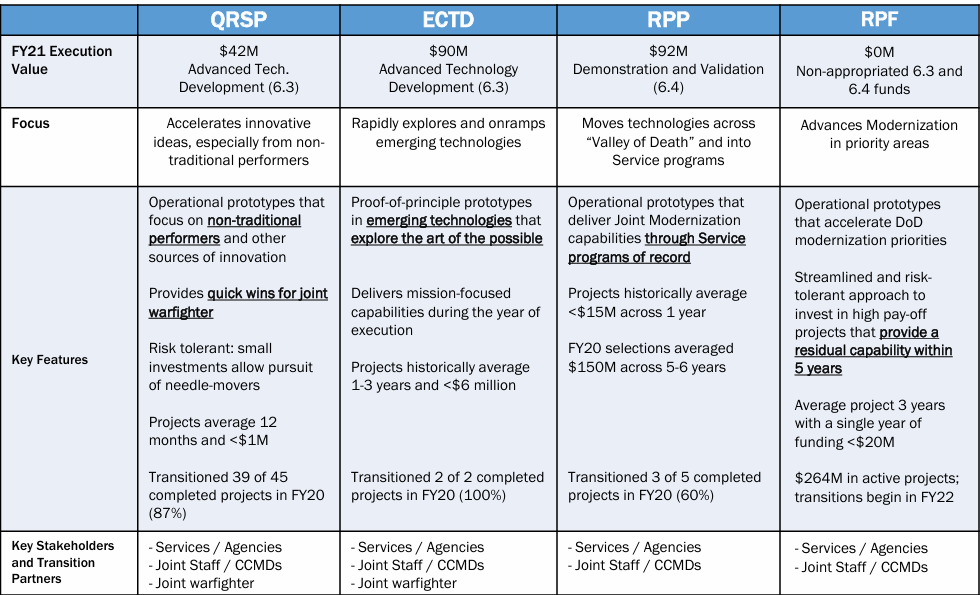

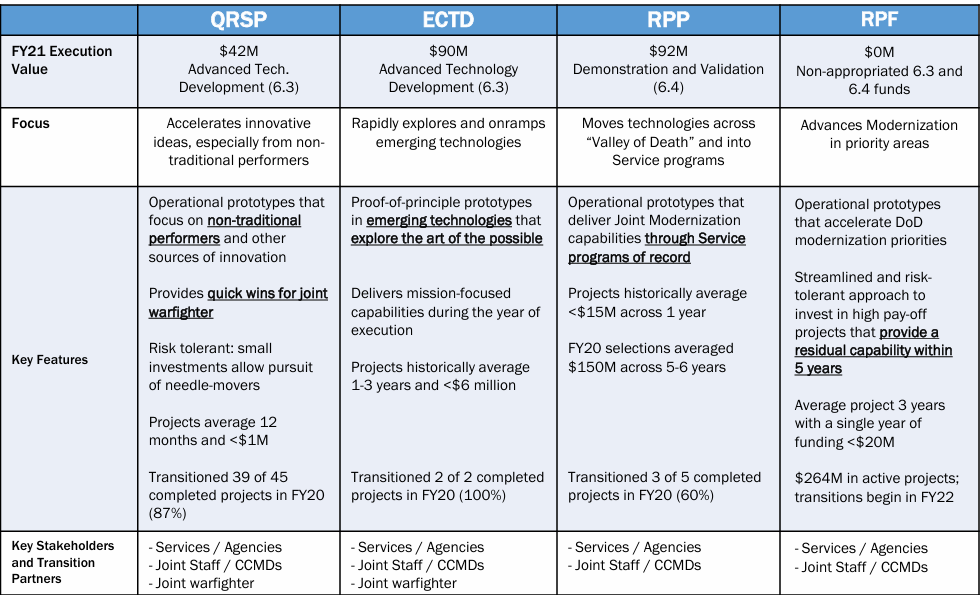
R&E also runs the Accelerate the Procurement and Fielding of Innovative Technologies (APFIT) program which focuses on rapid fielding but with a procurement focus to enable future scaling.
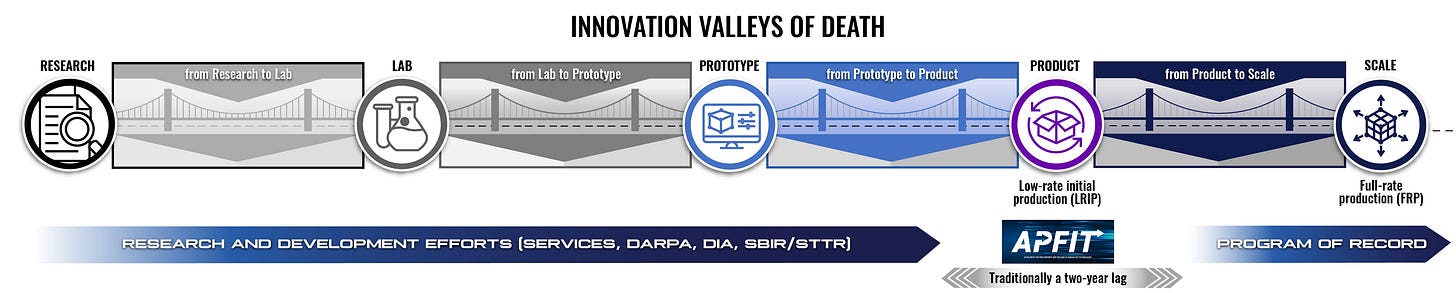
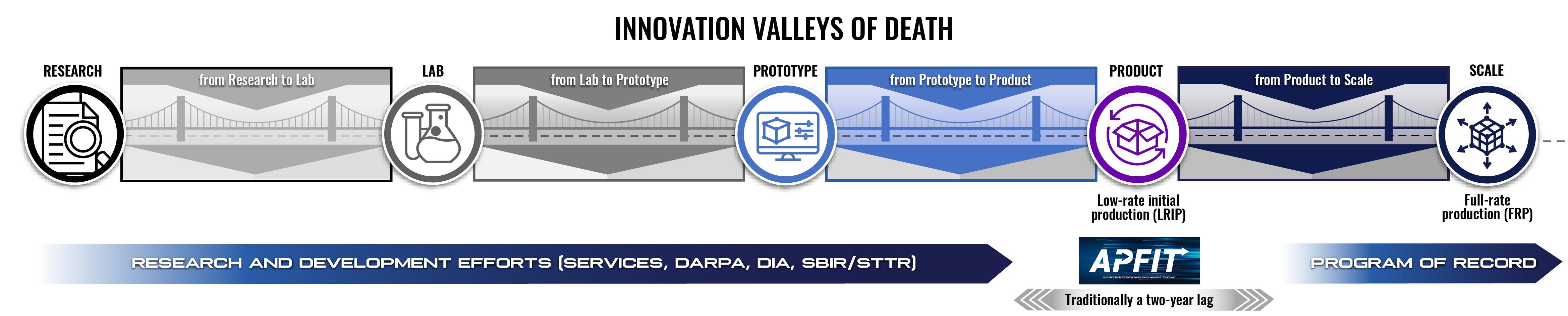
USD(A&S) while historically only focused on managing Service-run programs also started a Competitive Advantage Pathfinder effort in 2022 that runs different sprints focused on rapid integration to accelerate capability delivery while also identifying acquisition process improvement areas.
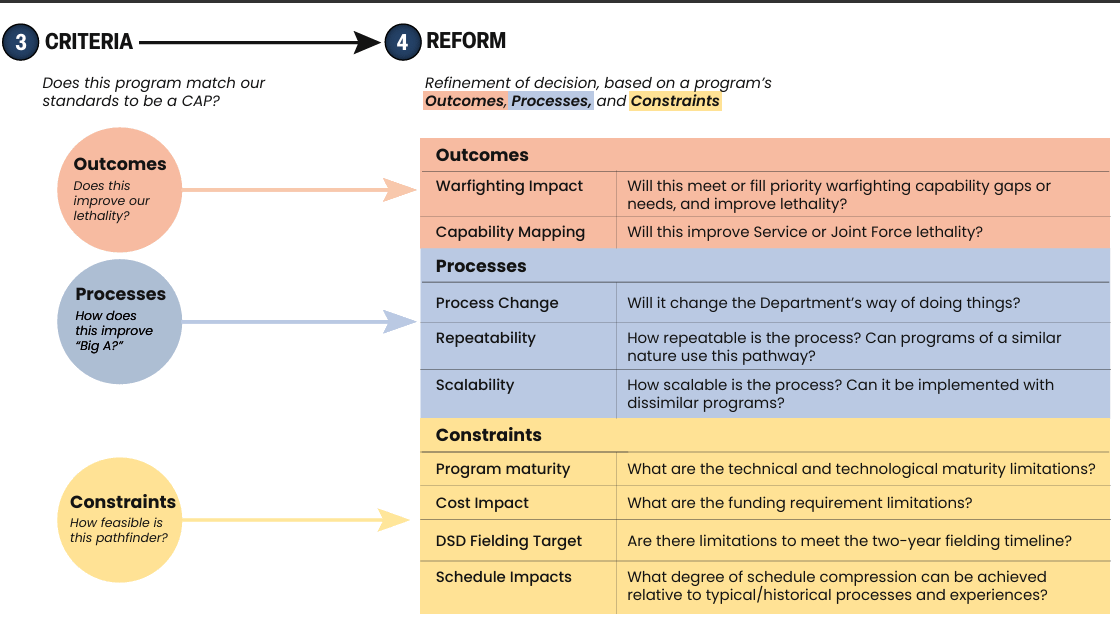
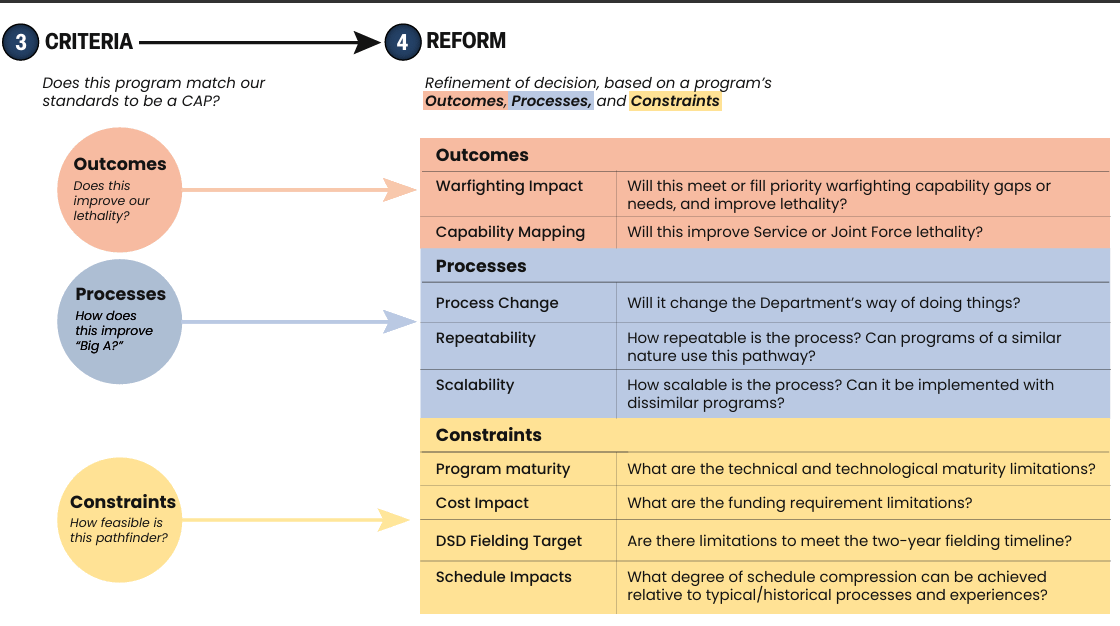
While the Test Resource Management Center has a bit less overlap given its focus on developing test infrastructure, it also executes numerous prototypes.
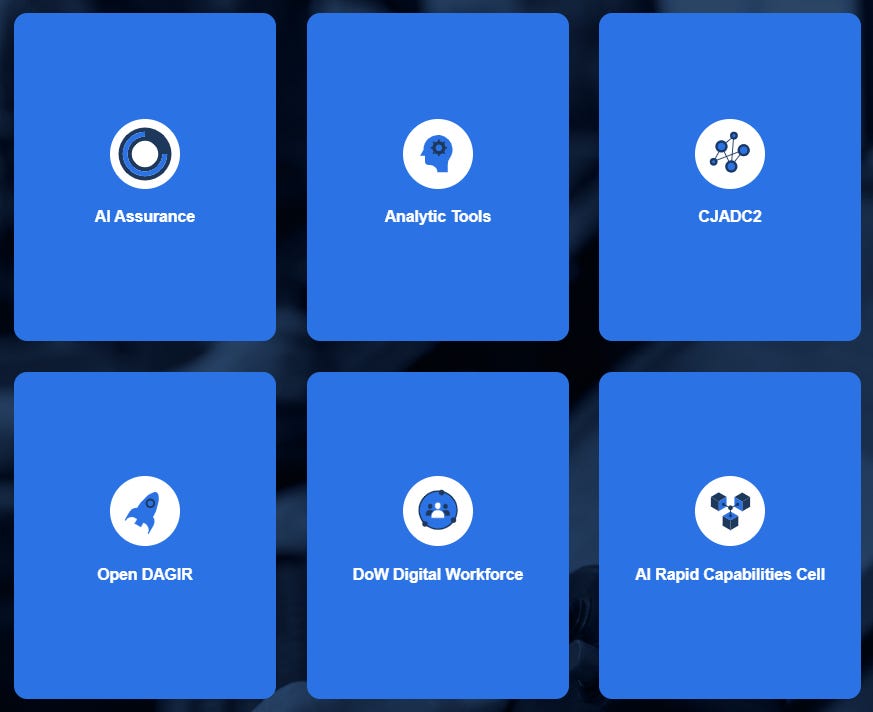
CDAO, an independent organization until recently, also contributed to the sense of overlap as it ran extensive JADC2 experiments and funded prototypes not dissimilar to efforts that R&E, DIU and DARPA were executing.
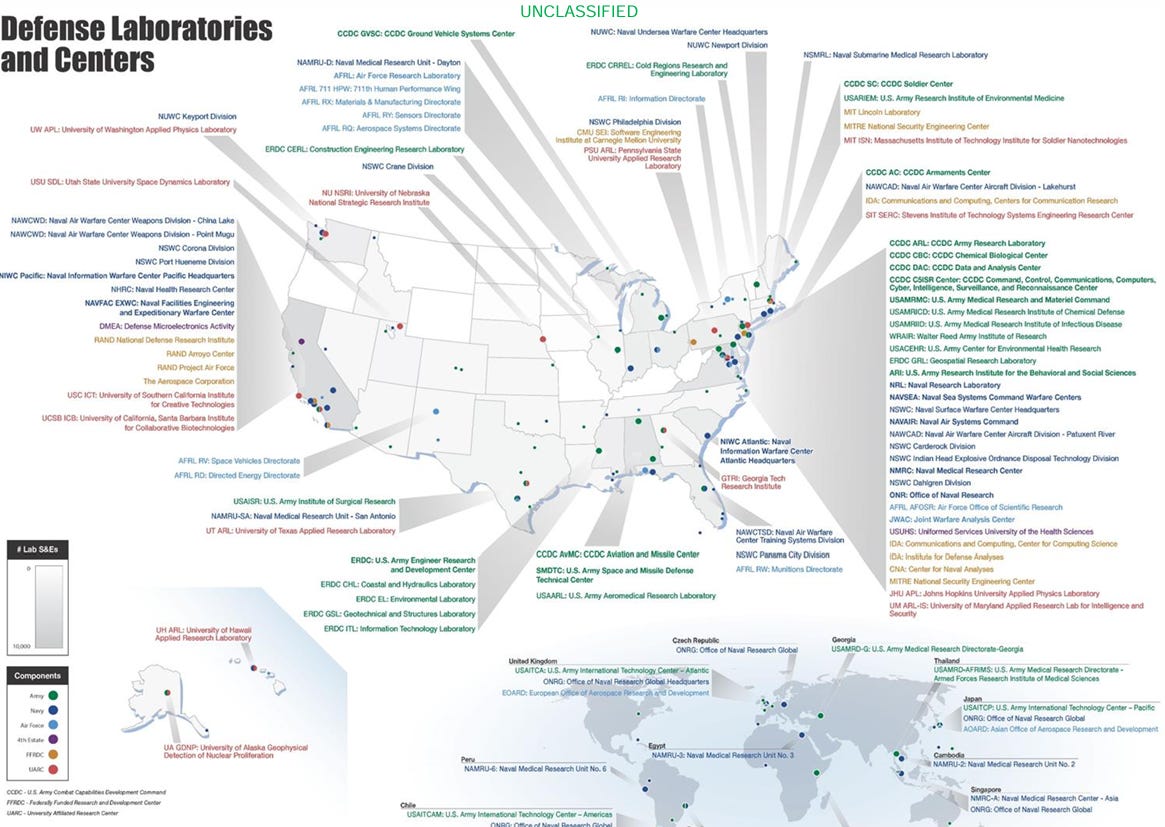
These OSW organizations do not even account for the vast complex of defense laboratories run by the Services, including SBIR-focused entities like AFWERX/SPACEWERX and Army Application Lab.
Unclear Authority. While it’s not 100% clear what authorities were being confused, this generally seems to be a reassertion of R&E’s statutory authority to be the central point on technology priorities and direction for the Department. In general, there has been confusion about the level of direction that is acceptable from OSW to the Services since the 2016 NDAA that pushed most acquisition oversight down to the military service elements. This memo reasserts the CTO as the decision (and by virtue) oversight authority on technology projects.
Workarounds. While again we’re not 100% sure, this likely refers to the fact that most of the success stories from rapid prototypes at the OSW-level were not driven through the normal process i.e. a program office ingesting a new tech and adding it to their delivery baseline. More often, there was a senior champion at the right level that could advocate for funds, a forcing function to get it integrated into some platform (maybe a DSD push) or a CCMD willing to field a prototype.
Industry Confusion. As one very cogent article recently noted, there are many front doors, but they rarely act as a portal for innovation but rather serve as a new valley of death with no clear implementation paths. There is not always public clarity on submission processes for the different prototyping programs. A recent APFIT industry day was an exemplar by providing very clear guidance, contacts and advice. Their website is also an inspiration.
Linear Model. Technology is still viewed through the narrow lens of TRL levels (see page 14) which are not inherently bad but also drive the impression that progression is a linear and time-intensive process, when in reality the leap up the ladder can happen quickly with the right testing support and commercial iteration cycles.
The New Model
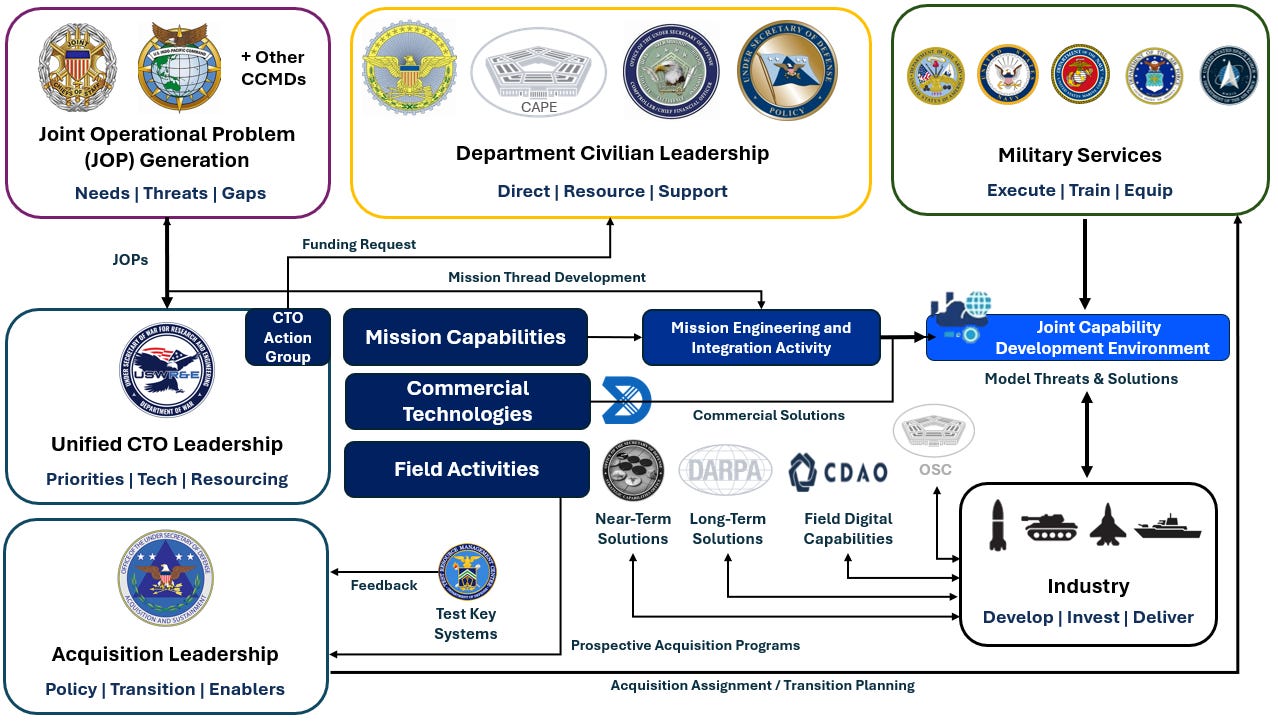
The new elements, as envisioned in the memo, is organized around three Innovation Outcomes (header titles are ours):
Exquisite Capabilities. Create differentiated capabilities and concepts that only DoW possess - capabilities that change what is possible.
Commercial Capabilities. Harness the creativity and drive of U.S. entrepreneurs and capital markets, who draw from abundant commercial and dual-use technology to create reliable, scalable products fielded in serial production.
Evolutionary Capabilities. Combine technologies and weapons with tactics and doctrine into new ways of fighting that create asymmetric advantage.
Organizational Shifts
Below are some of the key organizational movements in the memo.
A CTO Action Group (CAG), chaired by the USW(R&E), is established as the Department's senior forum for the innovation ecosystem. It will serve as the body that sets the tech agenda, assess status, clear blockers, and make decisions.
What Does It Really Mean? This is a shift from previous DSD-level direction (DISG and DAWG) to USD(R&E) making more of those decisions. This is an indication that the DSD wants to focus on major decisions (see new DRPMs).
Demotes SCO from the Principal Staff Assistant level.
What Does It Really Mean? PSA status is an elevated position in OSW that provides more decision authority and influence, so this is indicator that SCO will have less independence and will take more direction from the CAG.
Establishes DIU and SCO as a DoW Field Activity (DFA) with clear missions, streamlined governance, durable authorities.
What Does It Really Mean? The DFA designation is a formal statutory mechanism that comes with certain review and congressional notification requirements. In practice, it means little.
Redesignates ASW(Critical Technologies) to ASW (Commercial Technologies).
What Does It Really Mean? An important messaging shift from broader tech areas with relatively generic roadmaps to a more concise and operationally focused set where commercial tech can more rapidly employed. One point of confusion is that this new designation and new tech areas seem to overlap with DIU’s portfolios and commercial focus.
Industry Engagement
R&E will establish two complementary channels to provide industry with clear strategic demand signals.
Mission Engineering and Integration Activity (MEIA): Share Joint Operational Problems with industry (through a joint information environment).
DIU: Execute product-driven industry engagement in support of its mission and CTO adoption priorities.
What Does It Really Mean? DIU’s mission is generally unchanged except that it has significantly less flexibility to set its own priorities. The DIU 3.0 that saw it more integrated with the CCMDs will likely be scaled back significantly. The MEIA will model mission threads derived from the Joint Operational Problems (which are approved by Joint Staff) and model different industry solutions to be assessed against those mission threads. As part of that process, it will share common mission threads with industry and the Services to inform their own analysis. It will also share threat data and the specific capability gaps identified in the Joint Operational Problems (at different levels of classification).
Overall Key Responsibilities
Below are the key roles of each organization from the memo.
DARPA. Creates and prevents strategic surprise through technology innovation.
CDAO. Serves as a horizontal enabler for Al and data infrastructure across all three of the Innovation Outcomes.
TRMC. Manages test resources and develops test technology essential for continuous evaluation and adaptive capability delivery.
OSC. Aligns private capital to critical technology priorities and addresses gaps the commercial market has not filled.
DIU. Accelerating adoption of commercial technology and externally developed products. DoW’s leading interface with the nontraditional and commercial ecosystem for rapid product adoption and transition.
SCO. Identifying, developing, and fielding disruptive applications of existing systems and near-term technologies that create strategic effects.
What Does It Really Mean? These are generally unchanged roles and responsibilities from their original mandate. CDAO may have a clearer mandate than it did previously.
Timelines. Generally, short horizon efforts will be funded through R&E efforts in conjunction with the Services. Mid-horizon capabilities will be executed using SCO and DIU. DARPA will be focused on the longer-horizon efforts.
Integration with Portfolio Executives
Beyond the OSW reorganization/refocus, the memo mandates that the Services align their various “innovation” organizations to the three Innovation Outcomes (IOs). Specifically, it requires Services to:
Identify how they will reduce overlap and duplication to support the IOs. This includes labs, RCOs, software factories and experimentation units.
Identify how the new portfolio structures will be organized to rapidly onramp innovation and rapidly address the Service and Joint capability gaps.
Identify how they will align their industry engagement to DoW priorities.
Identify policy or legislative obstacles requiring assistance.
Participate in the CTO Action Groups when equities are represented.
Allocate portfolio funding for rapid technology insertion titled Innovation Insertion Increment (III) that will be tracked in CTO Action Group reviews.
Provide quarterly updates to the DSD highlighting learnings, progress, transition opportunities, and barriers requiring decision.
What Does It Really Mean? This is essentially an attempt to manage the array of Service innovation organizations by oversight exception to ensure they are focused on solving joint problems. The CTO Action Group replicates some of the processes that USD(AT&L) managed pre-2018. Expect that this process will result in escalation to the Service Secretaries the first time that R&E directs any reallocation of funding away from a Service need. It is one thing for R&E to give funding above a Service’s topline for a priority; it is a whole other matter for it to direct Service funding to a different priority.
The Full Picture
There are a few other processes that will have to play into the Innovation Ecosystem that involve more organizations beyond R&E and the Service Innovation Leads.
Not Mentioned in the Memo
Joint Staff, CAPE, USD(A&S), or CCMDs .
The Requirements and Resourcing Alignment Board (RRAB).
The Joint Acceleration Reserve (JAR).
Experimentation campaigns were mentioned in passing but no details were provided on who would manage those and drive the structure and content. Generally, that is a Joint Staff function.
Will Be a Factor
The JROC (led by Joint Staff) will be the forum for identifying and annually ranking Joint Operational Problems and associated capability gaps. So, while the MEIA will conduct analysis and be the maintainer and sharer of the details, they will not be the originator.
While the plan is that CCMDs will help inform the mission threads used by the MEIA, they also have a role in helping form the Joint Operational Problems as the JOPs will most likely be derived from 4 sources:
JUONs/UONs not yet fulfilled.
CCMD IPLs
Concept Required Capabilities (JWC-derived)
MEIA-generated capability gaps.
The CCMDs may also be able to more regularly generate joint requirement documents - and Joint Staff is directed to prioritize their needs.
R&E will not be the only OSD entity conducting mission analysis. CAPE, as a member of the RRAB will also perform assessments and come to conclusions.
USW(A&S) also has a role in the MEIA (per the SECWAR’s Nov Requirements Memo). It is not clear what role USW(A&S) has in the CTO Action Group.
Funding will not come exclusively from R&E funding lines or Triple I (III) allocations from the portfolios. Joint Staff as a co-chair of the RRAB (with the Deputy Secretary) will get a say in how JAR funds (potentially 8-10% of Total Obligation Authority) is allocated for innovation priorities.
The RRAB shall select topics from the top-ranked KOP and nominations from the co-chairs to perform analysis, issue programming guidance, and recommend allocation of funding from the Joint Acceleration Reserve (JAR).
Conclusion
The efficient and effective execution of the innovation ecosystem will be a team sport, full of the political maneuverings typical in a bureaucracy. When funding and priorities are involved, differing opinions and positions are inevitable.
USW(R&E) makes a bold move to orchestrate a significant portion of the non-program of record activities. If it is even moderately successful in drawing greater attention and alignment to joint challenges that the Services are not prioritizing, it will be a win. If it enables sharing of currently siloed innovation information, it will be a win. If it provides industry a better DoW-wide demand signal, then it will be a win. If it accelerates fielding capabilities to CCMDs faster, then it will be a real WIN!
In shaping a cohesive innovation ecosystem, the DoW must consolidate its hundreds of disparate innovation outposts, while aligning resources, initiatives, and personnel around a focused set of strategic outcomes. At the same time, it must strike a careful balance: addressing Joint strategic imperatives at the highest levels while empowering lower-echelon organizations to rapidly identify, adopt, and integrate cutting-edge technologies from both industry and internal DoD sources—ultimately delivering lethal, operationally relevant capabilities to the warfighter at speed.
Join over 13,000 subscribers to get our weekly recaps and thought pieces. Paid subscribers also get budget, legislative, and initiative analysis and are valued supporters of our work.
Thanks. Excellent summary of a highly complicated, fractured landscape.
Any attempt at defense innovation ecosystem alignment should be enthusiastically welcomed. A few thoughts.
First, I spit up my coffee when I read the sentence in the guiding memo, "Today, we end the confusion." If only that's what it took after all these years! Your diagram of the innovation ecosystem is as clean as it gets, yet it's clear that there are still a whole lot of complex moving pieces that won't ever align perfectly.
Second, it's laudable that the CTO is designated to play the central aligning role for the entire Department. Grabbing the Pentagon bull by the horns is better than the alternative. For this to work, however, will require a special relationship between the Deputy Secretary and the CTO. The Deputy must still be hands on, given how OSD and the Joint Staff function. Unless & until the CAG is run by the Deputy, you have an invitation to struggle--mark my words; the Joint Staff, Services, & CCMDs will not answer to the CTO, no matter how it's portrayed on paper (ask me how I know).
Third, the memo employs classic building hedging language: "The Directors of DIU and SCO will continue to exercise their relationships with the Secretary and Deputy Secretary and execute authorities provided to them by law." Guaranteed friction ahead, both within the building and with Congress (with many powerful members deeply invested in the success of both SCO and DIU). This memo defers conflicts rather than resolving them. And once personalities change, look out.
Finally, as much as we should all want the Department to be run like a business, it's anything but. Treating it as a monolithic entity that will suddenly become much more efficient & effective because the CTO plays a commercial business-like CEO role sounds great on paper. Yet Pentagon rule #1 applies: guidance without constant oversight, ruthless enforcement, two-way communication (not just top down), and full accountability is like crafting a strategy without the ends & means to execute it.