



This is the first in a two-part series on The Acquisition Reckoning how the defense acquisition system was built, why it no longer fits the threat environment, and what a transformative new model looks like.
When the DoD identifies a critical need for a new major weapon system, the typical result is a 20-year wait before that system reaches the field at scale. Understanding why requires asking how the machine was built, and whether it ever made sense.
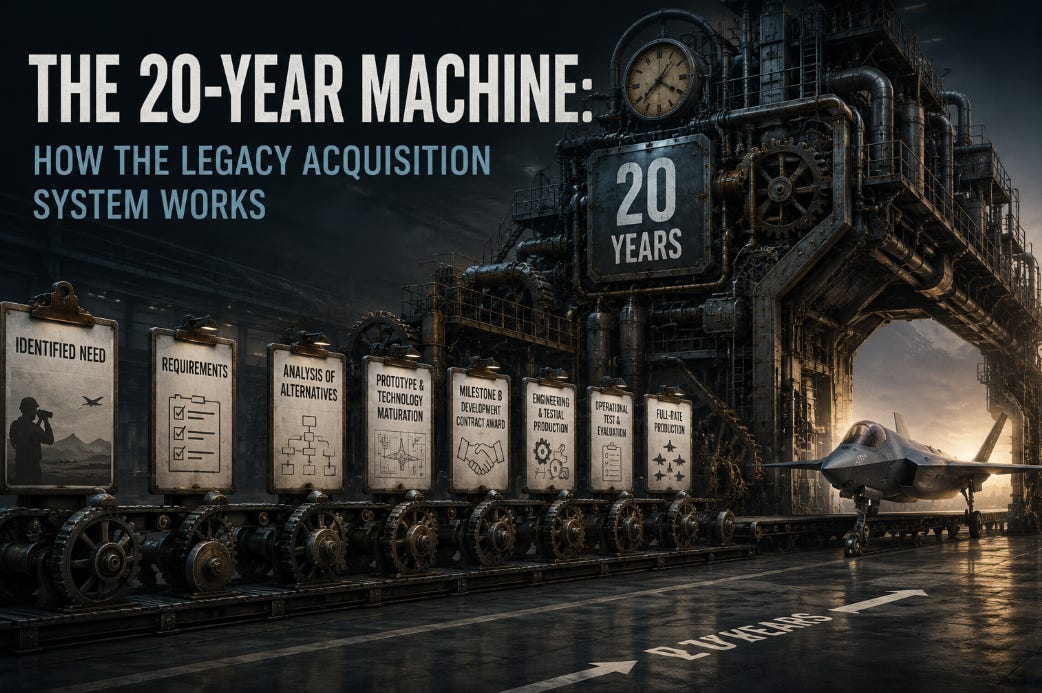
The model that governs how America buys major weapons wasn’t assembled by bureaucrats indifferent to outcomes. It was built, layer by layer, in response to real problems: cost overruns, contractor failures, program cancellations, and concerns by Congress. The requirements, budget, and acquisition systems, along with the oversight regime each have a rationale. The problem is that the rationale fit a threat environment that no longer exists.
The Bargain
At the core of the legacy model is a bargain struck between the government and a small number of large defense contractors. The government needed industrial partners capable of designing, developing, and producing systems of extraordinary complexity to include nuclear submarines, stealth aircraft, ballistic missile defense networks. No commercial market existed for these products. The companies that could build them required enormous, sustained investment to maintain the workforce, facilities, and expertise the mission demanded.
In exchange, the government offered cost recovery. Cost-plus development contracts, indirect reimbursement of R&D, and effectively sole-source ownership of production, sustainment, and modernization once a prime won the development award.
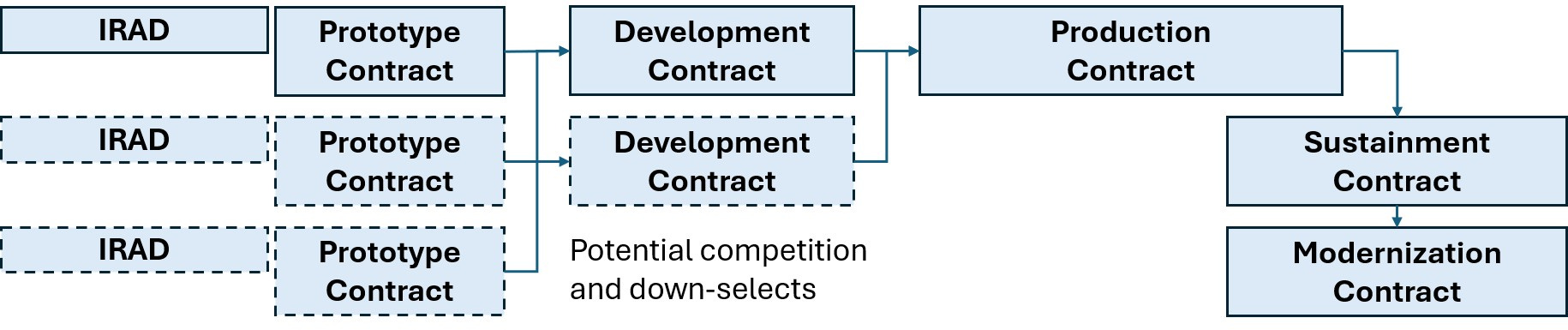
The government got predictability, accountability, and systems of genuine capability. Industry got stability, cost recovery, and long-term revenue streams. When the threat environment was relatively stable and the primary challenge was building exquisite, long-lived systems at manageable cost, the bargain held. The threat environment did not extend the courtesy of staying stable.
What the System Actually Produced
The legacy model has achievements. The Virginia-class submarine program is the most successful major shipbuilding program in modern Navy history. The F-22 remains the most capable air superiority fighter ever built. Aegis has been the backbone of fleet air defense for four decades. These are systems of genuine, sustained military advantage. They’re complex, integrated, and built to last.
The model was fit for purpose when the primary challenge was building exquisite, long-lived platforms against a threat environment that moved on a similar timescale. When the Soviet Union was the pacing threat and the defining competition was in aircraft carriers and ICBMs, a 20-year development cycle for a major system was painful but tolerable. The systems that came out the other end were worth the wait.
How the Machine Works
The Major Capability Acquisition pathway is the spine of the legacy model. Though formally updated under the Adaptive Acquisition Framework around 2020, its core structure has been largely unchanged for decades, much like the systems it produces.
The process begins with requirements. Under the old Joint Capabilities Integration and Development System (JCIDS), generating an initial requirements document could consume a year or more before a program was formally initiated. Requirements owners, knowing it may be two decades before the first systems reach the field, routinely stretched scope to capture every conceivable need and future good idea. The result was requirements documents that demanded multiple technology miracles and set programs up for cost and schedule risk from day one.
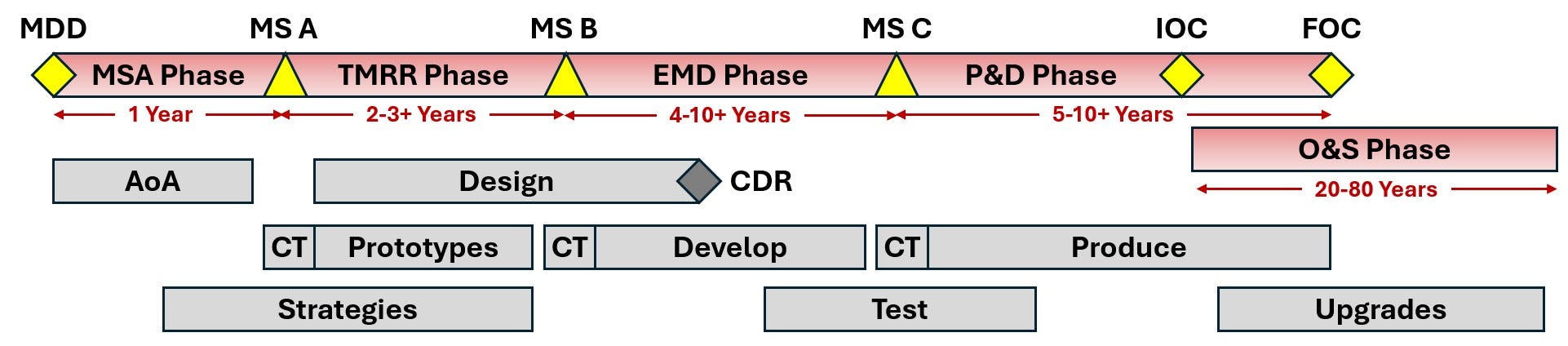
From there, the program conducts an Analysis of Alternatives often biased toward a preferred solution. For Major Defense Acquisition Programs, AoAs can take a year or more as the Director of Cost Assessment and Program Evaluation shapes the AoA plan and reviews the results. Then multiple prototyping contracts mature technologies and reduce risk, running in parallel with preliminary design work and a growing stack of acquisition documentation. The larger the program, the more documents and reviews. The decision authority must approve it all to release the request for proposal.
The most consequential moment in the lifecycle is Milestone B and the decision to award the development contract to a prime contractor. It is, as the draft analogy goes, a marriage. A long-term commitment through thick and thin for the program’s life. For competitors, it is winner-take-all. Many underbid aggressively on development, often accepting low margins or even losses to secure decades of production and sustainment work. Losers risk exclusion from that market sector for a decade or more. Protests follow as a long-shot bid to overturn the award, or at minimum to delay it and damage the winner.
The winning prime then spends years finalizing designs, developing the system, and conducting initial testing through processes the DoD imposes in exhaustive detail. Program offices baseline cost and schedule early, often using related programs as analogues, then apply Earned Value Management as if designing a novel weapon system were analogous to running a 20th century factory. Design changes multiply. Schedules slip. Costs grow. Eventually the program passes another milestone review, enters low-rate initial production, completes operational testing, and reaches full-rate production.
The total time from initial need to operational capability can routinely be 20 years for major weapon systems. Former acquisition executives claimed the program clock starts at Milestone B. In reality, the operational community identified the need years earlier, and many of those who drove the requirements have since retired.
How PPBE Locks It In
The acquisition lifecycle doesn’t operate in a vacuum. The 1960’s-era Planning, Programming, Budgeting, and Execution process is the financial architecture that governs it, and it reinforces every slow-moving tendency in the system.
PPBE operates on a cycle with lead times that can stretch two to three years from when a need is identified to when funding is available to act on it. Budgets are built around specific programs, not capability portfolios, meaning money allocated to one program cannot easily be redirected to a faster-moving alternative. The system is heavily weighted toward RDT&E funding in early phases, with procurement funding following years later after requirements are locked, designs are stable, and risks are nominally retired.
PPBE doesn’t just fund the acquisition system, it shapes it. A program that wants funding must look like a program with defined requirements, a fixed architecture, a predictable schedule. Flexibility, iteration, and commercial insertion don’t fit cleanly into a system built to plan and account for every dollar years in advance.
The Traditional Prime Business Model
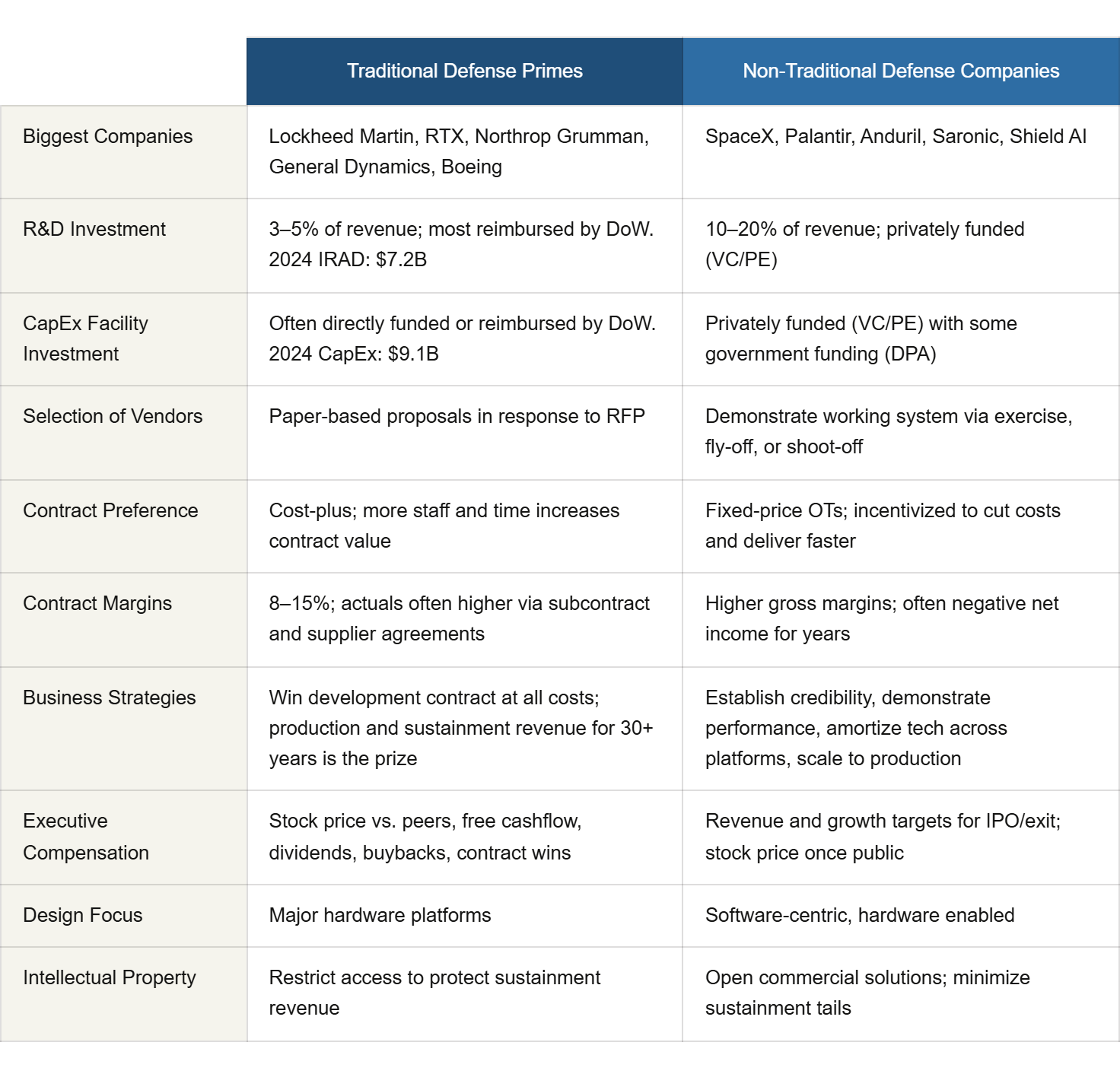
The acquisition structure produced a corresponding industry structure. The companies best positioned to win under the legacy model are the primes Lockheed Martin, RTX, Northrop Grumman, General Dynamics, Boeing which organized themselves around it.
Most of their R&D investment (3-5% of revenue) is recovered through government contracts. Capital expenditures for facilities are often directly funded or reimbursed. Business strategy centers on winning the development contract at all costs, because the prize is 30 or more years of higher-margin production, sustainment, and upgrade work. Executive compensation tracks stock price and free cash flow. This incentivizes dividends and buybacks over reinvestment in production capacity. Source selection is driven by paper-based proposals in response to detailed RFPs, rewarding proposal writing sophistication as much as technical capability. Intellectual property is closely held, even when developed with government funding, to protect recurring sustainment revenue.
These are companies responding logically to the incentive structure in front of them. The structure rewarded stability, incumbency, and risk transfer to the government. They optimized accordingly.
Why It No Longer Fits
China’s military modernization has compressed timelines across every domain. Autonomous systems, EW, hypersonics, and software-defined capabilities are advancing on commercial development cycles in months and years, not decades. The war in Ukraine demonstrated that mass, adaptability, and speed of production matter as much as individual platform sophistication. The commercial tech sector, which once lagged behind defense in most relevant domains, now leads in many of them.
Some systems will always require the legacy model. Aircraft carriers, nuclear submarines, and ICBMs have no commercial analog, no competitive market, and 50-year service lives. The MCA pathway, cost-plus development, and the specialized industrial base that supports them remain necessary for those platforms.
The problem isn’t that this legacy model exists. It’s that it’s applied to far too may acquisitions. Counter-UAS systems, autonomous platforms, software-defined communications, space domain awareness are capability areas where commercial technology is mature, development cycles are fast, and competition is viable. Too many are being run through the same 20-year machine designed for exquisite systems. The result is systems that are obsolete on arrival, industrial partners with no incentive to move faster, and a warfighter waiting a generation for new capabilities.
In Part 2, we examine the model taking shape to replace it and what it asks of everyone, including the traditional primes.
Join over 16,000 defense and industry subscribers to get our weekly recaps and thought pieces. Paid subscribers also get budget and legislative analysis and are valued supporters of our work.
20-year cycle is real but the real choke is requirements churn, not just Congress. When DOT&E rewrites the spec every year the prime burns calendar on paper changes.
the part that doesn't get enough attention is that china's acquisition equivalent has none of this lag. dji went from consumer quadcopter to PLAN reconnaissance asset in roughly 18 months, through SOE channels that don't require milestone B. the 20-year machine isn't just a US problem, it's a comparative disadvantage when the adversary's procurement loop is roughly as fast as a startup's product cycle.