



On 3 April, OMB submitted the topline defense budget to Congress with the expectation that detailed budget justification books would be delivered by the end of the month. While there are some details we just won’t know without those details, we try to provide the best breakdown possible in understanding what is changing.
Outline
This post will focus on the investment accounts in the defense budget while recognizing that O&M provides a substantial contribution to the modification and maintenance of systems and procurement of capability.
Overall Grade
Top Line Takeaways
Reconciliation Overview
RDT&E Deltas
Service Breakdown
Budget Authority Breakdown
Procurement Deltas
Capability Breakdown
Service Breakdown
PPBE Reforms
Overall Grade: A-
(+) Topline much more commensurate with the security challenges.
(+) Takes munitions seriously with real funding to replenish inventories
(+) The huge DAWG funding line has the potential to scale unmanned assets.
(+) Focuses serious resources towards an AI-enabled future.
(-) Many hedge capabilities heavily reliant on reconciliation success.
(-) Still missing a clear demand signal for new major systems.
(-) Overly favors centralization of resource allocation.
Top Line Takeaways
The $1.5T request represents a 42% increase from FY26 (+$445B).
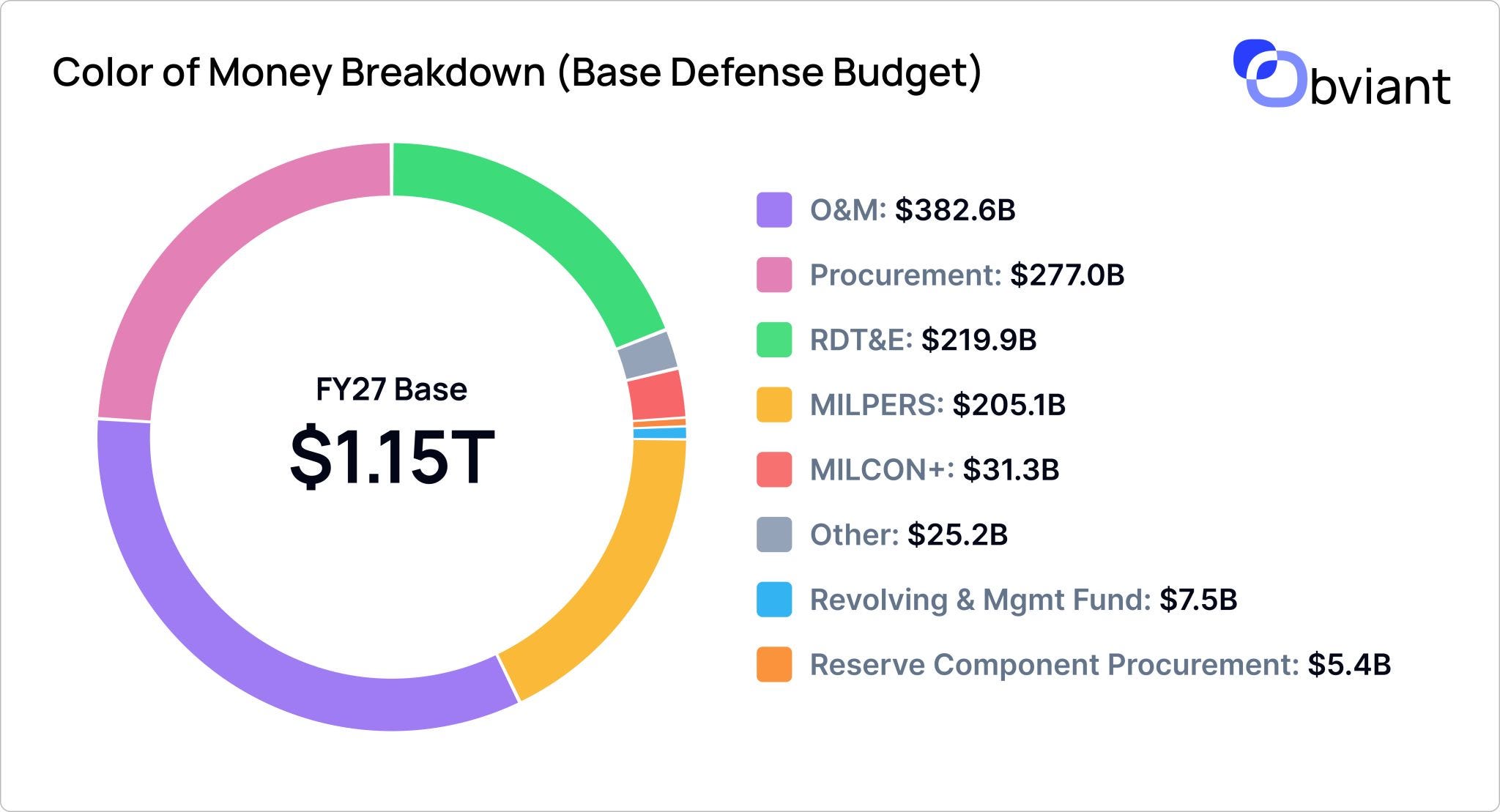
The total $1.5T request is broken into $1.1T Discretionary and $350B Mandatory.
The Discretionary process goes through normal appropriations process and requires 60 votes in the Senate.
The Mandatory (reconciliation) process goes through a special process and only requires a majority vote in both chambers.
Procurement funding exceeds O&M (last year O&M was $360B or 38%, while Procurement was $205B or 22%). The last time this was the case was the 1970s.
S&T was gutted by any historical measure with ~30% cuts across most services.
This budget represents a push to consolidate more decision-making at the OSW level with a 4X increase in prototyping and a 10-20X in some procurement lines.
Space Force is the biggest winner by percentage increase (certainly not by totals) with a 77% increase (2X RDT&E and 3.4X Procurement)
Munitions was a huge focus area with a 2.8X increase.
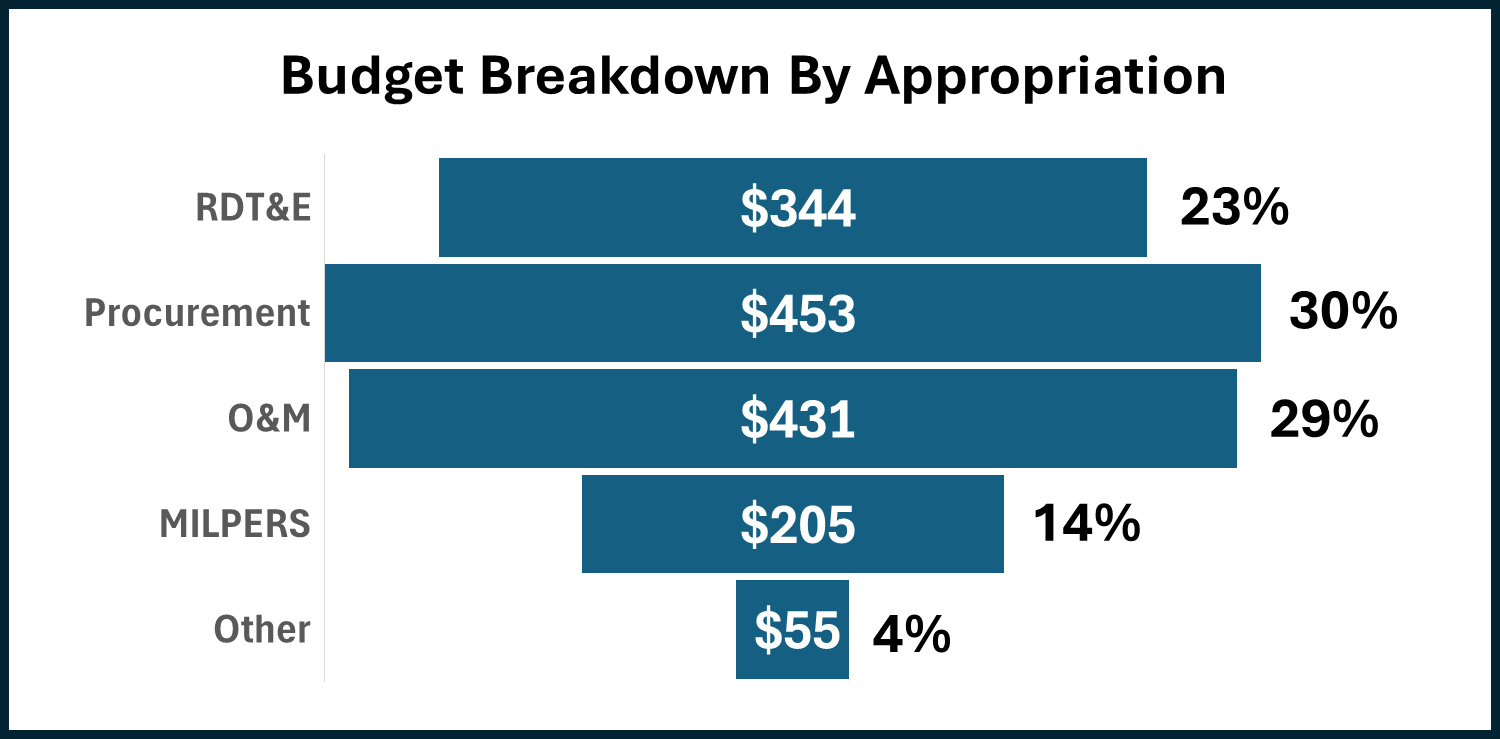
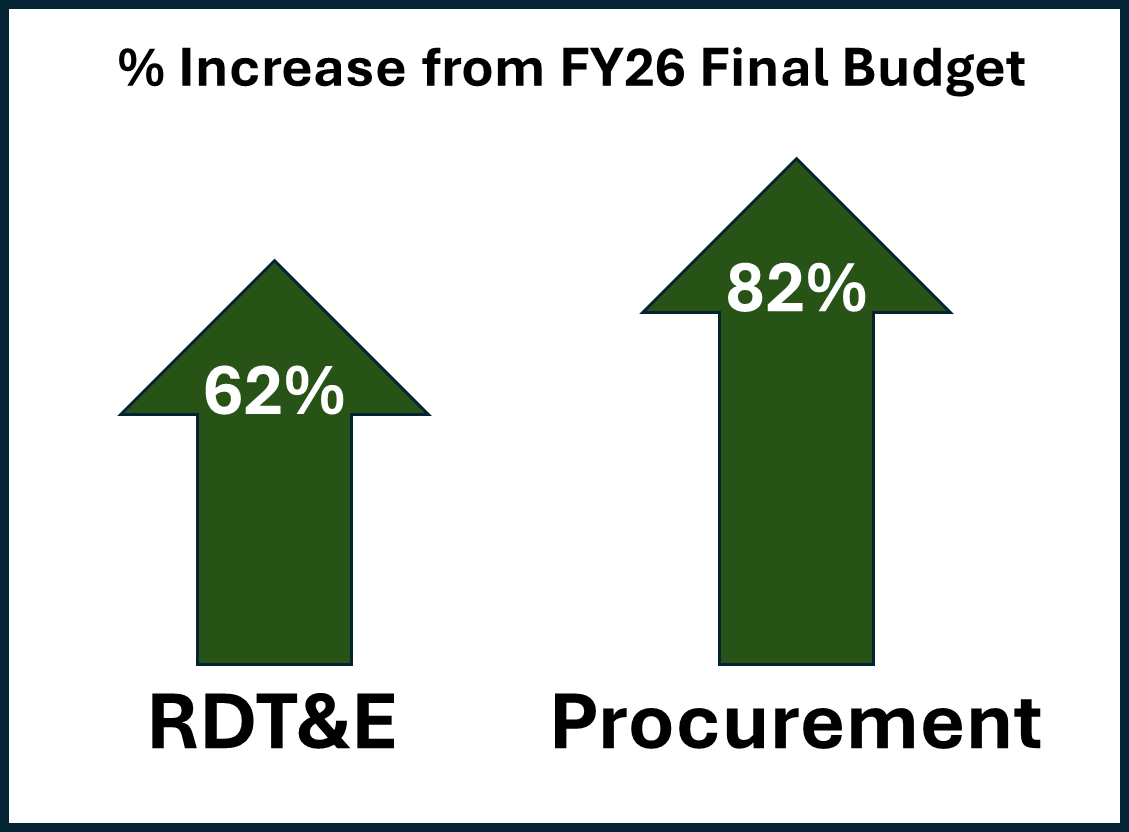
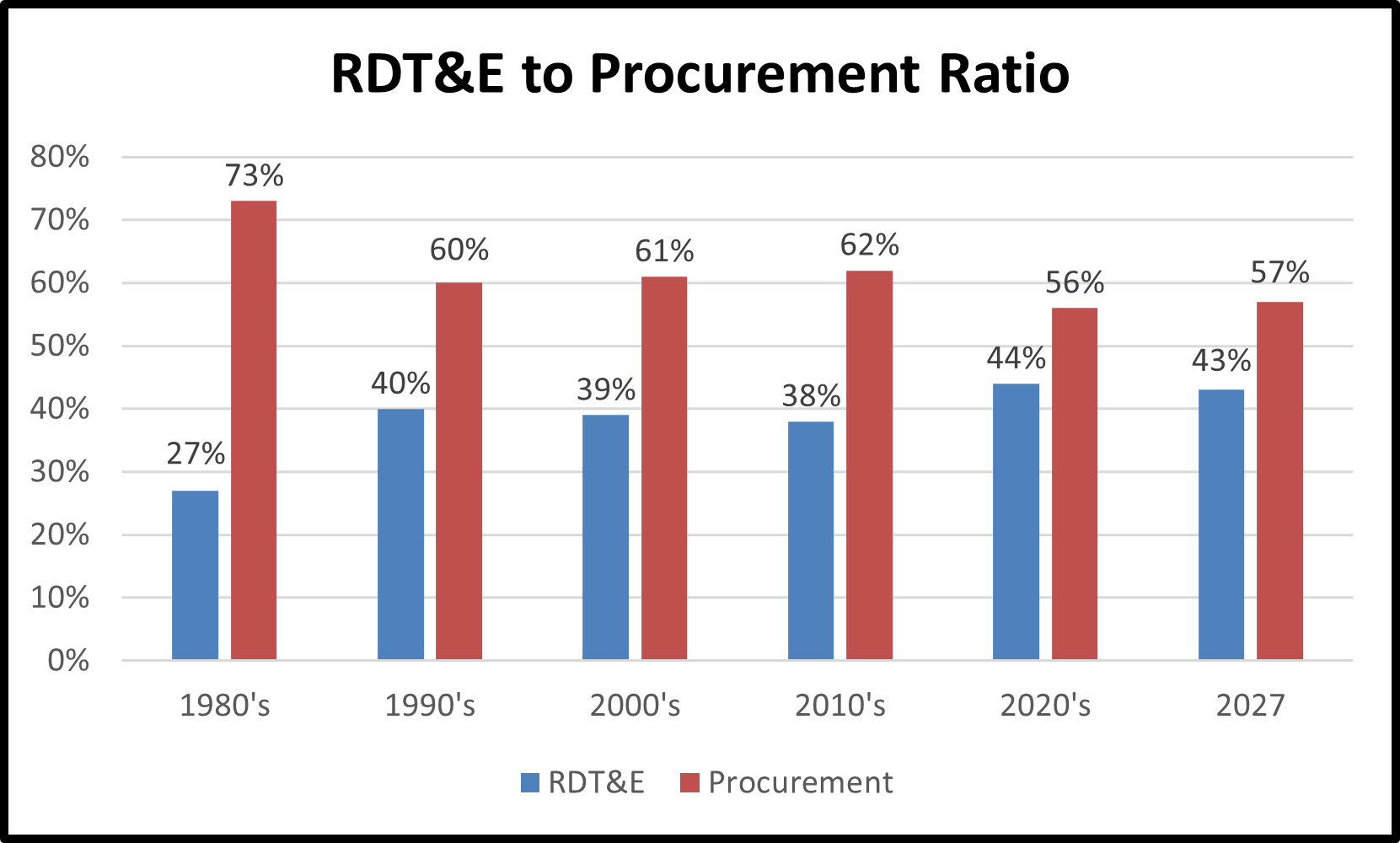
As longtime readers know, we analyze budget RDT&E vs Procurement ratios and have critiqued the past imbalances that prioritized keeping efforts in the prototyping or development phase rather than scaling to prepare for the conflicts ahead. While the ratio in this budget is only slightly better, the massive increase compensates for that minimal shift. The proposed increase in procurement is direly needed to produce many new weapon systems and increase lethality against a mass producing near peer. It will also hopefully enable retirement of dated legacy systems to build for the future.
The Defense-Wide accounts (which includes Golden Dome) are the largest at 29% which reflects an administration that prioritizes more top-down management. The Department of the Air Force (AF + Space Force) still fared well at 28%, although that reflects significant pass-through funds to non-DoD orgs. The Department of Navy (Navy and Marine Corps) is at 27%, with the Army a tier below the others at 17%.
Budget Breakdown with Base + Reconciliation
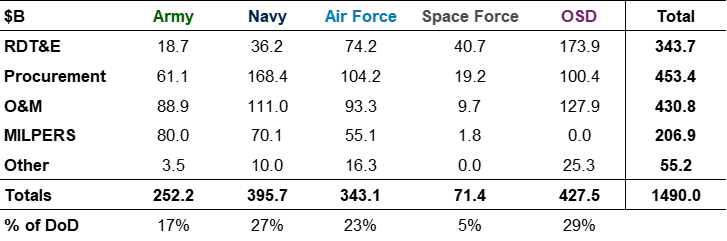
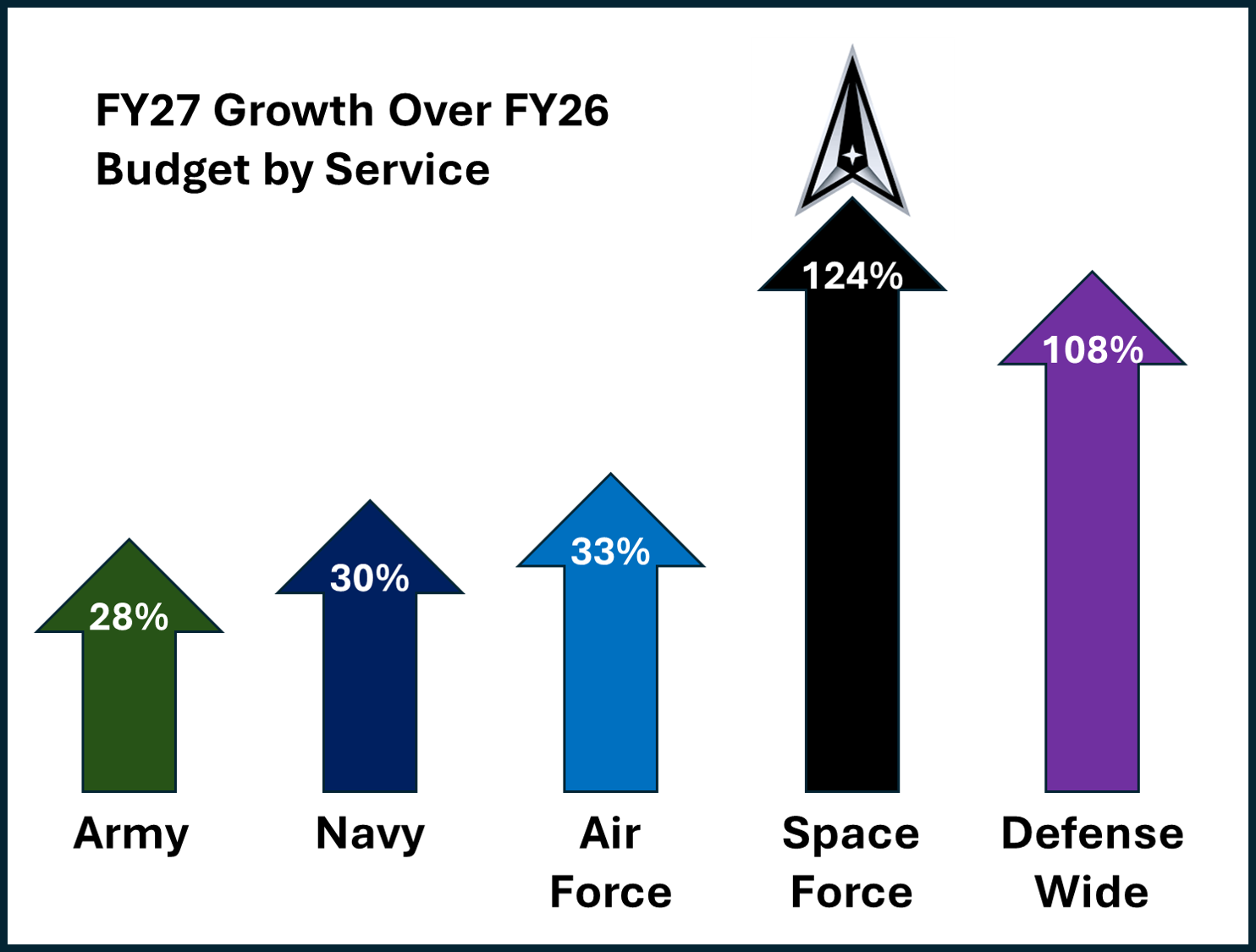
While the Space Force did gain substantial budget increases, it should still be noted that its percentage of the budget only increased from 3% to 5% - so still represents a fraction of the total defense budget.