


Imagine a Taiwan crisis in 2032. The PLA finally mobilizes forces from its Eastern Theater Command across the strait en masse. Washington is forced to respond given its regional alliances and statutory commitments. Yet the U.S. Navy, optimized for yesterday’s missions struggles to respond in the timeframe needed. Instead, they must pivot while the attack is underway. It takes them 18 months to reconfigure key command systems, deploy new unmanned capabilities, and retrain crews for a different fight. By the time it is ready, options have narrowed, and opportunities have passed. This is not a failure of current capability. It is a failure of adaptability.
Today, we measure naval power along a single axis: current capability. This includes ship counts, missile inventories, sortie rates, kill chains. While these all matter, any military force must also operate on a second axis: how quickly can it change? For seventy years after the Cold War, the U.S. Navy could afford to underweight this second axis given the relatively static nature of the adversary. That era is over.
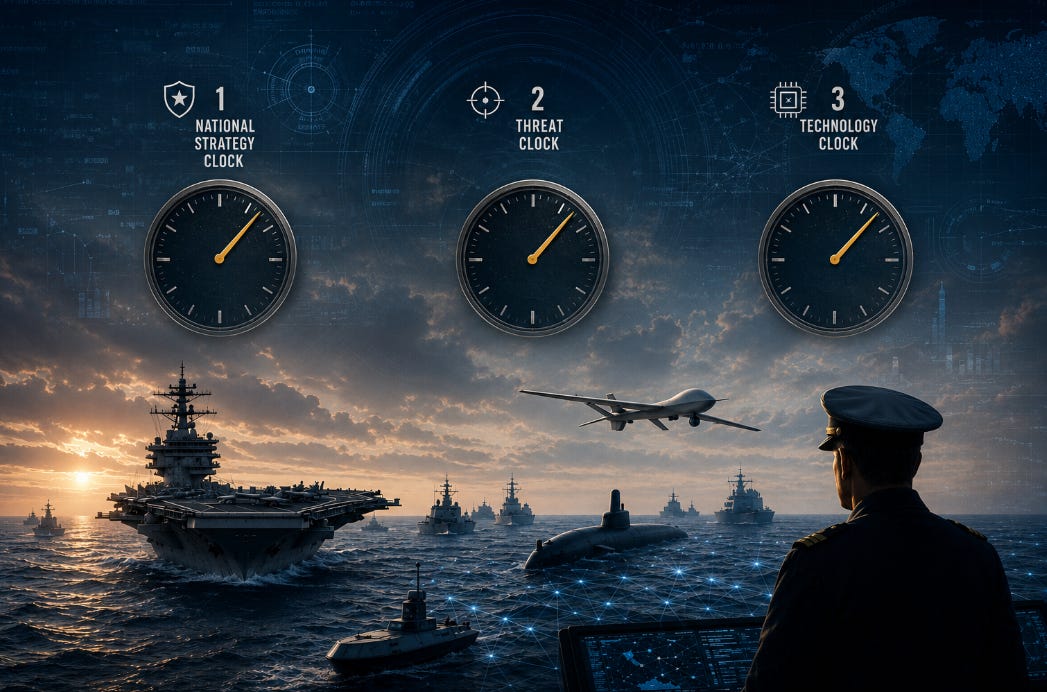
The Navy now runs against three rapidly accelerating clocks.
The first is the national strategy clock. Policy direction, including theaters, priorities, and levels of ambition, can shift rapidly. A Navy that cannot reorient within a relevant timeframe becomes a constraint on national options rather than an enabler. A fleet that arrives late to a strategic pivot can make the pivot impossible. Keeping pace with strategy is a naval responsibility that receives too little attention.
The second is the threat clock. China launches major combatants at a pace American shipyards cannot match, it fields advanced missiles on compressed timelines, and it has built shipyard capacity that dwarfs anything in the western hemisphere. Its programs do not pause for U.S. budget cycles or acquisition delays.
The third is the technology clock. Artificial intelligence, autonomous systems, and software-defined capabilities are surging forward at commercial speeds, driven by investments that dwarf the entire defense budget. The Navy can either exploit it or fall behind. There is no third option, but the price of this one is steep.
The strategic goal in this environment is not to match China ship-for-ship. Matching is reactive, cedes initiative and is likely impossible. The goal is to render China’s heavy investments in area denial and long-range precision strike obsolete by changing the game faster than Beijing can adapt. America has done this before.
In the interwar period, constrained by treaty limits on hulls and tonnage, the Navy used its time to run the Fleet Problems — a sustained series of large-scale exercises that essentially invented carrier aviation doctrine before the carriers existed at scale. By the time the Essex class began arriving in 1943, the Navy had already trained aviators, developed unique tactics, and built the institutional culture to employ them with devastating effect. The platforms arrived at an institution that was ready.
The contrast with the Royal Navy is instructive. Britain arguably invented carrier aviation but failed to build the human infrastructure around it. Doctrine was underdeveloped, aviators were treated as second-class officers, and institutional investment in using the capability never matched investment in building it. The cost was paid in operational failures in the early years of the war.
China has placed large, fixed bets on a specific vision of how the next naval war will be fought: area denial, long-range precision strike, a force designed to keep the U.S. Navy at a distance and degrade its ability to project power into the western Pacific. Those investments are real and deserve respect. They reflect a technological moment with the autonomous systems revolution that now enables AI-enabled sensor fusion and a software-defined kill chain. This is the environment the United States can shape, if it moves with sufficient speed and intelligence.
Whether the Navy can move that fast is the question the second axis forces. Traditional shipbuilding operates on long capital cycles. Conversely, autonomous systems are faster to field, easier to adapt, and able to absorb operational risk at scales a traditional fleet cannot match. They are how the technology clock gets run offensively, fielding capability fast enough to matter now while the capital force matures.
Neither delivers its promise without command and control that is resilient, distributed, and faster than the adversary’s decision cycle. C2 is where all three clocks converge. The side that can close the OODA loop faster has a compounding advantage. That is not a technical problem. It is a strategic one. And it runs directly into the fact that China has invested heavily in denying exactly that kind of decision speed.
The Fleet Problems generation did not have more hulls. They had doctrine, trained people, and an institutional culture in place before the war arrived. They used years of constraint to build the second axis — adaptability, not just the first.
The clocks are running. The Navy that invests deliberately in adaptability will not merely match China. It will define the terms of competition for the next great power era, just as the interwar generation did. The question is whether this generation will do the same and whether the institutions of American national security have the will to let them.
ADM John Richardson served as the 31st Chief of Naval Operations from 2015 to 2019.
Join over 16,000 defense and industry subscribers to get our weekly recaps and thought pieces. Paid subscribers also get budget and legislative analysis and are valued supporters of our work.

Replicator’s first tranche ships in FY25. Clock’s ticking louder than any fleet review.