



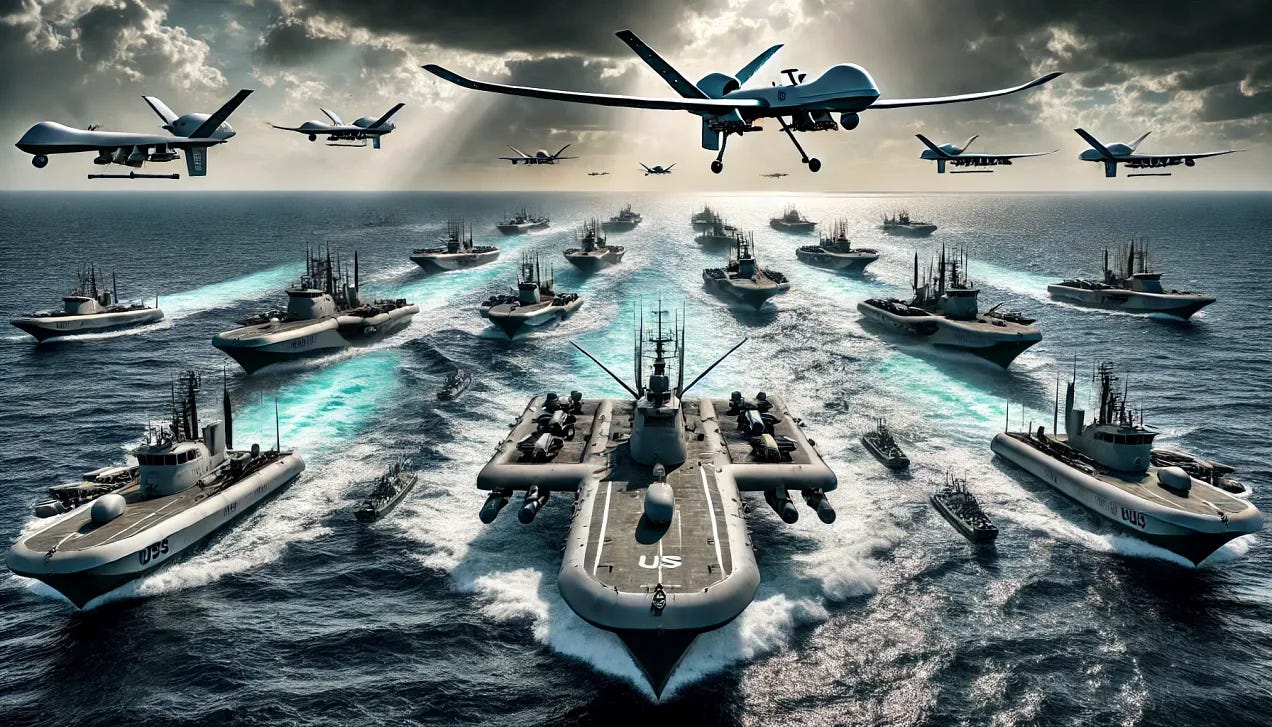
To meet the demands of modern warfare and counter pacing threats, particularly in the Indo-Pacific by 2027, the DoD must prioritize acquiring and operationalizing unmanned systems at scale.
In many of the updated military strategies, there is a renewed focus on improving numbers of fielded unmanned systems.
The Air Force doesn’t have a public unmanned strategy but has made substantial financial and operational commitments to fielding high numbers of Collaborative Combat Aircraft (CCA) to team with crewed fighters.
The Army’s Transformation in Contact 2.0 has a major emphasis on deploying unmanned systems at various echelons.
The Marine Corps Force Design 2030 specifically calls out doubling the number of unmanned aerial systems (UAS) squadrons and austere lethal unmanned air and ground systems to enhance the ability to sense and strike targets.
The Navy’s Navigation Plan focuses on building a hybrid fleet with integration of proven robotic and autonomous systems by 2027.
From a funding perspective, there is also a demonstrated commitment. According to AUVSI, DoD requested ~$10.1B in FY25 to support uncrewed vehicle acquisition and development which represents an approximately one billion dollar increase from the amount enacted in the previous fiscal year. Significant growth areas included:
The Air Force’s Collaborative Combat Aircraft (CCA) project, which is developing autonomous loyal wingmen for fighter jets.
The Army’s Tactical Unmanned Ground Vehicle (UGV) project developing hardware and software upgrades to improve autonomous off-road mobility, safety architectures, and vehicle perception.
The Navy’s range of Unmanned Surface Vehicle (USV) programs, which provide improved battlespace awareness and lethality.
A range of Counter-UAV (C-UAV) capabilities that will protect infrastructure and assets from emerging threats in combat scenarios.
“The future force should consist of smaller numbers of people operating much larger numbers of highly intelligent unmanned machines.” - Chris Brose, The Kill Chain
Given this increased focus from DoD and the growing funding, it is time each military Service establish a dedicated Program Executive Officer (PEO) for unmanned systems.
The Case for Dedicated Unmanned PEOs
Despite years of DoD leadership advocating for unmanned systems to complement traditional manned platforms, progress has been uneven. Initiatives like the Replicator program aimed to deliver thousands of unmanned systems within 18 months, bypassing slow planning and budgeting cycles. While bold, this effort lacks the sustained momentum needed for long-term success. While the Navy’s Navigation Plan (referenced earlier) championed robotic and autonomous systems, cultural and programmatic headwinds—rooted in centuries of tradition—have slowed adoption.
Current PEO structures dilute focus on unmanned systems. For example:
Navy: The PEO for Unmanned and Small Combatants is distracted by the Frigate program, sidelining unmanned maritime systems like LUSV, MUSV, XLUUV Orca, and others. The PEO for Unmanned Aviation and Strike Weapons juggles 12 program offices, including manned and unmanned systems, diluting resources for platforms like MQ-4C Triton and MQ-25 Stingray.
Air Force: The PEO for Fighters and Advanced Aircraft oversees Collaborative Combat Aircraft (CCA) alongside legacy platforms (A-10, F-15, F-16, F-22) and now the keystone F-47 program. This limits investment and focus for a broader range of unmanned aerial systems (UAS).
Army: PEO Aviation manages a mix of manned and unmanned programs, including MQ-1C Gray Eagle and RQ-7B Shadow. Proposed PEO consolidations and potential downgrading of leadership billets risk further deprioritizing unmanned systems.
A dedicated Unmanned PEO in each Service would centralize expertise, streamline acquisition, and align resources with a dedicate portfolio wholly focused on delivering a hedge capability to provide a more balanced high-low mix of capabilities.
Much like the Army Air Corps evolved into the Air Force in 1947 and DoD-wide space assets matured into the Space Force in 2019, unmanned systems demand a structural shift to fully realize their potential.
Unmanned PEOs should partner closely with DIU which has pioneered collaboration with industry, including non-traditional companies, to advance unmanned solutions. DIU’s Blue UAS program, along with its use of Commercial Solutions Openings and Other Transaction Authorities, has driven speed and innovation in adoption. Likewise, these PEOs should shape autonomy and AI research across DARPA and DoD labs, aligning efforts with industry to avoid duplication, and accelerate near- and long-term unmanned system goals.
These PEOs and their subordinate organizations need staff with specialized expertise in unmanned systems, distinct from traditional manned weapon systems. They require professionals with software-centric, hardware-enabled mindsets to design architectures and integrate systems effectively. Familiarity with both traditional and non-traditional defense contractor environments is essential to craft contracting strategies that prioritize speed, agility, and scalability for unmanned solutions. These experts must approach cost estimation, testing, evaluation, and sustainment with a fresh perspective, tailored to systems with shorter life cycles, unlike the 30-50 year spans of conventional major weapon systems.
Budget and Strategic Alignment
The DoD’s FY26 budget reprioritization, outlined in SECDEF’s February memo, identifies One-Way Attack/Autonomous Systems, CCA, and Counter-sUAS as investment priorities. Yet, current funding for unmanned systems remains insufficient to meet the 2027 timeline for deterring aggression in the Indo-Pacific. While major manned platforms won’t scale in time, thousands of unmanned systems—maritime, aerial, and ground—could be delivered to INDOPACOM rapidly with focused investment. This urgency is seen in ADM Paparo’s Hellscape initiative, which he sees as critical to defending the Taiwan Strait.
A dedicated Unmanned PEO would ensure budgets, resources, and personnel are aligned with these priorities, avoiding the dilution seen in mixed portfolios. It would also enable faster acquisition cycles, leveraging iterative development and commercial partnerships to deliver capabilities at scale.
Operationalizing Unmanned Systems: Beyond Acquisition
Acquiring unmanned systems is only half the battle. Operationalizing them requires addressing the non-materiel elements of Doctrine, Organization, Training, Materiel, Leadership, Education, Personnel, Facilities, and Policy (DOTMLPF-P). Without deliberate planning, even the most advanced systems will sit unused. Key considerations include:
Training: Operators need hands-on experience without fear of punitive investigations for mishaps, such as crashing a small UAS during training.
Logistics: How will systems be transported, fueled, maintained, and repaired in theater? What new maintenance infrastructure is needed?
Rules of Engagement: Clear guidelines are needed for diverse mission scenarios.
Allied Integration: Infrastructure, agreements, and policies must enable joint operations with partner nations.
To address these, each Unmanned PEO should embed operational personnel alongside acquisition professionals and industry partners. These embedded operators can also engage the broader operational commands. This includes working with the Navy’s Task Force 59 and the Transforming in Contact units. This integration would tighten the OODA loop, enabling rapid feedback on designs, prototypes, and testing. Operators can convey real-world challenges, adversary tactics, and mission needs, ensuring systems are fit for purpose. Operational feedback of deployed systems is vital to rapidly iterating on delivered capabilities and employment of them.
A Call to Action for DoD and Congress
The DoD and Congress must act decisively to establish dedicated Unmanned PEOs. This structural shift will:
Prioritize investment in unmanned systems to meet urgent strategic timelines.
Streamline acquisition of uncrewed systems to deliver capabilities at scale.
Integrate operational and acquisition to advance systems and DOTMLPF-P.
Signal to industry and allies a commitment to leading in autonomous warfare.
The future of warfare demands a force that leverages intelligent unmanned systems as force multipliers. Dedicated Unmanned PEOs are the linchpin to making this vision a reality. The time to act is now—before the window to deter conflict closes.
Join the thousands of subscribers to get our weekly recaps and thought pieces. Paid subscribers also get budget and legislative analysis and are valued supporters of our work.
Dedicated Navy PEO’s for the 3 main war fighting domains make sense, but not across the entire Navy enterprise of surface ships, aviation, and undersea war fighting. Different kill chains, conops/conemp, tactical mission threads, and VERY different vehicle types and technologies; and common solutions for all unmanned often do not consider the domain and warfighting challenges of each one, and they often clash due to SWAP-C and host platform architectures.
It could be worse… I was in PMA263 when it was the only unmanned program office, let alone sharing a PEO with weapons programs.
And to be clear, it is the Resource Sponsors in OPNAV that decide POM and program priorities, not the PEOs; with unmanned programs still competing with other capabilities in warfighting portfolios for resource constrained funding.
I think too what you see in Navy is a limited number of Flag billets to satisfy the proper management of emerging warfighting capabilities, and SECDEF’s 20% reduction in Flag/GO billets will only exacerbate the scarcity of senior leader positional rank for unmanned.
Bottom line is that there is no easy solution right now, but something to keep an eye on and work towards.
Excellent idea.
Also need to consider how AI fits within these new PEOs. Best option will be to bake-in AI during system design & development. Costs can be captured as part of the overall system lifecycle.
But there will also be the need to add AI to existing systems. AI that may come from outside the prime and subs that own development of the uncrewed system.
Vertical integration would be optimal, but the PEOs will also need a plan for bringing in the most current software from outside vendors, and sustaining it at a rapid CI/CD pace once the uncrewed system is fielded.
Those costs might have to be treated separately, depending on who’s doing what.