



Welcome to the latest edition of Defense Tech and Acquisition.
The biggest stories across the Department and the defense industry this week:
B-21 Raider first weapons release, validating digital twin modeling, architecture
DoW redesignates CDAO as the Super Intelligence Office
Hermeus - Northrop Grumman partner to add systems to high-Mach aircraft
Contested logistics and undersea mobility advance through ultra-large AUVs
Industrial base signals include expanded munition production and subs
Air Force has new force design and AI strategy - and new aerobatic trainer.
Space Force is all about integration as it embraces unified cloud and cislunar.
Ukraine unmanned system forces model and UK needs more maritime focus.

B-21 Raider Demonstrates Weapon Release Capability
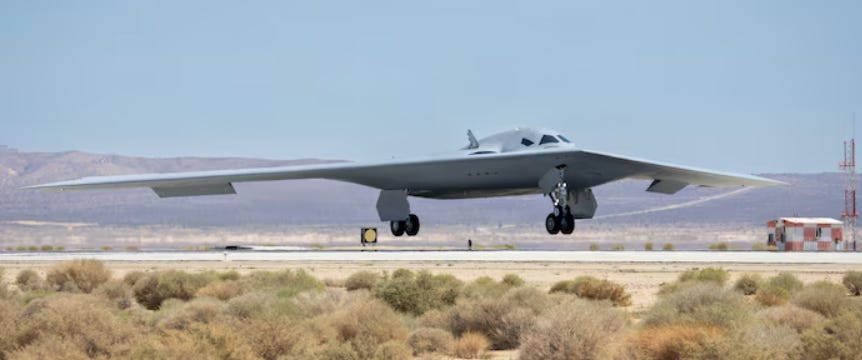
BLUF: The Air Force conducted a weapons release test for the B-21 Raider last week, transitioning the platform from flight test to a functional weapons platform.
A B-21 test aircraft flying from Edwards AFB, CA released a conventional weapon, validating its digital models and the maturity of its open systems architecture.
This test proves the B-21’s strike capability, proves its ability to rapidly onboard new weapons and solidifies its role as the future backbone of the U.S. bomber fleet.
The execution of the test was built on thousands of hours of virtual modeling within the B-21’s digital twin environment. This allowed the B-21 Combined Test Force to accelerate weapons integration and predict and refine the weapon’s trajectory with unparalleled precision before the aircraft ever left the ground.
“The B-21 is designed to deliver improved combat capability to the warfighter, combining reliability and maintainability to quickly integrate new weapons. This successful test demonstrates our ability to adapt rapidly and hold any target at risk if deterrence fails.” Troy Meink, SECAF
“This weapons test proves the B-21 program is excelling. We are building an impressive fleet that will give our joint force credible, penetrating strike options for decades to come.” Gen. Ken Wilsbach, CSAF.
Related: B-21 Raider Conducts First Weapons Release Test and Air Force validates B-21 Raider weapons release after test
High-Speed Startup Hermeus Joins Forces With Northrop Grumman

BLUF: Aviation startup Hermeus and established prime contractor Northrop Grumman are now working together toward the aim of delivering operational uncrewed aircraft capable of high-supersonic, if not hypersonic, flight to the U.S. military.
Through a newly announced partnership, Northrop Grumman is set to integrate EW systems, sensors, autonomy packages, and other capabilities onto next-generation Hermeus drones.
Hermeus, which was founded in 2018, has already flown a succession of ever-more capable uncrewed jet-powered Quarterhorse demonstrator drones.
The delta-winged Quarterhorse Mk 2.1 was the first of these to break the sound barrier during a test flight in May. The company is now working on a further evolved Quarterhorse Mk 2.2, which it hopes to push beyond Mach 2.
Northrop Grumman will provide integrated mission systems design, development, integration, and sustainment for Hermeus’ next-generation aircraft: reusable, unmanned high-Mach platforms designed to deliver affordable capability on relevant timelines.
“We’re building a new class of aircraft that gives the warfighter improved speed, range, and flexibility while integrating into the existing Force. Adding Northrop Grumman’s battle-tested mission systems will push what those aircraft can do in real world scenarios and help us field operational capability faster. Northrop brings decades of experience turning aircraft into effective mission platforms and that’s exactly what we want to tap into.” Zach Shore, Hermeus CEO
Our Take: We’re happy to see an innovative defense tech disruptor like Hermeus partner with an established prime like Northrop Grumman to combine rapid aircraft development with proven mission systems and integration expertise. This is exactly the type of collaboration the Department should foster by leveraging the speed, agility, and risk-taking of nontraditional companies alongside the technical depth, scale, and operational experience of traditional primes. The real opportunity is to move beyond impressive prototypes to affordable, mission-ready capabilities delivered at speed and scale (read: sizable procurement funding), demonstrating how a more dynamic defense industrial base can accelerate innovation and fielding.
Related: 930 mph unmanned supersonic aircraft gets advanced systems for military missions



Counter-UAS Task Force Turns to Intelligence Community for Input on Real-World Threat Assessments
BLUF: BG Matt Ross urged U.S. defense, federal and law enforcement officials to determine and describe their organizations’ unique threats and protection requirements before they move to field or buy commercial counter-drone assets from the government’s online marketplace.
The DoW and other federal agencies have deepened collaboration in this realm over the last few years, largely in response to surging reports about unlawful unmanned aerial systems flying or swarming near sensitive national security sites and U.S. military installations.
Clearly identifying the threat and defining needs is critical for counter-drone providers to ensure they are building the appropriate tools that target real-world, ever-changing UAS threats.
JIATF-401 and the IC partner to continuously assess the battlefield, analyze adversary tactics and employment, and anticipate evolving threats.
JIATF-401 takes a mission-focused approach by tailoring solutions to the operating environment, mission requirements, and specific threats.
“We’ve asked the Intelligence Community for authoritative assessments” - BG Matt Ross, JIATF-401, Director
Related: JIATF-401 Taps IC for Counter-Drone Threat Assessments
DoW Redesignates CDAO as Super Intelligence Office
BLUF: CDAO is now the DoW Super Intelligence Office (SIO).

Alongside the updated designation, the organization unveiled a new official logo and visual identity, launched its new primary digital domain at www.si.mil and transitioned its official social media presence on LinkedIn as DoW SIO and X @SIODoW.
Next Breakthrough Is Software Built on the Battlefield by Agentic Bots
BLUF: SI is not a new tool for the US military. However, it is rapidly evolving and offering new capabilities and challenges, moving from large language models that are limited by the data sets they were trained on to agentic SI models that can act with autonomy.
Building the SI tools needed to keep pace with rapidly changing battlefield threats will require understanding that time is of the essence, as countermeasures and defenses cannot take months or years to build.
With SI tools becoming available outside of classified settings, nation-states and rogue actors can adopt new technology to quickly develop new vectors of attack.
Our adversaries aren’t just processing data faster, they are acting faster. That makes it hard for humans to keep pace with constantly changing threats.
Autonomy will be needed, so agentic capabilities can do more than large language models can while still giving a human ultimate decision-making authority allows the US and its allies to maintain a speed advantage.
Pre-determined guardrails prevent SI systems from operating with free reign while enabling different levels of autonomy based on their task.
Building new tools or adapting existing tools to meet new challenges requires modernizing not only the technology involved, but also the processes and procedures to develop, build and field those tools.
Overcoming this challenge requires re-engineering workflows around current technology while enabling them to be adaptable to future technology.
“The goal of agentic isn’t to replace human judgment. We need an ecosystem approach by taking commercial frontier models, wrapping them in defense-grade security and domain-specific knowledge, and embedding engineers alongside operators to continuously evolve the solutions. When engineers and operators share the same feedback loop, we can move much faster as a living, strategic capability.” - Garrett Berntsen, Accenture Federal Services, Chief AI Officer
Cry Drone, and Let Slip the Fruit Flies of War
Col Dustin “Whiz” Thomas, Maj Aubry Eaton
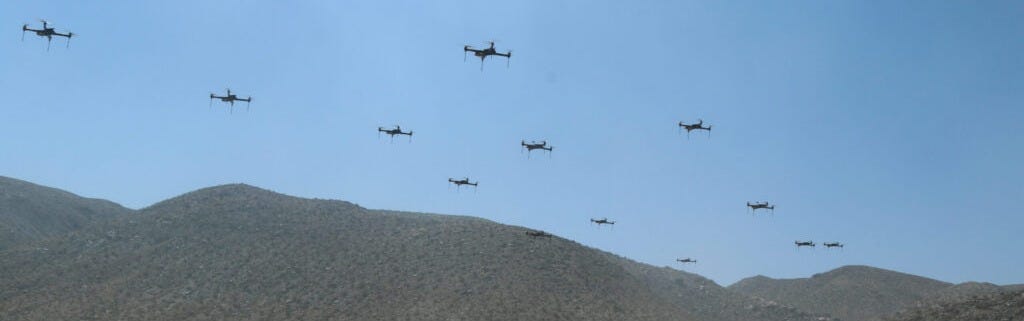
BLUF: The US military should focus on building drones that evolve so quickly an adversary’s defenses become obsolete before they can be deployed.
The rapid evolution of drones offers the military the chance to do something extraordinary: deliberately accelerate adaptation so that cheap changes on our side force expensive ones on theirs.
Traditional weapons take years, even decades, to develop and then remain in service for generations. Drones in every domain can evolve in weeks. Their radios, sensors, software, payloads, propulsion and even structures can change at different rates. In under a year, a drone can morph in both shape and function.
The American military doesn’t need to wait for an enemy to supply pressure: it can provide its own, in training and test events where operators choose where to apply selection pressure, aiming it at a problem instead of merely surviving it.
The military could use drones by experimenting with technologies, interfaces, manufacturing and acquisition processes that also govern more complex weapon systems. While modeling and simulation can help, nothing beats physical experimentation when you are looking for the unexpected.
Drone Dominance Program Gauntlets, testing helps select the best system. The program iterates but rewards the best drone rather than the teams that can produce successive generations the fastest.
Pick several drone problems and give multiple teams twelve months to produce four generations. Every three months, change the threat environment. Introduce an interceptor, jam the GPS or change the mission. Some changes should be unexpected. Give the teams the results, let them adapt and repeat.
Once a military learns how to shorten the time between generations, it can study which changes force expensive responses from an opponent. The goal would be to identify which adaptations would be inexpensive to add but expensive and time-consuming for an adversary to counter.
Our Take: This is exactly the mindset shift defense acquisition needs. Stop treating drones as static programs and start managing them as continuously evolving portfolios of capabilities. The Department should move beyond competitions that select the best system at a point in time and instead reward companies that can rapidly adapt, manufacture, and field successive generations against changing threats. Speed of adaptation should become a competitive advantage and a core acquisition metric, enabled by modular open architectures, continuous experimentation, flexible contracting, and rapid production cycles. The objective isn’t simply to outbuild our adversaries, but to outpace their ability to respond, forcing them into a costly and perpetual game of catch-up.
LUCAS Drones to Be Built in Containerized Robotic Micro Factories Designed to Be Forward Deployed

BLUF: Machina has been awarded a $9M contract to prove it can build LUCAS drones with its robotic manufacturing system at remote locations.
This 18-month contract from the DoW’s Organic Industrial Base Modernization Challenge calls for Machina to prove it can build LUCAS drones at deployed locations with its RoboCraftsman system.
LUCAS drones, and one-way attack weapons like them, are playing an increasing role in U.S. combat operations and military planning.
The award to Machina is the latest example of the Pentagon’s push to use containerized 3D printing and other advanced fabricating systems closer to the front lines to shorten supply chains that could get severely degraded in a major conflict.
Decentralizing production of drones also allows units to be more flexible and tailor their own production to their specific needs at any given moment.
For instance, a unit can produce variations of multiple designs that are best suited to an upcoming mission instead of having to use whatever they are shipped.
Creating containerized production of drones and components using 3D printing and other advanced manufacturing techniques at the forward edge is a burgeoning industry. The Machina system is one of a rapidly growing number of capabilities built around this concept, although many focus on smaller drones.
“The concept is that we’re going to bring this capability closer to the point of need.” - Ed Mehr, Machina, Founder and CEO
“Machina’s work advances capacity, reduces risk, and helps ensure we can deliver mission-critical capabilities at scale.” - Chris Moran, Lockheed Martin Ventures, VP and GM - who invested in Machina Labs
Measurable by Design: Project Meridian
BLUF: How can Project Meridian make its findings verifiable over time and give the Joint Staff and services a usable framework?
In establishing Project Meridian, the Secretary said the best forecasters of future conflict do not all sit inside the Pentagon and that a department asking and answering its own questions carries obvious biases and risks.
Findings are due by January 28, 2027.
The memo also gives an unofficial warning order to the Joint Staff and services to get ready to integrate Project Meridian’s work with their future plans.
Any organization that asks and answers its own questions carries built-in biases. But the strongest evidence on improving judgment says expertise works best when paired with a way to check results.
IARPA hosted a forecasting tournament in 2011 to find best practices to predict the near-term future. The story and results are told in Superforecasting and a number of journal articles.
The top 2% of forecasters were open-minded, approached problems with nuance, and iteratively updated predictions.
Giving 1-hour probabilistic training boosted accuracy by up to 11%.
Collaborative team forecasting outperformed individuals by 23%.
Superforecasters were correct 3X earlier than average forecasts.
Scenario planning generates multiple plausible futures for long-term problems.
Every well-built scenario has signposts—early indicators that a particular future is becoming more likely. They are what make a scenario operationally useful because they tell a planner what to watch.
Six Design Choices for Project Meridian
Make signposts clear and dated.
Build a ladder. Include signposts at several time horizons.
Make signposts diagnostic.
Pair experts with forecasters.
Record the reasoning.
Publish signposts in the unclassified report.
AFRICOM to Test Autonomous Cessna for Casualty Evacuation

BLUF: AFRICOM will soon see if a small, autonomous aircraft can evacuate casualties from austere locations during a demonstration planned for December in Morocco.
Merlin, an autonomous aviation firm, received a $500,000 contract from AFRICOM for the demo mission, set for early December.
During the demo, a Cessna 208B Grand Caravan modified with Merlin’s autonomy system and an air-ambulance medical module, will take off, fly, and land autonomously at an “austere casualty collection site.
Casualty Evacuation (CASEVAC), refers to the transportation of wounded personnel from the battlefield or their unit’s location to a location that can provide more advanced emergency medical treatment.
The CASEVAC mission will serve as a proving ground for autonomous aviation more broadly.
“Long distances, intermittent communications, and austere environments are among the most demanding conditions. A system proven under these conditions could support casualty evacuation, logistics, and personnel movement for other combatant commands, allied forces, and civil operators, as well as disaster response and medical transport missions worldwide.” - Matt George, Merlin, CEO and Founder
Ultra-Large AUVs Set to Be Built With $38M New Funding

BLUF: Corridian emerged from stealth with a $38M seed funding round to accelerate the development of its ultra-large Autonomous Underwater Vehicles (AUVs).
It seeks to transform undersea logistics with ultra-large autonomous underwater vehicles designed to transport critical payloads across contested maritime environments.
The funding round was led by Point72 Ventures, with participation from Balerion Space Ventures, Harpoon Ventures, DCVC, Marlinspike, and several additional defence and deep-tech investors.
Inexpensive drones and long-range missiles have made ships and aircraft easier to find and costlier to defend, leaving the military with few survivable ways to move payloads and materiel across contested waters.
The U.S. and allies must close a widening gap in their ability to deliver mission-critical capabilities across contested regions, such as those in the Western Pacific.
Corridian designs its platforms to carry ISO-standard, containerized payloads across vast distances, traveling thousands of nautical miles without a crew, stealthily and with high survivability.
Corridian draws on a supply chain that is independent of the Sub Industrial Base.
“America’s dependence on the surface and air domains to move mass at scale is an acute vulnerability. The U.S. and its allies are buying drones, sensors, effects, and supplies that need a way to reach the fight, even when operating in heavily contested and denied environments. That’s stealth logistics: carrying that cargo underwater, out of sight, autonomously, thousands of nautical miles at a time. Corridian adds the undersea capacity commanders need, working alongside the submarines that operate at the tip of the spear today.” Mike Guay, Corridian CEO
A Hub-and-Mesh Architecture for Contested Logistics
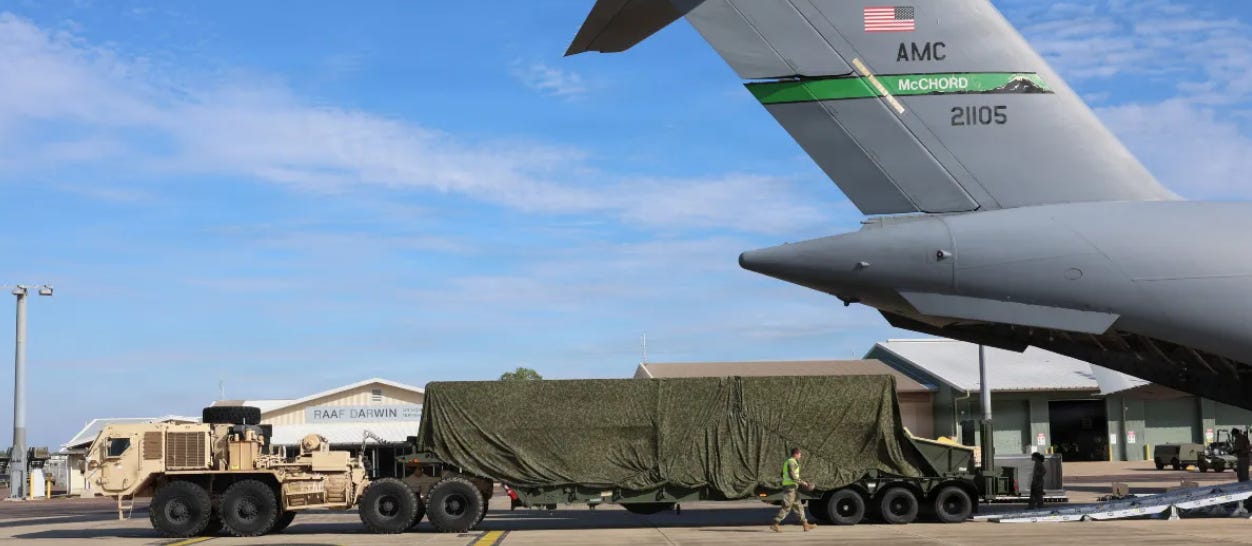
BLUF: The current threat environment is driving the US armed services toward operating concepts that distribute combat power to complicate adversary targeting, create multiple axes of attack, and disrupt enemy decision calculus.
Air Force’s agile combat employment, the Navy’s distributed maritime operations, the Marine Corps’s expeditionary advanced base operations, and the Army’s multidomain operations approach the problem differently, but all place greater demands on movement, maneuver, and the logistics system that enables them.
Distributed forces preserve options and present multiple dilemmas to an adversary. However, they increase the logistics burden across the joint force. That burden will fall on a network that is still being built while under attack.
The central joint problem is that setting the theater will occur simultaneously with major combat operations. In a future major conflict, the logistics network will still be expanding while the joint force generates, sustains, and regenerates combat power.
The joint force needs a logistics architecture designed to operate while the theater is still being set and the force is actively engaged in combat.
A resilient mesh must absorb displaced demand, not simply provide alternate airfields. The mesh must connect alternate APODs to viable theater distribution paths that can deliver the requirement to that force in time to support the commander’s scheme of maneuver.
A hub-and-mesh network also requires visibility of the requirement moving through it. Commanders need to understand what it carries, who needs it, when it must arrive, and which alternate distribution path can still deliver it in time to generate combat power.
In a future large-scale conflict, aircraft will already be airborne when their planned destinations become unusable and the theater will not have time to redesign the logistics network under attack. The alternate pathways and command relationships required to redirect the flow must already be in place. Therefore, we must design and implement that architecture now.
Our Take: The Department must treat contested logistics as a core warfighting capability, not a supporting function, investing in resilient distribution networks, autonomous resupply, real-time visibility, and dynamic decision-making. This demands a shift from acquiring individual logistics systems to delivering integrated, adaptable capabilities across Service and portfolio boundaries, with operational experimentation that tests the entire network under attack. We cannot afford to build a distributed fighting force dependent on a centralized, fragile logistics enterprise.
FORTRESS America Must Measure Missions, Not Megawatts

BLUF: A 90-day endurance goal will mean little unless bases can sustain combat missions and trustworthy local control when power, software and supply chains fail.
FORTRESS America seeks to strengthen independent energy, supply chains, strategic reserves, installation defenses and space and spectrum resilience.
A subsequent report described a goal of keeping major bases operating independently for at least 90 days.
There is an immediate decision point. The September memorandum gave the department 30 days to establish its FORTRESS program office, and implementation instructions followed in October.
The office should make clear from the beginning what each investment must prove. Megawatts, fuel inventories, and project milestones are inputs to readiness, not its outcome.
An air base should identify the minimum sorties, maintenance cycles and airfield functions it must sustain. A logistics center needs a measurable cargo throughput; a medical installation, a level of care. The exact thresholds may be classified or mission dependent. Each can still be tested against the same question: what useful military output continues when civilian infrastructure does not?
FORTRESS also needs a test that an electricity-only program could miss. A base may separate from the commercial grid while still depending on outside identity services, a vendor cloud, remote maintenance access or networked controllers to operate essential equipment. Losing one of those services can disable a process even while every generator is healthy.
FORTRESS should require progressive, safely controlled tests that combine these failures rather than examine them one at a time. Begin with grid separation. Then remove an external communications or identity dependency, degrade a water service, interrupt resupply, and introduce a simulated unauthorized automation request in an isolated test environment. Measure what the mission still produces, not simply whether each component reports green.
The next FORTRESS milestone should test what the force can still do on day 90, and whether commanders can trust the systems that let it do it.
America Must Win the Biotech Race Against China
BLUF: The medicines and biotechnology that underpin public health are highly dependent on China, and the competition in that field is moving faster than many policymakers realize.
China occupies a central position in the global pharmaceutical supply chain, particularly with regards to the key starting materials used to manufacture many essential medicines.
Hundreds of drugs approved for use in the U.S. rely on at least one chemical produced solely in China.
In a major geopolitical confrontation or another large-scale emergency, access to medicines would be just as important as access to fuel or food.
The CCP has also made biotechnology a national strategic priority, and it is treating it like one. Through streamlined regulation, centralized clinical trial networks, and deliberate investment in manufacturing and talent, China has built the world's fastest-growing drug innovation pipeline.
Biotechnology is no longer simply a commercial enterprise but a strategic asset that will help shape economic, technological, and geopolitical power in the decades ahead. How America chooses to respond to this challenge will be one of the most important questions policymakers will face in the years to come.
The United States still holds the advantage. It remains the world’s leading source of new medicines and the largest destination for early-stage clinical research.
Policymakers should make it faster and simpler to launch clinical trials in America, building on coordinated efforts like Operation TrialBlazer.
They should also clear the permitting and inspection bottlenecks that slow new American plants, work with industry and allies to rebuild capacity for the chemical inputs essential medicines depend on, and protect the strong IP rights that make long-term investment possible.
Other Defense Tech News:
Advertise with Defense Tech and Acquisition to put your brand in front of the people driving the future of national defense.

Lockheed Martin Will Invest over $8B to Expand Missile Production
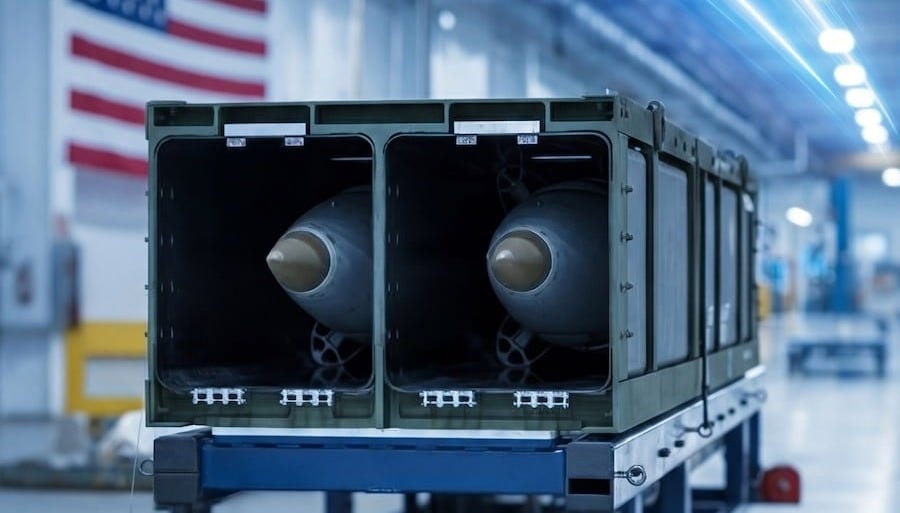
BLUF: Lockheed Martin is investing more than $8B through 2030 to expand missile production, modernize more than 20 facilities and hire workers,
Seven-year contracts for PAC-3 and THAAD interceptors underpin the expansion, which now includes the JATM and a new version of the Army’s PSM.
The company plans to add 2 million square feet of manufacturing space across eight sites over three years, including at its munitions center in Troy, AL.
Lockheed Martin signed a framework agreement with the DoW to accelerate production of the Joint Advanced Tactical Missile. The agreement allows the company to step up production work ahead of a multiyear contract.
The Army’s Precision Strike Missile Increment 2 moved from flight tests in March and August to a $1.2 billion production award within the same year.
The seven-year PAC-3 contract (and seven-year THAAD award) was the largest contributor to quarterly backlog and brought the total value of the PAC-3 contract to as much as $58.6B.
The frameworks call for an agreed starting price and annual adjustments tied to an industry inflation index. Under those terms, manufacturers could keep the savings from investments such as factory automation, giving them an incentive to improve production over the life of the contract.
Related: US Allies’ demand for Precision Strike Missile grows; Lockheed ramps up production
Nominal Raised $240M in Series C at $3B Valuation

BLUF: Nominal raised $240M at a $3B valuation, led by Lightspeed Venture Partners and co-led by Insight Partners, to give the engineering teams building the world’s most advanced machines a platform they can build on.
The next generation of machines will be built by engineers working with increasingly powerful intelligence. They’re designing aircraft that fly farther, robots that do more, energy systems that generate and store power more efficiently, and spacecraft that take us places we’ve never been.
For four years, we’ve built the infrastructure, connections, and engineering context hardware teams need. This round turns that foundation into the intelligence platform engineers build on.
A Hardware Intelligence Platform brings together the systems, data, intelligence, and applications that hardware engineering requires. At Nominal, we think about this foundation in four connected layers. Each solves a distinct problem and, together, they make intelligence useful across the hardware lifecycle.
DoD Issues Three Loans totaling $450M to Bolster US Space Companies

BLUF: OSC issues $150M loan to Rocket Lab to increase the flight rate of its reusable Neutron rocket beyond first launch, $150M to Stoke Space to help it build a second launch pad at Cape Canaveral. and $150M to LeoLabs accelerate the deployment of critical radar infrastructure and advanced decision science software
The proposed loan would support faster vehicle delivery and processing and allow Rocket Lab to expand its fleet of maritime vessels with additional equipment for Neutron recovery and transport.
It would also enable manufacturing upgrades to increase the production of composite structures and engines, and support infrastructure that would reduce turnaround time between launches once the reusable rocket makes its operational debut.
Stoke originally had hoped to launch Nova in 2025, but now is planning lift off in March 2027.
Related: OSC Signs $150 Million Conditional Commitment with Rocket Lab and Pentagon Gives $150M Loan to Rocket Lab to Boost New Vehicle’s Launch Cadence
Path Robotics Raises $300M, Quadrupling Valuation to $2.45B
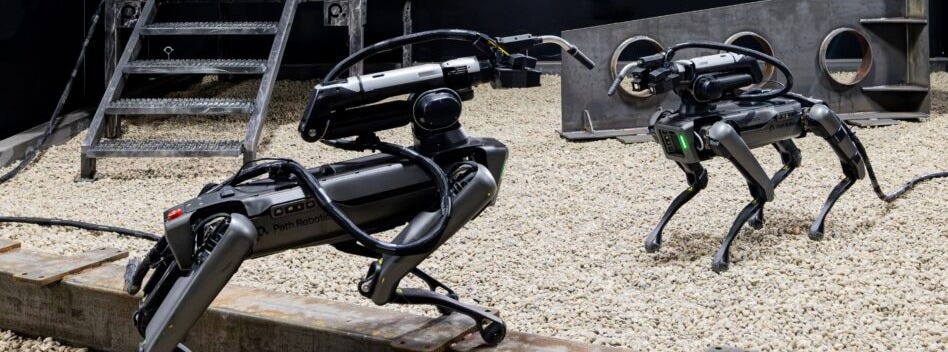
BLUF: Path Robotics raised $300M in Series E funding led by Canadian VC giant Georgian, quadrupling its post-money valuation to $2.45B and bringing its total cash raised to a cool $610M.
Path started by targeting the unsexy but pretty dang essential world of welding, introducing physical AI and robotics to a primarily human-dependent subsector of the industrial base.
The company’s Weld World Model is a neural network simulator trained on high-fidelity welding data. The company says it’s collected tens of millions of welded inches of data from its robots over eight years.
That model is operationalized through Obsidian, Path’s “reinforcement learning agent” that lives inside the deployed robots to help them better perceive each part by pulling in live data from the company’s sensor stack and adapting to make welding decisions seam by seam and in real time. Put simply, the Weld World Model knows what welding is, and Obsidian knows how to do it.
York Space Expands Into Unmanned Ground Systems With Acquisition of Outlook Industries
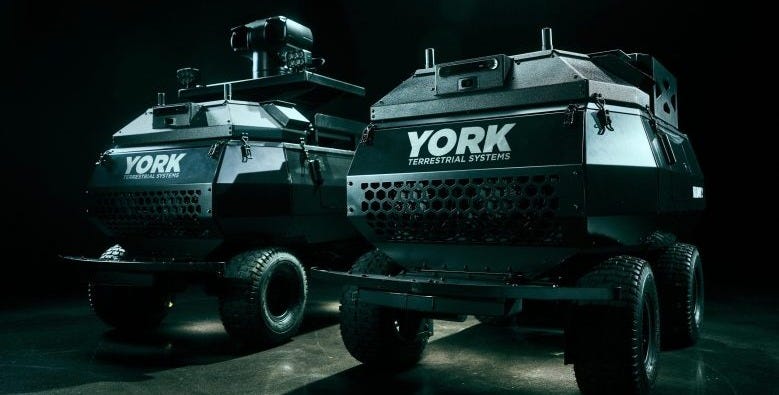
BLUF: York Space Systems is buying a small Australian military robot maker Outlook Industries, a deal that would take the satellite manufacturer outside the space business and push it toward a broader role as a defense contractor.
Other Defense Industry News
AEVEX Secures Nearly $400 Million IDIQ Award for Unmanned Aircraft Systems
Helsing unveils Clarity, a sovereign software platform for military intelligence
Seasats and Neros Partner to Pair Maritime Persistence with Precision Strike Capability
Forterra and May Mobility Advance to Phase III of DIU’s ROADS Challenge
Axon invests $1.2B more in drone maker Skydio, lowers annual revenue growth forecast
AV Awarded $405M International Order for LOCUST X3 Laser Defense Systems

Why the Resilience Paradox Matters for Defense Supply Chains
BLUF: The defense market values secure and resilient supply chains, but with the caveat that there is a clear price ceiling.
Resilient sourcing is achieved by qualifying alternative suppliers, expanding available capacity, or securing additional inventory, to name a few options.
These capabilities require significant upfront investments that suppliers currently appear unwilling to fully absorb by reducing profits or by carrying higher working capital costs.
Our 2026 survey of more than 160 US defense suppliers found that 96% of respondents would consider a 5% premium for more resilient sourcing. But willingness collapsed at 20%, with only 10% saying they would support that investment.
The true cost of supply base fragility remains hidden. Because structural demand uncertainties are unlikely to change for the US defense market, suppliers should be building flexible and resilient supply chains capable of performing under every condition, rather than patching them when the system breaks down.
How defense suppliers can build more resilient supply chains
Design resilience into the process before production begins
Manage supply chain recovery time, not number of sources
Preserve options to scale and strengthen supply chain resilience
Redirect the trust tax to fund resilience in defense manufacturing
To Implement Acquisition Transformation, Empower Military Mavericks
Ben McNally and Donald Gansberger
BLUF: DIU should lead the implementation of this transformation by becoming the department’s weapons school for commercial technology acquisition.
Two things make this work:
training that turns motivated people into experts
incentives that ensure that time at the unit enhances their careers instead of ending them.
The Pentagon’s response to this competency gap places renewed responsibility on WarU to produce tougher, faster buyers.
Centralizing education and certification does not ensure that practitioners can execute a program based on sound mission engineering, negotiate a commercial agreement, exercise judgment, or move a promising technology into operations.
Certification establishes a baseline, but it does not demonstrate mastery.
The answer is to give the services a stronger role in developing acquisition judgment through live work, supported by experienced government and industry practitioners.
Instead of operating as a national missions force for innovation, DIU hould position itself as DoW’s weapons school for commercial technology acquisition.
To meet the moment, the unit should undertake a six-step process.
Select for Temperament and Reputation
The unit should seek out mavericks with reputations for challenging status quos and finding novel paths through institutional obstacles while following the law.
The unit’s most experienced program managers and agreements officers should conduct candidate interviews and selections.
Run a Course, Not An Onboarding
The unit should establish a formal curriculum that teaches how commercial-first acquisition programs are executed, taught through case studies of the unit’s successes and failures.
Candidates would be taught the basic principles of startup formation, venture capital, the authorization and appropriation process, the adaptive acquisition framework, and receive briefings from other innovation organizations.
See It, Do It, Teach It
Upon completing the initial course, candidates would serve probationary periods in the same way that weapons school graduates do prior to becoming instructors, working with experienced colleagues and applying their training.
Credential It
Completion of the assignment should confer a special experience identifier, recognizing the graduate as weapons school graduates are recognized.
Time at the unit should enhance specially selected servicemembers’ careers, an incentive the mavericks who built the unit never had.
Sow Seeds of Success
Upon departing the unit, servicemembers would be strategically placed in program offices that would directly benefit from their experience.
As qualified, seasoned, credentialed mavericks proliferate throughout the services, assignment breadth should expand, increasing adoption of commercial technology acquisition practices, and creating a deeper bench for future leadership of commercial-first organizations.
Reconvene Regularly
The unit should host an annual conference with similar goals to the Air Force’s annual Weapons and Tactics Conference providing a professional forum for the warfighting function of commercial technology acquisitions.
This would strengthen the connective tissue between the center of excellence and its alumni.
Our Take: We think this is a great idea. DIU could serve more as both a facilitator of commercial technology to the warfighter and the propagator of the lessons for what it took to be successful - so that the entire acquisition community benefits.

The Army Needs a Data Logistics Discipline Before the Next Surge

BLUF: Acting Army Secretary Adam Telle announced a manufacturing rodeo that will strain and stress-test the Army’s organic industrial base supply chain to see where it breaks. Yet it has no comparable map of the data dependencies its depots need to fix what breaks, a gap the Army will pay for the first time it has to surge.
Everything the OIB produces now rests on four digital inputs: Chips. Compute. Data. Models.
The microelectronics inside machine tools and controllers, the processing behind depot analytics, the technical and operational data those analytics consume, and the models themselves. The Army governs none as an industrial input, and its OIB Transformation Strategy does not supply the discipline that would.
Call that discipline data logistics: planning, provisioning, protecting, and sustaining the digital resources industrial output requires.
Put compute and data on the capacity sheet. Revise the methodology to count digital capacity (processing, model availability, data throughput) alongside labor hours, then have Army Materiel Command load-test it at surge volume and rehearse production control without it.
Extend obsolescence management to the machines that build. Diminishing manufacturing sources management exists because component lifecycles of five to seven years sit inside system lifecycles of twenty or more.
Map the data each line depends on. Inventory the technical data packages and operational data every line needs, and judge each by whether it is current, complete, and held with usable rights.
The Army is building a digital-physical arsenal on all four, but not the data logistics discipline it requires, and still measures the result with a number invented for a factory that no longer exists.
Army Fields Launched Effects to 11 of 12 Divisions, with Griffon Aerospace Delivering the Majority

BLUF: The Army has fielded launched effects to all but one of its headquarters divisions, with Griffon Aerospace supplying the majority of the systems.
Per the Drone Dominance memo, the Army was directed to provide each headquarters division and multi-domain task force with launched effects.
The unmanned systems have been delivered to 11 of its 12 HQ divisions and each multi-domain task force (MDTF).
Launched effects are unmanned aircraft or payloads deployed from crewed aircraft, ground vehicles or maritime platforms to deliver various kinetic and non-kinetic capabilities.
Depending on their range and payload, the systems can extend the reach of units and provide effects without putting personnel directly in harm’s way.
“That is the vendor that we’ve been able to scale the most based off of priority. The great thing about the way that these systems are designed and the way that they operate is that we can adjust the payloads based off of the user requirement in near real time.” - LTC Hunter Gray, Army PAE Maneuver Air, Product Manager for Launched Effects
“The real magic behind the marketplace is all the rapid acquisition authorities and the contract vehicles.” - Michael “Ski” Horrocks, Army PAE Maneuver Air, Deputy Program Manager for UAS
Army Wants New Palletized Short-Range Air Defenses By 2029
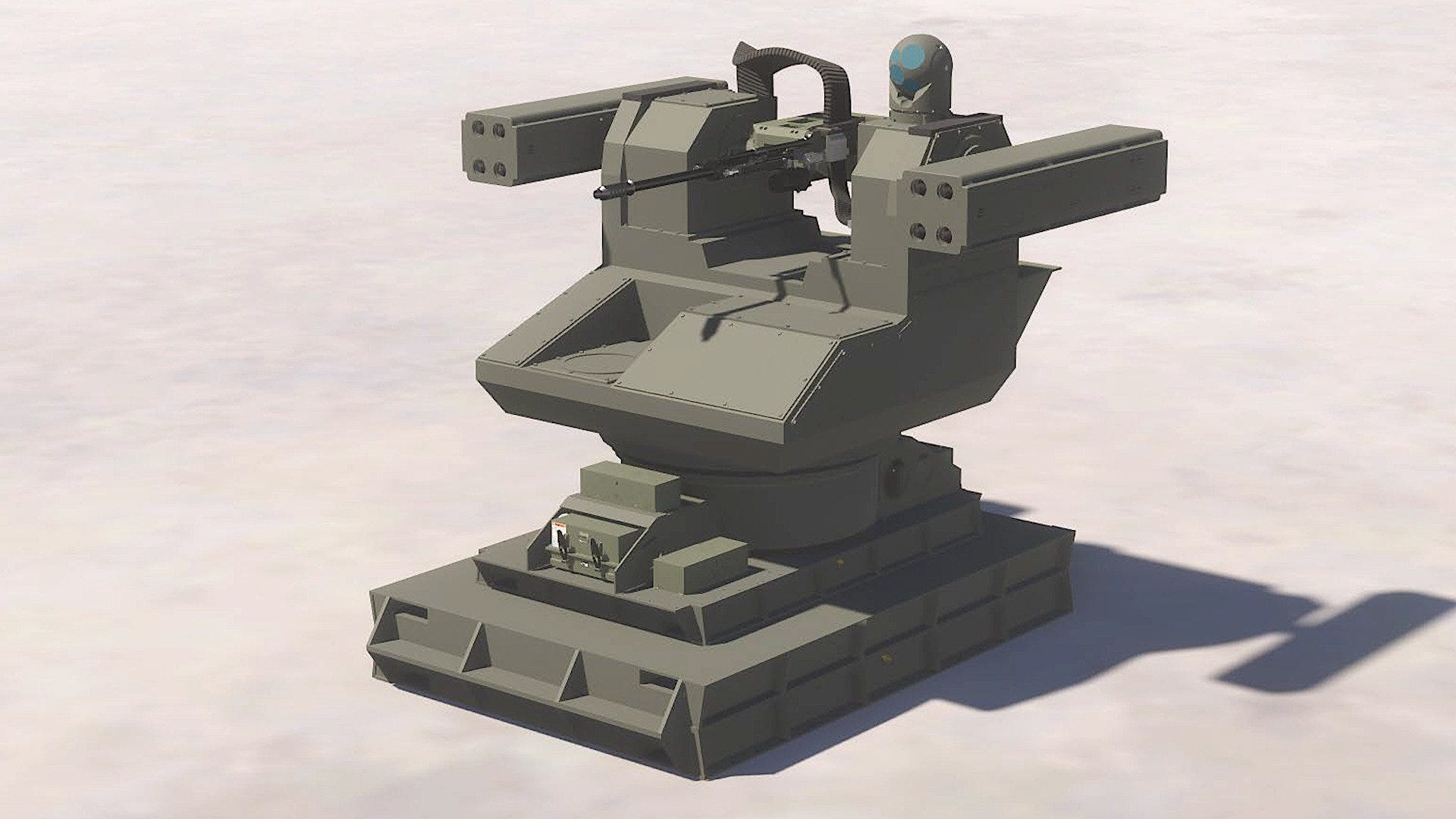
BLUF: Army sees new short-range air defense 'sleds' providing critical new flexibility and capacity, especially against drone swarms.
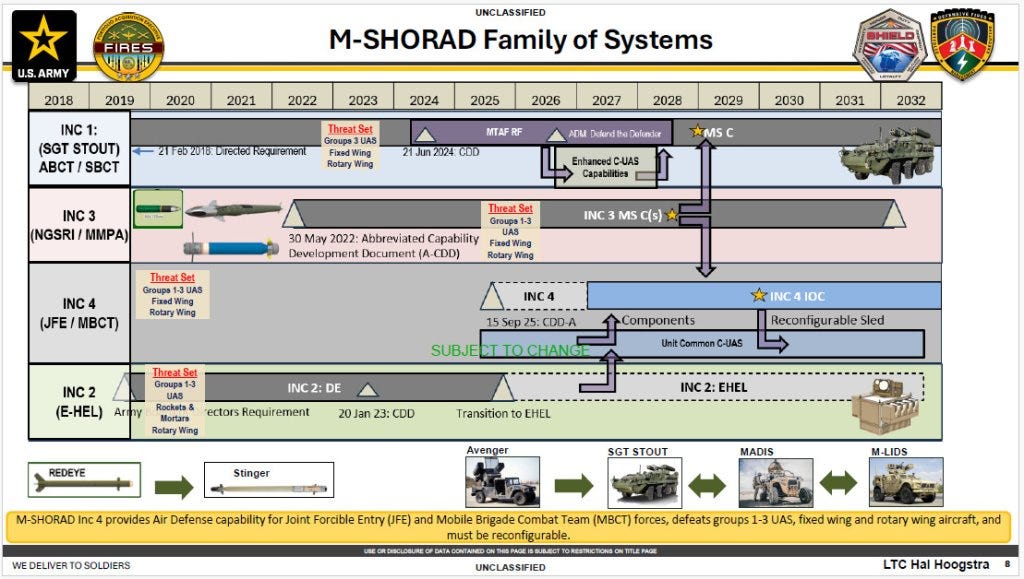
The Army is aiming to have new palletized short-range air defense systems in service before the end of 2029. The Army expects these systems to be fielded on crewed and uncrewed vehicles, as well as deployed in static positions.
The goal is to give combat units a more flexible array of point defenses against aerial threats, especially drone swarms, but alsoused against ground targets.
Details of the Maneuver-Short Range Air Defense Increment 4 (M-SHORAD Inc 4) program are included in briefing slides recently released online.
The Army wants the Increment 4 system to be capable of defeating a wide range of uncrewed aerial systems, from small quadcopters up to longer-range one-way-attack drones like Iran’s Shahed 136, operating individually or in swarms.
It also has to be able to provide point defense against traditional helicopters and fixed-wing aircraft making attack runs on friendly ground units.
Army fields 1,000-mile runway-free electric drones to hunt battlefield targets
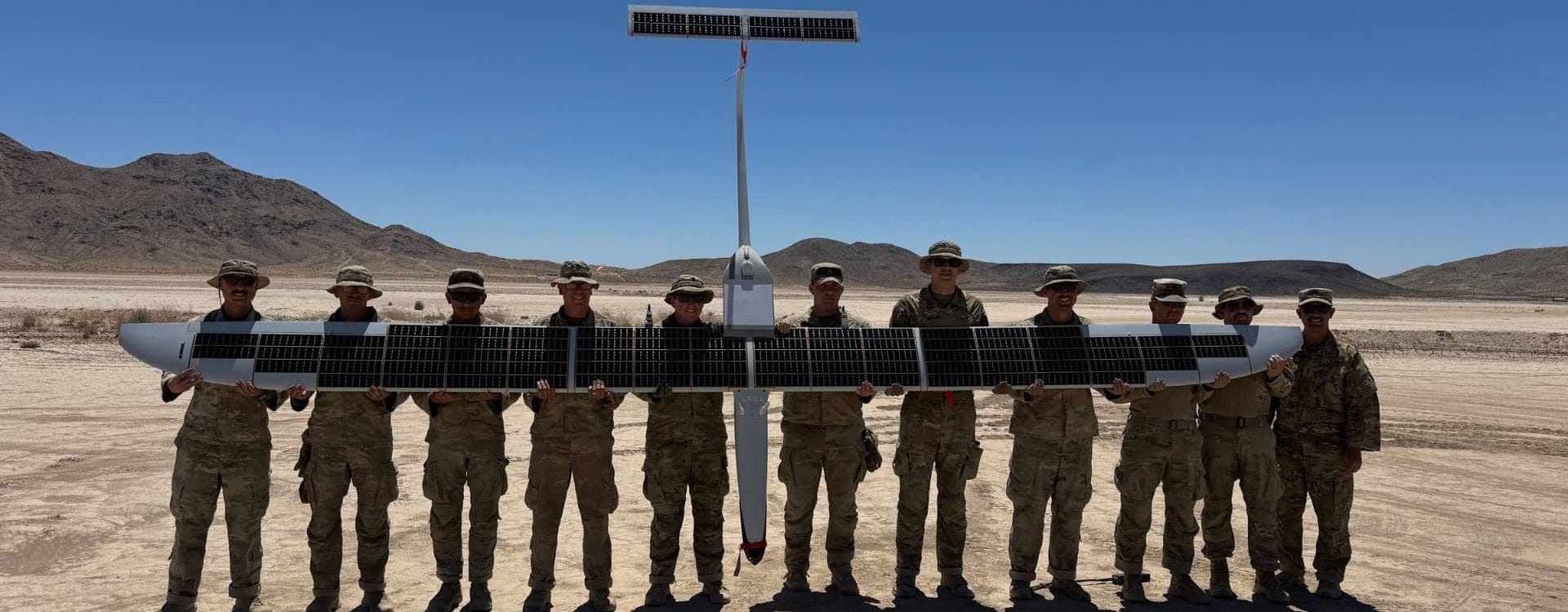
BLUF: The Army selected Kraus Hamdani Aerospace’s (KHA) K1000ULE UAS for a major Program of Record. The contract will integrate the autonomous drone into the military’s reconnaissance and surveillance operations. It will also support target acquisition missions in the field.
KHA will supply its Group 2, fully electric platforms to Army units. These multi-mission aircraft feature vertical takeoff and landing (VTOL) capabilities. As a result, troops can launch and recover them without needing a runway.
K1000ULE is designed for rapid deployment in austere and contested zones. According to the company, there is no need to have a big team to operate the system. A team of just three people can easily operate it in the field.
The aircraft’s aerodynamic design allows it to stay airborne for up to 24 hours on a single charge. Across that timeframe, it can cover a flight range of 1,000 miles (1,609 kilometers). It cruises at speeds of 46 mph (40 knots) and can reach a service ceiling of 20,000 feet.
Despite its long endurance, the platform remains compact and lightweight. The airframe measures 9.8 feet (3 meters) in length with a 16.4-foot (5-meter) wingspan. It supports a maximum takeoff weight of 42.5 pounds (19.3 kilograms).
“We engineered the K1000ULE around a fundamental operational need—keeping critical capabilities airborne for longer while reducing the burden on the forces using them.” -Stefan Kraus, KHA CTO and co-founder
Instead of Stockpiling Small Attack Drones, Army Looking to Simply Buy New Ones
BLUF: As the Pentagon has been making a major effort to spread small drones across the force, logical questions have emerged about how the Pentagon plans to store these systems and how much money it will take to maintain and update them. The solution, it turns out, is simpler than anyone could have expected: fly them until they break.
The core of the challenge is the reality that these drones become obsolete quickly.
Subcomponents like the software, the circuit cards, the radio sets and cameras are all vulnerable to counters and need to be swapped out quickly.
The Army was in the process of receiving 10,000 of the first 30,000 small drones out of the Drone Dominance Gauntlet 1.
Those drones will be sent to units for training, just like the Army does with equipment like M16s, Humvees and gas masks. The entire point is for soldiers to figure out how to train with them and use them in combat, not for them to sit on a shelf.
For some drones in Group 2 category (21 to 55 lbs.) that may be more expensive, and used to fly higher for intelligence, surveillance, and reconnaissance missions or delivery operations, those will likely be sustained and used for longer.
“The Army had told us right away when we started this that none of this stuff’s getting stored on shelves because the iteration cycle is so much that we have to manufacture to deliver, not to stock.” Jon Strzelec, AMC Advanced Manufacturing Lead
It’s Time to Debate How the Army Fights
Robert Rose and Patrick Sullivan
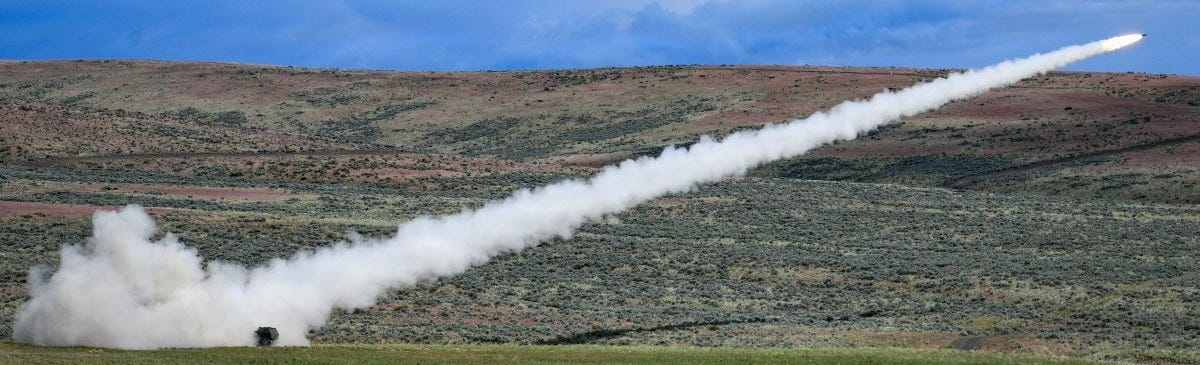
BLUF: How the Army Fights is not clearly grounded in the NSS strategic context and does not offer the Army a theory of victory for how to fight in that context. Absent the logical framework, it risks providing ambiguous and contradictory guidance.
The Army released How the Army Fights (HTAF) to change how the Army prepares for war. The document takes inspiration from AirLand Battle.
The 2025 National Security Strategy transitioned the U.S. to a strategy of deterrence by denial in the Pacific’s first island chain.
The document explains that it is a distillation of the Army’s existing operational concept of multidomain operations (MDO). In being so, it inherits the flaws of that concept.
Even after the release of the 2025 National Security Strategy, HTAF continues to center on a counteroffensive to dislodge an enemy rather than reinforcing partners to prevent a fait accompli. HTAF neither mentions defensive tasks nor cites partners’ operational concepts. Instead, it continues MDO’s focus on achieving convergence to enable a vague notion of operational maneuver.
The confusion comes from the lack of an organizing thesis. Instead of proposing a theory of victory, it offers a “central idea,” which it defines thus: “The Army fights through four operational elements. While those four elements may be a way to categorize how the Army fights, HTAF does not argue why this categorization is essential to deterring China.
Furthermore, it is unclear how these four elements guide the Army’s development.
HTAF does not discuss the pitfalls of methodically sequencing warfare. Once convergence establishes conditions, an adversary is defeated through strike and close battle.
During peacetime, the Army must understand how it will fight its next war. HTAF may not provide that understanding, but, like active defense, it may stimulate a debate that results in an appropriate theory of victory.
Army Looks to Autonomize Logistics in Indo-Pacific

BLUF: The Army is working to modernize sustainment logistics using uncrewed ground vehicles in the Indo-Pacific region, where traversing land is notoriously difficult.
The Army’s Global Tactical Edge Acquisition Directorate — an office launched in late 2025 to streamline capability delivery — recently wrapped up the first Accelerated Capability Event that focused on the Indo-Pacific.
The event brought together and evaluated six autonomous ground systems designed to address one of the hardest problems in modern warfare, contested last-mile logistics, tactical resupply and mobility under fire.
Sustaining land forces is one of the greatest challenges the Army faces in the Indo-Pacific.
Autonomous sustainment holds the potential to reduce human risk, bolster the resilience of logistics networks and offer commanders a greater array of options when fighting in a contested environment.
The purpose of holding an Accelerated Capability Event is not just to demonstrate new technology, but to understand what works and what doesn’t in this particular context, then refine and streamline the fielding of those systems.
The Army will distribute up to six Other Transaction Agreements to vendors that performed well in the recent event.
Those companies will then have a roughly 45-day period to incorporate feedback and improve their systems before enduring an operational assessment.
Feedback from the challenge included improvements to the mobility of the vehicles, as some systems tended to bear weight higher, resulting in instability and tipping over.
Our Take: This is exactly the type of operationally driven, iterative acquisition approach the Army should embrace. Rather than spending years developing requirements and selecting a single solution, the Army is putting multiple commercial tech through realistic operational challenges, providing rapid feedback, and allowing industry to adapt and compete. The real test will be whether the Army can translate these experiments into rapid fielding and production at scale, while continuously improving capabilities based on soldier feedback. Contested logistics is a critical warfighting challenge, and autonomous resupply offers an opportunity to strengthen resilience, reduce risk to soldiers, and fundamentally rethink how distributed forces are sustained.
Other Army News:
The Army’s Coming C2 challenge is Fighting Across Thousands of Miles
Army CID Looking for New Commercial Software Tools to Monitor Darknet, Encrypted Messaging Platforms

Navy Expands Tomahawk Warhead Production Capacity at China Lake

BLUF: A newly inaugurated 300-gallon energetics mixer at China Lake is slated to reach production rate by June 2027, establishing an additional Navy-run source for WDU-36/B Tomahawk warheads alongside industry partners.
NAWCWD cut the ribbon on a new 300-gallon mixer in the rebuilt Motor Assembly Compound. Once online around June 2027, the mixer will let the team reach production rate. The goal is warheads ready before Raytheon needs them, helping ensure continuous, on-time Tomahawk deliveries to the fleet.
The Navy awarded Raytheon a $23B contract to accelerate Tomahawk production.
Faster production calls for more warhead capacity. During the demonstration build, the team also found the warhead specification needed a major update.
The team spent much of the past year updating the specification and the approved supplier list. The Navy’s technical authority for the warhead must approve each new supplier. Every future producer, Navy or industry, must build to that specification.
“At PAE Munitions, we know that increasing weapons production takes more than contracts and funding. It takes people, infrastructure, materials, and strong partnerships across our Navy, our warfare centers and industry.” - RAML Eric Gardner, PAE Munitions, Principal Deputy
“Weapons take too long, cost too much, and are irrelevant when they get there.” - Dan Carreño, NAWCWD, Executive Director
Related: NAWCWD Builds Tomahawk Warhead Capacity to Stay Ahead of Missile Production
Navy’s NATO SEASPARROW Delivers 1,000th ESSM Block 2 Missile
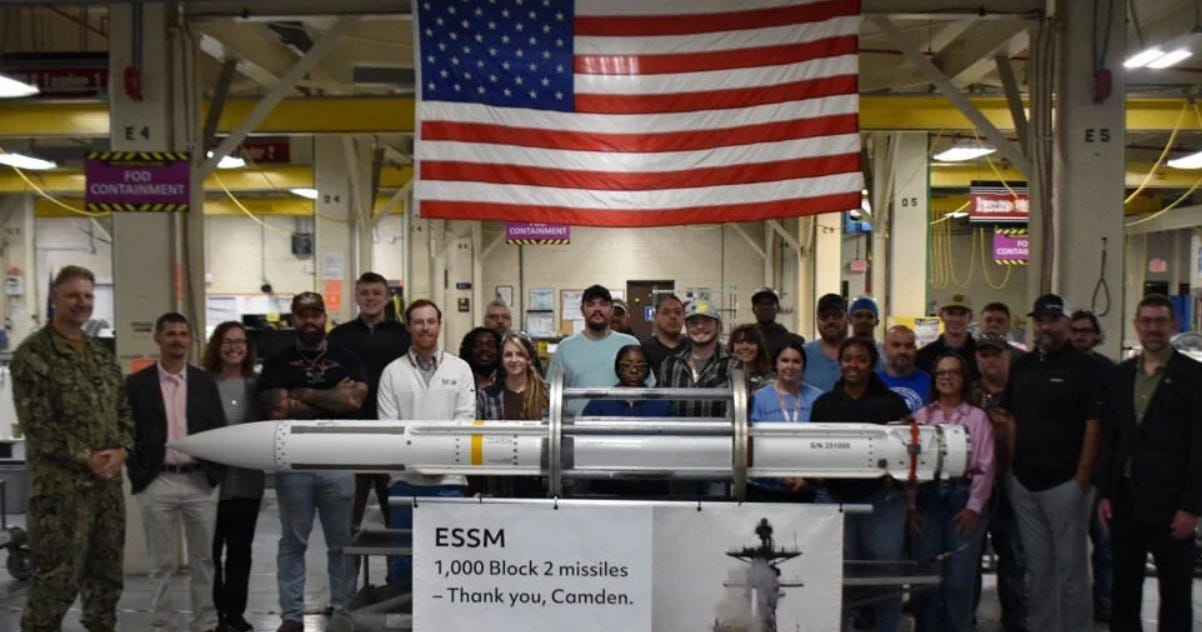
BLUF: PMX-312 marked a major production milestone with delivery of the 1,000th Evolved SeaSparrow Missile (ESSM) Block 2 produced for the 12-nation NATO SEASPARROW Consortium.
A ship-launched surface-to-air missile, ESSM Block 2 provides critical ship self-defense and local-area defense against advanced airborne and surface threats. The missile delivers a vital layer of protection for ships, Sailors, and maritime operations in increasingly contested environments.
This milestone reflects the continued expansion of ESSM Block 2 production to meet growing U.S. and international demand. The program reached its 500th missile delivery in June 2025, doubling production in just over a year.
Navy Missile Gets Smarter RF Sensors Without Hardware Replacements

BLUF: The Navy’s Long-Range Anti-Ship Missile (LRASM) program has reached another production milestone, with BAE Systems delivering all Lot 8 radio-frequency (RF) sensors to Lockheed Martin. These advanced sensors provide a critical part of the missile’s targeting system, helping it detect and engage maritime threats in heavily defended environments.
BAE Systems supplies the RF technology that helps LRASM identify strategic naval targets. The sensor supports the missile’s ability to operate around sophisticated air defense networks, where electronic interference and other battlefield threats can complicate targeting.
BAE Systems supplies the RF technology that helps LRASM identify strategic naval targets. The sensor supports the missile’s ability to operate around sophisticated air defense networks, where electronic interference and other battlefield threats can complicate targeting.
LRASM uses its onboard sensor technology to locate and engage enemy vessels across contested maritime environments.
Related: BAE Systems Completes Lot 8 LRASM Sensor Deliveries to Lockheed Martin
DONRCO to Trial New Industry Engagement Software Platform
BLUF: DoN Rapid Capabilities Office is piloting Project Roundtable, a prototype software platform designed to serve as a hub for industry engagement.
Supported by NIWC Pacific and PAE Mission Systems, the DONRCO has tapped GovSignals for the effort, which will create a digital environment where vendors can submit information about their capabilities and connect with the DoN on the technology’s ability to address operational challenges.
Project Roundtable will be self-reinforcing: Companies can make updates about their capabilities to allow stakeholders to watch the technology mature, and the DON can send demand signals back to vendors earlier in the process so no time is wasted developing unwanted products.
The system automatically logs each engagement, providing participating organizations with a full history of their relationship with the Navy, and dashboards will show real-time data about a capability’s readiness.
“The DON has many disconnected channels for interacting with the industrial base, but with Project Roundtable, we can create one shared system that cuts through red tape to get Sailors and Marines the solutions they need faster.” Charles Yang, DONRCO COO
Delivering First Columbia-Class Sub in 2028 Is Absolutely Achievable
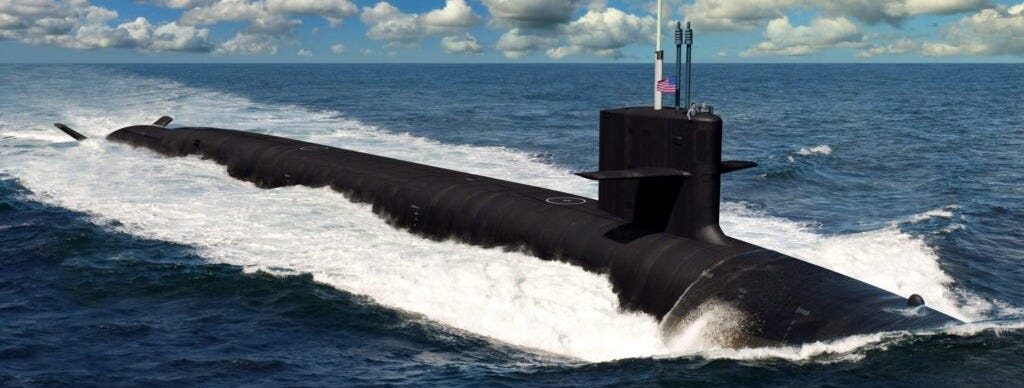
BLUF: VADM Rob Gaucher, DRPM Submarines said delivering the first Columbia-class submarine in 2028 is still a heavy lift, but absolutely achievable amid an increase in operations in recent months.
My confidence grows each week as we review deck plate performance, align on goals, improve our production planning, and address day-to-day production bottlenecks.
He further said at the time that a 2028 delivery time would not be met if it meant long-term consequences for the program.
Navy leaders have consistently said this year that they are aiming for a 2028 delivery date for the submarine.
That estimate comes after the Navy and its shipbuilding partners who are building the District of Columbia, General Dynamics Electric Boat and HII’s Newport News Shipbuilding, established an acceleration plan in 2025 to deliver all modules for the Columbia-class submarine to the final assembly yard at General Dynamic Electric Boat in Groton, CT., by the end of 2025.
Our Take: Delivery of warfighting capability is the ultimate measure. By elevating Subs to DRPM increased authorities, investments, and resources. Hopefully this yields accelerated sub deliveries and a more robust industrial base to deliver and maintain.
BAE Systems wins Navy contract for Virginia-class nuclear submarine propulsors

BLUF: BAE Systems has received a $138M Navy contract to continue manufacturing propulsor assemblies for the Virginia-class nuclear-powered attack submarine fleet.
The contract covers the manufacture of propulsor assemblies, engineering services, replacement parts, and associated manufacturing support. Its ordering period extends through September 2032, giving BAE Systems a longer-term role in supplying one of the submarine’s critical propulsion components.
A propulsor is the assembly that converts mechanical power from a submarine’s propulsion system into thrust, allowing the vessel to move through water.
Unlike a conventional exposed propeller, modern submarine propulsors are designed with acoustic performance and structural requirements in mind.
SSN(X) Will Be a Swift, Lethal Mothership for Undersea Drones
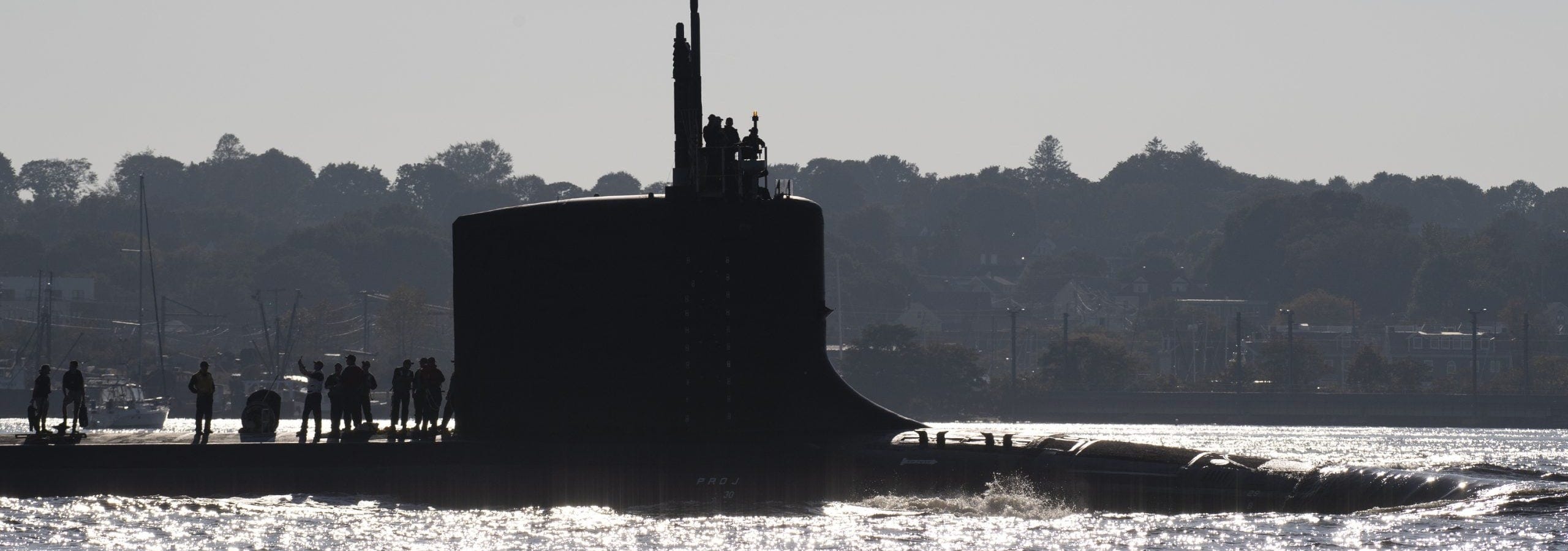
BLUF: The next American nuclear attack submarine design will be faster, take less time to repair and serve as a mothership for a constellation of undersea drones.
The Navy is finalizing the analysis of alternatives of the SSN(X), the submarine class that will follow the Virginia-class attack boats.
The Navy completed an analysis of alternatives in Nov 2025 and CAPE approved requirements in Mar 2026 with hopes for Milestone A approval by end of 2026.
The attack boat, slated in the Navy’s latest shipbuilding plan to start in the early 2040s, has been under development by for decades to eventually replace the Virginia-class.
The Navy identified five major characteristics the new sub needed. Flank speed and tactical control speed; improved operational availability; decisive lethality; superior stealth and layered survivability; and organic robotic and autonomous systems hosting and C2.
The Navy is redefining the role of the submarine from a standalone hunter-killer to a capital mothership. By launching uncrewed systems directly from submarine torpedo tubes and integrating unmanned vehicles into our battle plans, they dramatically expand the tactical reach of the manned fleet.
CBO estimated the SSN(X) could cost an average $9B each.
“The analytical conclusion was unequivocal: to dominate high-end peer threats in the middle of this century, a clean sheet design is required. The Virginia class is a fantastic, unmatched world-class warship, and it will remain the backbone of our attack fleet for decades. But as adversary capabilities evolve, we require expanded payload capacity, greater electrical and hydrodynamic margins and unprecedented architectural flexibility that simply cannot be backfitted into an existing hull form.” RADM Andrew Miller, Head of Submarine Requirements
Our Take: We strongly support the Navy’s vision of transforming the next-generation attack submarine from a standalone platform into the centerpiece of an integrated undersea warfare portfolio. However, a clean-sheet design approaching $9B per sub, with delivery decades away, presents enormous affordability, schedule, and industrial base risks. The Navy cannot afford to wait until the 2040s to realize this operational vision.
It should aggressively experiment with integrating autonomous undersea systems into today’s fleet, mature modular architectures and common interfaces, and rapidly field capabilities that can evolve independently of the host submarine. The real measure of success isn’t simply building a faster, stealthier submarine, but delivering a more lethal, adaptable, and affordable undersea force that combines exquisite platforms with distributed autonomous capabilities.
Underwater Arms Race Puts US Naval Supremacy at Risk
BLUF: The revolution in favor of UUVs, including autonomous craft capable of operating independently of continuous human control, threatens to leave some of the powerful tools of the world's top naval power, the U.S., behind the times.
Unlike their aerial counterparts, underwater drones require specialized software architectures that necessitate limits on constant communication with operators in order to perform effectively and quietly over long distances.
The U.S. has no major operational program for large-scale UUVs. That could change quickly though. But any US program has to overcome a really hard problem. The simple fact of transiting the vast distances of the Atlantic or Pacific chew up a lot of space, energy and computing power.
China has touted success, however, having rolled out two extra-large UUVs—the HSU100 and the AJX002 during a PLA parade in September 2025. Recent satellite imagery also shows construction at a Shanghai shipyard of what analysts believe to be a large new ship capable of deploying and recovering UUVs.
Another Chinese craft that has drawn attention is the Zhu Hai Yun, an uncrewed, AI-supported oceanic research vessel. Sometimes referred to as the world's first drone mothership.
The most advanced underwater vehicles to date belong to Russia. A titanium hulled deep-diving device called Losharik, which can undertake seabed espionage and sabotage at huge depths; and an autonomous, nuclear-powered, nuclear-weapons carrying massive torpedo called Poseidon.
Two other nations often factoring into U.S. wargaming scenarios, Iran and North Korea, may also soon to enter the field.
"While the U.S. has fielded a variety of UUVs and launched new innovative programs for more, our military is arguably behind given the challenges of this technology, its onboard communications, and still-growing industrial base." Mackenzie Eaglen
ACES High: Tactical Software Development for Operational Insight
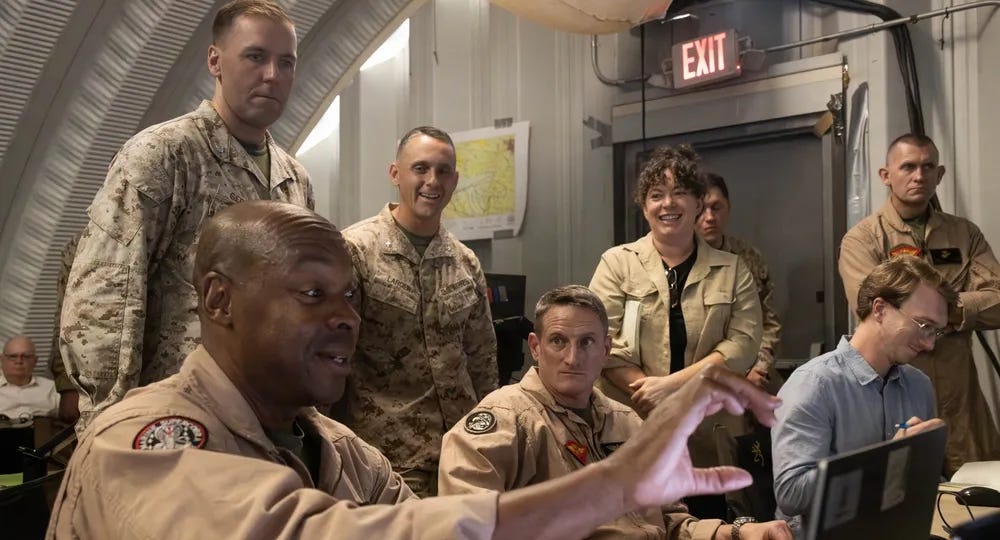
BLUF: Leveraging the internal development capabilities of Maven Smart Systems, Overmatch’s Architecture Analytics and Emerging Capabilities (ACES) team created an integrated dashboard to provide enhanced situational awareness.
The Overmatch Rapid Capability Cell, in partnership with Project Dynamis and 3rd Marine Aircraft Wing, tested a prototype command and control capability during Weapons and Tactics Instructor Course (WTI).
The effort demonstrated how rapid software development, direct operator engagement and continuous feedback can accelerate the delivery of capabilities tailored to operational needs.
The ACES team combines systems engineering and data analytics to connect subject matter expert knowledge, system models, and authoritative data into mission products. Less than two months after receiving 3rd MAW’s request for support, the ACES team identified existing data sets, built a functioning prototype, and deployed it to the field aboard Marine Corps Air Station Yuma.
The rapid development cycle demonstrated the value of maintaining close collaboration between software developers and the operators who will ultimately use the capabilities.
Other Navy News:
Leonardo Wins Contract for DAIRCM Aircraft Protection System
New Facilities to Pump Out Upgraded F/A-18E/F Super Hornets Eyed by Navy
Austal USA Awarded $43M Navy Contract For USS Canberra Maintenance And Modernization

MQ-58 Valkyrie Drones Now Cost $6M-$8M Each
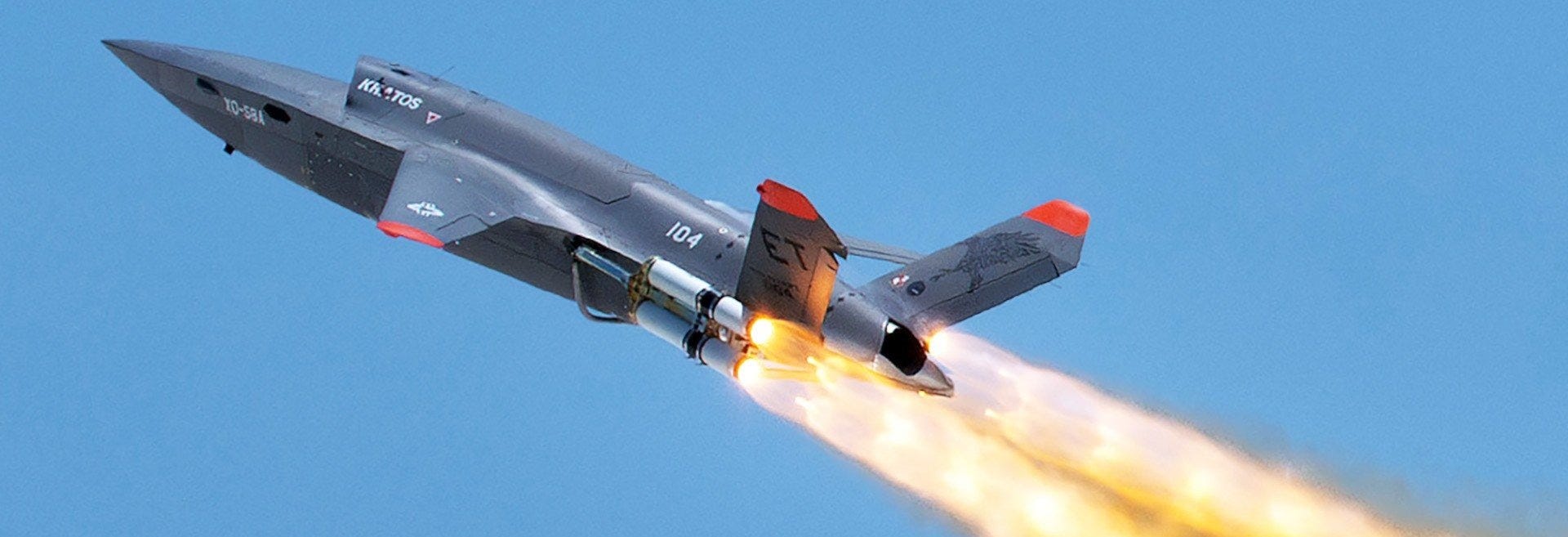
BLUF: Kratos has provided an interesting update on the price of its Valkyrie drones. The uncrewed aircraft currently cost roughly $6-$8M, depending on their configuration and without certain mission systems installed.
Though this is a more expensive price point than Kratos has said it has been aiming for in the past, it still puts Valkyrie firmly at the lower end of the cost spectrum for Collaborative Combat Aircraft (CCA) type drones based on available information, while still providing relatively high-end capabilities.
Affordability will be a central key factor for Kratos’ prospective customers for CCA-type drones going forward.
“Affordability is gonna win. I would not want to be anyone else than Kratos with the Valkyrie, that’s in production, that comes off the line, white tail, six or maybe eight million dollars, depending on configuration. Missionized is more.” - Eric DeMarco, Kratos, President and CEO
Marine Corps Shows CAC2S Air Command System
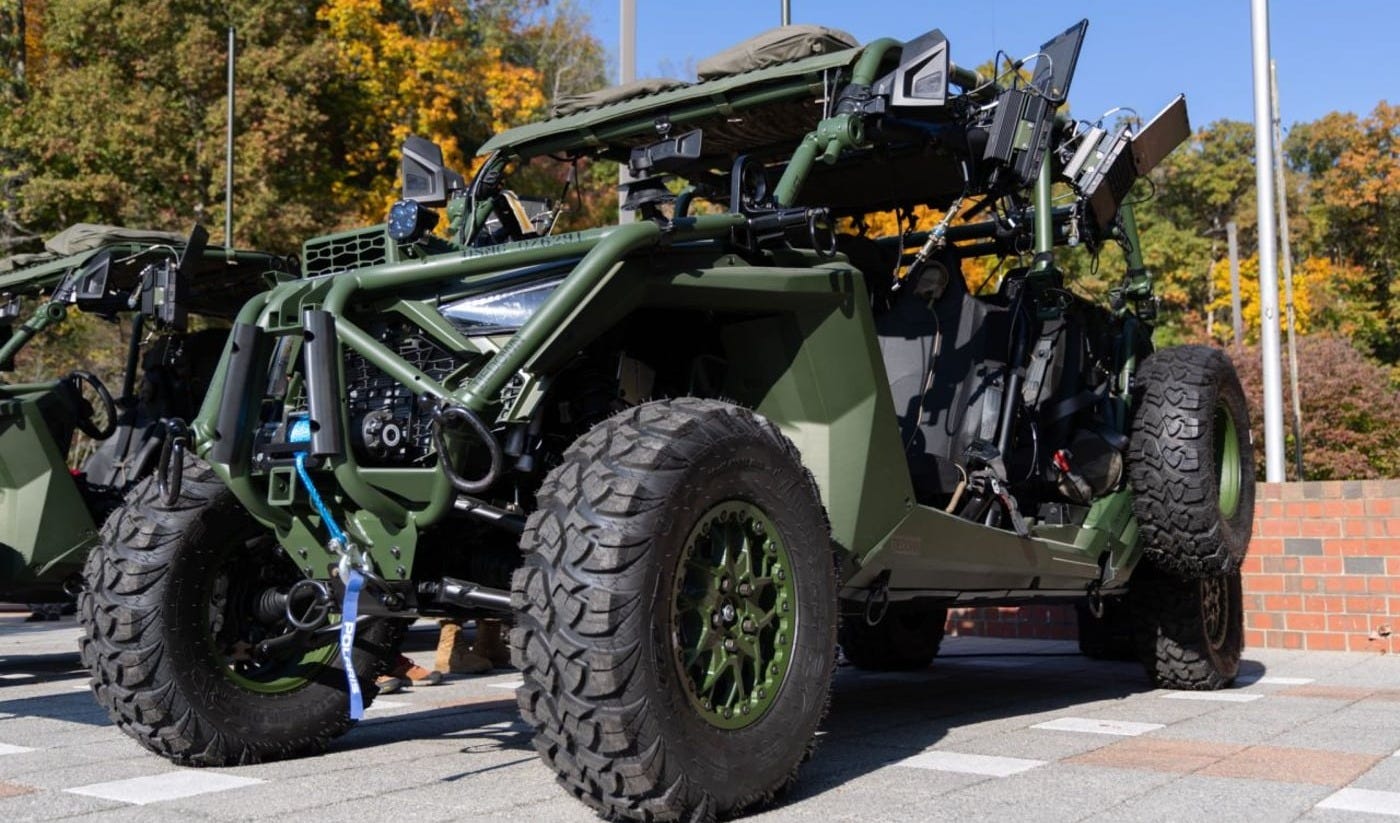
BLUF: The Marine Corps has shown off a smaller, lighter version of the system its aviation units use to control airspace and manage air operations, the Common Aviation Command and Control System (CAC2S).
The new Small Form Factor variant was put through an operational demonstration last week, per PAE Marine Corps.
Specialists from Program Manager Marine Air Ground Task Force Command and Control, the office that runs the program, presented the system.
Photos from the event show the equipment fitted to Polaris light tactical vehicles, the open-frame all-terrain vehicles Marines use to move small teams quickly over rough ground.
General Dynamics Mission Systems, which builds CAC2S, has marketed a related Small Form Factor command and control node based on the CAC2S design.

New USAF Force Design Bets on Technology, Remains Under Wraps
BLUF: The Air Force announced it has finished an updated force design plan, that spells out how it will use combat power in a future war against capable adversaries.
Details of that force design are classified and there is no publicly releasable unclassified version.
The new plan builds on and replaces the One Force Design 2024 released under Wilsbach’s predecessor, Gen. David W. Allvin.
That plan which released an unclassified overview laid out a framework of three “mission areas capabilities” ranging from highly survivable in contested airspace to long-range systems that can launch standoff weapons.
Force Design 2026 is focused on laying out how the Air Force needs to change to meet future operational challenges in a high-end, technology-driven conflict with a special focus on “technology, autonomy and integration.”
The Air Force said that a slew of rapid technological advances in sensing, networking, AI, autonomy, unmanned systems, long-range weapons, and electronic warfare are changing the speed, scale and complexity of warfare.
It is also changing how the service must generate and use its own airpower.
“We must evolve if we want to remain the world’s best Air Force. New technologies are enabling fantastic capabilities that were unimaginable just a few years ago, but those same technologies threaten some of the ways we have historically generated airpower.” Lt. Gen. Chris Niemi, Air Force’s Chief Modernization Officer
Related Article: Air Force Design 2026: Designing the Air Force for the Future Fight
Our Take: While there aren’t many details here, it is encouraging to see the Air Force recognize that tech advances are likely to change the nature of combat and they need an adaptable force design that can evolve with the threats and opportunities.
CSAF Emphasizes Mobility Modernization Importance
BLUF: At the 2026 Airlift/Tanker Association Symposium, Gen Wilsbach emphasized that the Joint Force’s ability to project decisive combat power relies directly on the rapid acceleration of Air Mobility Command modernization initiatives.
ATOMS experimentation is fueling a new program, MAF NEXUS, designed to further connect the MAF fleet, facilitating dynamic taskings and C2 requirements which enable combat air force (CAF) fleet and Joint Force success.
This increased battlefield situational awareness provides crews with information they need to make informed, timely decisions and increase combat effectiveness.
“Our environment isn’t just evolving, it’s changing at a rapid pace. And when we need to adapt quickly, our nation turns to our mobility forces. We do not move, we do not sustain and we do not fight without air mobility. The Airlift/Tanker Open Mission System, or ATOMS, is closing the gap. AMC took the concept from development to a combat-tested capability, compressing years of traditional development and testing into just six months. ATOMS uses beyond line-of-sight connectivity to deliver a common operational picture.” Gen. Ken Wilsbach
In First, Two CCAs Fly Air Combat Maneuvers Using Autonomy Software
BLUF: Two of the Air Force’s semi-autonomous drones flew air combat maneuvers coordinated by an “AI pilot,” or mission autonomy software.
The autonomy software, called Hivemind, was from Shield AI, while the aircraft were FQ-44As, built by Anduril Industries.
The test took place at the Nevada Test and Training Range, involved FQ-44s flying in formation and carrying out beyond-visual-range air combat maneuvers.
Future tests will include building up to larger teams, teams of teams, and more intricate operations such as changing assets between teams that are in-flight.
Related Article: First-ever Collaborative Combat Aircraft fly in formation, demonstrate air combat maneuvers
Netting to Shield F-35s from Drone Attacks Eyed by USAF

BLUF: The Air Force is looking for contractors who could install netting at Tyndall Air Force Base in Florida to help protect F-35 Joint Strike Fighters from drone attacks.
The netting plan, which has yet to be finalized, does reflect growing support for increased physical hardening of bases within the U.S. military, especially against uncrewed aerial threats.
Each one of the open-ended structures is 630 feet long, 65 feet wide, and 30 feet high. They are designed to accommodate up to six F-35As apiece at a time.
Even before Operation Spiderweb, the Air Force had at least considered installing nets or other physical barriers to help blunt drone attacks on parked aircraft
C-17s Will Soon Be Armed with Pallets of Cruise Missiles
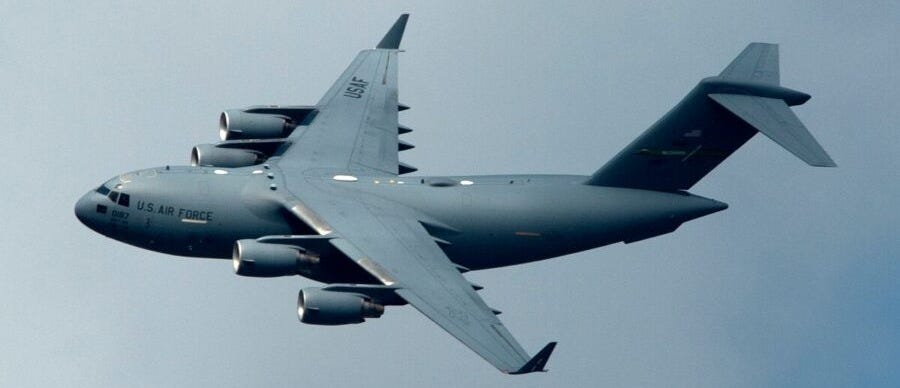
BLUF: After years of experiments and tests, senior Air Force leaders say they’re on the verge of using C-17s and other cargo aircraft to launch cruise missiles via airdrop.
The Air Force is investing in its Family of Affordable Mass Missiles to expand its munitions stockpile with affordable, less exquisite, air-to-ground missiles.
The palletized munitions concept involves putting a specialized container loaded with cruise missiles on a standard airdrop platform.
The container is released like another airdrop and deploys its parachute, then the weapons are deployed, engines ignite, pull up, and proceed toward their target.
In its 2027 budget request, the service is asking for $355M for procurement of 1,000 FAMM weapons, with plans to acquire 28,000 FAMM missiles over the next five years, with a price tag of $12.6B.
“This system is modular and smart; the weapons are networked and affordable. As you might gather, capabilities like FAMM-P blur the distinction between our combat and mobility air forces mission sets. That’s a cultural shift we need to be prepared for, and I need every mobility Airman in the room to embrace that change.” Gen. Kenneth S. Wilsbach, Air Force Chief of Staff
Related Article: C-17 Cruise Missiles: Palletized FAMM
Our Take: This is going to be a cultural shift as cargo planes will now have to be integrated into combat plans with weapons allocation for specific targets. This will add pressure on the mobility force that will have to make decisions on when assets are used for logistics missions versus when they can be used for weapons delivery.
The Air Force’s Newest Trainer Is an Aerial Stunt Plane
BLUF: The Air Force unveiled its newest aircraft today by flying them over the Air Force Academy, where they will be used to train a future generation of pilots and serve as the basis for a new aerial demonstration team.
Dubbed the T-19A Kestrel, the aircraft are two-seat, single-engine GB1 Gamebird all-carbon-fiber aerial performance planes.
They were made by Game Aerospace Composites.
Unlike other new aircraft such as the T-7A Red Hawk jet trainer, the T-19As did not require a lengthy, expensive development and procurement process.
They were delivered in under a year and paid for through a gift from corporate and civilian donations and the Air Force.
Related Article: Air Force Unveils T-19A, a New Aerobatic Plane to Train Future Pilots
Air Force Advances B-21 Stealth Bomber Rollout with 46,000-Square-Foot Texas Hub
BLUF: Air Force is accelerating preparations for its next-generation stealth bomber fleet. The Pentagon is expanding factory floors in California while constructing dedicated high-security facilities in Texas to support future flight operations.
At Dyess Air Force Base near Abilene, construction crews have broken ground on a 46,000-square-foot mission-planning complex.
Under a joint agreement, that site will expand annual B-21 production by 25%.
At Dyess, the new building will serve as the nerve center for operating those incoming bombers.
Modern stealth missions require sophisticated ground support architecture.
Ground teams must calculate radar-evading flight paths, process classified target intelligence, and maintain encrypted satellite communications before crews launch into contested airspace.
B-21 Raider vs B-2 Spirit: Lessons that Helped America Shape its New Stealth Bomber
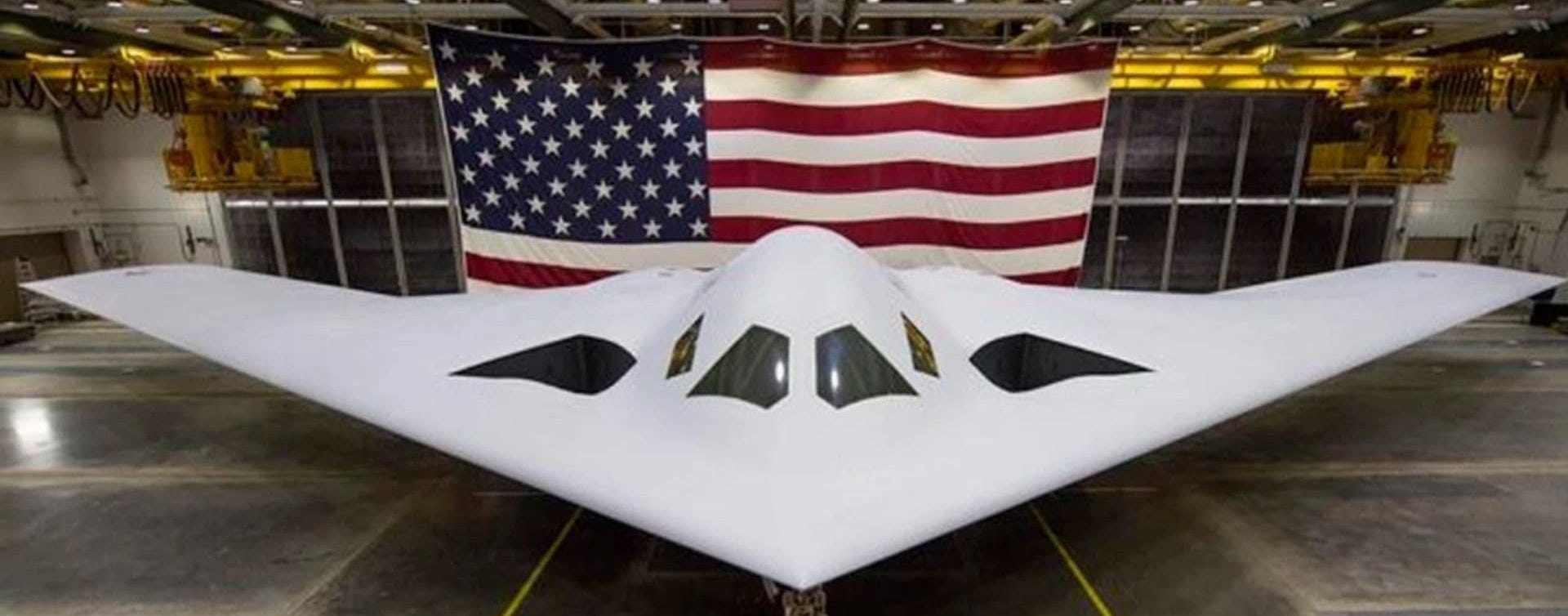
BLUF: The B-21 is designed for long-term maintenance and affordability. Its newer materials and manufacturing methods are intended to reduce the time and resources required to maintain its low-observable characteristics.
Air Force Builds Sentinel ICBM On Launchpad
BLUF: Air Force and Northrop Grumman fully assembled an inert LGM-35A Sentinel ICBM at Vandenberg Space Force Base after a four-month Pathfinder logistics and integration exercise.
The milestone confirms all stages, propulsion elements and the shroud are integrated into a single configuration ahead of a planned 2027 test launch.
The Air Force Test Center’s 719th Test Squadron also carried out a critical design review performed in parallel with the Sentinel’s assembly.
It confirmed the stringent requirements for the missile’s performance, safety and mission assurance ahead of flight testing scheduled in 2027.
Air Force Launches New AI Strategy Across 15 Mission Areas
BLUF: The Air Force is launching a new AI strategy across 15 mission areas, including everything from intelligence to human resources to nuclear operations.
Each of the 15 domains will be overseen by either a general-grade officer or senior civilian executive who will track governance and data access.
The old process included a centralized data team tagging, cleansing, and copying data, created an immense bottleneck to get the information out to the force.
Our Take: It’s a really good approach to have senior champions who can help drive the changes needed to open data access and manage governance.
Air Force Special Warfare Wants Versatile Mobile Comms System Across Vehicles
BLUF: Air Force Special Warfare teams need a network of communications and command-and-control systems that can integrate with any vehicle rather than being custom-built for disparate platforms.
An RFI published Thursday, is intended to inform the Mobile Communication System-Universal (MCS-U) program, envisioned as a mobile C2 node that can pass “critical voice, data, and video communications” between Tactical Air Control Party (TACP) operators while driving or parked.
MCS-U systems would also tap into the Advanced Battle Management System, which builds the DAF Battle Network.
The TACP-Modernization program office asks companies for feedback on available capabilities and components for MCS-U, including weatherproof kits that keep systems running while integrated with various vehicles, including:
Joint Light Tactical Vehicles
Infantry Squad Vehicles
MRZRs
Special Operations Craft-Riverine (SOC-R)
Amphibious Combat Vehicle (ACV) Family of Vehicles (FOV)
Marine Vehicles
Commercial trucks and SUVs
“The days of rewarding the old guard for stagnation, process over results, and failures are over. If you invest your capital, your capacity, and deliver for America, our warfighters, and our allies, will be there with you financially. If your company decides to live in the past, rely on sole-source, or move at the speed of bureaucracy, we will find someone else to do the work.” BGen Joshua Williams, PAE C3BM

The Future of Space Power Depends on Integration
Damian DiPippa
BLUF: For decades, military planners viewed space primarily as an enabler. Satellites provided communications, navigation, intelligence, and missile warning while the decisive fight happened elsewhere. That paradigm no longer exists.
Ongoing operations in the Middle East have reinforced that military advantage increasingly depends on an integrated space enterprise that connects sensors, decisionmakers, and warfighters across every domain.
Victory is no longer defined by the performance of a single platform.
It depends on how effectively disparate systems work together to deliver resilient communications, secure data, and synchronized C2 under operational pressure.
Long-range precision strike, integrated air and missile defense, and coalition ops all rely on a digital backbone that stretches from orbit to the tactical edge.
Space-based sensors detect emerging threats.
Communications networks move mission data across the battlespace.
Ground systems fuse information from multiple sources, enabling commanders to make decisions at the speed modern operations demand.
Remove any one of those links—or prevent them from communicating effectively—and the entire operational advantage begins to erode.
Increasingly, the advantage belongs to organizations that can connect existing capabilities into operational ecosystems that evolve as quickly as the mission itself.
That means embracing open architectures, software-defined capabilities, cloud-enabled mission systems, and data transport that can adapt as missions change.
Our greatest challenge is not generating innovation but integrating it into operational missions quickly enough to maintain our competitive advantage.
Our Take: We could not agree with this more. This is the most important element of the shift to portfolio acquisition.
Air Force Wants AI for Cislunar Space Vehicles

BLUF: The Air Force is surveying industry for ready-made AI and ML software geared toward autonomous space vehicles operating outside of the near-Earth domain.
They are seeking out “flight-ready” concepts to help cislunar space vehicles run through autonomous maneuvers like station-keeping, trajectory optimization, and hazard avoidance of objects moving outside of planetary orbit.
Cislunar systems deal with a much larger domain volume than that of near-Earth systems, which can cause communications delays and issues for command and control systems on the ground.
The service wants fully developed autonomy software that would require no development and little training inside of 90 days of an “Authority to Proceed” order and to be fully qualified within a year and a half.
Our Take: This is a significant initial project for the cislunar space and shows the Space Force’s deepening commitment to building out capabilities in this challenging but increasingly important orbit.
Pentagon Mulls Placing Fleet of Military Satellites Around the Moon
BLUF: Space Force published an RFI signaling interest in deploying a “proliferated cislunar constellation” consisting of an unspecified number of satellites performing an undisclosed mission in the vicinity of the Moon.
The Pentagon has taken a preliminary step toward a “Cislunar Space System,” a constellation of military satellites deploying around the Moon.
The new RFI asks companies to inform the military on their ability to provide “rapid” and “low-risk” solutions to meet the government needs.
It will consist of up to five spacecraft, each with a government-provided payload, to meet military “mission needs” in late 2029.
Space Force to Tackle Electromagnetic Threats with New Unified Cloud C2 Initiative
BLUF: Space Force has awarded three OT agreements for development of the Space Electromagnetic Warfare Operating Location (SEWOL) program to provide a single, cloud-native C2 application to replace and better align current Space EW tools.
Through SEWOL, operators will have access to a unified Common Operating Picture (COP) to orchestrate hundreds of remote EW systems, drastically reducing crew workload and accelerating decision-making.
Winners are Anduril Industries, Booz Allen Hamilton and Peerless Technologies Corporation.
During the three-month Phase I, the selected vendors will each develop a Minimum Viable Product (MVP), which is a functional prototype of the core SEWOL framework, mission applications, and Software Development Kit (SDK).
Space Force Creates BMC3I Lab in Texas for Academic, Industry Partnerships
BLUF: The Space Force has created an innovation incubator in Texas to pair academics and commercial developers to advance battle management, command, control, communications and intelligence capabilities.
The BMC3I Tools, Applications and Processing (TAP) Lab Texas, which is part of University of Texas at Austin, is funded through a $9.27M grant from the Texas Space Commission.
The TAP Lab Texas will work with another TAP Lab in Colorado Springs which supports technology maturation and transition with the PAE BMC3I and SYD 85.
Related Article: UT Austin and Space Force Launch BMC3I TAP Lab Texas to Mature Research and Development for Battle Space Managers
Scout Space Selected for $60M SpaceWERX STRATFI Award to Scale Space Domain Awareness Sensors
BLUF: Scout Space was selected for a $60M STRATFI award to scale production and expand its Owl suite of space domain awareness sensors.
The expansion will add more payload options, multi-phenomenology sensing, and intelligence on other objects in orbit.
The goal is to make Scout the industry leader in flexible, tactically responsive payloads that can be integrated across a wide range of spacecraft platforms and orbital regimes.
The team has flown six payloads to orbit, with roughly a dozen more missions planned over the next two years.
Kratos Completes SRR for Space Force Missile-Warning Program
BLUF: Kratos Defense & Security Solutions completed a System Requirements Review (SRR) for the Space Force’s Resilient Missile Warning and Tracking (MWT) program.
The review covers the Ground Management and Integration (GMI) effort, which is intended to support the ground architecture connecting the program’s satellites with military users.
Kratos used digital engineering and model-based systems engineering tools during the review.
The company said these supported requirements development and planning for an open architecture capable of integrating different space and ground segments.
Anduril Says Its First Satellite Can See Adversaries Maneuver in Orbital Night
BLUF: Anduril Industries has announced the successful demonstration of a new satellite-based sensor designed to track other spacecraft that may be hiding their maneuvers in Earth’s shadow.
The company’s oven-sized satellite launched on a SpaceX rideshare mission in July with a package of tech demo payloads:
an edge-compute processor
a power-management system adaptable to different mission types
a long-wave infrared space sensor capable of detecting other objects in orbit.
The US military and commercial data providers use a network of radars and optical sensors on the ground and in space to monitor satellite traffic.
But there’s a gap in optical tracking as satellites fly in Earth’s shadow, so space traffic monitors could temporarily lose track of a spacecraft if it performs a maneuver in orbital night.
Anduril’s long-wave infrared sensor works by detecting heat signatures from spacecraft, even in periods of eclipse.
“This is a unique sensor that allows us to take imagery in long-wave infrared. What’s unique about that is it’s got a huge dynamic range. It has very low solar exclusion, so we’re blocked by the Sun very rarely, and we can see things in full dark.” Gokul Subramanian, Anduril’s senior vice president of engineering.
Related Article: From the Edge to Orbit: Anduril’s Journey to Space

Golden Dome’s Satellite Network Just Hired a Switchboard
BLUF: SSC announced a competitive contract to Viasat, with a ceiling of $450M, to design, field and scale the Mission Operations Center for the Space Data Network (SDN) Backbone. The first task order is $115M.
Viasat will integrate network and mission systems across satellite providers.
The center is where data from satellites built by different companies gets routed by mission priority, and where traffic gets shifted from one constellation to another when a link is congested or jammed.
Related Article: Pentagon launching mission operations center for Space Data Network to support Golden Dome and other modernization efforts
SDA Explores Integration of SpaceX Laser Communication Terminals with Missile Tracking Sats
BLUF: SDA has awarded SpaceX a contract worth almost $10M to study how the company’s laser communications terminals can best integrate with the agency’s missile defense related satellites.
The study will look at challenges with transmitting data from the agency’s Tracking Layer of missile warning, tracking and targeting satellites in LEO with the SpaceX Plug and Play, or Plaser, optical communications terminals (OCTs).
The Plasers provide the satellite-to-satellite laser links at the heart of the Space Force’s nascent Space Data Network Backbone, being built by SpaceX to provide high speed, low latency communications.
Issues with connectivity between the SDN Backbone, SDA’s Tracking Layer and the medium Earth orbit missile warning/tracking satellites being developed by Space Systems Command (SSC) now are a key concern for the Space Force.
Golden Dome Missile Shield Funding Could Be Under Threat
BLUF: The outgoing Republican chairman of the SASC (Sen Roger Wicker) is raising concerns that funding for President Trump’s signature Golden Dome missile defense shield project could be under threat in the wake of the GOP midterm election loss.
At issue is a roughly $350B defense funding gap for fiscal year 2027.
A large portion of Pentagon space-based capabilities and Golden Dome support are dependent on the gap being filled.
Mr. Wicker said Deputy Secretary of Defense Steve Feinberg will be holding meetings on Capitol Hill early next week to talk about several defense priorities, including Golden Dome.
Other Golden Dome News

Winning Time: Ukraine’s Unmanned Systems Forces and the New Dimension of War
BLUF: In late 2023, Ukraine’s military leadership faced an institutional choice: establish a dedicated branch of the armed forces for unmanned systems or integrate drones into existing branches.
The advocates were mostly newcomers from civilian life, and the opponents were career generals. Within existing doctrine, the generals were right.
However, things were changing and Ukraine created the Unmanned Systems Forces anyway, the first branch of its kind in the world.
A force with about 2.5 percent of Ukraine’s military personnel has accounted for roughly a third of Russian losses this past year.
Military doctrine treats a domain as the environment in which operations take place, and NATO recognizes five: land, sea, air, cyberspace, and space.
Cyberspace earned its spot on the list not because it occupies a physical location, but because the contest there follows a logic the older categories never captured.
On that shared field, they were playing by rules nobody had written down, and they created a new game: a technology race detached from any portion of space, yet decisive in what happens on the ground.
That is the game Ukraine built the Unmanned Systems Forces to play.
The clearest place to see this game institutionalized is the 412th Brigade “Nemesis” whose primary platform a strike copter with six kilograms of payload that can be carried over 10 kilometers.
In the Brigade’s first seven months, 47 crews flew over 950 combat sorties and destroyed 520 targets, including over 360 pieces of equipment valued at $308M.
In under two years, the battalion grew into a regiment and then a brigade.
Its structure now includes a dedicated technology and innovation unit. Its analytical section studies everything from sortie rates to munitions effectiveness, and its academy trains pilots and engineers at its own base.
This is a new type of combat unit, with its own research, production, and school, whose product is the speed of its own evolution as much as any individual strike.
I call this architecture the Combat Hub: combat operations, analytics, research and development, and production fused under a single command as parallel, continuous processes feeding one another.
There are reasonable warnings against treating Ukraine’s improvised innovation as a model, and I agree with many of them.
The lesson of the Time Domain is different: The prize is time, and adaptation speed is how it is won — a dimension of military power that Western institutions today neither measure nor deliberately build.
The decisive dimension of the war in Ukraine is not where forces fight, but how fast each side adapts. A unit that updates its tactics and technology every six weeks does not cancel the firepower of a unit that updates once a year — a slower side can still pay in mass, as Russia does. What the faster unit wins is time: It sets the terms of every exchange for as long as the gap lasts. Mass decides how long a side can continue to pay, and speed determines how much each payment buys.
Our Take: Any acquisition effort that is not factoring in the time dimension and the ability to execute rapid updates is really setting up their operators for a lower level of effectiveness and missing a huge opportunity. Adaptation on a rapid timescale needs to be the foundation for any new program.
NATO Secretary General’s Message to Defense Industry: Do More
BLUF: NATO Secretary General Mark Rutte praised the defense industries residing within the alliance for their work to boost capacity but said they can do more.
NATO nations have pledged to spend 3.5% of GDP on defense and another 1.5% on tangentially related budget items such as cyber and infrastructure by 2035.
He praised Norway for its increased defense spending and robust support for Ukraine.
“To all of you in this room on the industry side, we need you to do even more — increase production, further innovate, work together. It’s crucial. We can’t afford to wait. Thank you for what you are doing. We need much more of it.”
Russia Using Own Version of Starlink for Military Comms Over Ukraine
BLUF: Russia is already using its new Rassvet satellite network — billed as a homegrown version of Starlink — for military communications over Ukraine, aiming to make its strike drones more accurate and harder to jam.
Russia has launched 32 Rassvet satellites into orbit so far this year in two batches in March and July.
That is a tiny fraction of the more than 10,000 satellites in the Starlink network.
Moscow plans more Rassvet launches by the end of 2026 to expand the network’s geographic coverage, gradually bringing it closer to a full low-orbit satellite communications system.
Russian forces had been using grey-market Starlink terminals in Ukraine until Kyiv successfully lobbied SpaceX to disable them earlier this year.
Russia had plans to create a constellation of more than 900 satellites by 2035.
Why Britain Needs a Maritime-First Defense Strategy
Joshua Huminski
BLUF: Britain should pursue a maritime-first approach to defense is based on an assessment of three factors: British national interests, present British capabilities and resource limitations and the current trajectory of the European pillar within NATO.
While the United Kingdom has interests in the Indo-Pacific, it lacks the resources and capabilities to sustain a presence in both the region and prioritize the Euro-Atlantic, necessitating prioritization for the latter over the former.
British armed forces should focus more on the maritime and associated domains, developing credible naval, air and space power to pursue its own interests and develop and deliver deterrent effects on the continent.
London must first secure the area around its unique strategic geography — it is an island-nation and that will never change.
Through these waters flow the United Kingdom’s lifeblood: more than 40% of its energy is imported, over 99% of its data flow through 60 subsea cables and some 95% of its imports and exports move via the sea.
This must consist of primarily crewed vessels, augmented by uncrewed systems, integrated via an emergent digital kill web connecting terrestrial and space-based sensors and effectors.
U.K.-Norway Drone Mothership Revealed as Nations Strengthen Maritime Ties

BLUF: The U.K. Royal Navy will acquire up to six offshore support vessels from Norway designed to coordinate and launch uncrewed mine-hunting systems.
The new class of ships follows the announcement in 2025 that Norway and the United Kingdom would jointly acquire the Type 26 anti-submarine warfare frigate, which is being built by BAE Systems in Glasgow, Scotland.
The U.K. Royal Navy will operate eight of the ships and Norway five, and they will jointly patrol the North Atlantic to deter and track Russian subs.
Three new offshore support vessels — with an option to buy three more ships — will be built in Norway and are scheduled to be delivered in 2031.
Norwegian defense giant Kongsberg Defense and Aerospace and Salt Ship Design currently have the contract to design those ships, which are in the beginning stages of development.
The ships will fit into the United Kingdom’s Hybrid Navy concept, which calls for a mix of crewed and uncrewed vessels and aircraft in future operations.
Related Article: UK Selects Norwegian P1118 Design for New Mine-Hunting Motherships
U.K. Royal Navy to Launch Jet-Powered Drones Off Carrier in 2027
BLUF: UK will sign an agreement with Northrop Grumman to prepare their Talon demonstrator for trials with the Royal Navy under Project Vanquish. The goal is a demonstration in U.K. waters in 2027, including a launch from the carrier.
The recapitalization includes 13 new frigates under construction, including the Type 26 anti-submarine warfare ships that will be operated alongside Norway.
Those will be followed by six Common Combat Vessels (to command uncrewed systems), four new amphibious ships, and three Fleet Solid Support ships.
L-39NG Skyfox Jets Could Give Ukraine a Critical New Russian Drone Hunting Capability

BLUF: The Czech Republic could supply Ukraine with up to 16 Aero L-39NG Skyfox aircraft, giving Kyiv another option for countering Russia’s Shahed-type attack drones.
The proposal includes four aircraft previously agreed to for transfer and 12 more that Czech officials are now discussing with their Ukrainian counterparts.
Skyfox is based on the Cold War-era Aero L-39 Albatros jet trainer, a rugged and reliable Soviet aircraft produced in the thousands and served all over the globe
The Skyfox’s redesigned structure makes use of modern materials, reducing weight and increasing structural lifespan to 15,000 flight hours.
AeroVironment Wins Middle East Order for LOCUST X3 Laser Systems
BLUF: AeroVironment has secured a $405M international contract to supply its LOCUST X3 high-energy laser weapon systems for countering uncrewed aerial systems (C-UAS) in the Middle East.
The company announced the direct commercial sales order noting it will support regional partners facing an increasing threat of drone attacks.
The new award comes as Middle Eastern states grapple with a rise in low-cost, increasingly sophisticated drones that have targeted energy facilities, airports, and critical infrastructure.
LOCUST X3 changes the economics of defeating drones while preserving traditional interceptors for higher-end threats.
It is the third-generation version of AeroVironment’s high-energy laser weapon system designed to counter Group 1 to 3 uncrewed aircraft systems, which include small, commercial off-the-shelf drones up to larger military-grade UAVs.
AUKUS Review Was Best Thing for Trilateral Pact: Colby
BLUF: A 2025 review of the AUKUS agreement has given the US, Australia and the UK an opportunity to have more candid conversations about the challenges facing the trilateral agreement.
Undersecretary of Defense for Policy Elbridge Colby called the review “the best thing” that ever happened to the trilateral pact.
It also prompted what he described as “very productive conversations” with Australia about “reconciling and understanding” how the submarines should be employed, while acknowledging that “everybody has political constraints.”
Related Article: AUKUS on Track, Even Ahead of Schedule for Some Parts
Rafael Unveils Super Ice Cruise Missile With 1,000lb Warhead
BLUF: Rafael Advanced Defense Systems has introduced the Super Ice, a new long-range cruise missile designed for stand-off strikes against strategic targets.
Super Ice features autonomous navigation, low-altitude terrain-following flight and all-weather operation. Its guidance system utilises electro-optical technology with image-matching to support accuracy across diverse target sets.
The missile is fitted with a 1,000lb warhead compatible with the MK83, and has been designed for launch from air, land, and maritime platforms.
Super Ice is compatible with all of Israel’s main combat aircraft, including the F-35, F-16, and F-15.
Other International News:

Defense Industry Takes Aim at Right to Repair as NDAA Decision Looms
BLUF: Proponents of right to repair say it will allow troops the ability to fix equipment in the field without needing to reach back out to a contractor, but industry is raising concerns about IP.
Both the House and Senate versions of the FY27 NDAA contain similar provisions that would give the DoW default government purpose rights for technical data and software.
This is a paradigm under which the department has access to technical data, can use it to repair equipment, and can share it with third parties doing work on government contracts.
Industry organizations contend those new regulations would let the government pass on trade secrets and other proprietary information to competitors, eroding a company’s technical edge.
Technical data can include engineering drawings, manufacturing specifications and equipment manuals, while software rights can cover source code and related documentation.
Under government purpose rights, the Pentagon would be able to share that information with other contractors for government work.
The House language does not explicitly exclude commercial items and would apply only to future contracts.
The Senate bill includes clawback provisions that would allow the government to reclaim funding from a company, should it find that the firm unjustly obtained more restrictive rights that resulted in it receiving a sole-source contract.
The Administration is committed to partnering with Congress to guarantee that any right to repair requirements included in the FY 2027 NDAA balance the Department’s need for data delivery with preserving the intellectual capital of our industry partners.
“When you look under the hood, it really is a pretty expansive authority for the government to share this information.” - Matt Murphy, AIA, Senior Director of Acquisition Policy
See our NDAA and budget posts for the latest insights and analysis.

US Navy - Specificity is King | Justin Fanelli
Creative Defense Foundation
Operation Jailbreak | Dr. Alex Miller
Creative Defense Foundation
The Pentagon Is Rethinking How It Spends Billions, and the Changes Are Already Underway | Jules Hurst
Fed Gov Today
Orchestrating Autonomous Forces: Commander’s Intent at Machine Speed | Phil Duong and Ken Hampshire
Mitchell Institute for Aerospace Studies
The Army's Next Big Transformation Starts With Data, Not Tech | LTG Jeth Rey
Fed Gov Today
NatSec News | Eric Lofgren and Matt MacGregor
Acquisition Talk
Readiness Equation: People, Parts, Data, and Decisions | Steve Morani
Logistics Lens
Defending Taiwan: Preventing War with China | Eyck Freymann
Mission Matters

Navy Outlook Summit
DLF • Nov 16-17 • Reston, VA
Golden Age of Space
Threat Status • Nov 17 • Arlington, VA
Loitering Munitions
SAE Media • Nov 17-19 • London, UK
Military Vehicle Systems Summit 2026
Nov. 18-19 • Detroit, MI
Year End Update and 2027 Projection for Gov’t Acquisition
ACT-IAC • Nov 20 • Tysons, VA
AFCEA Annual Data Forum
Nov. 19-20 • Alexandria, VA
Counter UAS Tech
SAE Media • Nov 30-Dec 2 • Washington DC
I/ITSEC 2026
Nov 30-Dec 3 • Orlando • FL
TechNet Transatlantic 2026
Dec. 1-2 • Frankfurt Germany
Tectonic European Defense Summit 2026
Dec 1-2 • Shangri-La, Paris
AUSA Landeuro 2026
Dec. 3-4 • Wiesbaden, Germany
Reagan National Defense Forum
Dec 4-5 • Simi Valley, CA
DOW Maintenance Symposium / Software Summit
Dec 8-11 • Ft Lauderdale, FL
AOC International Symposium & Convention
Dec. 8-10 • National Harbor, MD
Plan the quarter from the events page. It has the full year, so you can lock travel and decide which conferences are worth the pipeline before the calendar fills.

Damn near a UFO in itself. Anti-gravitics.
Lockheed is putting more than $8 billion into missile production through 2030, backed by seven-year PAC-3 and THAAD contracts that raise PAC-3 MSE capacity from about 600 a year to about 2,000 (Lockheed, January 6), with the new floor space alone taking three years. The Iran war gives a measure of that target. In the first sixteen days American forces fired 402 Patriot interceptors, by the Payne Institute's count. Held for a year, that rate comes to about 9,000. So even at full rate, after years of building and $8 billion, the line would cover a little over a fifth of a sustained war fought at the Iran rate, against a second-tier power. The 2023 CSIS Taiwan war games had the US running out of some precision munitions in under a week of a peer war. The expansion is sized to restock between wars rather than to supply one.
"Iran: The Stress Test": https://solon42.substack.com/p/iran-the-stress-test