



Welcome to the latest edition of Defense Tech and Acquisition.
The biggest stories across the Department and the defense industry this week:
Strategic investments in quantum and production capacities.
Anduril wins Navy (shipyard) and Army (NGC2) billion dollar contracts.
The Army Vice Chief outlines how the Army Fights; FUZE year one recap
Naval leaders discuss the future of the Navy and autonomy sails ahead
HACM flies; LRASM heads to the B-52; F-15EXs jump to 267.
Megaconstellations hit supply chain limits; GPS moves on without OCX;
SM-3 IB multiyear, PAC-3 seeker award; Lockheed unveils PAC-3 Edge.
First F-16 Block 72 flies; Ukraine fields a ballistic missile in two years

Anduril Dives Into Submarine Construction With New Baltimore Plant

BLUF: Anduril will invest $3.7B in Arsenal-2, a 2M-square-foot software-defined shipyard at Sparrows Point near Baltimore to build Virginia-class submarine components, backed by a Navy contract worth up to $2.9B tied to production outcomes.
The Navy and Anduril will invest $6.6B to create a new facility in Baltimore County that will manufacture critical components for the Virginia-class submarine.
The Navy contract is contingent on demonstrated production outcomes, which Anduril says ensures it, not the taxpayer, takes on most of the execution risk.
Arsenal-2 will build complex components and large scale assemblies, starting with torpedo tubes and spherical air flasks, and deliver them to Electric Boat and Newport News Shipbuilding for final assembly. It marks Anduril’s first entry into the supply chain for a major legacy defense program.
The yard would add about 9M labor hours a year, roughly a 15% increase for the Virginia-class program. Torpedo tubes are a gating component holding up boats already under construction.
The Navy has bought two boats per year since FY11, but production has never reached 2 and since 2022 has been limited to about 1.1 to 1.2 boats per year.
Trump called it the largest new U.S. shipyard since World War II and said it would support autonomous submarines.
Trump announced that American taxpayers will receive a 40% stake in the new shipyard. Anduril subsequently clarified that the interest sits in a newly formed subsidiary created to operate Arsenal-2, not in Anduril itself.
ArsenalOS will provide the digital backbone, connecting fabrication workflows, outfitting sequences, material movement, inspection protocols, and documentation in a single system. Digital records of precision welding provide traceability for certification.
Permitting and site preparation begin immediately, with initial operations in 2030. A new facility in Orange County, CA gives Anduril a two-year head start and is already building torpedo tube prototypes.
The project is expected to create 3,100 direct jobs, support 11,000+ indirect jobs, and drive $2B in annual economic output. Anduril plans to recruit from commercial aerospace, automotive, high schools, and vocational schools.
“It’s not about the inability to bend steel in America. We know how to do that.” - Chris Brose, Anduril, President and Chief Strategy Officer
Related: Trump announces largest US submarine shipyard since WWII, spanning 2M square feet, Anduril launches new shipyard to manufacture components for Virginia-class subs Trump, Hegseth Announce New Maryland Shipyard.
America Needs to Spend More on Defense and Build More with It

BLUF: America needs to spend more on defense to maintain existing platforms and invest in production of future systems.
Anyone paying attention knows we are at a military technology crossroads.
Robotics and autonomous systems are changing what weapons can do, and industrial capacity will decide who can actually build enough of them.
China is a powerful adversary. The problem we have the most control over, and have spent years neglecting, is our own. We shipped manufacturing overseas and grew comfortable depending on supply chains we would struggle to replace in a conflict.
In 2024, China installed 295,000 industrial robots, compared with 34,200 in the United States. China accounted for 54% of installations worldwide.
Factory robots, not military drones, should not make anyone comfortable. They are the machinery that makes production possible.
China also dominates commercial shipbuilding, and its civilian fleet has military uses. The Pentagon's 2025 assessment also describes China as having the world's leading hypersonic missile arsenal.
They should also recognize that rebuilding production costs money before it saves money. We cannot stop maintaining today's ships and aircraft while waiting for autonomous systems to mature, and we cannot keep postponing new programs because existing commitments consume the budget.
For a period, we will have to pay for both.
Private capital can help expand manufacturing and bring costs down over time. But a company cannot responsibly build a factory around the hope that a successful demonstration will someday become a production contract.
Technologists and private investors are looking seriously at defense, and the Pentagon is seeking more private-sector expertise in acquisition. A receptive department still needs Congress to buy what works.
Our Take: Larsen makes a compelling case. America’s defense challenges extend well beyond technology innovation to the industrial capacity and sustained investment needed to field capabilities at scale. Modernizing legacy forces (Stop Funding Duct Tape and America’s Ancient Arsenal) while building the next generation of autonomous systems creates a costly transition, and private capital cannot bridge the gap without credible, long-term government demand. The critical question is whether Congress and the Pentagon can align funding, acquisition priorities, and production commitments to turn America’s technological advantages into military capability before our adversaries close the gap.
DoW Executes White House Strategy for a New Golden Age of Science
BLUF: DoW announced a series of initiatives that will modernize how the Department supports and evaluates scientific research, bring new talent to work on critical scientific challenges in defense of the nation, and strengthen partnerships across the science ecosystem between discovery, innovation, and national defense to ensure American warfighters are supported with cutting edge technology and capabilities. These build upon the report Science: A New Golden Age.
Revitalizing America's Defense Research Enterprise
DoW and NSF MOU to advance science, technology, and innovation. Initial areas of joint interest include X-Labs, the Programmable Cloud Laboratories Network ($200M), and AI Forge ($40M), among other initiatives that advance experimentation, modernize research infrastructure, build the workforce.
DoW advances metascience-informed framework to strengthen the Defense Research Enterprise. New framework to improve the performance and effectiveness of labs, FFRDCs, and UARCs. They will focus on outcomes, independent verification, long-term progress, respect institutional differences, reduce distorted incentives, and inform leadership decisions.
New DoW Center for Defense Academic Research’s (CeDAR) unites academic researchers with broader industry, VC, and non-profit ecosystem.
Investing in America's Scientific Talent to Support the Warfighter
Expansion of Hands-On Technical Learning
Accelerating and Safeguarding American Defense Innovation
Enforce Robust Research Security and Program Protection
Dismantle Commercialization Barriers via the Defense Patent Holiday Initiative
Leverage R&D to Strengthen Domestic Manufacturing
"We are dismantling barriers to commercialization, modernizing our labs, and ruthlessly securing taxpayer-funded research from foreign exploitation." Emil Michael, USW(R&E)

Systems Selected for JIATF 401 Directed-Energy Counter-Drone Pilot Program
BLUF: DoW announced the directed-energy systems selected following the JIATF-401 counter-UAS directed energy pilot program, marking the next phase of efforts to expand the operational use of high-energy laser (HEL) and high-powered microwave (HPM) capabilities across the homeland.
AeroVironment Palletized High-Energy Laser system
Epirus Leonidas High-Powered Microwave system
Kord Firefly High-Energy Laser system
Boeing Compact Laser Weapon system
"High-energy lasers and high-powered microwave systems are tools that can be effectively used in a layered drone defense. This pilot program will test these capabilities in an operational environment so we can understand how best to integrate and sustain them to defend the homeland." BG Matt Ross, JIATF 401 Director
Related: Pentagon names 4 directed-energy weapons for counter-drone program at US bases
Northrop Logs First Flight For Self-Funded Drone Wingman
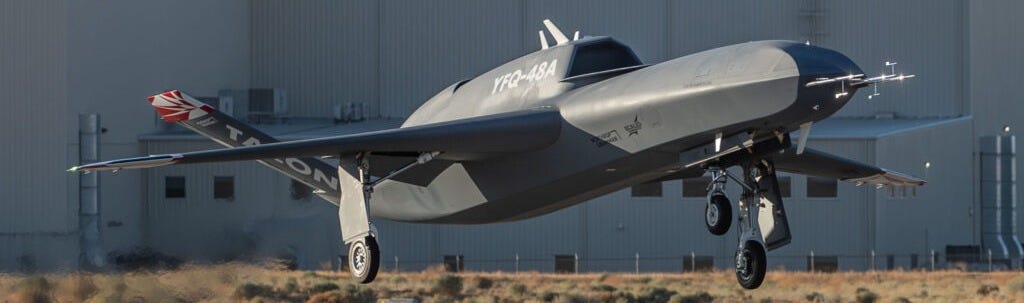
BLUF: Northrop Grumman’s internally developed drone wingman demonstrator Talon Blue has notched its first flight.
The YFQ-48A performed fully autonomous taxi, takeoff, in-flight maneuvers and landing over the Mojave Desert in California.
Northrop has internally funded the drone to date, after the company lost out on previous Air Force contracts for Collaborative Combat Aircraft drone wingmen.
Still, the government has expressed interest in the Talon Blue platform, and the Air Force has even designated the drone the YFQ-48A.
Northrop emphasizes the drone’s modular design and says its weapons bay can support a variety of missions.
Related: Northrop’s Talon Blue Collaborative Combat Aircraft Makes First Flight, Northrop Grumman’s YFQ-48A CCA completes first fully autonomous flight
DoW Announces $350M in Quantum Computing Initiatives
BLUF: OSW(R&E) announced new initiatives and programmatic updates totaling approximately $350M to strengthen U.S. leadership in quantum computing capabilities that support national security.
DARPA announced the advancement of four prospective quantum-computing providers to Stage C of the initiative, representing approximately $200M.
DARPA added Atom Computing, Diraq, IonQ, and IBM to Stage C Verification for its Quantum Benchmarking Initiative (QBI).
Advancing to Stage C means companies will move to physical testing of their fault-tolerant quantum computing (FTQC) architectures, and the initiative looks to roll out industrial-scale quantum computers by 2033.
OSC announced a $150M conditional loan commitment to support PsiQuantum's advanced manufacturing and prototyping capabilities in the U.S.
Related: IBM’s 100-qubit chip advances self-correcting quantum computers with 5,000 operations
Advances AI Strategy with Swarm Forge Autonomous Drone Initiative

BLUF: The DoW announced progress on Swarm Forge - Pace-Setting Project #1, a pioneering initiative serving as the proving ground for future robotic forces and the tactical operators who command them.
Launched in January 2026, Swarm Forge is a cornerstone of the Department’s AI Strategy, executing on the directive to accelerate America’s military Super Intelligence dominance through highly iterative, field-tested technologies.
Operating under the DRPM(UxS), Swarm Forge represents an operational shift from legacy procurement models.
The project establishes a continuous, hands-on combat season environment, where elite military operators, commercial technology innovators, and government experts co-develop software, hardware, and tactical concepts under real-world conditions.
This collaborative framework compresses the traditional acquisition timeline into a rapid, 90-day zero-to-deployment pipeline, taking cutting-edge drone capabilities straight from field testing to operational use by trained warfighters.
Swarm Forge sets the operational challenges, and companies compete and integrate alongside SOF operators.
The initiative began with over 130 competing companies. Through rigorous, continuous field testing, they narrowed the field to ~25 key industry partners.
America Is Unprepared for Autonomous Warfare
BLUF: America needs cheap drones and fast, but the harder problem is defensive. How do American forces operate when the sky above them is crowded with cheap, numerous machines that increasingly need no human at the controls?
In Ukraine and across the Middle East, cheap, mass-produced drones are changing the economics of warfare. Drones that cost thousands of dollars are doing work that once required great-power arsenals, forcing advanced militaries to spend millions of dollars to shoot them down.
The Pentagon is beginning to recognize this; in May it selected five domestic bases for a directed-energy counter-drone pilot program.
C-UAS systems traditionally cut the connection between the drone and operator, but now they can fly autonomously. The target is the machine itself: its airframe, its battery, its sensors, its navigation, and its ability to identify a target.
The Pentagon needs to make counter-autonomy a real mission. The Pentagon needs a single accountable home for buying and fielding systems that can defeat autonomous threats.
The Pentagon should buy systems that prove they can work in the real world. Contractors should be paid for demonstrated performance against maneuvering targets, swarms, and degraded conditions, not for polished briefings.
Washington needs to secure the supply chains beneath these systems before a crisis exposes them.
Exail Unveils New Maritime Surveillance Model
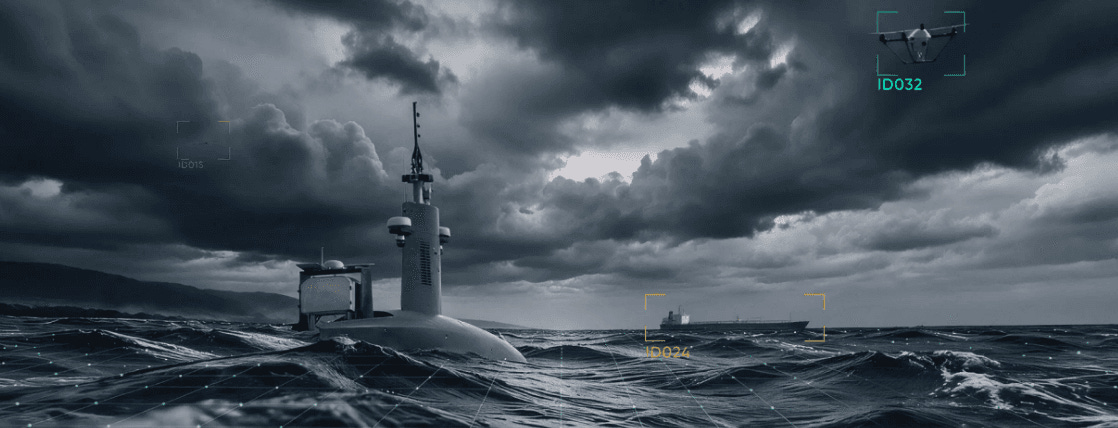
BLUF: Exail has unveiled Neptis, an integrated maritime surveillance system designed to coordinate uncrewed surface vessels (USVs), defense-grade sensors and a mission C2 system for naval operations.
Neptis is designed to support intelligence, surveillance and reconnaissance (ISR), anti-submarine warfare (ASW), critical undersea infrastructure protection (CUIP) and Counter UAS missions.
The system combines distributed sensors operating above, on, and below the water with autonomous platforms to provide naval forces with a broader operational picture.
What Are Humanoid Robots Actually For on the Battlefield?

BLUF: The near-term military value of humanoid robots lies in doing dangerous physical work inside environments, vehicles and infrastructure designed for human bodies.
The decisive test will be whether they can sustain the wider unmanned force at acceptable cost. Militaries should therefore treat humanoids as a specialized enabling capability, not a replacement army.
In the Q1 2026, Ukrainian ground robotic systems conducted ~24,500 missions.
China has also demonstrated a teleoperated humanoid that mirrored the movements of a human controller.
Humanoids can perform hazardous work in human-designed spaces.
Humanoids may provide a physical interface between commanders and autonomous systems.
Humanoids may become the maintainers of the unmanned force.
If one humanoid can turn around multiple UAVs or UGVs, establish a temporary launch site, or keep a robotic logistics detachment operating through the night, its value comes from the additional sorties and reduced human exposure it enables.
Humanoid robots should initially be attached to organizations that already understand specialized equipment: engineers, explosive-ordnance teams, logistics units, maintenance formations and unmanned-systems units.
Militaries should buy limited prototype batches, expose them to realistic field conditions and update hardware and software in short cycles.
Open interfaces for batteries, tools, payloads, control software and data links are essential; otherwise, each manufacturer will create a closed ecosystem that cannot support the mixed robotic fleets already emerging.
World’s First Drone to Reach the Stratosphere Climbs 34,245 Feet
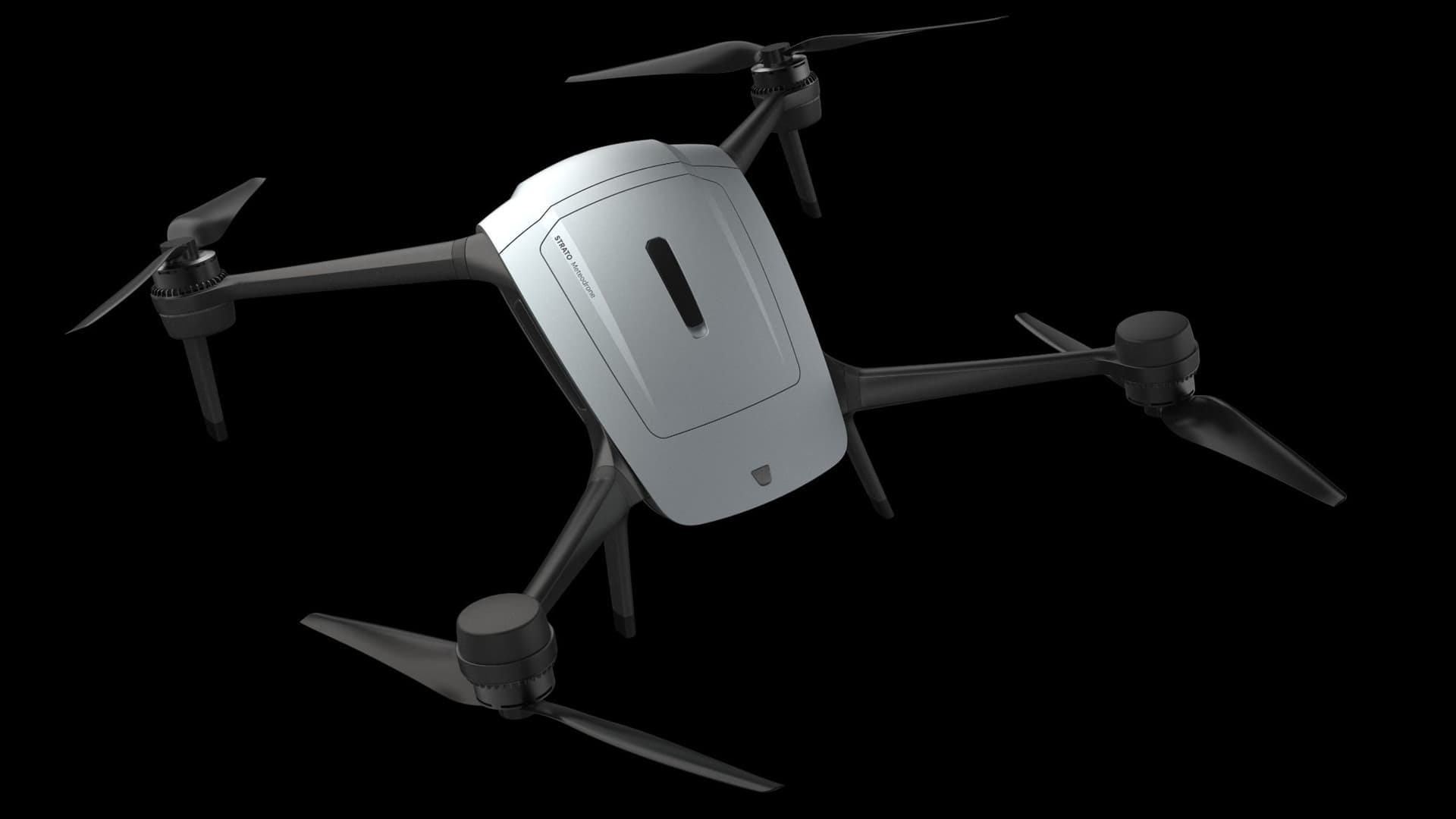
BLUF: Swiss weather technology company Meteomatics has unveiled a multicopter drone that it says reached an altitude of 34,245 feet (10,438 meters), allowing it to collect atmospheric data at heights normally monitored by weather balloons.
Called Strato, the aircraft is designed to measure temperature, humidity, air pressure, and wind speed as it climbs through different layers of the atmosphere.
Meteomatics claims it is the first multicopter capable of collecting atmospheric profiles from near the ground to the stratosphere.
The drone can withstand sustained winds of up to 80 mph and uses an active de-icing system to prevent ice from building up on its propellers.
These features are designed to keep it operating in the cold, windy conditions encountered at high altitudes.
Unlike conventional weather balloons, which drift with the wind and are generally not recovered for reuse, Strato can fly toward a selected location, collect measurements, and return to its launch site.
This allows operators to gather weather data when and where they need it.
Our Take: This also allows military operators to gather other data when and where they need it.
Hammers and Nails: Military Innovation as a Strategic Dead End
BLUF: Innovation has become an end in itself. It is crowding out the harder job of defining a strategy that is meaningful, justifiable and achievable.
Western militaries’ focus on disruptive innovation repeats an old institutional failure: the belief that technology can solve every military problem.
Promises of future technological advantage let political leaders put off hard decisions about force structure, spending, mass and risk.
Recent approaches, from the Third Offset through Multi-Domain Operations and JADC2, recast military effectiveness as a problem of speed rather than strategy, munitions production or political purpose.
Relying on proprietary commercial systems for command and control locks forces into specific vendors and weakens sovereign control of military power.
The challenge for Western forces is how to put innovation in service of strategy. Otherwise it becomes a solution searching for a problem.
State of AI 2026
BLUF: Agents are doing valuable work in software and science, physical AI is learning how to act in the world, and access and control are becoming more consequential.
The frontier is now a three-lab race between Anthropic, OpenAI, and Google. Anthropic leads on Artificial Analysis’s Intelligence Index, while Google leads on Arena’s ranking of the answers people prefer, for now.
AI is already helping build better AI. Claude led 26% of measured model R&D work. Researchers set the tasks and supervise execution, and Anthropic reports that this is speeding up development. This is the most exciting branch of AI research.
Broader pre-training is helping robots generalize to unfamiliar tasks. This is why I think robotics is approaching its GPT-2 moment, as new models, hardware, and data collection methods come together.
Three of our nine predictions for the next 12 months are:
An agent halves its failure rate on new tasks after a month of customer work, without a model upgrade. This will be a practical measure of continual learning.
An autonomous AI team beats human-led model research on equal time and compute, setting its own agenda. This will help us understand if models are capable of expressing better research taste than the best researchers.
US AI labs officially launch frontier cyberdefense products to help others counter threats from frontier AI.
H/T: Jack Shanahan
Other Defense Tech News:
Pentagon Recruits Drone Pilots from Across Services for Upcoming Competition
Behind the Front Line: Integrating AI Agents into Joint Force Support Functions

Drones, Missiles, and the U.S. Munitions Shortage
Philip Sheers and Stacie Pettyjohn

BLUF: CNAS report examines the potential utility of lower-cost long-range one-way attack drones or cheap cruise missiles for standoff strikes in a war against China.
In a potential war with China over Taiwan, the clearest and most strategically consequential application of low-cost drones would be to attrite the Chinese invasion fleet.
Affordable mass can also saturate air defenses and suppress coastal air bases, creating temporary windows in which U.S. forces can conduct offensive operations.
Recommendations for the DoW
Replenish stockpiles of high-end missiles and build them up to the levels that would be needed for a war with China.
Continue to fund, develop, and field extended-range, low-cost expendable munitions as a near-term priority.
Continue to invest in modular payloads for low-cost airframes and munitions.
Develop new operational concepts that pair cheap and high-end weapons into effective mixed attacks.
Emphasize producibility when developing new affordable mass weapons.
Recommendations for Congress
Appropriate funds for multiyear procurement contracts so that industry can expand its weapons production capacity.
Require DoW leadership to provide regular reports on the progress of its low-cost munitions programs as well as high-end missile stockpiles.
Require DoW leadership to brief congressional leadership on the tactical and operational effects of the LUCAS in Operation Epic Fury.
Our Take: Philip and Stacie reinforce the case for a high-low mix of weapons. The challenge is moving beyond promising prototypes to scalable production, modular designs, and operational concepts that deliver meaningful effects at a fraction of the costs. The DoW and Congress must align sustained funding, commitments, and industrial capacity across traditional and non-traditional vendors to produce these weapons in the quantities a prolonged conflict would demand.
Made-in-America Won’t Secure the Pentagon’s Supply Chain

BLUF: A defense contractor can know where a component was assembled and still have no visibility into the companies behind it.
Executive Order 14415 directs the DoW to develop deeper supply-chain mapping and supplier-vetting requirements for national-security acquisitions, including greater visibility into critical materials and the financial, ownership and manufacturing risks associated with suppliers throughout the chain.
A prime contractor may have thoroughly vetted its direct supplier without knowing that several upstream companies share a foreign parent or depend on the same manufacturer. Supplier certifications and questionnaires provide useful information, but they may leave significant gaps below Tier 1.
EO 14415 directs prime contractors and subcontractors at any tier to map critical supply chains from raw materials through finished products. It also calls for vetting suppliers for foreign ownership, control or influence.
Contractors need continuous monitoring to account for frequent changes.
Contractors should begin with the components, materials and programs where an upstream disruption or undisclosed relationship would have the greatest consequences. They must establish how far below Tier 1 their existing supply chain visibility extends.
A Made-in-America label can tell the Pentagon where a component was made. It can’t establish who controls production or where the source materials originated.
As defense supply-chain regulations evolve, contractors will need to demonstrate both.
The Factory Floor and the Balance Sheet

BLUF: What if the most important question in defense manufacturing is no longer simply how to produce more, but where to put the next dollar?
Washington is increasingly focused on production scale.
USD(A&S) Michael Duffey recently described scaling production as the next challenge for government and industry. Significant private capital has entered defense, but investment still has to become production if capability is going to reach the warfighter. He also emphasized factory expansion and credible long-term demand signals.
Deputy Secretary Steve Feinberg’s recent Fostering One Strong Industrial Base memorandum directs the Department to reduce government-unique accounting, audit, and compliance barriers, broaden competition, and rely more heavily on financial controls and audits companies already maintain.
These are creating the conditions for greater production and reducing barriers between defense and the broader commercial economy. Industry still has to convert demand and capital into output.
A&D manufacturers have invested heavily in digital engineering, connected supply chains, advanced production, automation, integrated planning, and increasingly AI.
The most financially efficient supply chain may minimize inventory. A resilient defense supply chain may deliberately carry more. The lowest-cost sourcing strategy may concentrate volume with one supplier. Resilience may favor a second source. The highest near-term return on capital may argue against excess capacity. Surge requirements may justify preserving it.
The leanest balance sheet is therefore not necessarily the balance sheet best suited to defense production. Nor is the factory with the highest utilization necessarily producing the most capability.
Traditional capital planning can evaluate the expected return from each investment. But a production system is more complicated than a collection of standalone projects.
Production schedules, equipment utilization, workforce availability, supplier performance, inventory, backlog, purchasing commitments, cash requirements, and capital plans all contain pieces of the answer.
The goal is therefore not the leanest possible enterprise. It is to deploy capital in a way that produces the required output with the right level of resilience.
The next industrial advantage may therefore belong not simply to the companies with the most capacity, the largest backlogs, or the greatest access to capital.
It may belong to those that understand their operating systems well enough to know what is actually limiting output and where incremental resources will create the greatest effect.
Our Take: Scaling defense production isn’t simply about building more factories or investing more capital, it’s about identifying and eliminating the constraints that actually limit output. The DoW must provide credible demand signals and flexibility, while industry must leverage data, AI, and integrated planning to direct investment where it delivers the greatest production gains. We’re hopeful for continued collaboration between the Department, industry, and investors to focus resources smartly.
LASS is More: Coordinating UAVs at Scale
Kevin Schaeffer and Sam McEntee
BLUF: LASS Is More explores the technologies reshaping unmanned systems across land, air, sea, and space (LASS). Across these domains, the emerging advantage is not simply smarter individual platforms, but the ability to field distributed systems that can operate together, adapt through disruption, and create effects at scale.
The next frontier for UAVs will be less about individual intelligence and more about integrating that intelligence into collective action.
Operational demand is increasingly moving toward proliferation: large numbers of lower-cost, often attritable systems, where mass, dispersion, persistence, and redundancy can create effects that individual platforms cannot.
The questions shifts from what one UAV can do to whether hundreds or even thousands of systems, built by different vendors, performing different roles, and operating in contested environments, can robustly and realistically coordinate toward a shared objective.
At scale, autonomy success is how machines communicate, allocate and prioritize tasks, adapt to disruption, interact with other systems, and remain aligned with human intent.
Scaling Autonomy Amplifies Three Problems
Communication: What information actually needs to move, and where does it need to go?
Coordination: Who decides what each UAV should do?
Resilience: What happens when the network breaks?
The result is a distributed decision-making enabled by resilient communications, distributed computing, and C2 architectures designed for groups of systems.
In a world of autonomous systems at scale, the advantage will not belong to whoever has the smartest drone, but to whoever can make thousands of them function effectively as one team.
OSC Announces $1.5B Conditional Loan Commitment to Wolfspeed
BLUF: OSC announced a $1.5B conditional loan commitment to Wolfspeed, Inc., a vertically integrated U.S. manufacturer of silicon carbide (SiC) wafers, SiC power devices, and gallium nitride (GaN)-on-SiC wafers. The proposed loan, combined with private capital, would help strengthen the U.S. supply chain for wide bandgap materials and power devices, which have critical military and commercial applications.
Our Take: This is the largest loan in OSC’s four year history.
Other Defense Industry News

DPCAP Implementation of Supplier Cost and Pricing Transparency
BLUF: The name of the memo is deceptive as this is a very broad directive for implementing a slew of contracting and acquisition reforms.
Review requirements reform in practice. Joint Staff review the Services’ and Military Departments’ implementation of requirements reform.
Accelerate acquisition transformation. A&S issue DoW-wide MOSA policy and the PAE Operating Framework.
CAS containment within existing authority.
Apply immediately the increased CAS thresholds.
Prevent shadow CAS.
Limit new CAS coverage pending Board action.
Make rapid commerciality determinations. Direct that commercial product and service determinations be completed within 15 business days of a request.
Extend use of other transactions. Within 45 days issue interim other transaction (OT) policy, followed by the full Guide reissue within 120 days.
Modernize profit policy. Within 90 days, initiate the DFARS rulemaking, eliciting industry feedback, to revise the Department’ s profit policy so that negotiated margins reflect value delivered, risk carried, and private capital invested - not merely cost incurred.
Require a basis for requirements. Every recurring review, checklist, data demand, or approval imposed below the FAR/DFARS will be annotated with the authority that requires it.
Modernize forward-pricing support. Direct that DCMA immediately work with DCAA to overhaul the approach to establishing and maintaining forward pricing rate agreements (FPRAs) consistent with this memorandum.
Implement supplier cost and pricing transparency consistent with the Aug memorandum.
Advance CAS coverage reform at the Board. Develop and formally transmit to the Cost Accounting Standards Board the Department’s proposals for various changes intended to support moving to GAAP.
Ensure audits are risk-based. Within 60 days, direct that the Department consider a contractor’ s audited GAAP financial statements and internal-control attestations before performing additional work.
Consolidate contractor business systems. Reduce contractor burden by relying on government-wide FAR property-stewardship duties and remedies, aligned with commercial practices and tools.
Implement Portfolio Acquisition Executive authorities. Within 120 days of the Framework’s issuance, each Component’s implementation plan will delegate those authorities.
Scale advance market commitments. Structure additional advance market commitments, including aggregated allied demand consistent with the America First Arms Transfer Strategy, building on the success of the Drone Dominance initiative.
Align the contract-oversight enterprise. Within 90 days, deliver options to the Deputy Secretary for clarifying roles and charters, eliminating duplication, and addressing workforce effects.
Measure results. Within 90 days, define and baseline: government-unique requirements eliminated | business units under full CAS coverage | business systems subject to review | audit and oversight cycle time | commercial content |
performers at production per program, paired with unit-cost and affordability effects | new entrants and returning commercial firms | declined 5 solicitations, where observable.
Our Take: While there is a lot to love in here from pushing GAAP, using AMCs more and modernizing requirements, there is also some extremely nuanced positions on cost and pricing that the general workforce is not going to find intuitive. We still fear that it will result in additional burdens being placed on new entrants and will make commercial procurement more complex.
Bonnie Evangelista to Lead Drone Buying on DRPM-UxS Team
BLUF: Longtime federal contracting professional Bonnie Evangelista recently moved into a new role at the Pentagon, according to sources who indicated she’s leading procurement in the office of the DRPM for Unmanned Systems.
That team will serve as a unique acquisition engine for military drone and counter-drone capabilities and help chart a path for a new functional, four-star U.S. combatant command focused on autonomous warfare.
Our Take: We’re big fans of Bonnie and wish her the best in this awesome new endeavor.
Pentagon Memo Outlines Plan to Operationalize New FORTRESS America Program Office
BLUF: As part of the government’s new plan to quickly secure domestic military assets and infrastructure against cyberattacks, sabotage, power grid failures, and foreign supply chain disruptions, the Pentagon’s acquisition chief on Tuesday initiated the process to set up the new FORTRESS America Program Office.
FORTRESS stands for Federal Operations for Resilience, Troop Resources, Energy, Supply and Survivability
It calls for every major military installation in America is going to generate its own power, independent of the civilian grid. It will also harden every installation on American soil against cyber intrusions, sabotage and drones.
Five foundational pillars set forth in Hegseth’s prior directive:
Space and spectrum resilience: Securing end-to-end mission assurance across space and electromagnetic domains by hardening satellite links; boosting positioning, navigation, and timing resilience; and integrating agile electronic protection to deny adversary interference.
Installation hardening and cyber resilience: Modernizing force protection, structural fortification, zero-trust industrial control systems, command-and-control, and continuity-of-operations architectures.
Energy independence: Ensuring resilient, sovereign, and uninterrupted power generation, distribution, and microgrid autonomy across all critical installations and operational nodes.
Supply chain and defense industrial base (DIB) resilience: Securing domestic and allied supply lines, mitigating single points of failure, and insulating critical materiel pipelines from disruption.
Strategic defense reserve: Building robust inventories, emergency capacity, and stockpile depth to sustain protracted military contingencies.
Our Take: These are fantastic goals and there has been forward progress in some areas. Doing this all at scale for every installation, every supply chain and every constellation is a massive undertaking that will require budget that DoW may not have or will get given all the other priorities. Pursuing it within available resources and prioritizing initial areas would still go a long way.
Autonomous Warfare Command Drone Acquisition
BLUF: The new command addresses the problem of converting money and tech into fielded capability quickly enough to keep pace with adaptation in combat.
DoW’s model of “warfighting acquisition” would move operational feedback, testing, and some spending decisions closer to the units employing the systems.
For suppliers, the emerging acquisition model could place greater value on rapid integration, software adaptability, and the ability to move quickly from operational testing to scaled production.
AutoWarCom could become the institutional mechanism that connects the Pentagon’s large autonomy investments to operational learning.
The announcement does not yet settle the key execution questions.
Authority over requirements, testing, budgets, sustainment, and acquisition remains distributed across the military services and existing DoW orgs.
The command’s impact will depend on which of those authorities it transfers, delegates, or shares.
Indicators to Watch
Congressional action establishing the command and defining its statutory authorities.
Selection of the four-star commander and clarification of the command’s relationship with the military services and the Direct Reporting Portfolio Manager for Unmanned Systems (DRPM-UxS).
Transfer or delegation of acquisition, test, budget, and requirements authority.
Project Agincourt competitions and operational demonstrations tied directly to follow-on procurement.
Technical standards for command-and-control, data exchange, and cross-vendor integration.
Evidence that operational feedback changes quantities, configurations, or software baselines within a single budget cycle.
Our Take: There will be a lot to watch here.
Unmanned Forces as a Service
Dan Madden and Dominic Ventimiglia

BLUF: Pentagon leaders should carefully consider the Ukrainian experience as they pave the way for the Autonomous Warfare Command. Ukrainian Unmanned Systems Forces (USF) are not simply conventional forces armed with unmanned systems.
Rather, they have evolved an organizational design and culture to optimize the employment of such systems at the tactical, operational, and strategic levels.
This includes not only traditional staff functions, but also intensive operations research and direct, real-time coordination with industry to enhance capabilities used today and shape the ones for tomorrow.
Tactics, techniques, and procedures have become increasingly sophisticated, multi-domain, and adaptive to techno-economic competition.
DoW has laid the foundations for scaling production of unmanned systems. DRPM UxS is unifying requirements, resourcing, and acquisition. OSC has been deploying capital to increase capacity for systems, components, and minerals.
A comparable level of effort is required in developing America’s unmanned forces.
The cancellation of the 173rd Airborne Brigade’s tactical unmanned systems battalion is symptomatic of the conservative attitude, as is the apparent lack of preparation for Iranian Shaheds in the U.S. war with Iran.
Simply copying Ukrainian practices is not a viable solution. The U.S. has different strategic priorities, competitive advantages, and operational challenges.
The current moment calls for a doctrinal transformation on the scale of AirLand Battle during the Cold War. Deferring transformation for readiness for the wrong kind of war would be strategic malpractice.
Our Take: This is a great piece, worth a full read. We couldn’t agree more with its conclusions. This is why we have argued that getting unmanned systems fielded even if they are not initially perfectly integrated and all the illities are not resolved is key because only then can the tactics and doctrinal transformation occur.

How the Army Fights
GEN Christopher LaNeve, Army Vice Chief of Staff
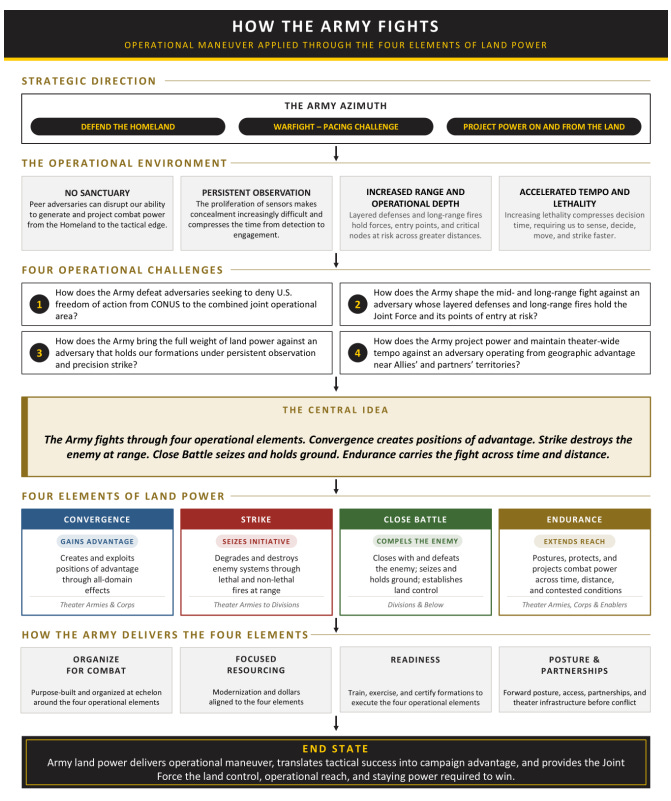
BLUF: The Army fights with interdependent elements of land power to deliver operational maneuver, and it serves as the foundation of the Joint Force. Against a peer adversary, tactical lethality alone is not enough.
War remains a human endeavor fought to achieve policy ends in a chaotic and dynamic environment.
How the Army Fights provides a modern framework for operational warfighting on and from the land, translating the conceptual depth of multidomain operations into practical warfighting guidance for combat.
The core thesis is that the Army fights with interdependent elements of land power to deliver operational maneuver while serving as the unbreakable foundation of the Joint Force.
Four elements of land power work together. Convergence and Endurance set the conditions; Strike and Close Battle deliver decisive outcomes.
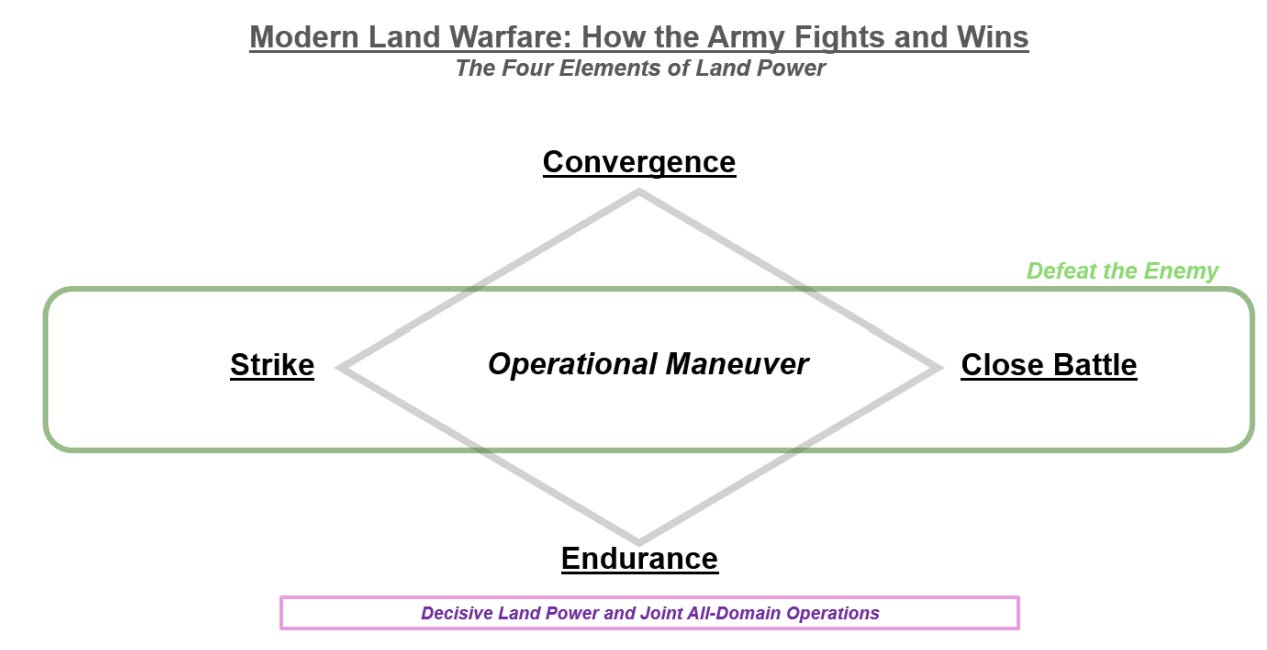
Battlefield transparency is not a given. Deception, dispersion and counter-reconnaissance can deny an adversary its picture of the battlefield.
Ground maneuver is not obsolete. Long-range fires degrade the enemy, but only ground forces can seize, hold and secure terrain.
The Homeland is not a sanctuary. Adversaries will target mobilization, rail, port and installation networks, so the Army has to protect power projection and harden installations.
Modernization has to be focused under a flat budget. That means a few priority capabilities, such as low-cost munitions, mobility and fleet simplification, with the Soldier staying at the center.
Our Take: This is required reading for all Army personnel and all who are developing solutions for the Army.
One Year In, Army’s FUZE Leader Eyes Bigger Acquisition Challenges
BLUF: After a first year focused on adapting prototype technologies for military use, the Army’s FUZE innovation hub is setting sights on more complex acquisition challenges in FY27.
The Army innovation hub's first year also revealed the challenge of making sure promising technologies don’t stop at the prototype stage.
FUZE is the service’s flagship venture-capital innovation engine designed to accelerate deployment of new technologies using pre-existing acquisition mechanisms.
FUZE falls under the Army’s Pathway for Innovation and Technology (PIT) portfolio.
FUZE’s overall goal is to find new tech and deliver it to the warfighter faster. Their first year also showed the challenge of making sure promising technologies don’t stop at the prototype stage where they can fall into the ever-dreadful tech valley of death.
That prompted the organization to focus on getting Army acquisition officials involved earlier to create a clearer path toward procurement in FY27.
FUZE is allocated $750M in annual, non-dilutive RDT&E funds.
“A lot of what we’ll see in FY27 is leveraging mechanisms within the Army FUZE portfolio to address bigger Army acquisition problems, and I think again this demonstrates that the Army recognizes we need to diversify the defense industrial base.
We need to incentivize innovation, and we need to invest in emerging or bleeding-edge capabilities to stay ahead of the rapidly evolving threat landscape … or how fast war is changing.” Matt Willis, FUZE Director
Army Awards Anduril $1.8B Five Year Contract to Expand NGC2
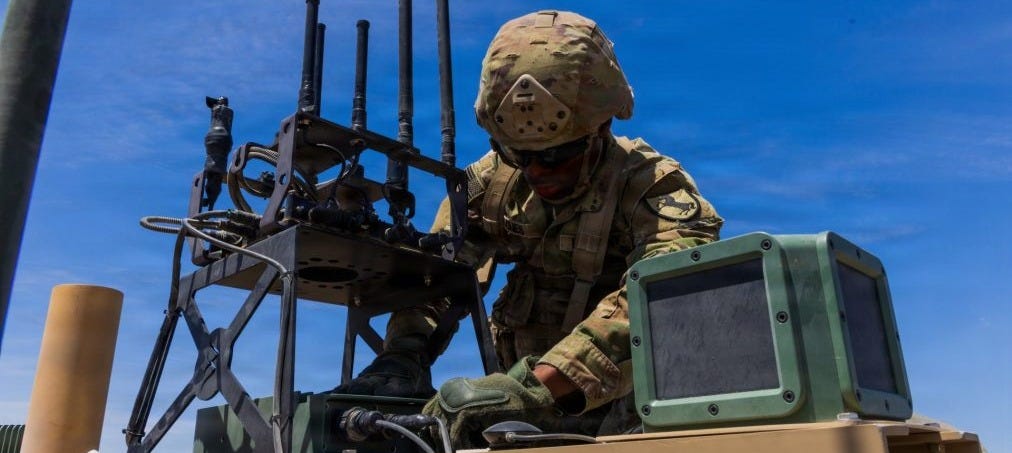
BLUF: The Army awarded Anduril a contract worth up to $1.8B over five years to expand the Next Gen C2 ecosystem to additional units.
The contract marks the latest signal for the Army’s expansion of NGC2, an ecosystem of interconnected hardware and software underpinned by Anduril’s Lattice software platform.
The contract includes a $162.8M base period, which is focused on expanding NGC2’s common data layer to I Corps. The Army chose Anduril to lead its common data layer baseline for NGC2 in June.
The contract marks the latest signal for the Army’s expansion of NGC2, an ecosystem of interconnected hardware and software underpinned by Anduril’s Lattice software platform.
The idea is to give commanders the ability to quickly exchange data and make decisions through an ever-evolving suite of sensors, AI programs and other advancing technology.
Anduril Continues to Scale Next-Generation Command and Control Across the Army
Army Issues Just Under $100M in Application Awards for NGC2 to 9 Companies
BLUF: The Army awarded nine companies contracts collectively totaling around $93.6M to supply applications in support of the Next Generation C2 effort, the latest move in the service’s effort to field the technology as it scales to the corps level.
The companies include General Dynamics Mission Systems, Air Space Intelligence Federal, Immersive Wisdom, LMI, Mente Systems, Stilman Advanced Strategies, Onebrief, Rune Technologies, and AIR (formerly Govini) with contracts for an initial one-year period.
The applications will enable critical software capabilities that will be delivered to I Corps in the Pacific, which is the first fielding organization for NGC2, and will perform functions across six warfighting areas: C2, Fires, Intelligence, Movement/ Maneuver, Sustainment, and Protection.
“Providing core software applications is a critical next step. It provides a foundation that can be rapidly scaled and trained with continuity across the force.” Joseph Welch, PAE C2/CC2
Despite Unclear Delivery, Army’s Next-Gen Rotorcraft Flies Forward

BLUF: The Army’s MV-75 Future Long-Range Assault Aircraft program has promised an aircraft that will go twice as far and twice as fast as any in their fleet and revolutionize Army aviation.
Army leaders have deemed the platform so important they have pushed to accelerate its delivery. While a concrete fielding date remains uncertain, the story is not the day it will arrive, but what it will bring when it does.
The Cheyenne II will eventually replace Sikorsky’s battle-worn UH-60 Black Hawk, which first entered service in 1979.
The platform is intended for vertical lift, air assault, maritime interdiction, aeromedical evacuation, combat search and rescue, humanitarian relief and tactical resupply.
It has embraced a modular open systems approach that has given the aircraft a digital backbone built to evolve. The Army can rapidly integrate new technologies, adapt to emerging threats and avoid the cost of redesigns of the past.
Digital design has allowed the program to do some unique things in its acquisition approach, such as removing the gaps between test aircraft, development, prototyping and production.
“The aircraft combines the vertical lift of a helicopter with the speed and range of an airplane, allowing the Army to project combat power from safer distances, penetrate deeper into contested environments and deliver soldiers where they are needed faster.” Brent Ingraham, Army SAE
“It not only enhances the lethality, but also revolutionizes our aircraft design and construction through the advanced open architecture and model-based systems engineering.” MG Clair Gill, Former PAE Maneuver Air
Blackbeard Hypersonic Missile Shown Fired from Ground Launcher
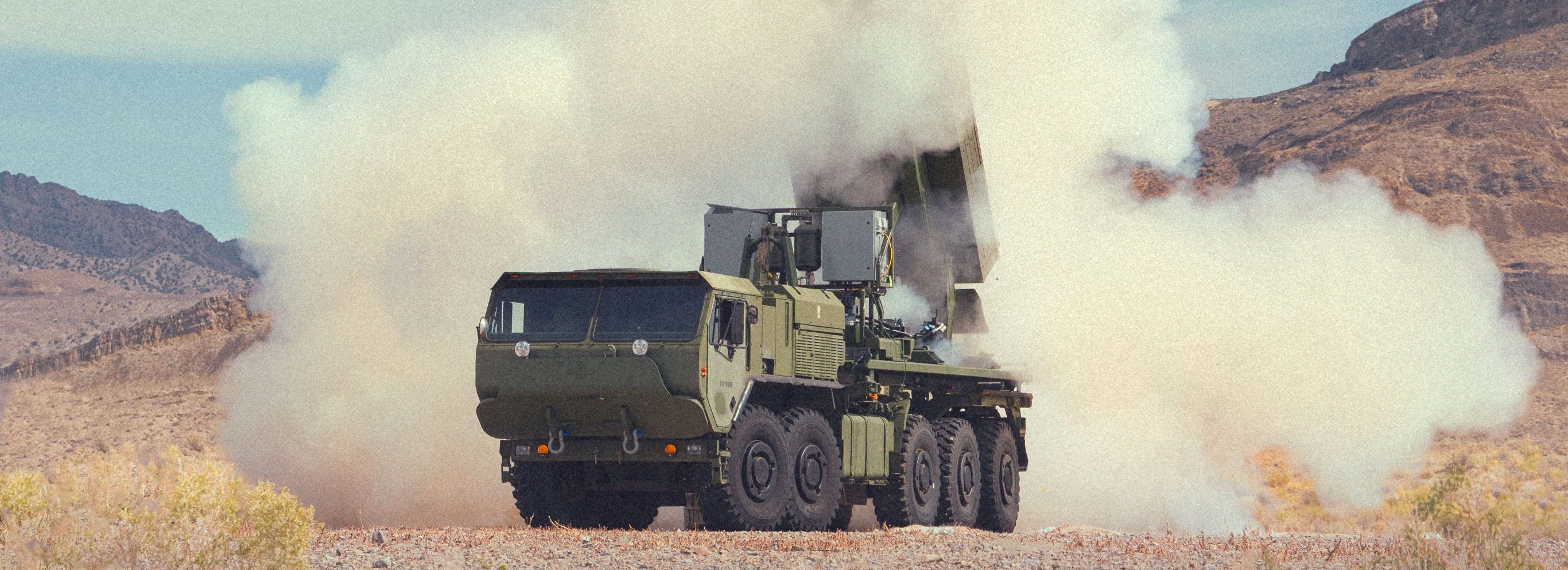
BLUF: Castelion released what appears to be the first image of its relatively ‘cheap’ Blackbeard hypersonic missile being fired from a ground launcher, providing a new look at the containerized launch architecture now under development for the Army.
The photo shows a Blackbeard missile leaving a launcher mounted on a high-mobility truck chassis. While the missile itself is by now a familiar sight, the new image offers a first public glimpse of how Castelion intends to package and operate the ground-launched version of Blackbeard, known as Blackbeard GL.
The Army’s FY27 budget documentation indicates that this effort is moving toward increasingly representative hardware. Among the milestones listed for FY27 is a live-fire launch of a production representative Blackbeard GL and launcher pod.
The launcher appears to use a relatively compact enclosed container, consistent with the Army’s stated interest in leveraging the existing MFOM ecosystem and, eventually, HIMARS.
Army Tests Autonomous Mules for Frontline Resupply and Evacuation
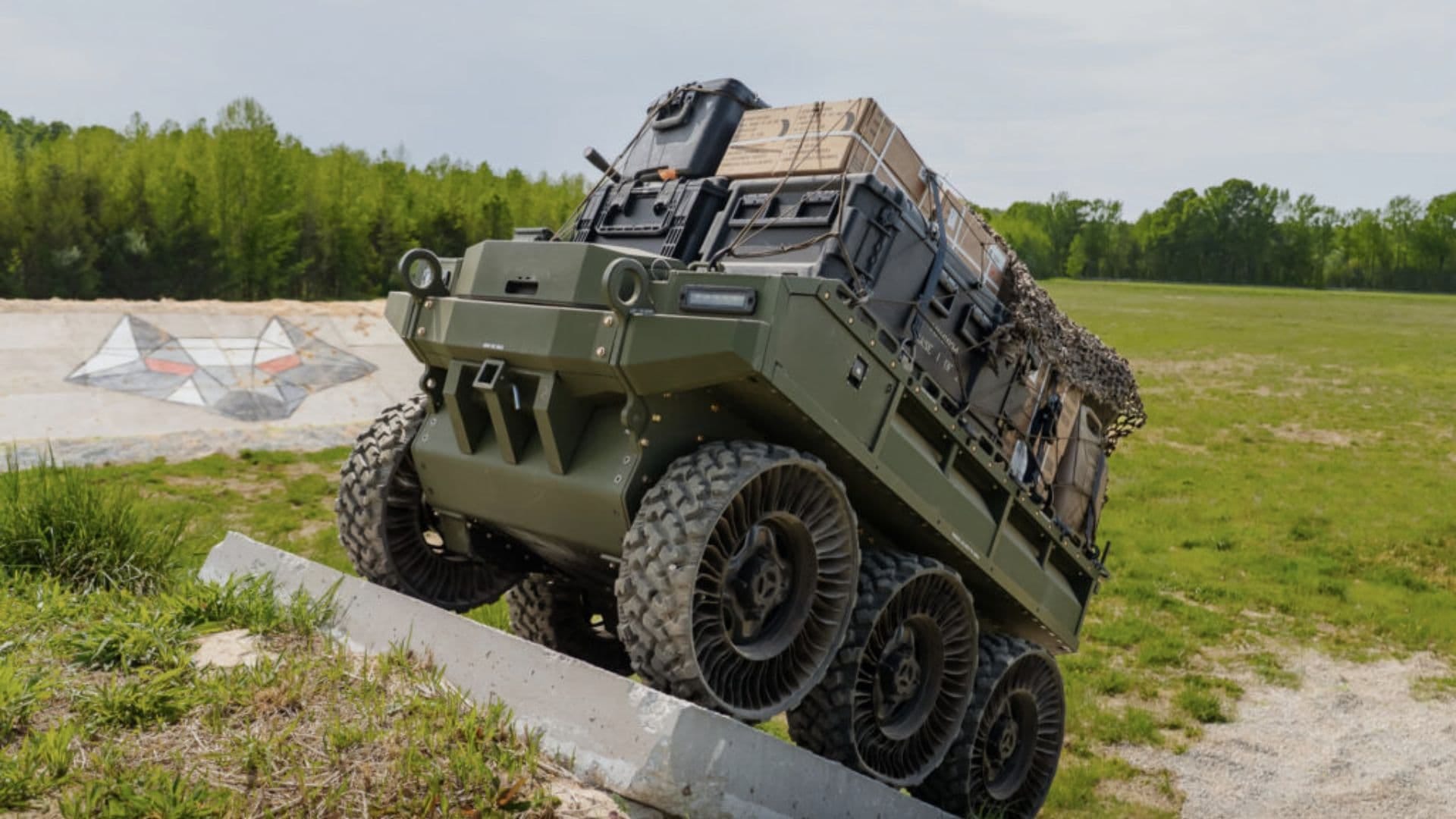
BLUF: The Army has selected six companies to develop production-ready robotic vehicles for a program to automate one of the most dangerous logistical tasks on the battlefield: moving supplies and evacuating casualties close to the front line.
BLADE is one of the six companies selected for the Army’s Infantry Last Tactical Mile (ILTM) initiative. The company has submitted its Hunter WOLF unmanned ground vehicle (UGV), a six-wheeled diesel-electric hybrid designed to support light and dismounted infantry.
The other participants are Maren-Go, Overland AI, Forterra, Hendrick Motorsports, and American Rheinmetall.
The Army selected the companies through prototype OTA. The companies are expected to provide production-ready prototypes for demonstrations and an operational assessment with an Army unit in early 2027.
The results of that assessment are intended to help the Army determine the requirements and inform a potential production decision for its next generation of autonomous infantry support systems.
Related: 2,800-lb unmanned vehicle with higher payload, weapon firing system to showcase battle power
AM General Is Giving the Humvee a High-Tech Second Life
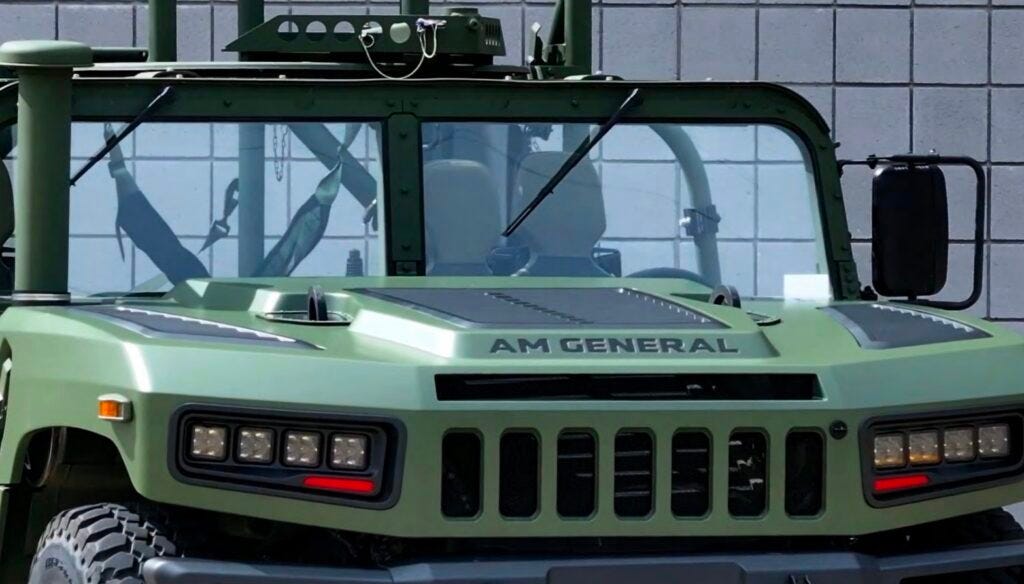
BLUF: AM General is overhauling its four-decade-old Humvee with a mix of new hardware and digital capabilities to bring the iconic military vehicle into the modern era.
The upgrade is divided into three main phases, starting with a more powerful 250-horsepower engine, an improved transmission, and long-travel suspension.
The engine delivers more than 745 newton-meters (550 pound-feet) of torque and can run on JP-8 jet fuel, F-24, and conventional diesel.
The second phase focuses on ergonomics and comfort, adding a modernized dashboard and scalable armor to the platform.
The final phase brings the most significant technology upgrades, including drive-by-wire controls, health monitoring, and autonomy-enabled capabilities.
To Counter Drones, Army Must Get Out of Its Own Way
BLUF: The Army lacks an acquisition system that can convert battlefield urgency into fielded capability before the threat changes again.
The Army knows it must move faster, but its own processes, requirements, funding pathways and demand signals often slow down the development of the capabilities it says it needs.
None of that argues for abandoning discipline, testing, requirements or accountability.
Speed emerged as the dominant acquisition challenge. Stakeholders pointed to several contracting pathways built for velocity.
For companies deciding where to invest, credible demand signals matter. Programs of record, appropriated funding, budget requests, RFPs, contract awards and technical roadmaps justify production capacity and private capital.
A better approach would define the operational problem while preserving room for iteration. The Army should tell industry what must be achieved, not dictate every technical answer.
Counter-UAS demands clear outcomes, open architectures, user feedback and regular refresh cycles tied to threat intelligence and field performance.
Speed and rigor do not need to be opposing choices. The Army needs a counter-UAS acquisition model in which rigor happens earlier, continuously and closer to users.
A faster model would include stable problem statements, open systems, soldier feedback, standing test opportunities, rapid contracting pathways, clear transition gates and honest communication about what the Army will and will not buy.
If the Army wants to defend against drones at battlefield speed, it must stop making industry guess what matters, stop allowing prototypes to stall without transition and stop treating integration as an afterthought. To go fast, the Army does not need to lower the bar. It needs to clear the path.
Our Take: Fully agree. This is where JIATF-401 and potentially the new Autonomy PAE can act. Army leadership must still take bold action to enable greater speed and agility across acquisition, requirements, and budget systems. There are many bureaucratic areas ripe for streamlining and elimination while delegating decision authorities to the lowest practical levels.
Army Eyes Critical Gallium for Jets, Missiles in Gold Mine Waste After 40-Year Gap

BLUF: The Army has recently launched a novel initiative to recover gallium, a critical mineral used in fighter jets, military radars, and advanced electronics, from gold mine waste after nearly 40 years without domestic primary production.
SAFE Structure Designs is developing a pilot project to recover gallium at the request of the US Army Corps of Engineers. The project will test new equipment to recover gallium from US sources, including waste left behind by gold mining.
After Developing Pentagon’s Counter-Drone Marketplace, Kaizen Nabs $49M IDIQ From Army With First Task Order for Classified Work
BLUF: Kaizen won a five-year Army IDIQ enterprise agreement worth up to $49M through the Digital Capabilities Contracting Center of Excellence, with a first task order of $43M over five years for classified workflows.
Delivered through the Army’s Digital Capabilities Contracting Center of Excellence (DC3oE), the award allows select Army organizations to use Kaizen’s application layer system, one meant to streamline typically clunky military workflow tools.
Kaizen’s product is based on two systems: its Taproot tool, which provides the building blocks for various workflow functions such as identity verification, data reporting, payments and scheduling.
The other is Blacksmith, an AI tool that turns customer requirements into the architecture, configuration, and data model for a working application.
Army Activates New Multi-Domain Task Force to Deny, Disrupt Enemies in Indo-Pacific

BLUF: A new Army multi-domain task force, one of five recently established or under development, was activated this week with a ceremony at Fort Carson, CO.
The 4th Multi-Domain Task Force will focus on synchronizing long-range precision fires in the Indo-Pacific region to deny, disrupt and disaggregate adversary capabilities and create advantages for other units in the joint force.
The task force includes four battalions and is planned to grow to 2,100 soldiers.
“While we build this formation to deter aggression and preserve peace, if war comes, we must be prepared to fight and win. We owe those in harm’s way every advantage we can give them, while leaving our enemy nowhere to run and nowhere to hide.” COL Hugh Jones, Task Force Commander
Other Army News:


Ursa Major Wins $137M Contract for CAAM and NMM Rocket Motors
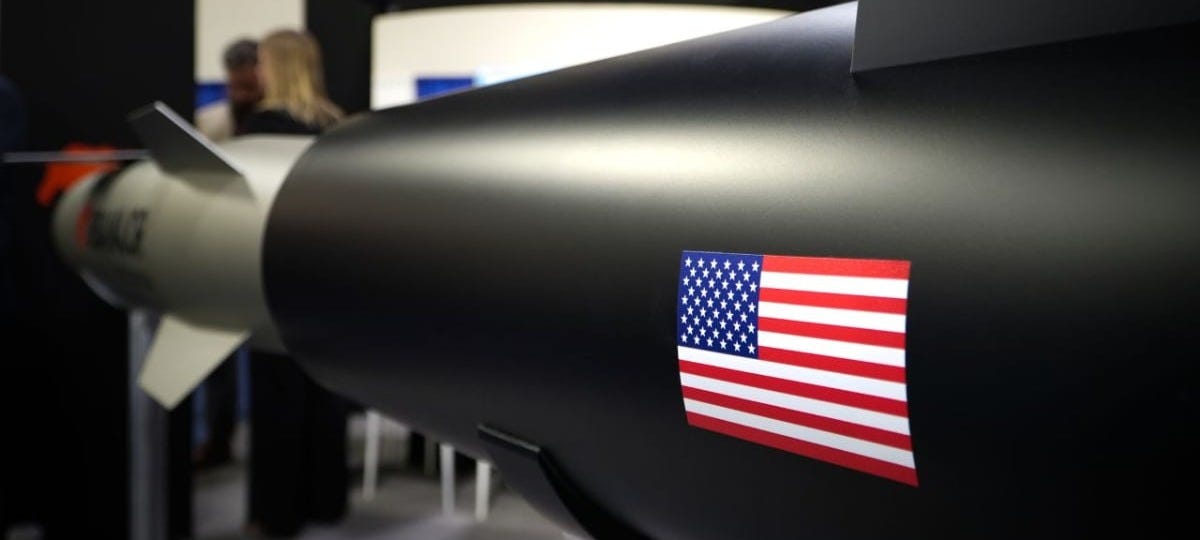
BLUF: The Navy awarded Ursa Major two contracts worth a combined $137M to develop and qualify solid rocket motors for the Compact Air-to-Air Missile (CAAM) and Naval Modular Missile (NMM) programs.
Funded through the OUSW, the awards cover motors for the CAAM, an air-launched missile program, and the medium-range variant of the NMM.
Ursa Major will use its Lynx manufacturing approach for both efforts, which incorporates additive manufacturing techniques and is intended to increase energetics production capacity.
Under the $91m CAAM contract, Ursa Major is developing a 7in solid rocket motor using Highly Loaded Grain propellant.
The $46mNMM work covers a 10in solid rocket motor for the missile’s medium-range variant.
“Navy and OUSW are building solid rocket motor capacity now and getting new tactical air and naval capabilities into development sooner. Our Lynx manufacturing approach and growing energetics capacity enable us to design, build, test, qualify and field these motors faster to support the warfighter. Production is the bottleneck in missile programs right now, and that’s the part we’ve been building for.” Jason Meredith, Ursa Major Solid Missile Systems President
Related: Ursa Major Lands $137M to Develop Solid Rocket Motors for Navy Missiles, Navy taps advanced 3D-printed rocket motors for next-generation missiles Ursa Major Lands $91M to Power a Mini Missile for F-35s
National Commission on the Future of the Navy

ADM James Kilby and Gen Bradford Gering testified to the National Commission on the Future of the Navy. Summary of their remarks.
Funding flexibility: Navy and Marine Corps leaders asked for broader multiyear procurement, incremental funding beyond carriers and submarines, and multi-year FSRM money. FSRM is currently one-year money and often expires before it can be put on contract after a CR.
Right to repair and industry accountability: The Marines want the IP rights and test equipment needed to fix components at the edge instead of sending them back to CONUS. Both leaders called for the same oversight of industry cost, schedule, and performance that Congress applies to the Services.
Unmanned systems: The VCNO said the Navy remains platform rich and enabling technology poor and has stood up a RAS warfighting development center under Fleet Forces, but he is not satisfied with progress. Both leaders said attritable systems should be bought to a warfighting effect, not to a lifetime buy target like a 40-year MDAP, and should use standardized controls and interfaces.
Readiness and logistics: Deployment extensions for Operation Epic Fury are inflating combat surge ready rates, and the maintenance bill will come due when the ships return. Contested logistics priorities are reloading VLS at sea for the Navy and, for the Marines, prepositioning plus a family of lift platforms including LSM and autonomous low-profile vessels.
Industrial base: The VCNO said he would rather have shipbuilders producing independently in competition than in teaming constructs, and pointed to a new Baltimore submarine parts facility as the kind of capacity needed. Both leaders were optimistic about new entrants supporting a high-low munitions mix, but said legacy primes still have to deliver.
Navy Equips Australia With New Digital Test Range to Advance Autonomous Collaborative Platforms

BLUF: The Naval Air Warfare Center Aircraft Division (NAWCAD) is accelerating the deployment of autonomous collaborative platforms for U.S. and allied forces following the delivery of a new digital test range to the Australian DoD, designed to test unmanned systems in virtual flight.
NAWCAD, which has successfully scaled digital test and training ranges across the DoW, recently delivered the first version of the new range, a framework known as the Joint Digital Autonomy Range (JDAR).
Historically, evaluating new aircraft required expensive, complex, and time-consuming physical flights. The JDAR framework replaces much of that overhead with an advanced simulated environment where engineers can safely analyze how autonomous software and flight maneuvers react to diverse, high-threat scenarios.
This virtual environment is critical for building trust between human pilots and unmanned wingmen before they fly real-world missions.
While the JDAR framework is the digital range’s foundation software, NAWCAD plans to significantly upgrade Australia's capabilities with an autonomy-enabled unclassified Joint Simulation Environment (JSE).
“In the future of aerial combat, unmanned systems will fly wing-to-wing with crewed fighters, and our aviators must be able to trust those systems implicitly. A digital test range provides the secure environment to test and trust these technologies before flight, ultimately improving readiness and protecting warfighters.” RADM Todd Evans, NAWCAD Commander
Navy Sends First Crewless Ship of Its Type to Sail with the USS Theodore Roosevelt
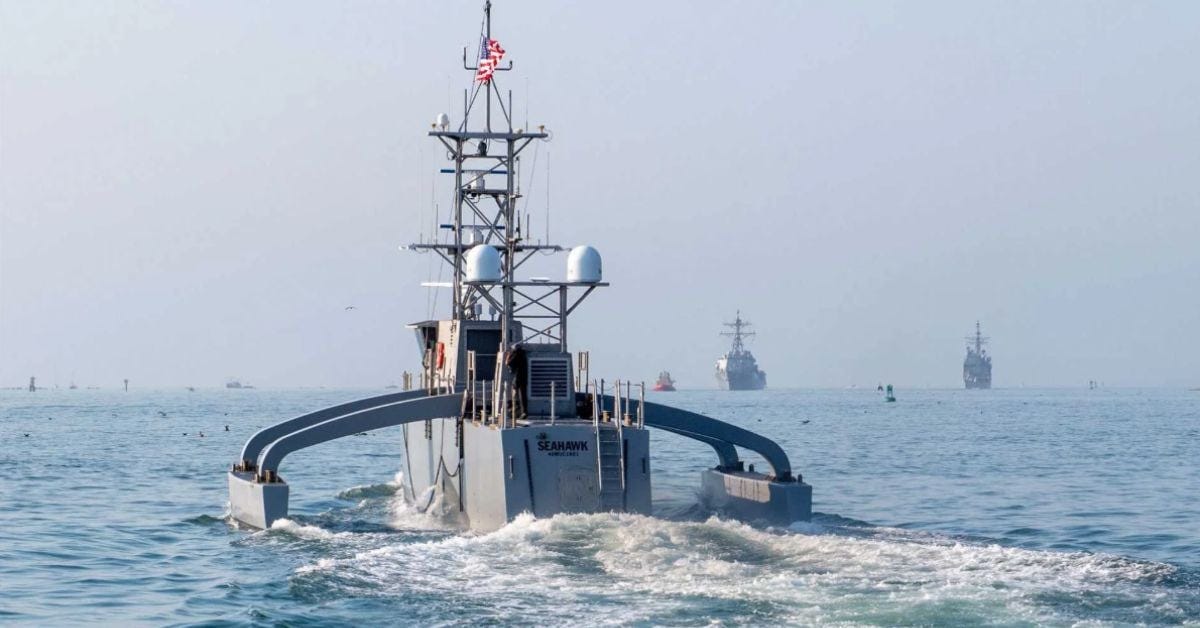
BLUF: For the first time in U.S. naval history, an unmanned surface vessel has been deployed with a carrier strike group in a sustained deployment.
The vessel is the Seahawk, which is sailing alongside the Navy’s aircraft carrier Theodore Roosevelt across the Pacific Ocean as part of Carrier Strike Group 9.
The entry of an unmanned vessel into the carrier strike formation that undertakes combat missions is of great importance for the Navy.
This would give the service an opportunity to gather data regarding the integration of Seahawk’s autonomous systems, its C2 systems, and other features with the other vessels of the group.
While Seahawk does not provide extra ammunition, it acts as an autonomous surface component to this formation, coordinating with it throughout the operation by seamlessly interpreting and predicting the changing operational requirements without having a crew onboard.
The MUSV Seahawk utilizes Leidos Autonomous Vessel Architecture (LAVA) for navigation, avoiding obstacles and completing designated missions.
Unmanned Warfare Has Now Expanded to the High Seas. Is the U.S. Ready?
VADM Michael Connor (ret.) and Yoni Tobin
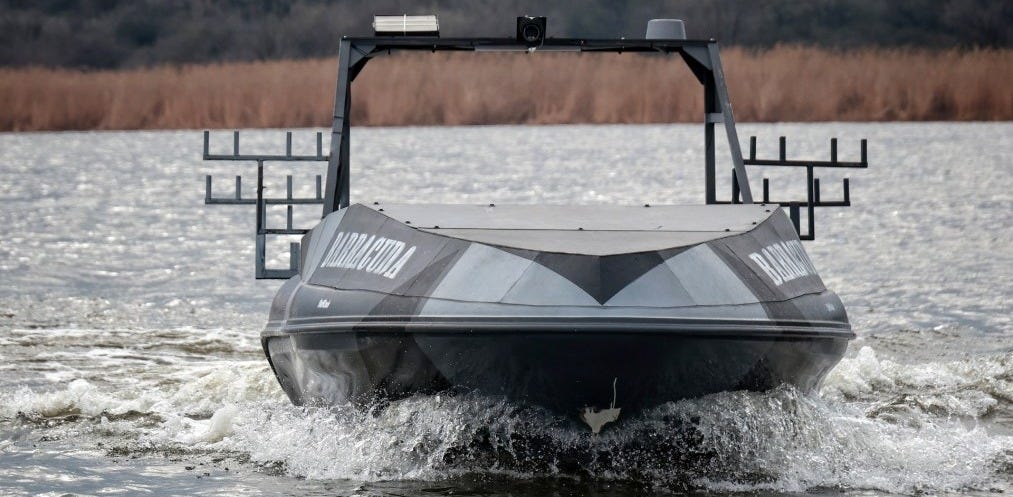
BLUF: Drone warfare is expanding from the skies to the seas, and the U.S. must be ready. From the Russia-Ukraine war with the first naval battle in history between unmanned boats to USVs striking Iranian facilities and rescuing Army pilots.
Accelerated U.S. efforts, not complacency, are needed to build on this recent tactical success. Greater strategic imagination is the first step. The Pentagon needs to think bigger about unmanned military platforms, but also smaller.
Thinking smaller means complementing high-end platforms with inexpensive, expendable ones. Thinking bigger means integrating them into a single network with manned assets and human warfighters.
Today, the U.S. military does neither at scale.
Expendability has its own currency.
Unmanned platforms offer more than strike or surveillance functions.
Take, for example, the since-axed UCLASS program to build carrier-based surveillance-and-strike drones. Due to a lengthy requirements list, the project became unsustainable. That is subtraction by addition. Now, the Navy is developing the MQ-25 Stingray, an unmanned aerial refueler, a simpler platform meeting a more fundamental need.
The Pentagon’s unmanned advances must be complementary, but currently are not. This is the think bigger half of the equation, and what makes the first two lessons pay off.
To prevail in a hypothetical Pacific war, American forces must have persistent adversary surveillance. Currently, that interconnectivity is lacking, impeding readiness. Surveillance drones cannot directly communicate with nearby submarines or USVs, nor fuse data into a common operating picture.
Innovating in the unmanned domain will require the Pentagon to be more imaginative in how it acquires, tests, and links its manned and unmanned platforms.
That requires thinking smaller, by acquiring more expendable unmanned systems, and thinking bigger, about operationalizing a joint-domain network.
Navy Doubles Down on X-BAT VTOL Fighter Drone Development

BLUF: Shield AI says it is on track to roll out the first prototypes of its X-BAT jet-powered stealth fighter drone by the end of this month.
Flight testing of this uncrewed aircraft, designed to take off and land vertically from a tail-sitting position, is still scheduled to kick off before the end of the year.
X-BAT’s core concept was already highly ambitious, but an extremely aggressive timeline to reach some degree of operational capability through the Navy’s Runway Independent Maritime Expeditionary Strike (RIMES) program has now been disclosed.
Shield AI received an additional $150M in funding from the OUSD(A&S) through its Defense Exportability Features program via the Navy. This is on top of the $50M investment the Navy, in cooperation with DIU, made in X-BAT’s development earlier this year as part of the RIMES effort. Shield AI committed an equivalent amount of internal funding, for a combined total of $400M.
“In broad strokes, the last year has been a bunch of collaborative risk reduction with the Navy. So, wind tunnel testing, engine testing, thermal testing, all kinds of stuff to basically take the major risks in the program, and burn them down, so we can move confidently into the production design. The last culmination of the risk reduction is the flight testing of the two full-scale prototypes. The first one of those will be done at the end of October.” Armor Harris, SVP and GM of Shield AI Aircraft Division
Related: Navy, Shield AI Pour Big Bucks into X-BAT Drone Development
Navy’s New Booster Uses Modular Design to Support Faster Missile Production

BLUF: X-Bow Systems won a potential $69.7 million agreement to develop a solid rocket motor booster for a future U.S. Navy weapon.
The propulsion developer will design, test, and qualify the motor under a two-phase program. The Navy plans to field an initial version of the weapon in early FY31.
The award comes with $50.4M for development and another $19.3M qualification option. The government has obligated $50M for the first 12 months of work.
The motor will support a common architecture intended to replace single-purpose interceptors. Some versions could also carry more interceptors within each launch system.
That architecture puts the booster at the heart of a broader effort to increase the Navy’s missile capacity.
X-Bow plans to use its Modular Motor Architecture for the program. The approach allows engineers to adapt propulsion designs for different military applications.
Navy Awards $743 Million for SLCM-N Nuclear Cruise Missile to Improve Deterrence Against Russia and China

BLUF: The Navy's Strategic Systems Programs awarded five prototype agreements valued at $743.57M to advance the Nuclear-Armed Sea-Launched Cruise Missile program.
These contracts task major defense contractors with designing and testing missile flight-integration systems and launch canisters compatible with Virginia-class attack submarines.
The program aims to field a non-strategic sea-based deterrent to address regional low-yield nuclear capabilities held by adversaries like Russia and China.
The SLCM-N would fill a deterrence gap after the Tomahawk Land Attack Missile-Nuclear (TLAM-N) was retired in 2013.
The agreements cover three development teams to compete in developing the actual missile and its flight-integration systems (Leidos subsidiary Dynetics, Raytheon, and Northrop Grumman), as well as two launch-canister suppliers (Northrop Grumman Mission Systems and Pacific Engineering), with work scheduled through December 31, 2027.
These awards task the contractors with designing and prototyping the SLCM-N Launcher Subsystem, which will be physically integrated with the Navy's Virginia Payload Tubes (VPTs) and be connected with the Virginia-class submarine’s shipboard systems, providing a nuclear strike option separate from the Trident II D5 ballistic missiles carried by Ohio-class submarines.
The effectiveness of a submarine-launched nuclear cruise missile would depend on whether U.S. attack submarines could reach suitable launch areas while remaining undetected and whether the missile could penetrate defenses protecting its intended target.
USS Arleigh Burke Enters Dry Dock in Spain, Expanding Navy’s Forward-Deployed Maintenance Capability in Europe

BLUF: Arleigh Burke-class guided-missile destroyer USS Arleigh Burke (DDG 51) entered dry dock at the Navantia shipyard in Cadiz, Spain, marking the first such evolution in the U.S. 6th Fleet area of operations since the arrival of Forward Deployed Naval Forces – Europe (FDNF-E) destroyers.
Throughout the availability, Forward Deployed Regional Maintenance Center U.S. military and civilian maintenance personnel and ship’s crew are working alongside industry partners at Navantia to execute planned maintenance and modernization.
“The dry docking of Arleigh Burke is a major milestone in expanding U.S. Navy forward-deployed maintenance capabilities in Europe. By integrating dry docking into planned maintenance periods overseas, the Navy is increasing material readiness for our forward-deployed warships.” VADM. J.T. Anderson, Commander, U.S. 6th Fleet.
The New Federation of American Shipyards

BLUF: Pressure to deliver ships faster is pushing the Navy’s major yards to farm out modules to smaller shipyards, with the Navy aiming to move distributed work from ~10% of shipbuilding to 50%.
The Navy and White House are pushing work out of the major assembly yards (Ingalls, Newport News, Bath Iron Works, Electric Boat) to smaller yards such as Austal USA, Eastern Shipbuilding, and Rhoads. The approach is known as distributed or federated shipbuilding.
Every class of battle force ship in production is taking longer to build:
Attack submarines: 10 years, up from six in the 2000s
Destroyers and big-deck amphibs: nine years, up from five
Aircraft carriers: close to 15 years
Austal is finishing its 400,000-square-foot Module Manufacturing Facility 3, a $450M Navy-funded site that is expected to produce 1 million labor hours a year by 2027 across four module types for Virginia- and Columbia-class submarines.
Austal is building control room modules for two Block V Virginia-class boats, which are barged to Electric Boat in Rhode Island. The modules have needed some rework but have been a net positive for EB, according to sources familiar with the program.
Austal has a reputation for quality work but has dealt with management turnover, underbid contracts, and a federal investigation. Its Australian parent company is selling it. After 20+ years of building aluminum ships, the yard’s 3,000 workers now focus mostly on steel.
Ingalls has Navy approval to send up to 37 of the 78 blocks of an Arleigh Burke-class destroyer to a network of vetted yards:
Eastern Shipbuilding and Gulf Copper built four blocks for DDG-135 in a pilot
Eight-block pilot planned for LPD-32, with more modules to be outsourced for LPD-33
The U.S. shipbuilding workforce has fallen 40% since 1977, and Gulf Coast yards compete for the same workers.
The risks are real. Australia’s Hobart-class program suffered delays after a keel block was built to the wrong dimensions, and late bow and stern modules contributed to a nearly two-year delay on the future USS District of Columbia.
Gulf Coast yards built for the offshore oil and gas industry have capacity and are eyeing government work.
“You can see the black dots are our major shipbuilders, and then outsourcing sites in blue. We want more blue dots.” - RADM Casey Moton, PAE Maritime
Drone Flights Take to the Skies for USS Eisenhower Inspections
BLUF: Norfolk Naval Shipyard (NNSY) alongside Naval Facilities (NAVFAC) Engineering and Expeditionary Warfare Center (EXWC) partnered with the CVN 69 team and Naval Station Norfolk (NSN) to leverage UAS to assist with inspections of the carrier.
“We were able to launch our drone and observe various points on the exterior of the ship, areas that would be hard to see with binoculars. We were looking for any defects or major rust areas as part of a pre-inspection before the ship got into the dry dock. Through our work, we were able to complete work in eight hours that previously took more than 1,600 manhours to accomplish.” Gary Baumbeck, Electronics Engineering Technician
Build an Integrated Approach to Theater Undersea Warfare
BLUF: For decades, the Navy’s undersea strategy had been built on a comfortable assumption: Adversary submarines were never as good as those of the U.S., which gave the Silent Service a technical and tactical advantage.
Twenty years ago the PLA Navy Song-class diesel-electric sub surfaced near the USS Kitty Hawk and caught the fleet by surprise. It was a wake up call.
Adversaries were investing in substantial research and development to narrow the acoustic gap. They were fielding highly capable conventional submarines and long-endurance nuclear platforms while demonstrating a growing capability in exercises and operations. And over the next several years, China achieved submarine build rates rivaling that of U.S. Cold War production.
The Navy has responded by evolving and reimagining theater antisubmarine warfare into theater undersea warfare (TUSW).
Preventing surprise and sustaining undersea dominance requires an integrated approach from the seabed to the surface, including maximizing international partner networks and encouraging innovative sailors and the defense industry to adapt with urgency.
This evolving threat landscape from advanced submarines to seabed warfare demands a cross-platform solution to TUSW.
Undersea warfare calls for integrating allies to make the fleet much larger. Allies also provide numerous logistics hubs and ports for repair across the theater.
This combined force is united by a common mission: protecting the sea lines of communication to ensure a free and open Indo-Pacific.
The pace of competition demands aggressive pursuit of new technologies and capabilities. Maintaining advantage, preserving the peace, and preparing for war require the energy and ingenuity of talented officers, enlisted technicians, and defense industry partners.
Rapid innovation in unmanned systems is essential.
Engagement with allies and partners must expand to find ways to counter the adversary’s gray-zone tactics.
Emerging risks to undersea infrastructure must be mitigated.
Modern Sea Control Will Be Episodic and Local
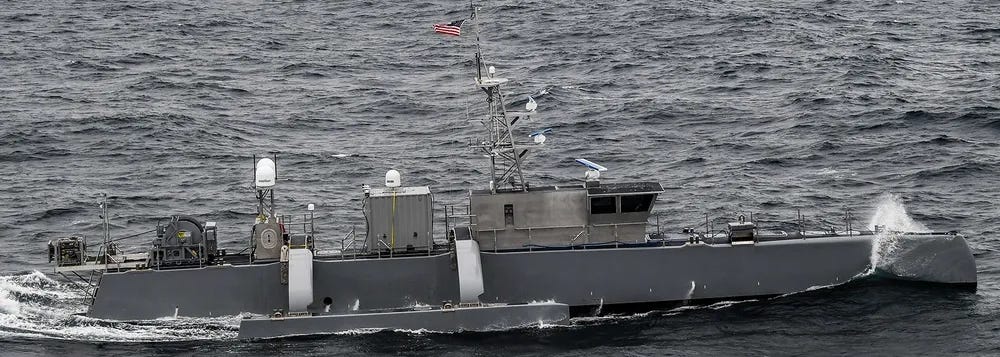
BLUF: A new combination of surveillance, drones and precision strike is eroding the old assumption that navies could generate sea control through superior ships, vessels, aircraft and operational skills alone. Geography still matters, but the new combination of systems exploits it to compress maneuver space, shorten warning time and make maritime operations more exposed and risky.
Increasingly, we will see not classic sea control – exerted by a largely unchallenged navy for long durations and over wide areas – but something far more intermittent, contested and geographically constrained.
In the Indo-Pacific, vast distances, archipelagic terrain, weather and electromagnetic clutter mean the maritime picture remains spurious, contested and temporary.
Navies must increasingly assume they can be intermittently seen, classified and targeted, especially inside the first island chain, including the South China Sea and the sea and air corridors linking the western Pacific to the eastern Indian Ocean.
Affordable unmanned aerial and surface systems add another layer of pressure. Used in numbers and tied to shore-based precision weapons, they can create attrition belts that complicate amphibious operations, port access and logistics movement.
These operations do not require continuous control of entire seas: forces can secure particular routes or operating areas long enough to land troops, deliver supplies or strike targets ashore, repeating these windows of control as needed to sustain operations.
Surface combatants, such as destroyers and frigates, therefore are not finished, but they must be used differently. They will need to operate in more distributed formations, with reimagined deception, better networking and faster access to rearmament and repair.
High-end missiles and crewed aircraft will remain vital, but from outside the areas most heavily threatened by drones and only if supported by resilient sensing, communications, industrial depth, basing access and ultimately political will.
Navy and AUKUS Partners Launch Landmark Maritime Big Play Pacific Demonstration
BLUF: The Navy, alongside international military and research partners from Australia and the United Kingdom, recently initiated active testing for the AUKUS Pillar II Maritime Big Play Pacific demonstration in the Southern California operating area.
Sponsored by OUSW(R&E) CT and hosted by Naval Information Warfare Center (NIWC) Pacific, U.S. Pacific Fleet as well as the U.S. Marine Corps, this experimentation event is expected to achieve milestones in integrating mature robotics and autonomous systems within AUKUS coalition maritime operations.
Running from October 5 - 25, 2026, the event will showcase more than 40 government and industry technologies from across all three partner nations, including multi-domain autonomous, crewed, and uncrewed systems (UxS).
The MBP-P demonstration builds off three years of intensive trilateral collaboration, advancing common command and control solutions for generating overwhelming combat mass, as well as delivering secure ‘stratosphere to seabed’ communications that enable AUKUS to act in coordination across the entire maritime domain.
The event will feature live-fire operational vignettes focused on increasing mission effect and delivering force multipliers during strike operations, contested resupply, and undersea warfare.
Other Navy News:
Future Submarine Digital Backbone Classified Industry Day Nov 18
Super Hornets Sortie with Blackbeard Missiles in Latest Test

Marine Corps Accelerated Acquisition Strategy to Transform Aviation Sustainment for the Future Fight
BLUF: To accelerate software acquisition, the Marine Corps completed a rapid vendor-selection process for predictive Super Intelligence/Machine Learning (SI/ML) technologies engineered to transform aviation sustainment for the future fight.
These SI/ML tools will help Marine Aviation generate sustained combat power through the integration of dynamic aviation supply, predictive maintenance, and optimized operations through forecasting, and decision support.
Using an Other Transaction Authority process facilitated by the Naval Aviation Systems Consortium (NASC), the DoN progressed from an approved statement of need to vendor notification in 34 days.
Following a detailed review of white paper and video submissions, SteerBridge Strategies, was selected to advance with the SOW collaboration activities.
Through this collaboration, the U.S. Government and industry will assess, prototype, and refine emerging technologies that may enhance operational readiness and support Marine Corps aviation sustainment, readiness and planning functions.
“The effort aligns directly with DoW objectives to accelerate acquisition timelines, strengthen collaboration with industry, and modernize acquisition processes.” Maj. Gen. David Walsh, Deputy PAE for Aviation–Marine Corps Aviation.
PMA-276, HX-21 Expand Expeditionary Strike Capabilities with Successful AH-1Z APKWS Live-Fire Delivery

BLUF: The U.S. Marine Corps Light/Attack Helicopter Program Office (PMA‑276), in partnership with Air Test and Evaluation Squadron TWO‑ONE (HX‑21), successfully conducted an aerial live-fire delivery of the Advanced Precision Kill Weapon System (APKWS) from an AH-1Z Viper attack helicopter at the Upper Zion impact area.
Integrating APKWS onto the H‑1 platform strengthens close air support across the spectrum of military operations and complements emerging manned-unmanned teaming concepts.
By bridging the tactical capability gap between unguided missiles and larger precision-guided missiles, APKWS provides combatant commanders with a scalable, low-collateral strike option against time critical targets in contested environments.
“By validating APKWS delivery parameters in one of the most space-constrained range environments, our H‑1 team demonstrated precise, scalable effects that commanders can employ with confidence.” Col. Jason Duke, PMA-276 PM
US Marines Add New Amphibious Recovery Fleet to Keep Combat Vehicles Moving in Battle
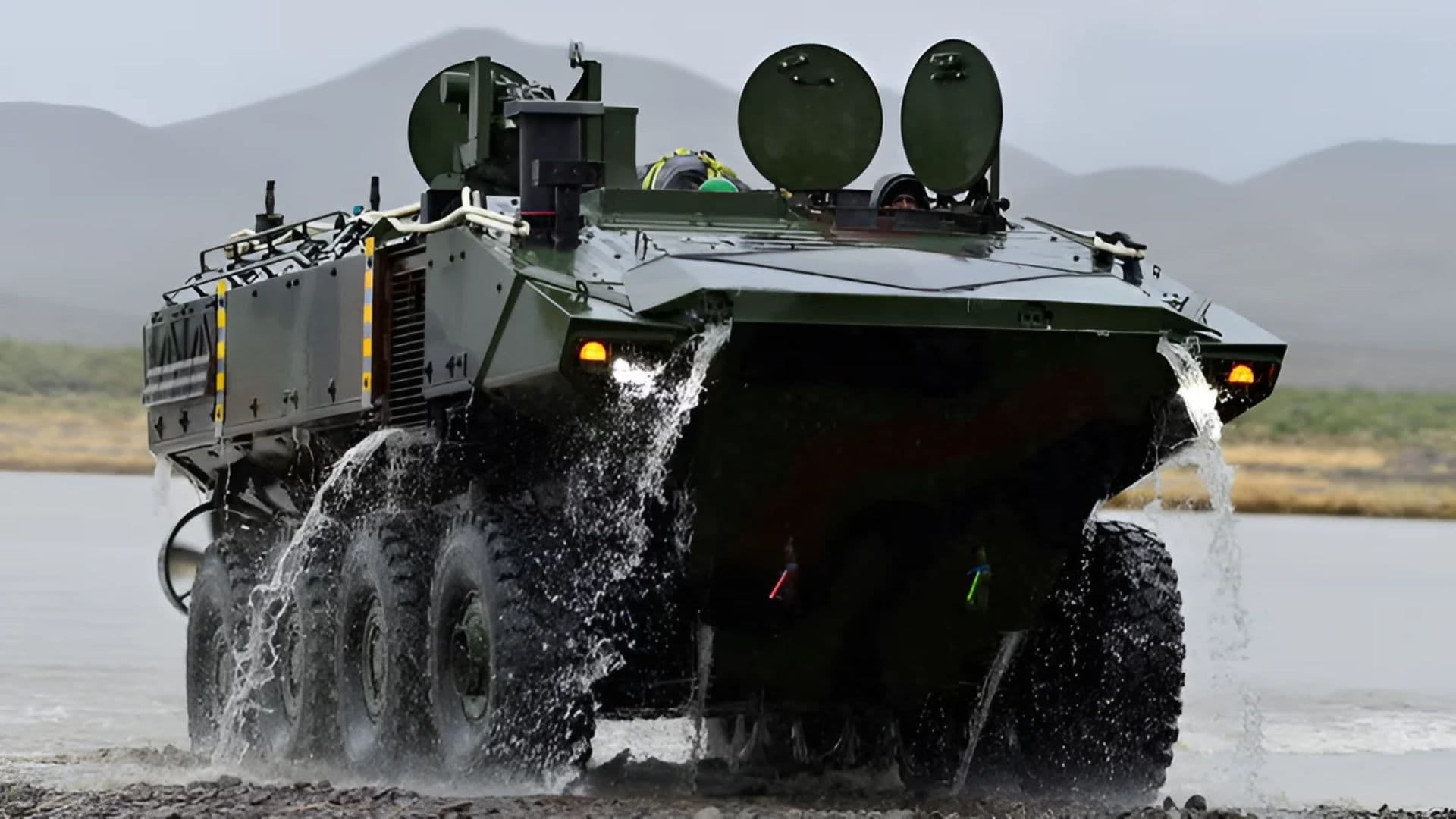
BLUF: BAE Systems won a $230.1M contract from the U.S. Marine Corps to produce 32 chassis for a new Amphibious Combat Vehicle recovery variant.
The ACV Recovery Mission Role, or ACV-R, will give Marines a vehicle specifically built to recover disabled or damaged ACVs in the field. The new variant adds a support role to a vehicle family already designed for amphibious operations and combat.
The ACV-R is designed to provide the Marine Corps with a dedicated recovery platform capable of supporting ACV units during field operations.
The recovery variant could also reduce the burden on other vehicles when an ACV becomes disabled. Instead of relying on improvised recovery arrangements, Marines will have a platform designed specifically for the job.
Related: BAE Systems to Produce 32 New ACVs for US Marine Corps
Cottonmouth ARV: The Amphibious Scout Built for the Marines’ Next Battlefield

BLUF: The Cottonmouth Armored Reconnaissance Vehicle (ARV) is a next-generation platform designed to replace aging reconnaissance vehicles with a digital, networked system built for modern warfare.
The Cottonmouth ARV is a prototype amphibious armored reconnaissance vehicle designed to gather, process, and share battlefield information while operating across land and sea.
More than a traditional armored scout, it will serve as a mobile reconnaissance hub, integrating sensors, communications systems, and unmanned platforms to support intelligence, surveillance, and reconnaissance missions.
The Cottonmouth’s design draws from Textron’s experience producing survivable wheeled combat vehicles while incorporating advanced autonomous and networking technologies.
Unlike traditional armored vehicles, the Cottonmouth ARV will also emphasize networking, modularity, and integration with drones and other UxSs.
Although it has not yet entered operational service, pre-production variants will be delivered in three variants: C4/UAS, 30mm Cannon, and Logistics (LOG).
PAE MC and PAE MS to Host Marine Corps Acquisition Exchange
BLUF: PAE Marine Corps, HQ Marine Corps Installation and Logistics, and PAE Mission Systems will host next quarterly Marine Corps Acquisition Exchange (MCAX) on 19 Nov.
The event will provide industry with visibility into anticipated contracting opportunities across participating Marine Corps organizations, while creating dedicated time for questions and direct Government–Industry engagement.
Register here by 5 Nov 2026.
Other Marine Corps News

Air Force’s Hypersonic Attack Cruise Missile Has First Flight Test

BLUF: The Air Force flight tested the first HACM over Australia.
The HACM flight test happened over a “designated Australian test range, gathering crucial data to advance the program’s objectives,”
The Woomera Test Range in the desert of southern Australia is commonly used to test missiles, aircraft, and projectiles.
This effort is part of the SciFIRE, a collaborative agreement built on partnership between the U.S. and Australia.
HACM is one of two hypersonic weapons the Air Force is pursuing, along with the larger AGM-183 Air-Launched Rapid Response Weapon, or ARRW.
The munition uses a conventional rocket booster to reach high speeds, then ditches it and engages the scramjet engine to reach and maintain speeds above Mach 5, or 3,300 miles per hour, at high altitudes.
Related Article: First Release Of USAF’s New HACM Hypersonic Cruise Missile Has Happened Over Australian Range
Our Take: It’s been a long time coming, good to see it finally arrive.
As Air Force Goes Big on Autonomy, Are Cargo Drones Next?
BLUF: Beyond the service’s signature Collaborative Combat Aircraft and Massed Modular Aircraft programs, a half-dozen or so firms are pitching another kind of autonomous aircraft: cargo drones to solve some of the thorniest logistics problems.
Textron Aviation and Merlin Labs unveiled a cockpit-less Cessna equipped with Merlin’s autonomy software and a nose hatch opening to a cavernous cargo bay.
Reliable Robotics is offering its own modified Cessna 208B Caravan.
Joby Aviation, which previously acquired autonomy startup Xwing, is also flying a modified Cessna Caravan, racking up 40 hours and 7,000 miles during last summer’s Resolute Force Pacific.
DZYNE and the Air Force Research Laboratory unveiled Grasshopper last May, as a self-guided glider capable of carrying up to 500 pounds after being dropped out the back of a C-130 to resupply troops in “high-risk environments.”
USAF officials have spent years talking about Agile Combat Employment but the ACE logistics is complex, especially in the vast and watery Indo-Pacific region.
Having small, unmanned aircraft to island-hop and resupply those forces so they can generate airpower without taxing manned airlifters could be a solution.
“We believe that there’s some value in that as well. It certainly could be valuable in the Pacific, with the ranges that we’re talking about. And so we’re looking at several different options and evaluating them, but I would say, no program of record just yet, but certainly taking a look at some demonstrators and the like to see what’s available to us.” Gen. Kenneth S. Wilsbach
Our Take: As has been the case for almost the last decade, the Air Force has toyed with the idea of an autonomous cargo aircraft without ever committing to buying them and institutionalizing the new tactics and technologies. In most planner’s minds, the large cargo aircraft will always arrive, and ACE is just a pipe dream to talk about but not truly resource.
Long-Range Anti-Ship Missile Will Integrate onto B-52
BLUF: The Air Force’s B-52 bomber may soon be able to carry up to 20 stealthy long-range anti-ship missiles to strike moving targets at sea, a key capability in a potential fight with China.
An Oct. 7 notice from Naval Air Systems Command states that the command plans to award a contract to Lockheed Martin to integrate its Long-Range Anti-Ship Missile on the B-52.
Lockheed produces both the the AGM-158 JASSM and the AGM-158C LRASM.
The B-52 can already carry 20 JASSMs.
Our Take: This is a logical move if commanders feel that B-52s can enter the airspace without being destroyed. As the PLA Navy extends its reach and armament, it may not just be ground-based SAMs or long-range HVAA killer missiles they have to contend with but forward-based ships. It could become a game of who can target who and counter the other first and the B-52 presents a rather attractive target.
The Revitalized Eagle: The Story of the F-15EX Procurement Surge
BLUF: In the strategic planning rooms at the Pentagon and across the sprawling flight lines of the Air Force, a dramatic shift in air superiority doctrine is underway.
The Boeing F-15, a recognizable silhouette born from a 1970s blueprint, is experiencing a massive twenty-first-century resurgence.
Driven by the F-15EX Eagle II’s proven capabilities in both offensive and defensive counter-air missions, the Air Force is expanding planned procurement.
It has authorized surging the acquisition target from an initial baseline of 129 aircraft to 267 jets.
The F-15EX solves a critical piece of this puzzle by fulfilling two distinct, immediate roles.
First, the Air National Guard faces an immediate demand for homeland air sovereignty. Defense of domestic airspace requires interceptors capable of rapid alert launches, heavy missile payloads, and extended loiter times to intercept cruise missiles and long-range unmanned aerial vehicles.
Second, the aging fleets of F-15C/D air superiority fighters and F-15E Strike Eagles are rapidly approaching the end of their viable service lives, creating a dangerous capability gap if not rapidly replaced.
Unlike new stealth airframes, which requires years of facility and infrastructure overhauls, the Eagle II plugs seamlessly into existing logistics networks.
Flight units can transition to the new variant in weeks or months, using existing hangars, current maintenance pipelines, and familiar ground support equipment.
Every production airframe is outfitted with the BAE System EPAWSS which provides the aircraft with full-circle, 360-degree situational awareness.
The backbone of its evolution is its strict compliance with the Open Mission Systems (OMS) standard.
This setup treats onboard systems as modular components within a flexible plug-and-play network. This architectural shift permanently breaks the dependency on original equipment manufacturers for software updates.
Our Take: There’s no question that the F-15EX has significant advances over its predecessor and adds some unique characteristics to the air force with increased range and weapons capacity. Its price provides a lot of value. A bigger question is whether using them for homeland defense becomes overkill when their true value is in the Pacific fight launching long-range weapons of different varieties or acting as a quarterback for other fighters. Given the limited quantity, if the aircraft are diffused across multiple mission sets, then there likely won’t be enough to contribute substantially.
Air Force Bets on New Sensing Tech to Catch Long-Range Missiles Early

BLUF: Air Force high-value aircraft could soon get a new set of eyes for spotting long-range missile threats, thanks to a sensor upgrade being developed by US firm SRC.
Called Ghost Mantis Gen 3, the multi-function aperture is designed to detect, track, and identify missiles at extended ranges, generating data that onboard processors can use to help aircraft respond to incoming threats.
The system uses a single aperture to perform multiple sensing missions across the electromagnetic spectrum, while its broad radio frequency (RF) coverage allows it to adapt to evolving requirements without major changes to the aircraft.
The technology will be paired with SRC’s Agile Condor high-performance airborne processor to provide onboard processing capabilities.
SRC said the combination enables advanced sensing and electromagnetic spectrum operations (EMSO) while reducing size, weight, and power requirements.
Once developed, Ghost Mantis Gen 3 will be integrated into the Large Aircraft Survivability System prototype, an advanced airborne threat-detection capability for the Air Force’s Mobility Air Force (C-17s, C-130s).
Pentagon, Lockheed Weigh Multi-Year F-35 Production, Sustainment Deal
BLUF: The Pentagon and Lockheed Martin are in discussions over a mega-deal for the company’s F-35 Joint Strike Fighter that could span up to a decade and include both production and maintenance for the stealth jet.
A successful deal covering both production and sustainment of the tri-variant fighter could be worth tens of billions of dollars.
The potential agreement would include “bulk buys” of spare parts, beginning around the jet’s 21st production lot, expected in roughly three years.
Increasing the supply of spare parts is viewed as a key way to help raise the fighter’s dismal readiness rates.
Lockheed has previously pushed for a larger sustainment deal in the form of a performance-based logistics (PBL) contract spanning five years.
But lawmakers have required the Pentagon to certify that any PBL agreement would either reduce maintenance costs or increase readiness, a hurdle officials were unable to clear.
BAE Wins F-35 Electronic Warfare Order for Lots 20-22
BLUF: BAE Systems will build electronic warfare systems for three more production lots of the F-35 Lightning II under a new contract from Lockheed Martin.
The AN/ASQ-239, the F-35’s built-in electronic warfare suite, listens for radar and other signals around the aircraft, identifies threats and warns the pilot, and supports both self-protection and offensive electronic attack.
The system’s passive, long-range sensing lets pilots detect threats without giving away their own position, and that it is designed to help the jet operate against enemy fighters, missiles, drones and modern integrated air defense networks.
The new order follows years of work on an upgraded version of the suite.
In December 2021, Lockheed Martin awarded BAE Systems a $493M contract modification to develop new core hardware for the AN/ASQ-239 as part of the F-35’s Block 4 modernization.
Other Air Force News:

Resource Competition Intensifies with Surge in Megaconstellations

BLUF: Amazon wants more than 5,000 satellites. Blue Origin has proposed another 5,400. Chinese companies have filed plans for vastly more. Elon Musk has talked about a constellation numbering 1 million. There is one issue: building all of them.
The unprecedented rush to put satellites into low Earth orbit is colliding with shortages of specialized components and materials, suppliers struggling to keep up and competition from the booming artificial intelligence industry.
The squeeze is forcing satellite companies to rethink designs, accept delays and confront a more fundamental question about the timelines for what’s possible.
Supply chain challenges have companies looking for where they can downgrade and not have to use a space-qualified component.
Aerospace Industries Association and PricewaterhouseCoopers have issued a 54-page analysis isolating nine critical components contributing to bottlenecks due ranging from valves and actuators to switchgears and transformers.
One bottleneck stems from access to the rare earth minerals that are crucial for electronic components.
Another issue is suppliers who were passing up changes to bid on space work, “citing high complexity requirements and low return on effort.”
Our Take: This is a major problem given the many constellations that the space community is planning, this definitely deserves special attention for national security if not commercial reasons.
With OCX Axed, Space Force Moves Forward with New GPS Ground Plan
BLUF: After scrapping the long-delayed GPS OCX ground system earlier this year, the Space Force and Lockheed Martin are pushing toward delivering a capability in time to support the first launch of the newest GPS satellites, currently planned for 2028.
A new report from the GAO raises concerns about that timeline.
The Space Force still lacks a plan to operationalize a key civilian signal installed in GPS satellites already on orbit.
That signal, called L5, provides higher bandwidth and is more resistant to jamming and interference than other civilian GPS signals.
Rather than continue with OCX, the service opted instead to funnel resources toward a series of upgrades Lockheed Martin has been delivering for the legacy GPS ground segment, dubbed the Architecture Evolution Program (AEP).
The Space Force has awarded Lockheed an additional $199M to upgrade AEP to support launch and command and control for GPS IIIF satellites
Vandenberg Eyes New Launch Support Facilities, Possible On-Site Manufacturing
BLUF: The Space Force is looking for launch provider’ feedback on its plans to create a new Mission Development Zone at Vandenberg Space Force Base, CA, a space for additional payload processing capacity, test and assembly facilities, and potentially rocket and spacecraft manufacturing infrastructure.
Vandenberg, which hosts one of the service’s two coastal spaceports, expects its cadence could approach 200 launches per year by the end of the decade, a sharp increase from the 66 space launch missions it supported in 2025.
To meet that higher rate, the range not only needs to designate space for more launch pads and ensure its roads can handle heavier traffic.
It must also make room for the administrative offices, processing facilities, and assembly and test infrastructure.
The Mission Development Zone could eventually host rocket factories or commodity plants.
On-site production of both rocket components and key commodities like propellants and purge gases could also make range operations more efficient.

Can Golden Dome Truly Succeed Without Logistics and Sustainment in Space?
BLUF: on-orbit logistics, which includes refueling, servicing, repositioning, resupply and deorbit, can have a major impact on the viability of a constellation.
It’s now cheaper to go up and do multiple refuelings of a constellation than it is to launch whole new satellites to be able to perform the mission.
Sustainment is one of the Pentagon’s joint functions and it applies to every domain (land, sea, air) and now it’s time for space.
Golden Dome represents more than just a new missile defense system. It represents a true warfighting capability in which we have the opportunity to build resilient, integrated architecture that’s designed to operate through conflict.
Resilience is more than just proliferation. It means that proliferation, rapid launch, reconstitution, maneuvering, on-orbit logistics, they should all work together.
DoW, Raytheon Ink Up to $6.3B Contract for SM-3 IB Missiles
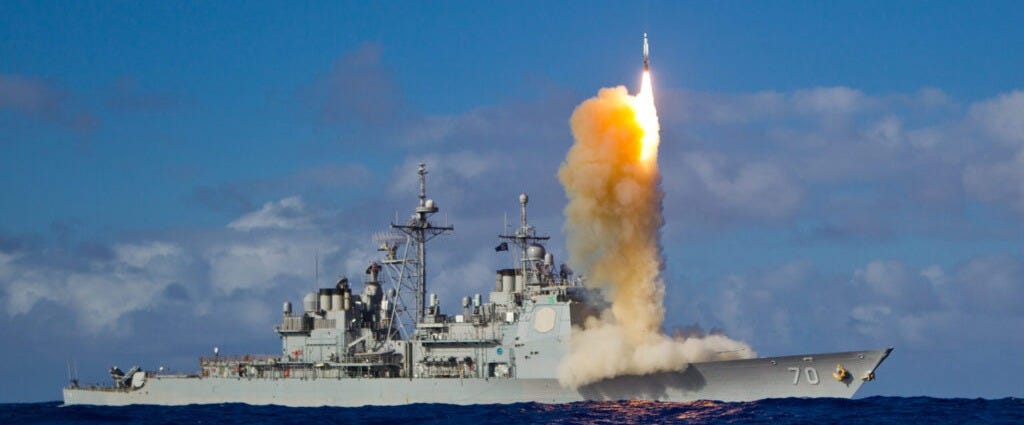
BLUF: Raytheon secured another multi-year munition deal, this time for up to $6.3B for Standard Missile-3 Block IB production.
The base value of the five-year contract is $4.4B, but options include an additional nearly $2B for more of the air defense munitions over another two years.
The Pentagon has listed the SM-3 IB as one of the critical munitions it is looking to scale as quickly as possible. Raytheon says the weapon can be fired from both ships and land to intercept short‑ to intermediate‑range ballistic missiles during the midcourse flight phase.
“This contract provides production certainty to our defense industrial base, breaks sub-tier manufacturing bottlenecks, and ensures that our fleets and combatant commands have the interceptors required to dominate the battle space: air, sea or land.” Michael Duffey, USW(A&S)
Related: DoW Awards $6.3 Billion Multi-Year Contract to RTX’s Raytheon for SM-3 Block IB and Raytheon Snaps Up $6.3 Billion Deal for SM-3 IB Interceptors
Next-Gen Missile-Tracking Ship Soon to Be Built in US; Boost Defense Power, Battle Superiority

BLUF: The U.S. will soon get a new generation of missile-tracking ships. For this, TOTE Services and Hanwha Philly Shipyard have finalized an agreement. The companies will build a new Missile Range Instrumentation Vessel (MRIV). This marks an important step in the modernization of the country’s missile-tracking and testing capabilities.
Under the agreement, TOTE Services will manage the vessel’s construction on behalf of the U.S. Maritime Administration (MARAD), while Hanwha Philly Shipyard will undertake the shipbuilding work.
The first vessel, named Golden Defender, is scheduled for delivery in 2030.
The new vessel will replace the Pacific Tracker and Pacific Collector, two ships that have supported U.S. missile testing and tracking operations for decades. Built in 1965 and 1970, respectively, the vessels are approaching the limits of their service lives.
Missile Range Instrumentation Vessels are specialized ships designed to collect and relay technical information during missile tests. Their tracking systems and instrumentation help monitor missile trajectories and generate data required to evaluate performance.
Such capabilities are particularly important when testing systems over long distances or in areas where land-based infrastructure cannot provide sufficient coverage.
The VCM approach offers advantages over traditional government acquisition strategies, reducing acquisition costs by at least 50%. By defining requirements upfront and approving change orders quickly, the model improves schedule certainty and ensures vessels are mission-ready when they are delivered.
Boeing Nabs Potential $14.7 Billion PAC-3 Seeker Contract
BLUF: Lockheed Martin awarded Boeing an undefinitized contract worth up to $14.7B to boost production of seekers for the PAC-3 Missile Segment Enhancement (MSE) interceptor, a key system used by Western allies for air defense.
The PAC-3 MSE is a hit-to-kill interceptor launched by the Patriot air defense system to bat down threats like missiles and aircraft.
A seeker is mounted in a missile’s nose and helps guide it to its target. The seeker award comes as the US rushes to replenish stockpiles of interceptors like the PAC-3 MSE drained by conflicts in Ukraine and the Middle East.
The multibillion-dollar award follows a seven-year framework agreement that Boeing reached with the Pentagon in April to triple production of the seeker, though the company has not disclosed specific quantities. The contract announced today essentially underwrites that framework.
Related: 4,000-mph PAC-3 MSE Missile Triples Seeker Production with $14.7B Award
Lockheed Unveils PAC-3 Edge, Its Next-Gen Patriot Interceptor
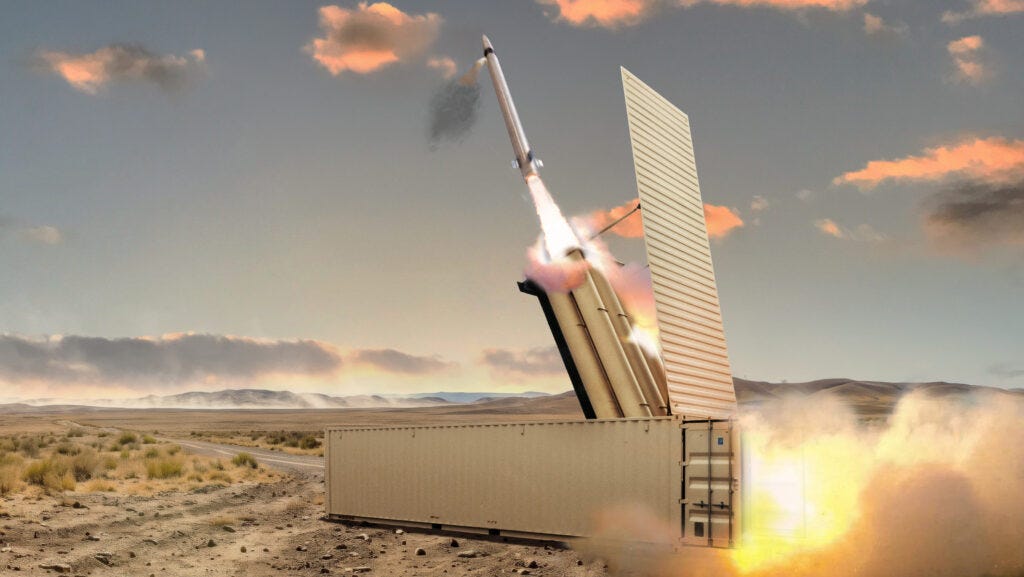
BLUF: Lockheed Martin revealed the PAC-3 Edge, its offering for the Army’s future Patriot interceptor that the company says can fly further and hit more capable targets than the current PAC-3 missile.
The new interceptor is meant for what Lockheed called the Army’s Future Interceptor program, which seeks to develop a next-gen version of the Patriot’s current PAC-3 missile segment enhancement (MSE).
Lockheed is developing the seeker in-house, with the intent of being able to use the new technology across other offensive and defensive systems. The company plans to invest about $800M into the seeker, having invested several $100M into it so far.
Lockheed intends to begin testing PAC-3 Edge in 2027, ahead of its first deployment in 2031
“PAC-3 Edge will be longer ranged. It’ll be higher altitude. It’ll be more capable to take on targets that are trying to hide. It’ll have greater sensitivity in its seeker. It’ll have greater capability to maneuver and to respond to threats.” Tim Cahill, Lockheed Martin President of Missiles and Fire Control
Other Golden Dome News
Golden Dome’s Hardest Problem Isn’t Technology. It’s Culture.
US-Built Interceptor Delivered for System That Recorded More Than 10,000 Operational Interceptions

First F-16 Block 72 Has Flown
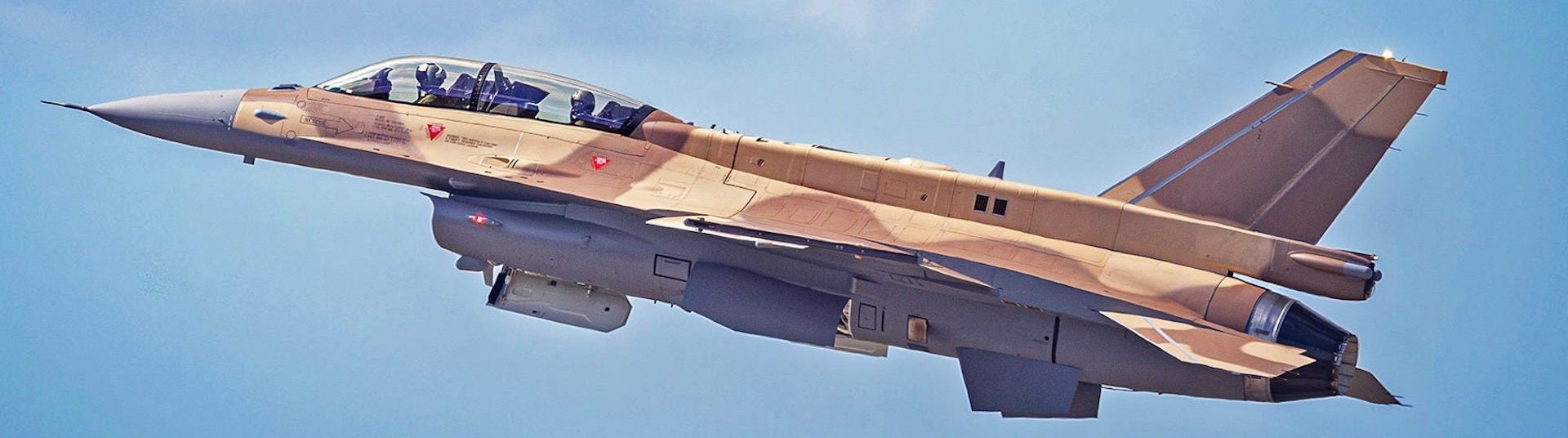
BLUF: The first-ever F-16 Block 72 has taken to the air, marking a major milestone for the program and for Morocco’s long-running effort to field what Lockheed Martin describes as the most advanced version of the Viper.
The first of the jets for the Royal Moroccan Air Force (RMAF), a two-seat F-16D, completed its maiden flight at Lockheed Martin’s facility in Greenville, SC. The aircraft will now proceed through flight testing ahead of its delivery to Morocco.
For Morocco, the choice of the Block 72 is based on ensuring as much fleet commonality as possible. The RMAF already operates F-16C/D Block 52+ aircraft powered by F100 engines, making the new aircraft a natural fit within its existing support infrastructure.
NIOA, AeroVironment Team to Offer and Support Loitering Munitions Down Under
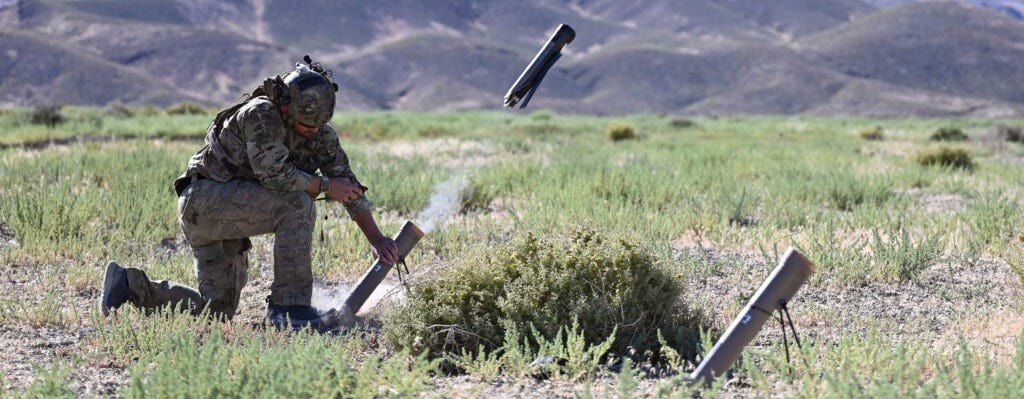
BLUF: Australia’s NIOA Group and US firm AeroVironment have entered into a strategic partnership to bring AV’s loitering munitions capabilities Down Under.
They will team together to support the introduction into service, sustainment and future growth of advanced loitering munitions capabilities across Australia and New Zealand.
The partnership establishes a framework for cooperation across the AeroVironment portfolio, including the combat-proven Switchblade family of precision loitering munitions, and positions NIOA as AeroVironment’s local partner for distribution, customer engagement, support and long-term capability development.
Rheinmetall Launches First Satellite for Space-Based Air Defense Surveillance

BLUF: Rheinmetall has launched its first jointly developed satellite with Italian space company Argotec, beginning an effort to add a space-based layer to military air-defense surveillance and situational awareness.
Rheinmetall says the satellite’s sensors are intended to identify ground-based indicators associated with emerging airborne threats.
The resulting imagery and situational data are intended to provide early-warning information that defense and air-defense systems can use.
The approach is designed to make information gathered from orbit available within existing defense networks rather than treating the satellite as an isolated surveillance system.
Ukrainian Startup Builds New Ballistic Missile in 2 Years
BLUF: Ukrainian company Fire Point developed its new FP-9 ballistic missile in a little more than two years of development and has been fired in combat.
The company’s first notable success came with the FP-1 and FP-2 strike drones, which were then followed by the FP-5 Flamingo cruise missile. The FP-9 ballistic missile can deliver an 800-kilogram payload up to 850 kilometers. Moscow is as close as 750 kilometers from the Ukrainian border.
One secret to Fire Point’s success is starting at what other companies would consider the final step. Manufacturing decisions are made at day one of the process.
Engineers working on scalability can put a veto on any design decision that is not scalable, or too expensive or if an item does not have a reliable supply chain.
They create 70% of its own parts for maximum vertical integration. For the other 30%, they have no vendor lock-in and work with open-source protocols.
Germany Is Finally Giving Its F125 Frigates Some More Teeth With IRIS-T SLM Surface-to-Air Missiles

BLUF: Germany is moving ahead with plans to give its unusually large F125 frigates a medium-range air-defense capability, helping address one of the most conspicuous weaknesses of a four-ship class that has long attracted attention for having relatively little combat power for its size.
Diehl Defense and Germany’s Federal Office of Bundeswehr Equipment, Information Technology and In-Service Support (BAAINBw) have signed a contract to adapt and develop the IRIS-T SLM surface-to-air missile system for operational use aboard the German Navy’s F125 frigates.
Under the agreement, Diehl will build prototypes and conduct comprehensive test firings intended to validate the system’s integration and performance within the existing F125 architecture.
Each frigate will be fitted with two new launchers, each capable of holding 16 missiles, for a total of 32.

Continuing Resolution
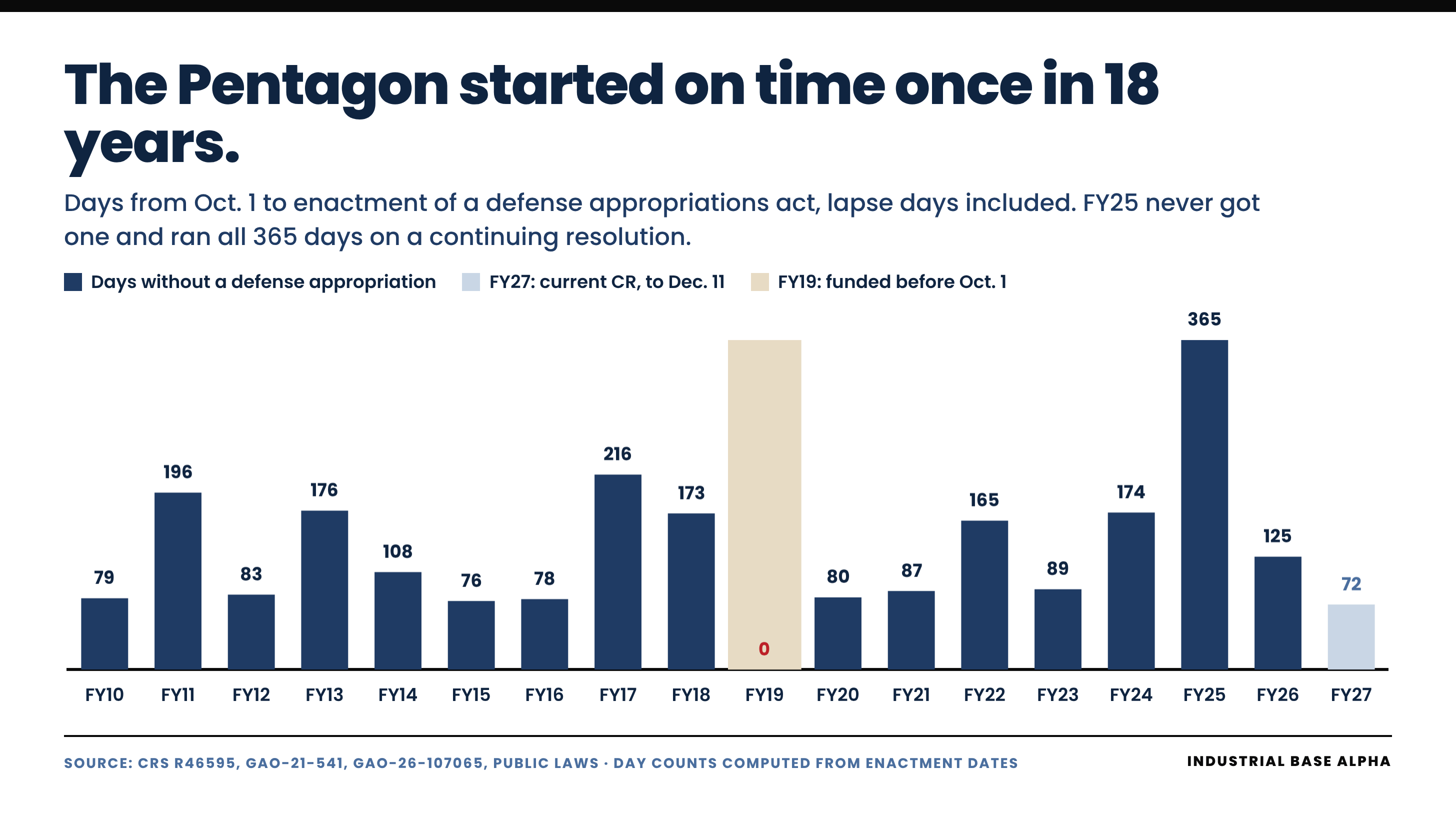
While the total number of congressional line items prevented during a CR has steadily declined, the amount of money at risk is at an all-time high: $19.3B.
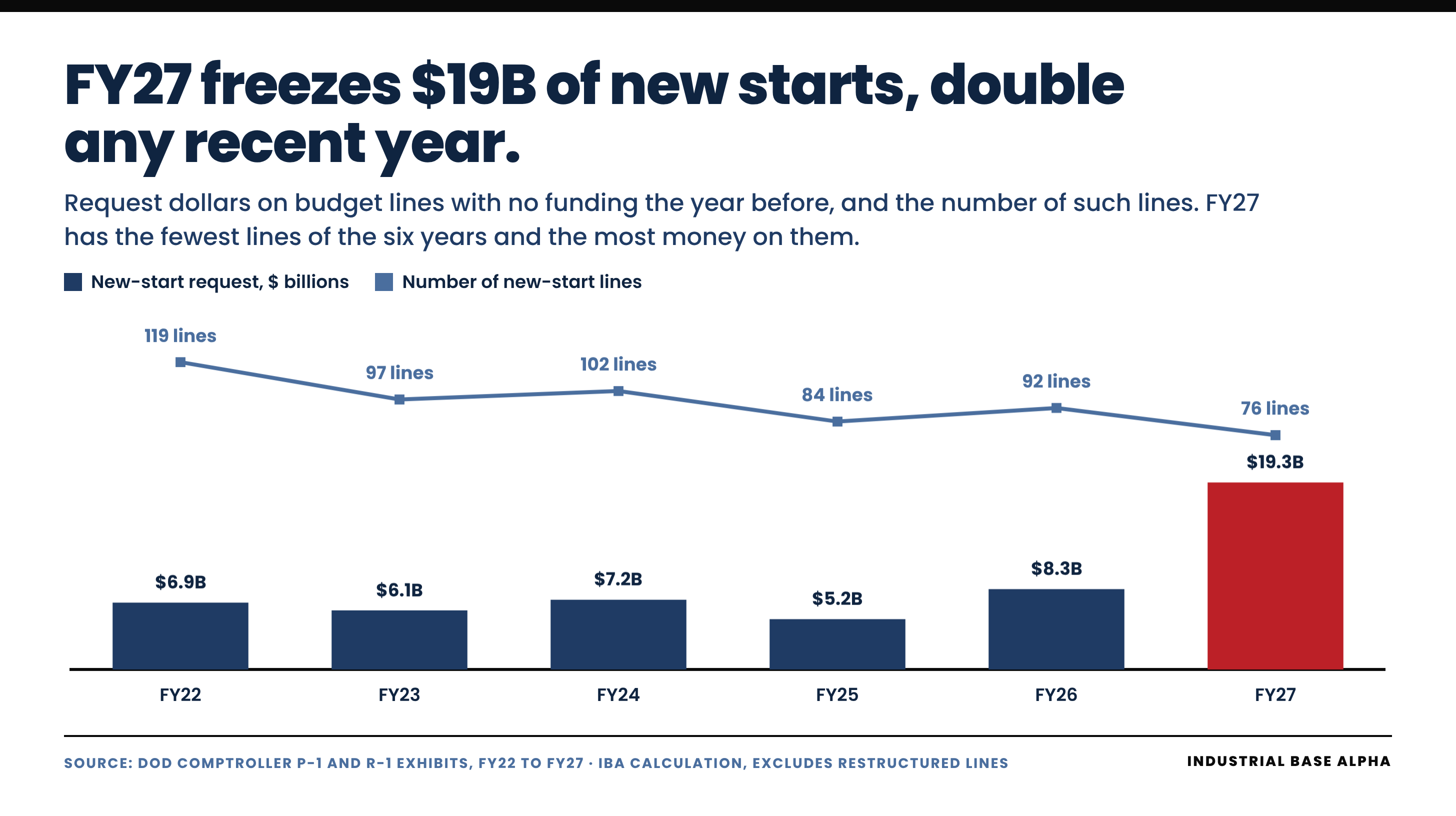
Bipartisan Senate Bill Would Push DoD to Expand Its Oversight of In-Use Commercial Frontier AI Models
BLUF: A bipartisan bill proposed in the Senate would require the Pentagon to continuously vet the commercial tech giants from which it buys frontier AI for security vulnerabilities, algorithmic failures and other emerging risks accompanying the models that could compromise U.S. defense and national security.
The bill would apply the DoW’s significant purchasing power to help enforce safety standards and transparency about the military’s AI use, ahead of Congress passing more sweeping industry-wide federal AI regulations.
If the bill is passed the defense secretary would be mandated to “issue regulations establishing reporting requirements for covered AI contractors to support the protection of DoW systems, missions, personnel, operations, and supply chains from counterintelligence, security, and other national security risks arising from the security practices of such contractors” within 180 days.
See our NDAA and budget posts for the latest insights and analysis.

The Pentagon’s New Autonomous Warfare Command | Bill Greenwalt
Mission Matters
National Commission on the Future of the Navy | ADM James Kilby, Gen Bradford Gering
The Pentagon Is Trying to Change How It Works With Startups | Mike Dodd
In-Q-Tel
How DIU’s Bridge is Accelerating Commercial Tech Into the DoW | Sara Pearson
Mission Matters
Delivering Capabilities at Speed and Scale wit OTs | PAE Maritime
Building a Combat-Credible Force to Deliver Space Superiority | AFA
Defense Innovation and Emerging Tech | Jason Potter and Stephanie Hughes
NDIA Emerging Tech Horizons
Driving Disruptive Innovation for Special Operations
Crossing the Valley
Tech, Sustainment, AI and the Future of Military Readiness | Dr. Carl Spinnweber
NDIA Emerging Tech Horizons
The $1.1B Plan to Scale Drone Warfare | Derek McBride
Drone Ultimatum
Building Defense Tech and Commercial First | Luke Fischer
All Quiet on the Second Front
Building a More Productive Defense Industrial Base w/CMMI | Ron Lear
NDIA Emerging Tech Horizons
GPS Update: What Does the Future Hold? | Christina Mancinelli
Mitchell Institute for Aerospace Studies

AUSA Army Annual Meeting and Expo - We’ll see you there.
Oct 12-14 • Washington DC
Scaling Our Industrial Foundation
Wharton Aerospace Ventures • Oct 12-14 • Washington DC
Mission Engineering and Integration Activity TEM
USW(R&E) • Oct 15 • TBD
Counter UAS Indo-Pacific
SAE Media • Oct 19-20 • Honolulu, HI
Unmanned Technologies for Earth and Space (UTES)
Oct 26-27 • Sweden
Silicon Valley Space Week
Oct 27-29 • Mountain View, CA
TechNet Indo-pacific
AFCEA • Oct 27-29 • Honolulu, HI
Ironclad Maritime Summit
Oct 27 • Norfolk, VA
Portfolios Not Programs: Transitioning to New Paradigm with Matt and Pete
War U • Oct 28 @ 12 • Webinar
Critical Technologies Industry Day
OASW(CT) • Oct 30 • Alexandria, VA
Defense Conference
PSC • Oct 30 • Crystal City, VA or Virtual
Global MILSATCOM
SAE Media • Nov 2-5 • London, UK
Space+Defense Investor Summit
Teconic x Payload • Nov 3-5 • Beverly Hills, CA
Euronaval 2026
Nov. 3-6 • Paris, France
International Fighter Conference 2026
Nov. 3-5 • Berlin, Germany
AUVSI Defense
Nov 9-10 • Washington DC
Space and Satellites USA
Reuters • Nov 9-10 • Washington DC
Plan the quarter from the events page. It has the full year, so you can lock travel and decide which conferences are worth the pipeline before the calendar fills.