



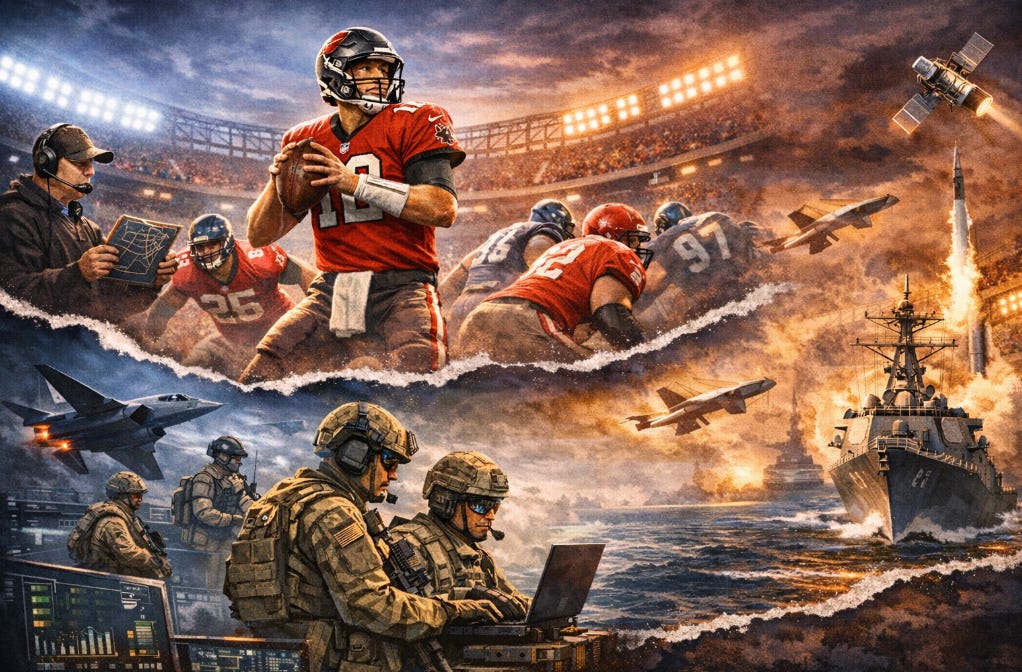
The NFL season reminds us why great teams win: It’s not just talent or stats, but integrated execution against thinking opponents under tight constraints. A franchise quarterback’s talent means little without offensive line protection, receiver route syncing, defensive reads, and mid-game adjustments. Simply put, a team’s ability to adapt to the other team’s strategies and neutralize them usually carries the day.
Similarly, the Department of War's ability to dominate in future conflicts will depend on its ability to rapidly develop and employ new operational concepts and transition new technologies into military capabilities forming dynamic and resilient kill webs. No longer can we win merely by optimizing individual capabilities in silos.
Key Enabler
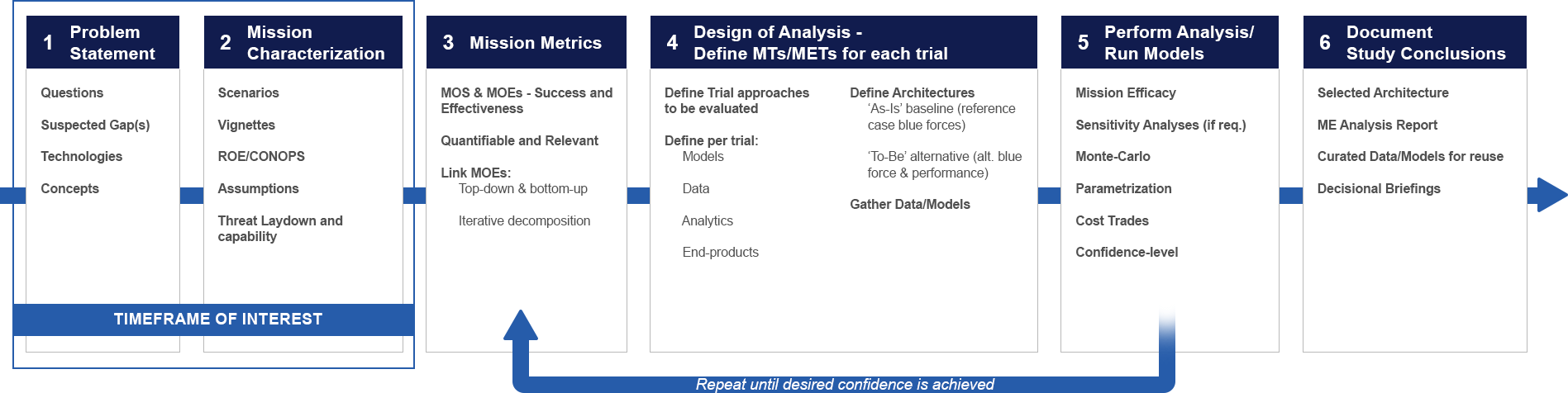
Mission Engineering (ME) is the discipline that enables DoW to achieve this flexible and adaptable future…sometimes referred to as mosaic or decision-centric warfare. The mission engineering process is crucial as it decomposes envisioned missions into constituent parts (mission threads) to explore and assess relationships and impacts in executing the end-to-end mission.
“Mission engineering can assess a range of potential solutions (materiel and non-materiel) within a mission context to inform systems or system-of-systems design and integration considerations, operational concepts, and trade-offs.
Findings can inform technology investments, suggest alternative ways to use current systems, identify mission gaps and preferred approaches to addressing these gaps, and trigger the initiation of a new acquisition to meet capability gaps.”
OUSW(R&E) matured its Mission Engineering Guide from previous revisions, emphasizing threat-informed, quantifiable analyses that inform Joint Warfighting Concept roadmaps, prototyping, requirements, and PPBE decisions. USW(R&E), in partnership with USW(A&S), are scaling the Mission Engineering and Integration Activity (MEIA) as part of the post JCIDS requirements environment. The MEIA aims to provide an integrated model-based environment that fully incorporates our industry partners and brings transparency to mission gaps, options and outcomes.
Opportunity Space and Challenges
Simulate the Wins
Just as NFL teams are using new tech to support AI-assisted coaching and advanced post-game analytics, ME provides the ability to see and simulate the wins. The biggest advance here is the improved engagement with industry which provides the opportunity for defense industry players to interact with a highly enriched environment with multiple tiers of classified data. It enables new entrants the opportunity to convert their systems into models that can be assessed against various kill chains and either have them validated as useful or understand where they need to improve against specific threats. It also helps provide a deep level of insight into the mission and specific capability gaps.
Build the Digital Backbone
To support these new technologies, NFL teams now collect and integrate massive amounts of data for pre and post-game decisions. This includes multiple sensors embedded on players and a Big Data Bowl. Similarly, for ME analysis, interconnectedness is needed to support these authoritative digital environments including from exercises, experiments, testing events, industry evaluations etc. In the operational context, this same need exists to get data where it needs to go and be able to react to that information. With faster adoption of open architectures, switchable components, and software pipelines, an adaptable digital backbone can enable the conversion of ME outputs into rapidly fielded capabilities. DoW must continue to execute its Software Modernization Implementation Plan.
Appreciate the Constraints
Just as NFL salary caps force ruthless prioritization when selecting team player lineups, defense organizational and program budgets face similar pressures even with the topline growing in recent years. ME provides a valuable tool for Services and Combatant Commands to allocate funding using data-driven methodologies that maximizes operational impacts. Legacy processes still exist however, and it will take a generation to fully move away from them. This is why every innovator must focus on retiring acquisition debt —questioning every requirement, deleting unnecessary steps, and shifting to portfolio-based models. Without this drive, ME insights may stay locked in databases.
Demand Iteration
Great NFL defenses don’t stand still; they are constantly learning and improving - so too must defense acquisition. Every process, person and technology in the enterprise must be oriented towards an iterative approach to delivering capability. The National Defense Strategy demands it, stressing integration over being first-to-invent. Success stories like Space Force’s Handle 2.0 standardization or CDAO’s Open-DAGIR framework have shown promise, but scaling across domains remains uneven. Workforce gaps, cultural inertia, and over-reliance on legacy platforms slow adaptation. ME must tightly couple with intelligence updates, wargaming results, and experimentation outcomes to drive good decisions. The acquisition system then needs to rapidly iterate and deliver.
Manage the Pipeline
Just as NFL teams scout, draft, and develop rookies, DoD needs to manage a robust innovation pipeline. The refinement of the Innovation Ecosystem, as directed by USD(R&E) takes some positive steps. Overhauling the DIB and DSB into the STIB was certainly commendable. However, commercial tech adoption will likely fail without cultural shifts that promote speed, scale, and risk tolerance. It will take our newly empowered PAEs and PMs and the rest of the innovation ecosystem to be active tech scouts, curators of technical information, deep engagers with industry partners and enablers of processes that can quickly convert a promising prototype into a scaled capability for warfighters.
While mission engineering isn’t a silver bullet—it is the key enabler for the playbook. If executed well, it will help ensure that investments drive clear operational outcomes. It will enable ruthless prioritization, which when paired with ruthless execution will be an unstoppable force.
Let’s treat mission engineering like a Super Bowl contender treats game planning—relentless, integrated, and adaptive. The stakes are higher than any championship ring!
If you’re in defense acquisition, industry, or the warfighter community, subscribe to Defense Tech and Acquisition for deeper dives on these shifts. 2026 is the year of execution.
A good article, but once again I have to get on my soapbox (although this is one I haven't climbed on for a bit). ME is just reproducing what the ACTUAL Capabilities Development process was supposed to do; and which it actually did during the 1980s and early 1990s. Changing the name without actual, significant process change is a sign of either cynical hypocrisy or (more likely I believe) a lack of understanding of what the original process intent was from the 1986 Goldwater-Nichols Act.
Regardless the reason(s), this process has two critical failure points (even assuming that it is properly resourced with $ and people):
First, there is no time horizon identified, which means that those seeking quicker solutions will focus on near-term problems to the exclusion of the harder longer-term problems. There will be no 'deep horizon' looks to deliver either the technology (e.g. stealth, GPS, special armor) or organizations to fight the war after next.
Secondly, it makes this an element of 'acquisition' vice making 'acquisition' an element of 'modernization.' This subservience is actually accurate to how the "system" has been working for at least 25 years; the reversal started in the early 1990s as DOD sought to avoid hard decisions in a decade of budgetary decline, and convinced ourselves that the tech we had was generally sufficient and just needed some minor tweaks. We found ourselves in a war not of our choosing, and then one we choose but were not equipped for, and pretty much terminated the remaining capabilities to look beyond the current fight. Now we find ourselves technologically on the back foot against nation-state competitors who have invested in basic and applied research and determined the material and non-material capabilities needed to defeat us on the battlefield.
Using your football analogy, you are focusing on getting the best players based on current operations, vice thinking of how the next few seasons are going to go and building the talent pipeline for enduring success in a dynamic environment. Might be able to win more than lose the next season, but no real look deep to how you establish a dynasty. We need to establish a dynasty, and that requires both near-term and long-term vision, which this ME process does not describe.